Get the best loyalty & customer engagement platform out there!
- Design industry shaping loyalty programs
- Integrate easily and go live quicker
- Deliver hyper-personalized consumer experiences
Capillary Named a Leader in The Forrester Wave™ Loyalty Platforms, Q4 2025 Report. Read more >
Capillary: Recognized as a Leader in Everest Group’s PEAK Matrix® 2025 Read more >
The Balanced Loyalty Quotient Report 2026 is now live — our largest and most in-depth loyalty report yet. Download Report >

Design, Data, Discipline: The Answer to Attrition for QSRs in Asia
Why loyalty is becoming critical infrastructure for QSRs in Asia — and how data, design, and discipline are reshaping retention.
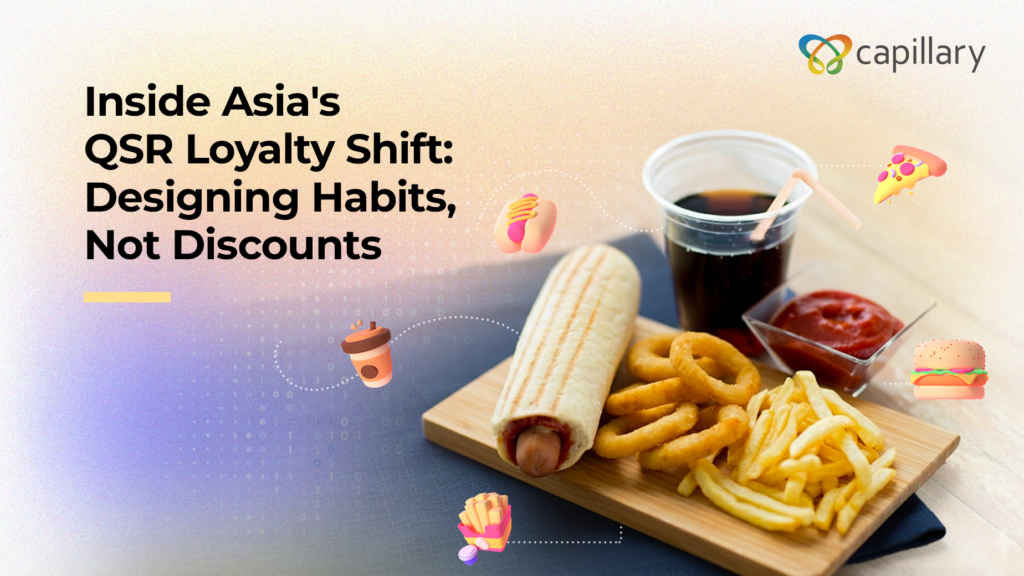
In a region like Asia, where dining habits are rituals—family weekends at Jollibee in Manila, late-night McDonald’s in Singapore, or bubble tea runs across Bangkok—loyalty should be the industry’s competitive edge. With millions of digital-first consumers making quick-service dining part of their weekly routine, the battle for retention is no longer optional—it’s existential.
Today, a handful of QSRs in Asia have started asking a different question: “How do we make the customers feel something again?”
Many loyalty programs see low usage and redemption, with points piling up unused, ultimately making the program costly without delivering real growth.
In fragmented markets, especially Southeast Asia, many QSRs run disparate loyalty apps, and as customers move between apps, kiosks, and delivery aggregators, tech stacks fail to recognize them as the same person, creating data silos and inconsistent experiences.
Overly complex points math, too many tiers, and unclear rewards create mental fatigue, causing activation drop-off before the first reward.
Most outreach remains one-size-fits-all—blending into an already noisy feed. When messages aren’t personalized to the moment, person, or platform, audiences tune out, and conversions decline as nothing feels meant for them.
Across APAC’s mobile-first markets, game loops have the power to build habits. The QSRs pulling ahead use everyday mechanics that make progress visible: streaks for visit consistency, quests that nudge the next action, status that signals recognition, and small “win moments” that feel earned.
Take KFC’s Shrimp Attack in Japan. The mobile game worked like Fruit Ninja: slice the falling shrimp, protect the chicken kingdom, rack up points, and unlock discount vouchers for the new shrimp menu.
The game was played by approximately 800,000 users, resulting in an engagement rate of nearly 91%. Sales of shrimp items rose by about 106% year over year, strong enough that inventory ran short and KFC curtailed the campaign to rebalance supply.
Generic push notifications (“We miss you!”)
Mass offers (“Get 10% off your next order”)
If your QSR business is doing any of the above, this isn’t loyalty. It’s digital couponing on autopilot.
Personalization starts with behavioral, mission-based segmentation instead of demographics: breakfast commuters vs late-night snackers, delivery-first vs in-store, value seekers vs explorers, and “lapsed-since-last-routine.” With AI as the decisioning brain, you can layer RFM/CLV and propensity cohorts (likelihood to try new items, respond to bundles, or churn after a poor experience) to create a living map of how people actually eat.
Sushi Tei (and its sister brand, Hokkaido-Ya) deployed AI-powered self-ordering kiosks that recognized returning guests and personalize menu suggestions and upsell prompts in real time. The kiosks first use broad patterns (time of day and trip purpose), then your own order history, to suggest what you’re most likely to want next.
Results: ~10% higher item value and ~5% higher order value—proof that context-aware, segment-led personalization lifts both basket and visit.
Third-party apps built discovery, but the real gains now come from making owned ordering the obvious, everyday choice. McDonald’s Singapore shows how to do it: the My McDonald’s App lets guests order ahead with clear pickup options like front counter, table service, and Drive Thru, so the experience feels faster and more reliable than a marketplace route.
They cut checkout friction by accepting the wallets that customers already use. With GrabPay working in-store, at Drive Thru, on McDelivery, and in Mobile Order, the journey stays on McDonald’s rails while customers earn GrabRewards—driving more direct-channel orders, better unit economics, and cleaner visibility into recency, cadence, and item preference than aggregators provide.
Asia’s diners already live inside super-apps and marketplaces—payments like Alipay, WeChat Pay, GrabPay, and platforms like GrabFood, Shopee, and Tmall. That’s where ID, checkout, and everyday rewards already happen. If your loyalty doesn’t plug into these rails, you’re asking customers to step out of their routine, and most won’t.
When QSR loyalty plugs directly into these rails, recognition, payment, and redemption collapse into one motion: tap, pay, perks applied, progress shown.
eCommerce tie-ups then multiply touchpoints: branded storefronts sell digital gift cards and limited-time boosters, live-commerce drops onboard new members in minutes, and the same rules follow them back in-store. You’re not forcing a new behavior—you’re hitching loyalty to habits people already have.
QSRs are moving from a jumble of tools to one connected system that actually works in the real world of lines, kiosks, and delivery apps. Think of it as one backbone for loyalty: your customer data, campaigns, and rewards all in the same place—and fluent in POS. A single customer identity follows people across app, web, delivery, and counter.
The payoff is a brand that sounds like one voice, not five: smart caps on messages, automatic pauses after a conversion, and channels that take turns instead of shouting over each other. Reporting comes from the same live stream that powers the experience, so you can show true lift—incrementality, daypart habits, offer efficiency—without spreadsheet gymnastics. And because consent, purpose tags, and in-region storage are built in, the stack plays nicely with Asia’s privacy rules as you scale.
Asia’s QSR loyalty doesn’t need a band-aid; it needs a rethink. The leaders here treat loyalty as infrastructure, baking data and recognition into every touchpoint across app, kiosk, delivery aggregators, and wallets; designing life cycles that move diners from first try to weekly habit to vocal fan; and using AI powered behavioral science so offers feel relevant. This way loyalty becomes a business system that creates predictable demand, real differentiation, and defensible growth even when menus, prices, and delivery speeds are easy to copy.
Share

Analytics and Insights
10 Best Self-Service Analytics Tools for Marketers and Business Teams in 2026Marketing teams run on data, but getting a straight answer out of that data is
Analytics and Insights
7 Best Augmented Analytics Tools for Marketing and CRM Teams in 2026Most dashboards show you what happened, but they leave the digging to your team. Augmented
Blogs
Power BI vs Tableau vs aiRAYour Dashboard Shows the Drop. aiRA Shows Why, & What to Do About It. Power