Get the best loyalty & customer engagement platform out there!
- Design industry shaping loyalty programs
- Integrate easily and go live quicker
- Deliver hyper-personalized consumer experiences
Capillary Named a Leader in The Forrester Wave™ Loyalty Platforms, Q4 2025 Report. Read more >
Capillary: Recognized as a Leader in Everest Group’s PEAK Matrix® 2025 Read more >
The Balanced Loyalty Quotient Report 2026 is now live — our largest and most in-depth loyalty report yet. Download Report >

Agentic AI in Fuel Loyalty: How Fuel Retailers Can Move Beyond Points to Predictive, Profitable Growth
Agentic AI is helping fuel retailers turn loyalty programs into intelligent growth engines that drive personalization, retention, and higher profitability across fuel and mobility services.
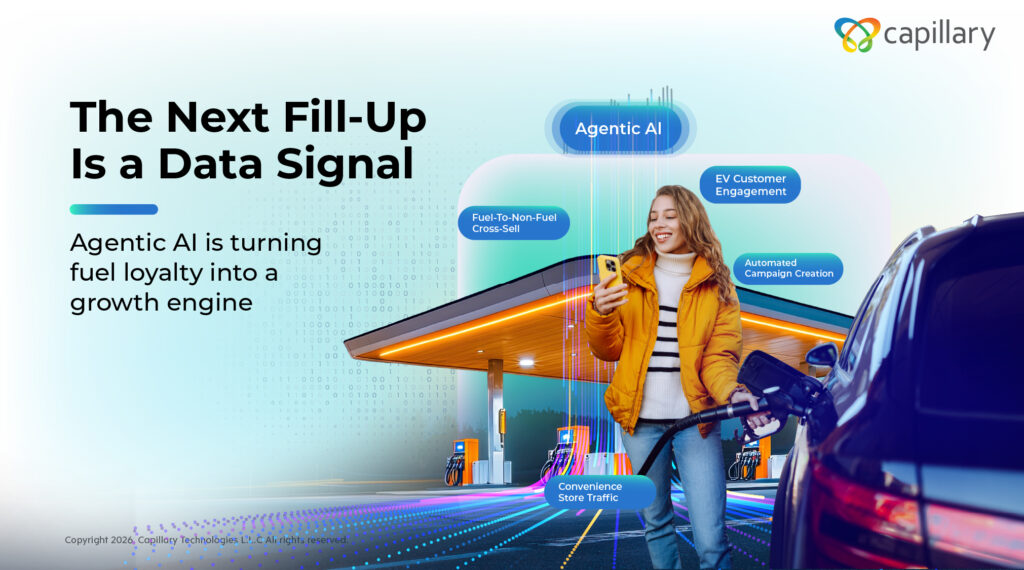
Fuel retail has always been a high-frequency category. Customers refuel every week, pass through familiar routes, visit familiar stations, and often make quick decisions based on convenience, price, proximity, and habit.
But here is the challenge: frequency does not always mean loyalty.
A customer may visit the same fuel station every Monday morning, but switch the moment a competitor offers a better price, a smoother app experience, or a more relevant reward. Another customer may buy fuel regularly but never enter the convenience store. A fleet customer may slowly shift volume away from the network before anyone notices. An EV customer may use charging stations but never connect that behavior to the broader loyalty program.
For fuel retailers, this creates a critical question:
How do you turn routine transactions into intelligent, profitable, long-term customer relationships?
This is where agentic AI is changing the game.
Unlike traditional AI models that only recommend an offer or surface a dashboard insight, agentic AI can plan, decide, act, test, and optimize loyalty decisions across the customer lifecycle. It helps loyalty teams move from manual campaign execution to autonomous, intelligence-led growth.
For fuel brands, that shift is especially powerful because loyalty is no longer limited to fuel discounts. It can now influence convenience store revenue, car wash uptake, EV charging engagement, partner monetization, fleet retention, fraud prevention, and overall customer lifetime value.
Fuel loyalty programs have traditionally relied on simple mechanics: earn points, redeem rewards, get cents off per liter or gallon, receive birthday offers, or unlock tier benefits.
These mechanics still matter, but they are no longer enough.
Today’s fuel retailers are managing a more complex customer environment:
The problem is not a lack of data. Fuel retailers already have rich behavioral signals across fuel purchases, store baskets, payment methods, locations, visit frequency, redemption behavior, and app activity.
The real problem is operationalization.
Most loyalty teams still need to manually analyze segments, build campaigns, configure rules, test journeys, monitor performance, and report impact. By the time an insight becomes a campaign, the customer moment may have already passed.
Agentic AI closes this gap.
It can detect patterns, recommend actions, create journeys, optimize offers, and improve outcomes continuously. In fuel loyalty, that means every fill-up, store visit, car wash purchase, charging session, or partner redemption can become part of a smarter engagement loop.
Agentic AI is not just another analytics layer. It is a decisioning and execution layer.
In simple terms, it can understand a business goal, identify the right audience, recommend the best action, configure the campaign logic, test the rules, forecast outcomes, launch the journey, monitor performance, and optimize the next step.
For a fuel retailer, this could mean:
“Identify fuel-only customers who are likely to buy coffee, create a morning offer for high-potential segments, exclude customers who would buy anyway, test two incentive levels, and optimize based on incremental basket uplift.”
Instead of waiting for multiple teams to manually move from insight to execution, agentic AI helps compress the entire loyalty workflow.
That is the real opportunity: not just better personalization, but faster and more profitable personalization at scale.
One of the biggest growth opportunities in fuel loyalty is converting fuel-only customers into convenience store customers.
Many members may regularly purchase fuel but never buy coffee, snacks, fresh food, beverages, or other in-store products. Traditional loyalty programs often miss this opportunity because they focus too heavily on fuel rewards.
Agentic AI can identify customers who have strong fuel frequency but low or zero non-fuel engagement. It can then determine the most relevant next action based on visit timing, location, purchase value, and historical behavior.
For example:
The value is not just in sending an offer. The value is in selecting the right incentive for the right customer at the right moment, while avoiding unnecessary discounts for customers who would have purchased anyway.
For fuel retailers, this is where loyalty starts becoming a margin expansion engine.
Fuel churn is often quiet.
A customer does not necessarily cancel a membership or send a signal that they are leaving. They simply start visiting less often. Their average fuel volume drops. They stop opening the app. They redeem fewer rewards. They shift part of their spend to a competitor.
By the time a customer is officially inactive, the relationship may already be weakened.
Agentic AI can detect these early warning signals before they become visible in standard reports. It can monitor patterns such as declining visit frequency, reduced transaction value, lower fuel volume, app inactivity, or absence of reward redemption.
More importantly, it can respond differently based on the likely reason for churn.
A high-value commuter who has reduced weekday visits may need a fuel frequency accelerator. A customer who has stopped redeeming rewards may need a clearer value reminder. A convenience store buyer who has stopped visiting may need a personalized basket offer. A fleet account showing declining volume may need account-level intervention.
This moves winback from generic reactivation to predictive retention.
Fuel loyalty programs often overuse discounts because they are easy to understand and easy to execute. But not every customer needs a discount. Some customers need recognition. Some need convenience. Some need a partner benefit. Some need a reason to try the convenience store. Some need no incentive at all.
Agentic AI can help fuel retailers answer a more profitable question:
What is the minimum effective incentive required to change behavior?
This matters because blanket fuel discounts can erode margins quickly. If a customer would have purchased fuel anyway, the incentive becomes a cost rather than a growth lever.
Agentic AI can evaluate customer behavior and recommend the best action across multiple possibilities:
The result is a more disciplined loyalty model where offers are not just personalized, but economically optimized.
Car wash is a powerful ancillary revenue stream for many fuel retailers, but adoption is often inconsistent. Some customers buy car wash frequently, some buy only after seasonal triggers, and many never try it despite regular fuel visits.
Agentic AI can identify which customers are most likely to convert and what type of offer is most likely to move them.
For example, it can detect:
From there, the AI can create targeted campaigns that improve attachment rates without relying on broad promotions.
A simple use case could be:
“Target customers who bought fuel at least four times in the last 60 days, visited car wash-enabled locations, but have never purchased a wash. Offer a first-wash incentive and track incremental conversion.”
This is where fuel loyalty becomes more than retention. It becomes an intelligent cross-sell.
Fuel retail is evolving into broader mobility retail. As EV charging grows, fuel retailers need to think beyond the traditional fuel transaction.
EV charging introduces different customer behaviors. Charging sessions are longer. Customers may spend more time on-site. They may be more digitally engaged. They may respond differently to rewards, subscriptions, convenience offers, and partner benefits.
Agentic AI can help fuel retailers understand and act on these new patterns.
It can identify:
For example, a customer who charges for 30 minutes at a retail location could receive a real-time convenience store offer. A frequent EV customer could be nudged toward a subscription plan. A mixed fuel and EV household could receive mobility-based rewards across both behaviors.
This is important because the future of fuel loyalty will not be only about fuel. It will be about mobility, convenience, and ecosystem participation.
Fleet and commercial customers are a critical segment for fuel retailers. But fleet loyalty is more complex than consumer loyalty because the buyer, payer, and user may be different.
A business owner may manage the account. Drivers may make fueling decisions. Finance teams may care about control and reporting. Operations teams may care about route efficiency and network availability.
Agentic AI can help fuel retailers manage this complexity by analyzing behavior at multiple levels:
For example, if a fleet’s volume begins shifting away from the network, agentic AI can detect the drop early and recommend a retention action. If a driver’s fueling pattern looks unusual, it can flag potential misuse. If a small business account is close to a higher tier, it can trigger a personalized accelerator.
Fleet loyalty becomes more valuable when it is not treated as a static account program, but as a dynamic commercial relationship.
Loyalty programs in fuel retail can be vulnerable to fraud and misuse. This could include card sharing, abnormal earning patterns, duplicate accounts, suspicious redemptions, promotion abuse, or unusually high transaction volumes.
Traditional fraud detection often works after the damage is done. Agentic AI can help detect anomalies earlier and trigger preventive action.
It can flag patterns such as:
The goal is not to create friction for genuine customers. The goal is to protect loyalty economics while preserving the customer experience.
For fuel retailers, this is critical because even small leakages across a high-frequency network can add up quickly.
Tiers are a proven loyalty mechanic, but many programs still manage tiers in a rigid way. Customers qualify, upgrade, downgrade, or lapse based on fixed rules. The problem is that static tiering often misses the moments when intervention could have changed behavior.
Agentic AI can make tier management more dynamic.
It can identify members who are close to an upgrade, at risk of downgrade, under-engaged despite high value, or showing signs of reduced participation. It can then recommend the right nudge.
For example:
These nudges are simple, but when timed well, they can influence behavior without heavy discounting.
The larger opportunity is to make tiering feel personal, active, and achievable rather than passive and rule-bound.
Fuel retail is deeply local. A station near an office district behaves differently from a highway station, a residential location, an airport corridor, or a rural outlet.
Generic national campaigns often fail to capture these differences.
Agentic AI can localize loyalty decisions based on store-level signals, customer behavior, and external patterns. It can recommend campaigns by location type, daypart, product availability, or customer density.
Examples include:
This helps fuel retailers move from broad campaign calendars to localized growth plays.
Fuel brands have strong potential to build partner-led loyalty ecosystems. Customers may value benefits across grocery, dining, travel, insurance, auto services, financial services, mobility, and lifestyle categories.
But partner ecosystems can become complex. Not every partner offer is relevant to every customer. Not every redemption creates value. Not every partnership drives incremental behavior.
Agentic AI can help identify which partner offer is most relevant for which customer, and when it should be presented.
For example:
This creates an opportunity for fuel retailers to move from self-funded rewards to partner-funded engagement and ecosystem monetization.
One of the most powerful applications of agentic AI in fuel loyalty is campaign automation.
In many organizations, campaign execution is still slow. Teams need to pull data, define segments, build rules, write offer logic, configure channels, set up control groups, test journeys, launch campaigns, monitor results, and create reports.
Agentic AI can compress this workflow.
A fuel loyalty team could give the system a goal such as:
“Increase convenience store attachment among frequent fuel-only customers in urban locations.”
The AI agent can then:
This turns loyalty execution from manual campaign management into a self-improving operating model.
For fuel retailers, the benefit is not only speed. It is better governance, better targeting, better testing, and better ROI.
Fuel retailers do not need more vanity metrics. They need to know whether loyalty is driving profitable behavior.
That means answering questions such as:
Agentic AI can help connect loyalty activity to business outcomes by continuously monitoring performance, comparing test and control groups, and recommending changes based on what is actually working.
This creates a stronger bridge between loyalty teams, marketing teams, operations teams, and finance leaders.
The conversation shifts from “How many customers redeemed?” to “What profitable behavior did this loyalty action create?”
For fuel retailers, the future of loyalty will not be won by simply offering more points or deeper discounts.
It will be won by brands that can understand customer intent, act in real time, optimize incentives, connect fuel and non-fuel behavior, and prove financial impact.
Agentic AI makes this possible by bringing intelligence into the full loyalty lifecycle.
The strongest use cases for fuel retailers include:
| Use Case | Business Outcome |
| Fuel-to-non-fuel cross-sell | Higher convenience store revenue |
| Churn prediction and winback | Better customer retention |
| Next-best-offer decisioning | Lower discount leakage |
| Car wash and ancillary upsell | Incremental revenue growth |
| EV charging engagement | Future-ready mobility loyalty |
| Fleet loyalty intelligence | Stronger commercial account retention |
| Fraud and abuse detection | Better margin protection |
| Dynamic tier management | Higher member motivation |
| Localized station campaigns | More relevant regional execution |
| Partner ecosystem monetization | New loyalty revenue streams |
| Automated campaign execution | Faster speed to market |
| ROI optimization | Better business accountability |
Fuel loyalty is entering a new era.
The winning programs will not be the ones that simply reward transactions. They will be the ones that understand behavior, predict needs, personalize value, and optimize every customer interaction across fuel, store, car wash, EV, fleet, and partner ecosystems.
Agentic AI gives fuel retailers the ability to move from static loyalty programs to intelligent, self-optimizing loyalty engines.
For customers, that means more relevant experiences.
For loyalty teams, that means faster execution.
For business leaders, that means stronger ROI.
And for fuel retailers, it means loyalty can finally become what it was always meant to be: a growth engine that keeps customers moving, spending, and coming back.
Share


Blogs
The Evolution of Mobile Based Loyalty MarketingCustomer Engagement is the lifeline of retail and it has long been established that loyal
Loyalty
From A to Z: Loyalty Words You Must Know!Loyalty programs have become more and more widespread, and with good reason. A staggering 75%

Blogs
Setting Up Hypermarket Strategies for Success: 4 Ways to Boost Profits and GrowthThe hypermarket industry, like many other consumer-facing sectors, is undergoing a massive transformation. With the