Get the best loyalty & customer engagement platform out there!
- Design industry shaping loyalty programs
- Integrate easily and go live quicker
- Deliver hyper-personalized consumer experiences
Capillary Named a Leader in The Forrester Wave™ Loyalty Platforms, Q4 2025 Report. Read more >
Capillary: Recognized as a Leader in Everest Group’s PEAK Matrix® 2025 Read more >
The Balanced Loyalty Quotient Report 2026 is now live — our largest and most in-depth loyalty report yet. Download Report >

Loyalty Program Revamps Without Regret: 5 Mistakes to Avoid Before You Hit Reset
See how Capillary bakes privacy, security, and global compliance so you can protect customer data, earn trust, and turn it into an advantage.

Recently, Dunkin’ Donuts revamped its loyalty program from DD Perks to Dunkin’ Rewards. A smart, researched move. But the customer reaction to this upgrade: Frustration!
On paper, the changes expand how members can use their points, including more options on food instead of just drinks. In practice, many customers have focused on something else entirely: the fact that they now need more points to unlock the rewards they were used to. Social media quickly filled up with frustration and comparisons to the old program.
Some level of pushback is inevitable when you refresh a loyalty program, but there’s a fine line between short-term confusion and customers mentally checking out of your brand altogether.
Once you have listened carefully to your most engaged members and understood how their feedback lines up with your broader business goals, a revamp often becomes the natural next step. Done well, it can reset the program for the next few years of growth. Done carelessly, it can damage hard-earned trust in a matter of weeks.
If brands anticipate where revamps typically go wrong, they can design transitions that feel honest, considered, and fair rather than confusing or punitive.
In this blog, we will look at the most common mistakes to avoid when revamping a loyalty program, and how to rethink change so that it strengthens your relationship with members instead of weakening it.
A lot of revamps start with a vague feeling of “we need to be more digital.” That is not enough.
Before you change anything, you should be able to answer:
What exactly are we trying to fix, and what outcome are we expecting?
Are you trying to increase active members? Get mid-value customers to visit more? Shift redemptions toward higher-margin rewards? Reduce the time it takes to launch new campaigns?
Capillary’s client Erajaya wanted to revamp their loyalty program, Eraclub, to MyEraspace so that they could move from a more transactional approach to one rooted in emotional loyalty. To match this shift, they upgraded the ecosystem with gamified tiers, AI rewards, and new partnerships. And the results speak for themselves. Connect with us to know more.
If you and your leadership team cannot articulate the objectives for a revamp clearly, you end up designing costly features for their own sake. New tiers, new badges, a fresh app interface, but no real change in behavior or business results, and a lot of money down the drain.
If you are not revamping your loyalty program with the latest tech stack, everything can crumble down, and all the efforts can end up becoming futile.
Your team has an idea, but it needs a big development effort.
New earn rules need weeks of testing.
Segmentation feels shallow.
Connecting a new partner or channel looks like another integration marathon.
You end up compromising because the system was never designed for that kind of agility.
Modern loyalty platforms with no-code or low-code capability put more control back in the hands of marketers and CRM teams. It becomes possible to try, test, and roll out changes without lining up behind a long queue of IT projects. That agility is crucial if you want your program to keep evolving instead of freezing in place.
You can design a brilliant program on paper and still see muted results simply because you did not communicate it well. But here’s the thing – customer frustration is normal to an extent. A well-planned communication is what draws the line between first-time confusion and complete disassociation.
If your revamp changes the way points are earned, how expiry works, what tiers mean, or what they can redeem for, you need to spell that out simply and honestly. This is exactly what went wrong with the Dunkin’ Donuts revamp we looked into in the beginning.
The website, mobile app, in-store signage, and customer service scripts should all feel like they belong to the same program with the same promise. If a member hears one version at the counter and reads another online, confusion creeps in, and trust starts to erode.
And then there is your frontline. Store staff, call center agents, relationship managers – they are the real ambassadors of your program. If they are not trained, do not understand the logic, or don’t believe in the changes, they will avoid talking about it. That silence is a missed opportunity every single day.
The revamps that go smoothly usually invest in internal storytelling before external storytelling. They run internal demos, create simple cheat sheets, take questions, and listen to concerns. Once your own people can explain the program confidently, your customers are much more likely to embrace it.
Fraud and technical glitches may not be as glamorous as tiers and gamification, but they are absolutely central to trust.
When you overhaul your program, you often bring in new earn sources, new redemption paths, partner ecosystems, and digital journeys. All of this introduces fresh risk. If you do not plan for it, you will feel it later.
Members rarely differentiate between “loyalty” and “systems.” If their points do not show up on time, if a voucher fails at checkout, or if they see inconsistent balances across channels, they simply feel that the brand cannot be trusted to keep its promise.
Behind the scenes, it is even more serious. Without proper detection, you could be leaking value through duplicate accounts, exploited sign-up bonuses, staff misuse, or automated attacks on promo codes. It does not take long for that to hurt your margins and your reputation. Marriott International’s recent data breach impacted 344 million customers, with $52 million paid in settlement and fines.
It is not about being paranoid. It is about being realistic and making sure the beautiful customer experience you are designing is also robust underneath.
One of the biggest mistakes brands make during a revamp is treating it as a one-time “reset” instead of designing for what happens next. You launch the new program, declare success, and move on – but if you have not built in clear KPIs, proper instrumentation, and the ability to read behavior at a segment and cohort level, the program will start drifting the moment it goes live. Without real-time or near real-time insight into activation, redemption, tier movement, and churn signals, you cannot tell whether the revamp is actually working or where it may be quietly failing.
A smarter approach is to bake evolution into the revamp itself. That means defining upfront which metrics will signal success, setting up dashboards that go beyond points issued and redeemed, and choosing a platform that lets you act on these insights without a full IT project every time. When you plan to review and refine mechanics, benefits, and journeys regularly – and expect a meaningful refresh every two to three years – the revamp becomes the start of a continuous improvement cycle, not a shiny new program that slowly goes stale.
Revamping a loyalty program will always involve trade-offs. Some members will miss the “old way,” some benefits will inevitably change, and there will be a period of adjustment. The real question is whether that change feels intentional, transparent, and grounded in value – or rushed, opaque, and tilted in favor of the brand alone.
When you are clear about why you are revamping, modernize the tech that sits underneath, communicate like you respect your members, protect the program from fraud and fragility, and build in the data and processes to keep evolving, a revamp stops being a risk and starts becoming a growth lever. You are not just repainting a tired scheme; you are reshaping how your best customers experience your brand for the next few years.
At Capillary, we have seen this play out first-hand with brands like Erajaya and many others who have moved from transactional, points-heavy models to more dynamic, emotionally resonant ecosystems. The pattern is consistent: when strategy, technology, and execution line up, a revamp doesn’t just “fix” a program – it redefines what loyalty can do for the business.
If you are at that crossroads and considering a revamp of your own, it might be the right time to explore what an AI-first, modern loyalty stack can unlock for you. Talk to the Capillary team, and let’s see how we can help you design a program that not only survives change, but is built to thrive on it.
Standards Mapping: Privacy Features to Regulations for Capillary as a processor
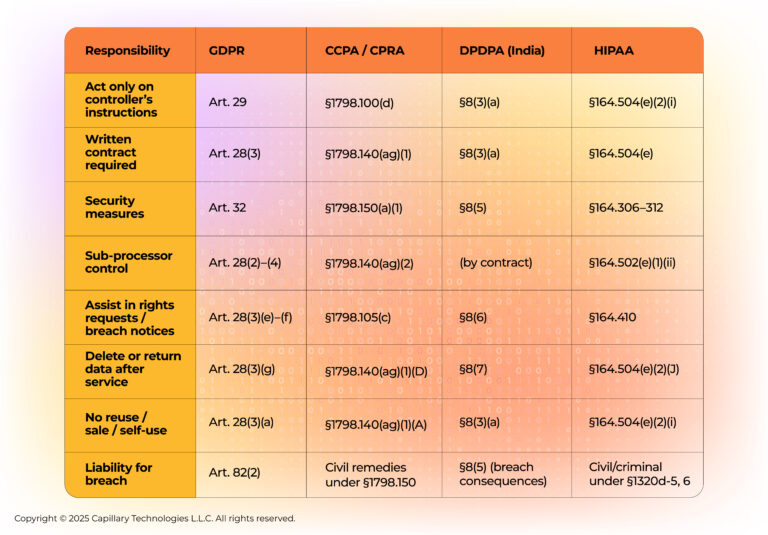
Though we are a Data processor, we support Data controllers, i.e,. our clients in the following clauses:
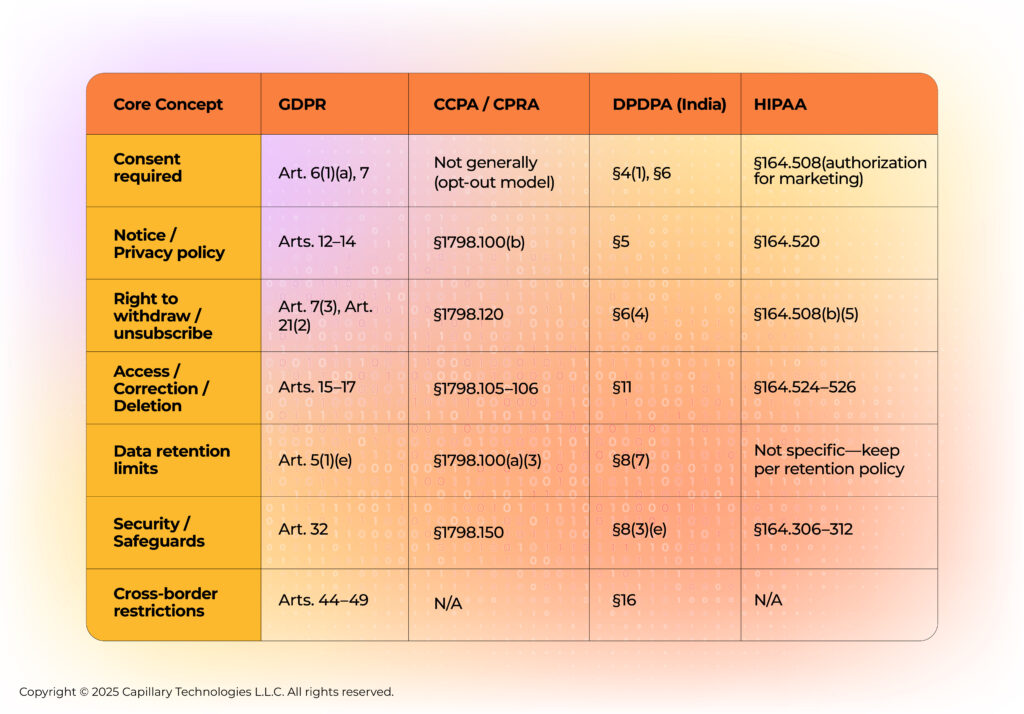
In a fast-moving world, true leadership means anticipating risks, enabling organizational control, and building trust no matter how the landscape evolves. Capillary’s Shield+ initiative envisions the next generation of data governance, adaptive security, and AI-driven privacy.
Shield+ imagines an AI-powered command center for data protection—where brands can ask questions like “Which systems accessed health data last week?” and get clear answers instantly. Shield+ Agent can discover and tag sensitive data, apply policies dynamically, and provide real-time compliance guidance. A unified dashboard brings this intelligence together, offering visibility into risks, policies, and solutions in one place.
As threats evolve, Capillary’s focus areas include automated provisioning through SCIM, brand-dedicated domains for greater control, and a credentials vault for secure integration management. AI-driven threat analytics is also a key priority—enabling early detection of risks across APIs, identities, and dataflows.
Secure Rooms reimagine how support teams handle sensitive operations. Access is minimum-necessary, time-bound, logged, and fully auditable. Permissions revert automatically after sessions end, ensuring complete control and visibility for brands.
Capillary’s vision for Shield+ is about building a resilient, transparent, and empowering security foundation for brands and end customers alike. Cyber risks are accelerating, driven by AI and cloud complexity, and SaaS platforms must evolve to meet them. Through innovation and collaboration, Capillary is working toward a future where security, privacy, and trusted engagement move at the pace of possibility.
If you are re-evaluating how your organization handles customer data, this is the moment to raise the bar. Speak with our team to see how Capillary’s privacy-by-design platform and Shield+ roadmap can help you operationalize global standards, strengthen security, and turn trust into a real competitive advantage. Get in touch with us now
Share


Analytics and Insights
How to Successfully Revamp Your Loyalty Program in 2025Popular airline company Delta made headlines when it announced a change in its popular loyalty