Get the best loyalty & customer engagement platform out there!
- Design industry shaping loyalty programs
- Integrate easily and go live quicker
- Deliver hyper-personalized consumer experiences
Capillary: Recognized as a Leader in Everest Group’s PEAK Matrix® 2025 Read more >
The Balanced Loyalty Quotient Report 2026 is now live — our largest and most in-depth loyalty report yet. Download Report >

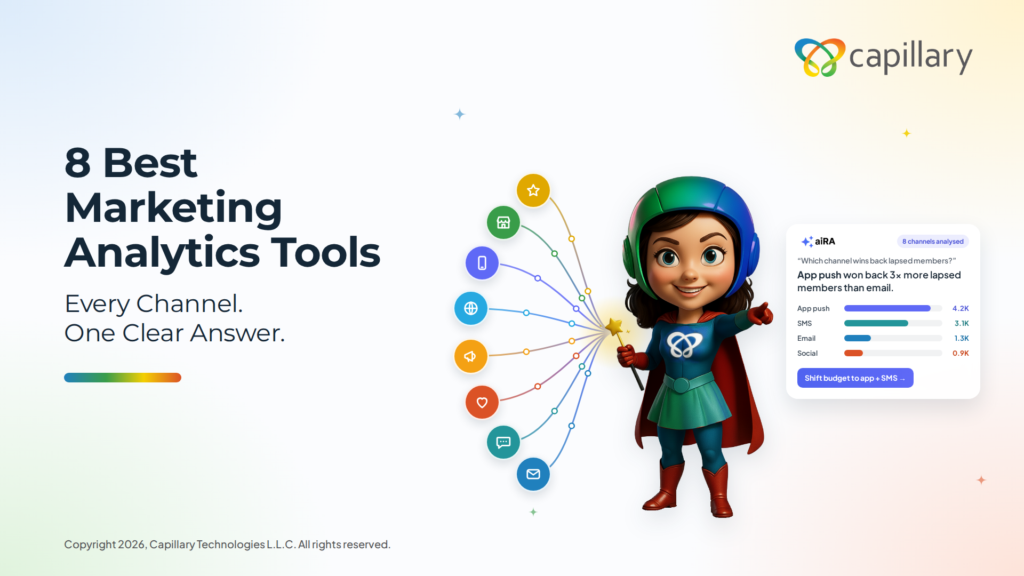
Marketers are drowning in channel data, yet most still wait days for a simple answer. The question goes into an analyst’s queue, someone writes the SQL, and by the time the numbers come back, the campaign window has closed.
The category is finally moving. Static dashboards are giving way to self-service, natural-language, AI-driven analytics, where a marketer asks a question in plain English and gets an answer immediately.
This article tackles one practical question: which marketing analytics tool actually lets a non-technical marketer get an answer without filing a ticket?
We compare 8 tools on self-service access, AI and natural-language querying, integrations, governance, and overall fit. We start with aiRA by Capillary, then cover GA4, HubSpot Marketing Hub, Mixpanel, Amplitude, Supermetrics, Power BI, and Tableau.
For enterprise loyalty and marketing teams that want to ask questions and act on the answers, aiRA by Capillary is the best overall pick.
Who should pick what:
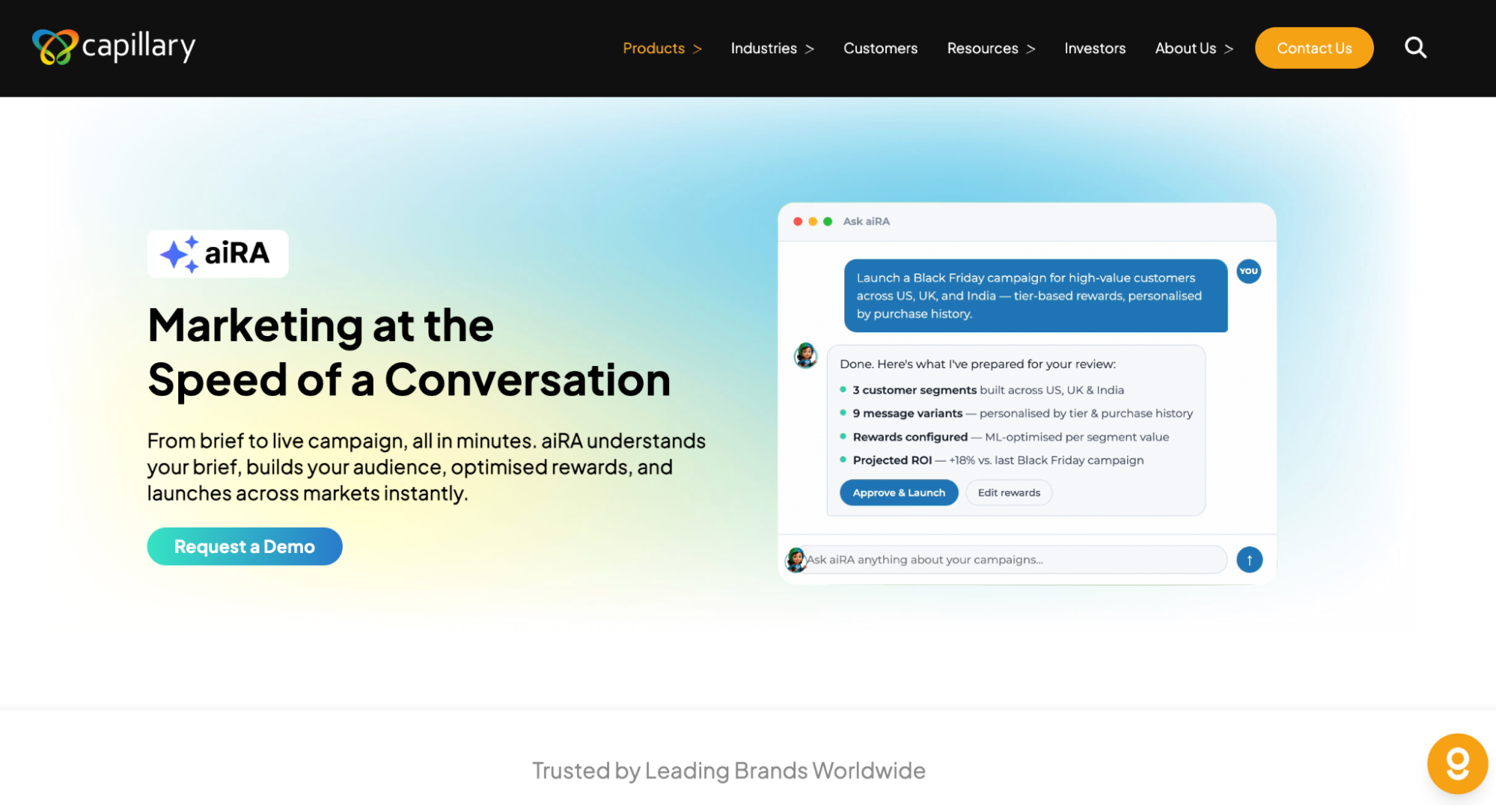
aiRA by Capillary is an agentic AI co-pilot for marketing and loyalty teams: marketing at the speed of a conversation. Instead of waiting on an analyst, you ask questions about your customers in plain English and get answers, the reasoning behind them, and a recommended next move.
aiRA is built around AI-powered conversational analytics. It reads customer data where it already sits, such as Databricks, Snowflake, BigQuery, or Redshift, so there is no migration or rebuild.
Self-service proof points:
Beyond analytics: Most tools on this list stop at the chart. aiRA carries the insight into execution:
Enterprise trust:
Proof: Capillary Technologies was named a Leader in The Forrester Wave: Loyalty (Q4 2025). On the customer side, askaira.ai lists brands already using aiRA, including NASCAR, Shell, Hertz, Rack Room Shoes, ASICS, IndiGo, Metro Shoes, Redtag, Aditya Birla, and Kanmo Group.
NASCAR’s marketing and CRM teams are one example. aiRA already understands their fans, their data, and the rhythm of a race season, and analysis that used to take weeks now takes minutes, according to the customer story on askaira.ai.
Limitations: aiRA is purpose-built for consumer brands with customer and loyalty data, so it is not a general-purpose BI tool for finance or product telemetry. Teams that need heavily custom visual reporting may still pair it with a classic BI tool.
Pricing: aiRA is priced on usage (credits). A credit is consumed when aiRA runs an analysis or builds an action, so adding more marketers does not add cost.
Best for: Enterprise retail, FMCG, and fashion loyalty and marketing teams.
See it on your own data → Request an aiRA demo.
GA4 is Google’s free, event-based analytics platform for websites and apps. It is the default baseline for most marketing teams because it ties traffic and conversions to Google Ads and Search Console.
Key features:
Best for: Teams that need a free baseline for web and app analytics.
Limitations:
HubSpot Marketing Hub is an all-in-one platform that combines marketing automation, email, landing pages, and reporting on top of HubSpot’s CRM. Analytics sit right next to the contacts and deals they describe.
Key features:
Best for: CRM-connected inbound marketing teams that want one system for everything.
Limitations:
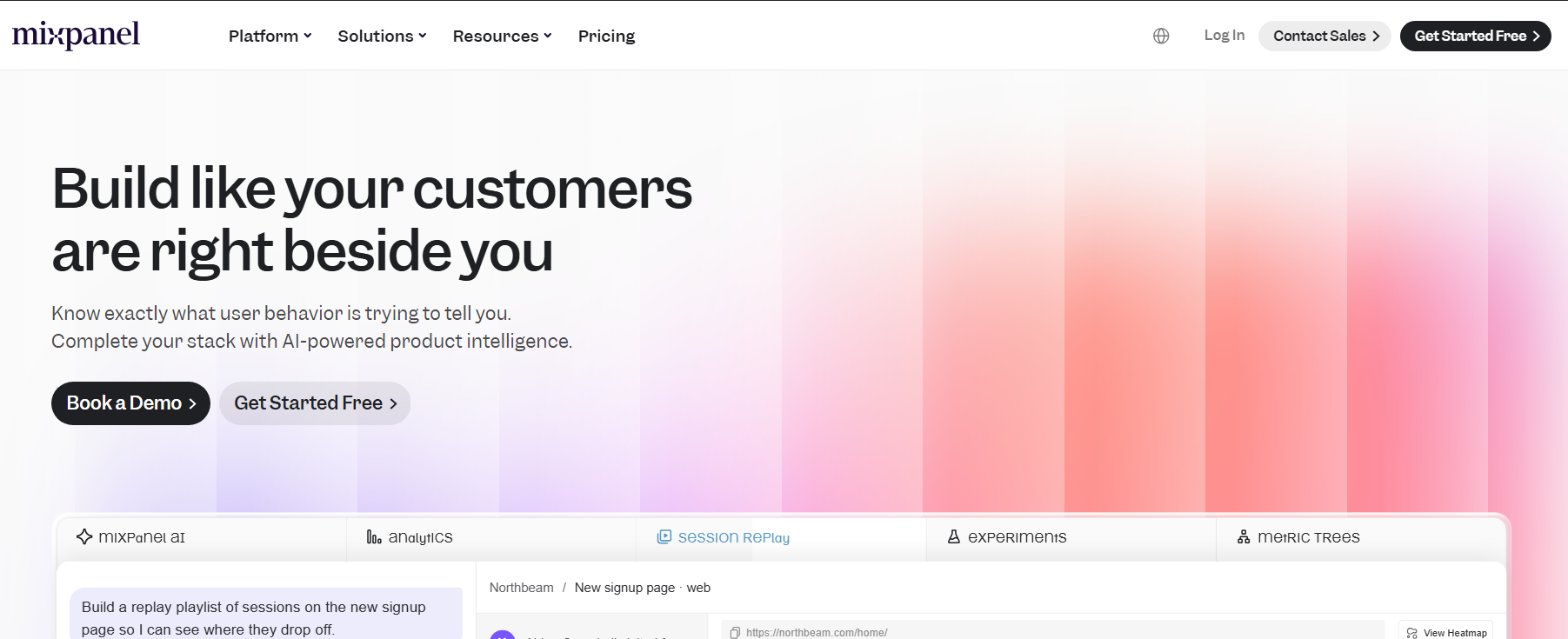
Mixpanel is an event-based product analytics tool. It makes funnels, conversion, and retention easy to explore, and marketers can answer many questions without writing SQL.
Key features:
Best for: Product and growth teams focused on conversion and retention.
Limitations:
Amplitude is a product analytics platform known for behavioral cohorts and journey analysis. It helps teams see which actions lead to retention and revenue.
Key features:
Best for: Product-led teams studying behavior and building cohorts.
Limitations:
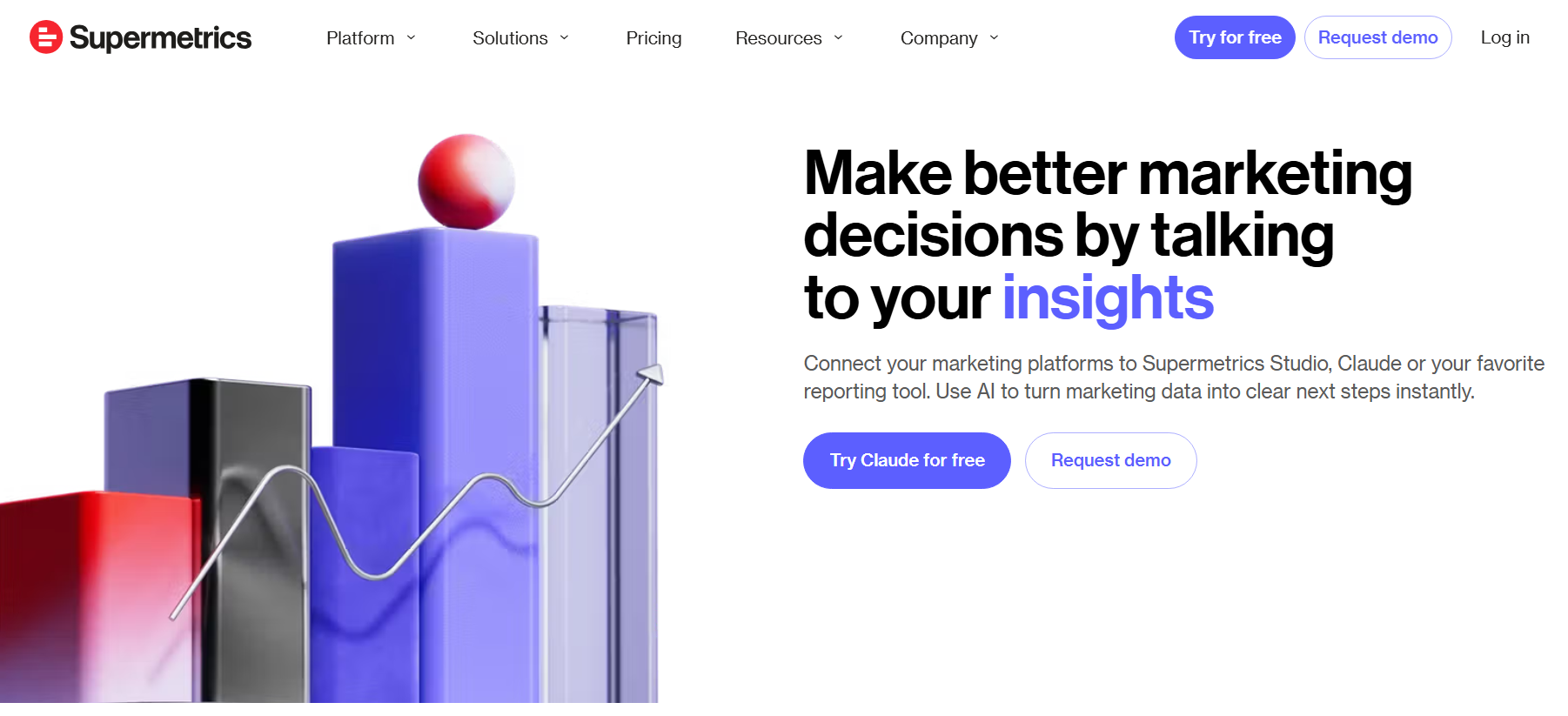
Supermetrics is a data aggregation tool rather than an analytics tool in its own right. It pulls data from ad platforms and marketing channels into spreadsheets, BI tools, and data warehouses.
Key features:
Best for: Teams that already have a BI tool or spreadsheet workflow and need clean marketing data to feed it.
Limitations:
Power BI is Microsoft’s enterprise BI platform. With Copilot, it adds AI assistance for building reports and asking questions of your data, and it fits naturally into Microsoft-centric organizations.
Key features:
Best for: Organizations with data teams that want deep, custom BI reporting on the Microsoft stack.
Limitations:
Tableau is a leading visualization platform known for rich, highly customizable dashboards. It gives analysts fine control over how data is explored and presented.
Key features:
Best for: Analyst-led teams that need advanced visualization and custom dashboards.
Limitations:
The best marketing analytics tool is the one your team can actually use without waiting on analysts. A powerful platform that only two people can operate will always lose to one that every marketer can query on their own.
GA4, Mixpanel, and Amplitude cover web, app, and product behavior. HubSpot suits CRM-connected inbound teams, Supermetrics moves data into your BI stack, and Power BI and Tableau serve analysts who build custom reports.
For teams that want self-service analytics plus the ability to act on insights instantly, aiRA by Capillary is the pick. You ask in plain English, review the reasoning, approve the recommended move, and launch.
Ready to see it on your own data?
What are marketing analytics tools?
Software that unifies and analyzes data across marketing channels to measure performance and guide decisions.
What is self-service marketing analytics?
Analytics that lets non-technical marketers query data and build reports without SQL or an analyst.
Which marketing analytics tool is best for enterprise teams?
aiRA by Capillary, for conversational analytics combined with loyalty and campaign execution at scale.
Do I need SQL to use marketing analytics software?
No. Tools like aiRA by Capillary let you ask questions in plain English.
Are there free marketing analytics tools?
Yes. GA4 is the most common free option for web and app analytics.
How is AI changing marketing analytics in 2026?
AI enables natural-language querying, auto-insights, and turning analysis directly into action.

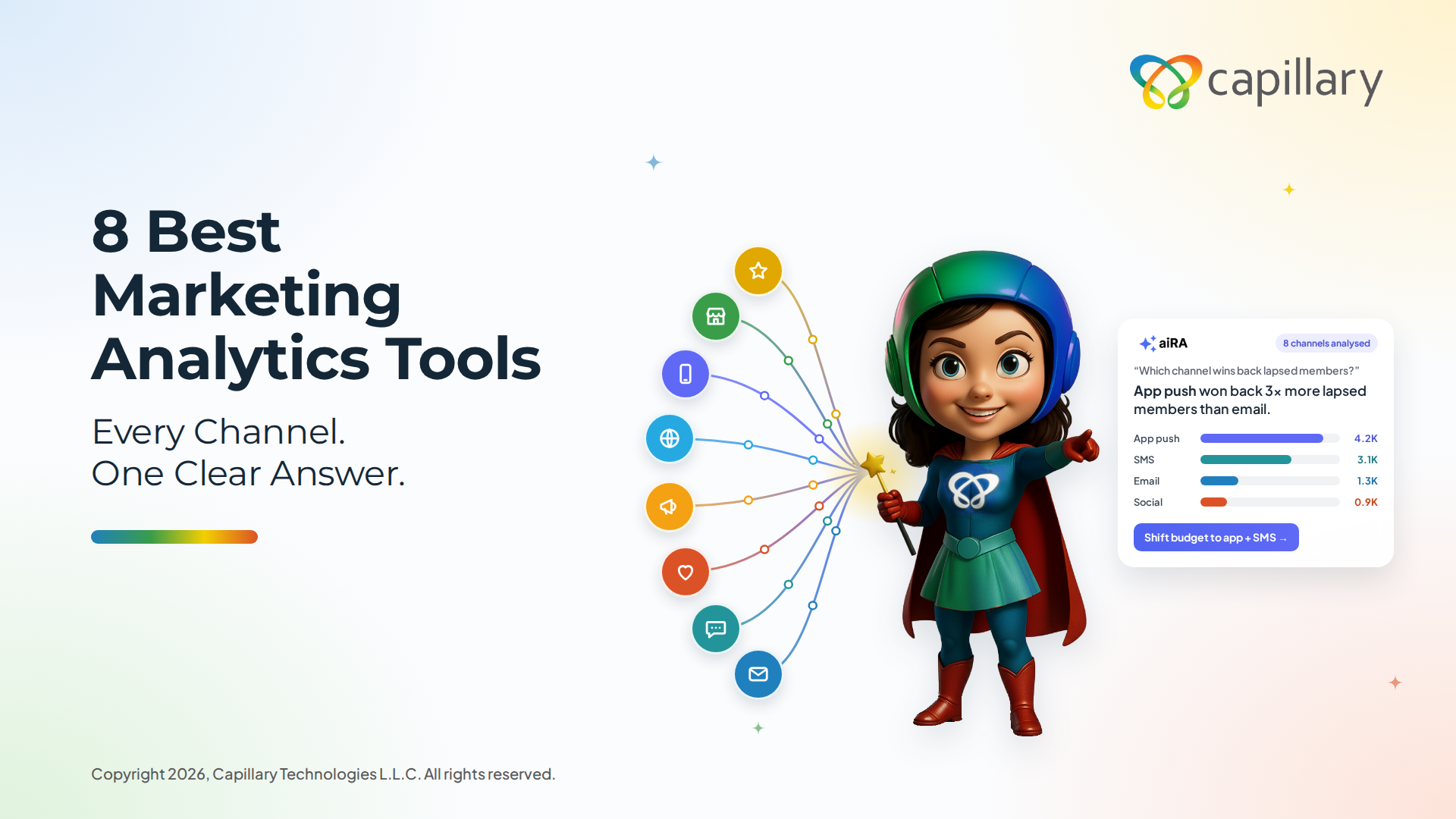
Agentic Analytics
8 Best Marketing Analytics Tools for 2026 (Self-Service & AI-Powered Compared)Introduction Marketers are drowning in channel data, yet most still wait days for a simple
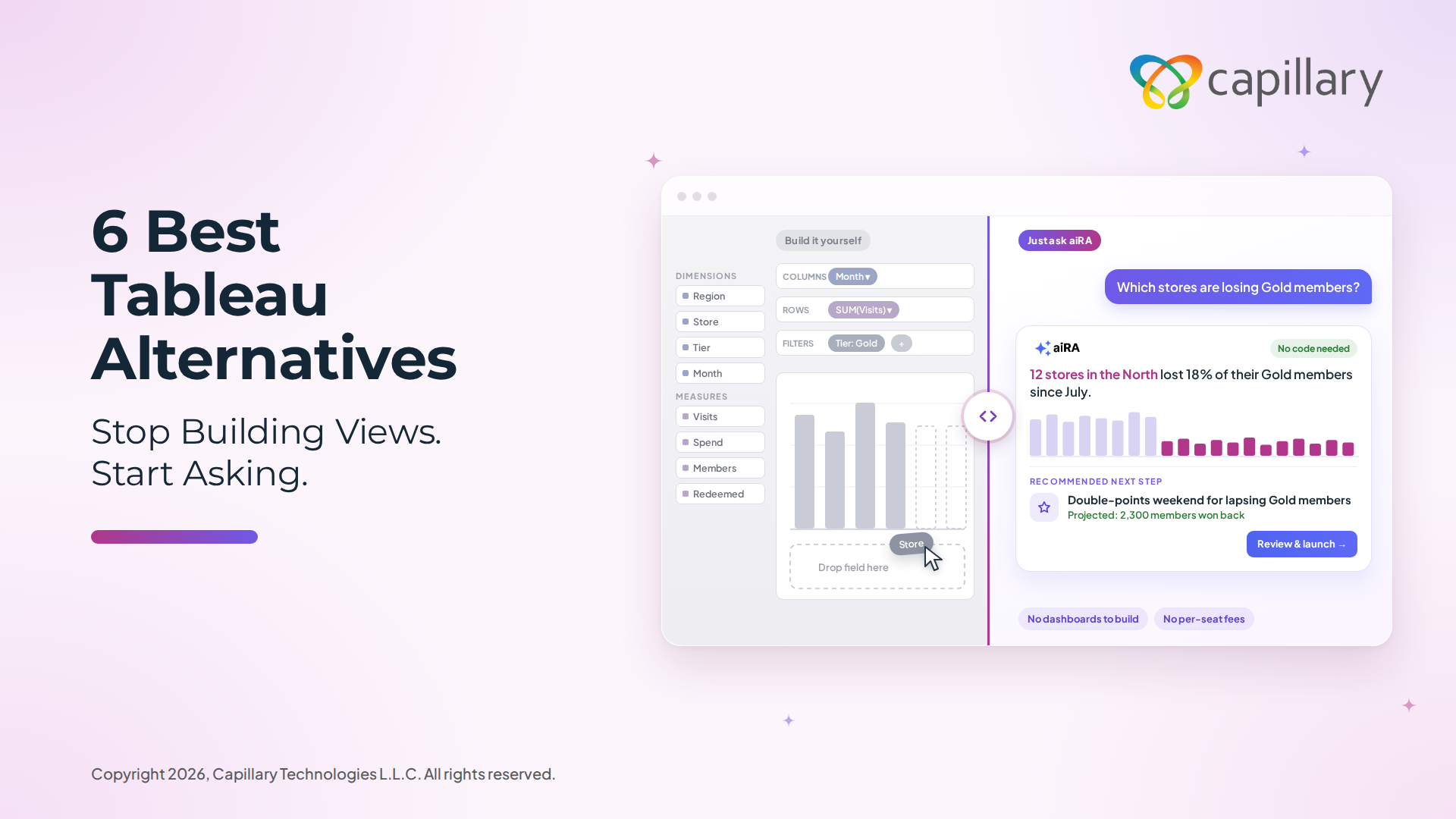
Agentic Analytics
Tableau Alternatives: 6 No-Code & AI-Powered BI Tools Worth Switching To in 2026Introduction Tableau is powerful, but it is also heavy. The learning curve is steep, most
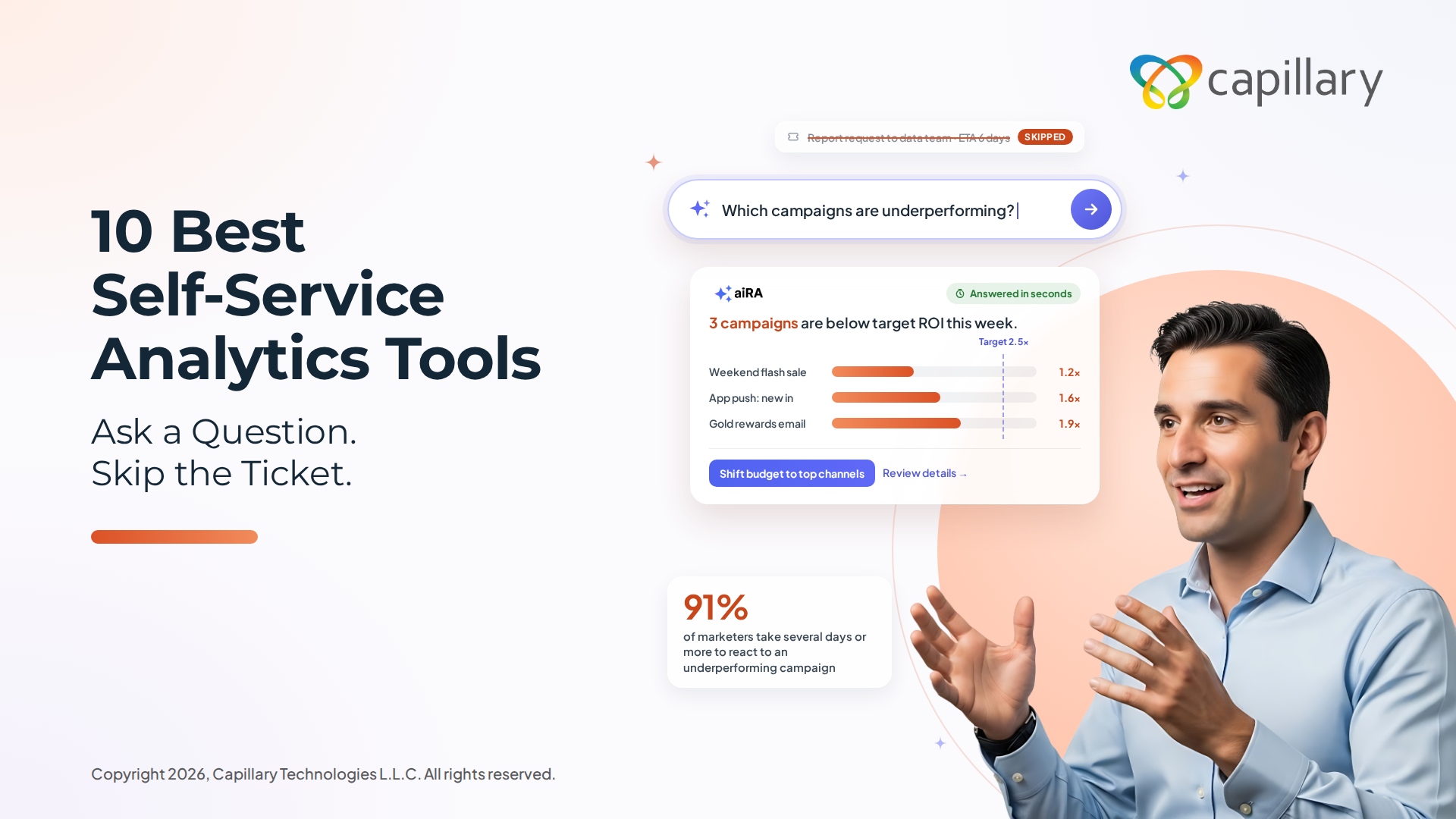
Analytics and Insights
10 Best Self-Service Analytics Tools for Marketers and Business Teams in 2026Marketing teams run on data, but getting a straight answer out of that data is