Get the best loyalty & customer engagement platform out there!
- Design industry shaping loyalty programs
- Integrate easily and go live quicker
- Deliver hyper-personalized consumer experiences
Capillary Named a Leader in The Forrester Wave™ Loyalty Platforms, Q4 2025 Report. Read more >
Capillary: Recognized as a Leader in Everest Group’s PEAK Matrix® 2025 Read more >
The Balanced Loyalty Quotient Report 2026 is now live — our largest and most in-depth loyalty report yet. Download Report >

Customer Data Analytics: How to Go From a Customer Question to a Live Campaign
Here’s a stat that should bother anyone running CRM campaigns. In Supermetrics’ 2026 Marketing Data Report, half of the marketers surveyed said it takes one to three business days just to get a basic question about their data answered.
And that’s only the question. Getting the campaign out takes even longer. GrowthLoop’s 2026 AI and Marketing Performance Index found that 41% of marketers take 30 days or more to execute a campaign.
If you work in marketing or CRM, you know how this goes. You have a simple question about your customers (who’s buying less, who’s about to lapse, who redeemed the holiday offer and never came back), it goes into the analyst queue, and by the time the answer shows up, the moment has passed.
That gap is what this guide is about. We’ll walk through how customer data analytics works and which metrics deserve your attention. Then we’ll get practical: how to go from a question about your customers to a campaign built on the answer.
Let’s start with the basics.
Customer data analytics means studying how your customers behave so you can decide what to do next: what they buy, how often they return, which offers they redeem.
Reporting tells you what happened and a customer data platform (CDP) tells you where the data lives. Customer data analytics tells you why it happened and what to do next.
It matters most to marketing and CRM teams, because they control the offers, rewards, messaging, and channels. McKinsey found that 71% of consumers expect personalized interactions, and 76% get frustrated when they don’t get them.
Most brands already have the data to personalize. The hard part is getting answers fast enough, because when every question waits in an analyst queue, the campaign window closes before the answer arrives.
Customer data analytics usually falls into four types and here are those:
Descriptive analytics tells you what customers did: repeat purchase rate, average order value, offer redemptions, active members by month.
A descriptive number shows that something moved, not what to change. A 2022 Gartner survey of 377 marketing analytics users found that analytics influenced only 53% of marketing decisions.
About a quarter of respondents said decision makers didn’t review the analytics team’s input (26%) or relied on gut instinct (24%).
Diagnostic analytics explains why something happened. You take a descriptive result and break it down by segment, channel, region, or time until the cause shows up. Then you check it against “why” data such as complaints, survey responses, and call-center logs.
An Asia-Pacific telecom profiled by McKinsey was losing customers, and its weaker network seemed like the likely reason. When the company looked closer, it found that a new pricing system had raised average bills, and the bill shock was pushing customers to leave.
The company then explained the bill changes in plain language to its high-value customers who were at risk of leaving and offered them plans that better fit their usage. Churn dropped by 5%, and the return on the effort was almost four times higher than before.
Predictive analytics uses past behavior to estimate what each customer is likely to do next. Marketing and CRM teams rely on three types of models most often:
Instead of telling you who left last quarter, these models tell you who is likely to leave next, so you can act before it happens.
Every score is a probability, not a guarantee. A model doesn’t need to be perfect, as long as it ranks customers well enough to change who you target.
Prescriptive analytics tells you what to do next. It recommends which customers to target, what to offer them, and when and how to reach them.
In McKinsey’s research, a US airline used to treat every customer the same when giving out flight-delay vouchers. Machine learning then helped its agents decide which customers to prioritize and what to offer each one.
As a result, targeting of at-risk customers improved by 210%, and churn intention among high-value ones fell by 59%.
Most customer analysis follows the same path, from asking a question to acting on the answer. Under each step below, you’ll see how to do it with aiRA, Capillary’s AI for marketing teams, which takes a marketer from a plain-English question to a live campaign in one conversation.
Dashboards are good for tracking performance, but they don’t tell you what to do about a specific problem. A clear business question does. For example, a CRM team might ask which loyalty members cut back their spending this quarter and what those members have in common. A specific question tells you which data to pull and which customers to include, and the answer leads straight to a decision.
How to do it with aiRA
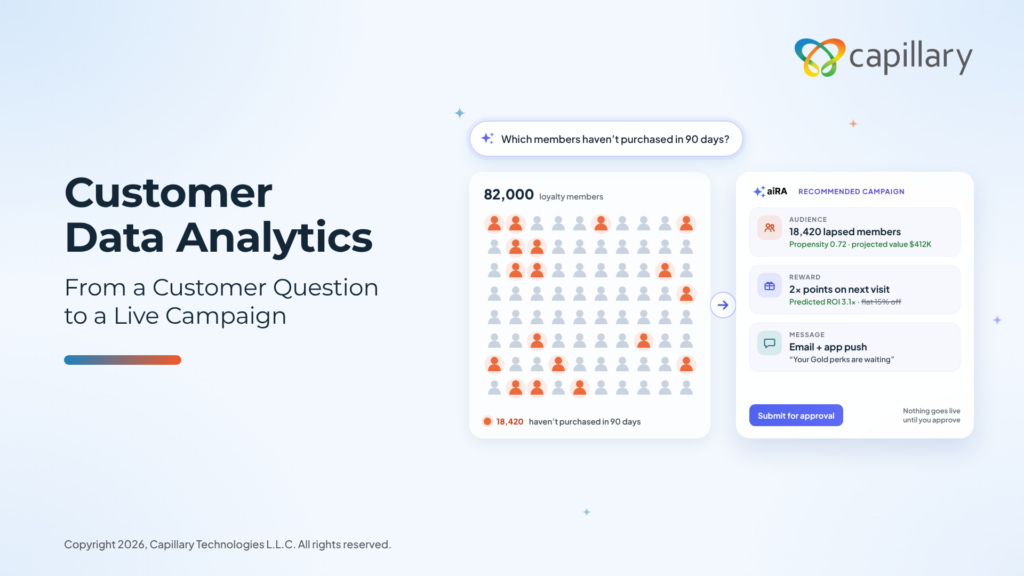
You type the question in plain English, the way you’d ask a colleague, and get the answer in the same conversation. You don’t need to write SQL or wait for the analytics team. For example, you could ask, “Which members haven’t purchased in the last 90 days?”
Averages can be misleading, because a small group of customers often brings in a large share of revenue. Segmentation splits your customers into groups based on what they buy, how much they’re worth, and where they are in their lifecycle. The most useful segments combine all three. For example, high-value customers in their first 90 days who have bought only once are a clear audience for a second-purchase campaign.
How to do it with aiRA
You describe the audience you want, and aiRA builds the segment for you. Each segment comes with a propensity score and a projected campaign value, so you can see which audiences are worth targeting before you plan a campaign.
Transaction data shows what customers did, but not why they did it. Adding experience data, such as NPS scores, complaints, and service records, helps fill that gap.
McKinsey describes a European telecom that stopped marketing to customers with open complaints or service issues. After that change, its NPS rose to match the market leader, and its cross-sell and churn rates both improved.
How to do it with aiRA
Once you have a segment, aiRA shows how those customers have behaved over time, including their seasonal patterns, preferences, and engagement signals. This gives you useful context before you decide what to offer them.
Next, decide how to respond: which segment to target, what to offer, and which message, channel, and timing to use. Agree on the metric you want to move before you launch. It also helps to hold back a small group of similar customers who don’t get the campaign, because comparing the two shows how much of the result the campaign actually caused.
How to do it with aiRA
You describe the campaign, and aiRA sets up the audience, rewards, messages, and channels in the same conversation. Instead of blanket discounts like a flat 15% off, it recommends offers optimized with machine learning. It also predicts ROI for each market and explains why it made each recommendation. You set the KPIs before launch, and nothing goes live until your team approves it.
| The usual way | With aiRA by Capillary | |
|---|---|---|
| Answer a customer question | Send a request to analysts and wait | Ask in plain English and get the answer right away |
| Build a new segment | Another analyst ticket, up to 62 analyst hours a month | Describe the audience in plain English |
| Launch a campaign | 26+ days across three or more teams | One conversation, approved by your team |
| Run a 7-zone, 6-language campaign | 2–3 days and several teams | 8 localized messages in minutes |
aiRA recommends, and your team decides. No campaign goes live without explicit approval. Personal data is masked before it reaches the AI, and every AI interaction is logged. aiRA is also ISO 27001 aligned, PCI DSS compliant, and compliant with GDPR, CCPA, and PDPA.
A typical aiRA pilot takes two to four weeks, and you get a dedicated Capillary success manager.
Bring one question about your customers to an aiRA demo. We’ll answer it live and show you the campaign it can turn into.
Most enterprise brands collect plenty of customer data. The difficulty is getting answers from it quickly enough for marketing and CRM teams to use them.
In most organizations, four issues slow this down, and each one adds time between a question and the campaign that should follow it:
In many organizations, customer data sits in warehouses that can only be queried with SQL, so marketers send their questions to an analytics or BI team and wait. Those teams handle requests from across the business, and a simple question can take days or weeks to come back.
In a 2025 survey by GrowthLoop and Ascend2 of 309 marketers at North American companies with at least $100 million in revenue, 53% named data analysis and insights as the biggest bottleneck in their marketing cycle.
Insights are usually delivered as a dashboard or a slide deck. Turning them into a campaign is a separate piece of work that involves building the segment, choosing the offer, writing the message, and setting everything up in a campaign tool. Each handoff adds time, and some findings are never acted on.
Many analytics tools need significant setup before they produce anything useful. Data has to be integrated and cleaned, models for churn or lifetime value have to be built and validated, and dashboards have to be configured. This can take months and often requires specialist skills that marketing teams do not have in-house.
Governance and privacy are frequently handled late, once a tool is already in use. Customer data includes personal information, so it matters who can see it, how it is masked, and whether its use is logged, especially as access widens beyond the data team.
In Cisco’s 2024 Data Privacy Benchmark Study, 94% of the 2,600 privacy and security professionals surveyed said their customers would not buy from them if they did not adequately protect data.
For marketing and CRM teams, the result is a long gap between asking a question about customers and launching a campaign based on the answer.
When comparing tools, it helps to look beyond the reporting features and check how quickly each one gets your team from a question to a live campaign. This checklist covers what matters most for marketing and CRM teams.
If you need to prioritize, start with the ability to act, since it decides whether your analysis ever reaches customers.
Getting an answer about your customers is only part of the job. The answer starts to matter once it becomes a segment, an offer, and a campaign that reaches the right people. For most teams, the delay sits between the analysis and the launch.
aiRA is built to shorten that stretch. Your team can ask about customers in plain English, build segments with propensity scores and projected campaign value, and set up the campaign in the same conversation, with a person approving every step. Book an aiRA demo to see how a question about your customers turns into a live campaign.
A CDP collects customer data from different sources and combines it into one profile per customer. Customer data analytics uses that data to understand behavior and decide what to do next.
Descriptive analytics shows what customers did, diagnostic explains why, predictive estimates what they will do next, and prescriptive recommends what to do about it.
Yes. Conversational AI tools such as aiRA let marketers ask questions about customers in plain English and build segments by describing the audience, with no SQL or analyst queue.
Start with retention and churn, customer lifetime value (CLV), and customer acquisition cost (CAC). Comparing CLV with CAC shows whether acquisition is paying off over time.
A marketer describes the campaign in plain language, and aiRA builds the segment, recommends rewards and messaging, and sets up delivery across channels. Nothing goes live without the team’s approval.
Share


Blogs
What makes shoppers choose one retailer over another? 5 lessons for growthA shopper walks into your store every weekend. They know your aisles, use your app,

News
Capillary Strengthens US Leadership, Names Bill Swift as President, AmericasCapillary Marcom
Latest News
Capillary Strengthens US Leadership, Names Bill Swift as President, AmericasDallas, TX, October 29, 2026 — Capillary Technologies, a leading provider of AI-powered loyalty and