- Design industry shaping loyalty programs
- Integrate easily and go live quicker
- Deliver hyper-personalized consumer experiences

Capillary Named a Leader in The Forrester Wave™ Loyalty Platforms, Q4 2025 Report. Read more >
Capillary: Recognized as a Leader in Everest Group’s PEAK Matrix® 2025 Read more >
The Balanced Loyalty Quotient Report 2026 is now live — our largest and most in-depth loyalty report yet. Download Report >
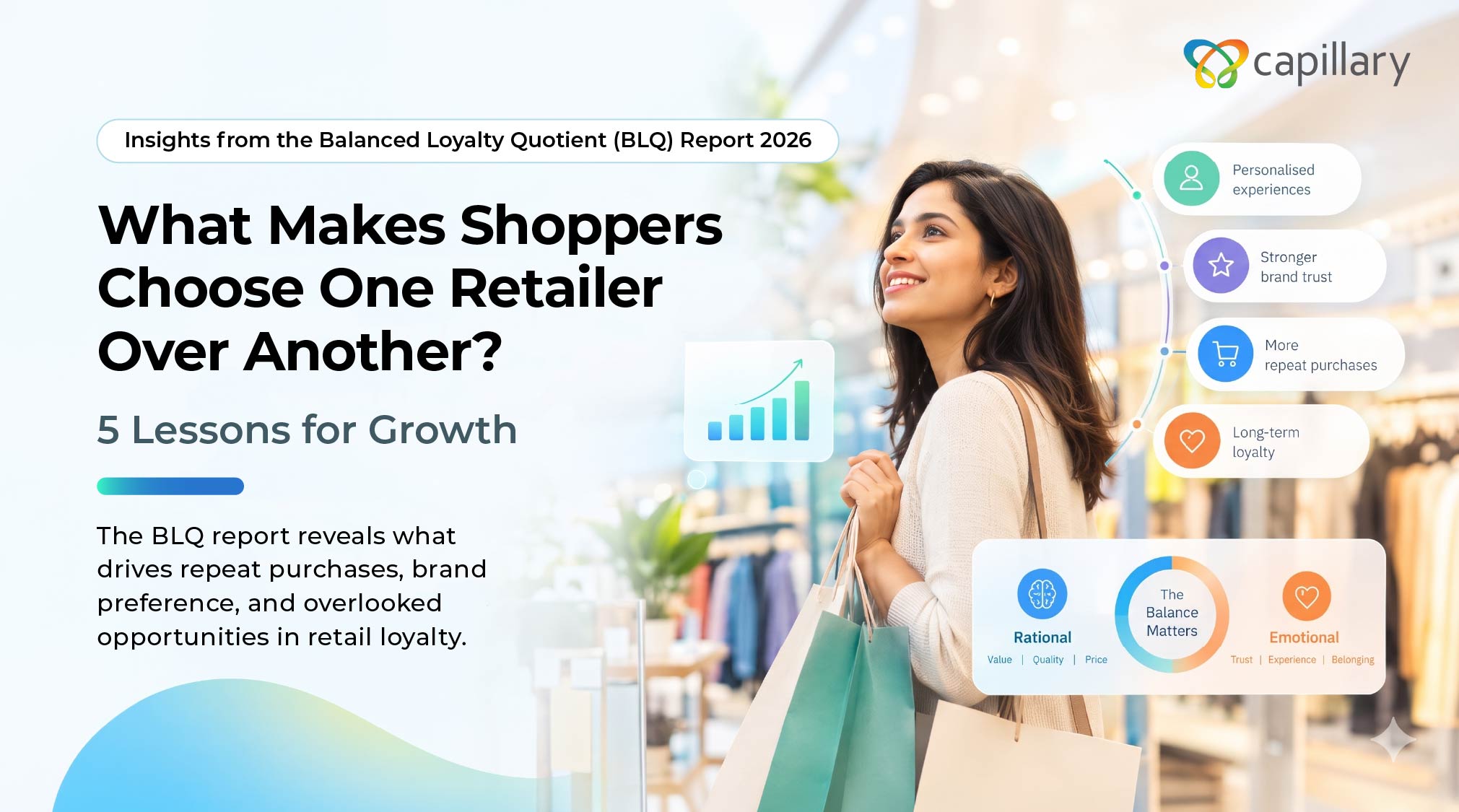
What makes shoppers choose one retailer over another? 5 lessons for growth
A shopper walks into your store every weekend. They know your aisles, use your app, collect rewards, and rarely miss a promotion.
Your dashboard tells a reassuring story. High purchase frequency. Healthy spending. Consistent engagement.
But here’s what it may not tell you.
That same shopper could be buying from three competing retailers. They might love your discounts but feel no particular attachment to your brand. And if another retailer offered a better deal tomorrow, they might switch without thinking twice.
So, how loyal is your loyal customer, really?
It’s an increasingly important question for retailers.
of surveyed US shoppers purchased from a new-to-them brand in the previous three months. Yet 77% regularly shop with five brands or fewer.
Attentive, 2026
Shoppers are clearly willing to experiment. But earning a lasting place among their preferred retailers is a different challenge.
And as competition intensifies, even a well-performing loyalty program may not guarantee that preference.
Capillary Technologies’ Balanced Loyalty Quotient (BLQ) Report 2026 offers a fresh perspective on this challenge. Based on 26,642 brand evaluations from 13,543 US consumers across 54 major brands and eight categories, the study explores two dimensions of customer loyalty: rational and emotional.
Retail & Specialty emerged as the strongest-performing category. But beneath that headline lies a more revealing story about what motivates shoppers to choose, stay with, and potentially leave a brand.
Here are five lessons retail leaders can take from the research to rethink their approach to customer loyalty and growth.
Retailers have become remarkably good at tracking customer behavior.
Purchase frequency, average order value, lifetime value, share of wallet, repeat purchase rates. Every metric offers a window into how customers interact with a brand.
But there’s a difference between being someone’s regular retailer and being their preferred retailer.
Imagine two shoppers.
Buys groceries from the same store every week because it’s close to home and the prices are reasonable.
Goes out of their way to visit a particular beauty retailer because they trust its recommendations, love discovering new products, and enjoy the overall experience.
Both are repeat customers. But the reasons behind their behavior are different.
This distinction becomes even more relevant when you consider the following.
of consumers in Capillary’s BLQ study shop at least two brands within a category.
BLQ Report 2026
Retailers aren’t necessarily competing for an exclusive relationship. They’re competing for a greater share of customers’ choices.
A customer might buy from you regularly while maintaining equally strong relationships with your competitors.
That’s not a failure of retail loyalty. It’s a reminder that repeat behavior doesn’t explain the full relationship.
Look beyond how often customers return. Understand what makes them choose you when other options are available.
Retailers who can identify customers driven primarily by convenience, discounts, habit, or genuine preference can make more informed decisions about retention, engagement, and customer investment. Because the customer who keeps buying today isn’t necessarily the customer who will stay tomorrow.
Value has always been a powerful force in retail.
And in 2026, its importance is hard to ignore.
surveyed global consumers are trading down to more budget-friendly alternatives.
NRF & IBM, 2026
Retailers are responding with sharper pricing, promotions, exclusive member discounts, and increasingly sophisticated rewards.
These strategies matter. But they also raise an important question.
If customers primarily choose you because of price, what happens when someone else offers better value?
Consider how shoppers navigate different retail categories.
Across these categories, rational considerations and emotional motivations work together, but not necessarily in the same proportions.
This is one of the central ideas behind Capillary’s Balanced Loyalty Quotient.
Captures practical reasons for choosing a brand, such as value, reliability, trust, and quality.
Reflects attachment, anticipation, and the feeling that a brand understands and matters to a customer.
Neither is sufficient on its own.
An excellent experience cannot consistently compensate for poor value. Equally, competitive pricing may not be enough to make a brand meaningfully different from its competitors.
The strongest retail relationships develop when shoppers have both practical and emotional reasons to return.
Retailers should ask what makes their value proposition difficult to replace, not simply whether it is competitive.
The BLQ Report explores how leading retailers perform across these two dimensions, revealing differences that conventional transaction-based measurement may not capture.
Loyalty programs have become an essential part of retail strategy.
From points and discounts to exclusive access, paid memberships, personalized offers, and tiered benefits, retailers have more ways than ever to encourage participation.
But participation and preference are not the same thing.
Upside’s 2026 Escaping the Loyalty Plateau research found that 86% of surveyed shoppers consider loyalty rewards important. Yet regular program usage trails that enthusiasm.
The same research found that loyalty members often belong to multiple competing programs within the same category.
In other words, joining your program doesn’t mean a customer has stopped considering alternatives.
So, what should retailers be measuring?
Beyond enrollments, active members, and redemptions, the more meaningful questions concern influence.
Is the program giving customers a reason to choose the brand more often? Is it changing how they allocate their spending? Does it make the overall brand experience more valuable?
Capillary’s BLQ study offers encouraging evidence that loyalty programs matter.
BLQ points: how much higher loyalty program members scored than non-members across the research.
BLQ Report 2026
While this is an association rather than proof that membership itself caused the difference, it highlights the strength of the relationships among program members.
But the real opportunity is understanding why some programs build stronger relationships than others.
Retailers can invest heavily in acquiring members without necessarily creating meaningful engagement. And a large member base may conceal very different levels of connection, understanding, and brand preference.
Shift the conversation from how many people have joined your program to how much the program influences their relationship with your brand.
The BLQ findings also examine the differences between retail membership models, offering a closer look at how program participation and stronger customer relationships intersect.
Which retail brands are turning membership into stronger loyalty, and which are leaving opportunity on the table?
Retailers have access to more customer intelligence than ever.
They can anticipate purchasing patterns, identify product affinities, personalize recommendations, and deliver offers across multiple channels.
AI is making many of these capabilities faster and more scalable.
But shoppers don’t experience personalization as a technology capability. They experience it through the interactions they have with a brand.
A recommendation that reflects a customer’s interests can feel thoughtful. A discount on something they’ve already purchased might feel repetitive.
A timely reminder about a product they genuinely need can be useful. Another generic campaign labelled “exclusive” might be ignored.
The distinction matters.
Only 38% of loyalty program members find their communications personalized and relevant.
BLQ Report 2026
That suggests an important gap between brands’ ability to collect customer data and their ability to translate it into experiences that customers value.
And the stakes are rising.
Attentive’s 2026 personalization research found that 70% of surveyed shoppers experience some degree of overwhelm, uncertainty, or difficulty finding appealing options while shopping online.
In a retail environment filled with choice, relevance can become a form of value.
The opportunity extends beyond generating the next purchase.
It involves creating interactions that leave customers feeling recognized, supported, and understood.
Use customer intelligence to improve the relationship, not just the next conversion.
Retailers should examine how often their personalization efforts create genuinely useful experiences, and whether those experiences strengthen customer preference over time.
Here’s an interesting finding from Capillary’s BLQ research.
Retail & Specialty achieved the highest overall loyalty score among the eight categories studied.
BLQ Report 2026
That’s encouraging for the sector.
But does strong category performance mean all retailers have equally strong customer relationships?
Not quite.
A retailer can be highly valued for convenience while another earns stronger emotional attachment. A customer can be satisfied without being deeply committed. A widely adopted rewards program may not necessarily create the strongest brand preference.
These distinctions are easy to overlook when performance is evaluated primarily through transactions, engagement, and satisfaction.
And that’s where the growth implications become significant.
A retailer might invest in retention campaigns for customers who were never particularly likely to leave. At the same time, genuinely vulnerable customers could remain hidden within a segment that appears healthy because they continue purchasing.
Another retailer might increase rewards spending without understanding whether those incentives create incremental preference or simply reward existing behavior.
Neither problem is easy to diagnose through transaction data alone.
The challenge isn’t that traditional retail metrics lack value. It’s that they answer different questions.
But understanding what makes shoppers actively prefer one retailer over another requires a more complete picture.
Capillary developed the Balanced Loyalty Quotient to help address this measurement gap.
The framework evaluates 14 attributes spanning rational and emotional loyalty, offering a way to examine not just the strength of a customer relationship, but the factors shaping it.
For retail leaders, this creates an opportunity to challenge some familiar assumptions.
Are your highest-spending shoppers necessarily your strongest advocates?
Does a successful loyalty program translate into deeper emotional attachment?
Are you competing primarily on value, experience, or genuine brand preference?
And perhaps most importantly, where does your brand stand against the retailers getting both sides of loyalty right?
The BLQ Report explores those questions through brand-level benchmarks and comparisons, revealing how different retailers build loyalty and where potential gaps emerge.
Measure the strength of the relationship behind the transaction. What you discover may change where you invest next.
The retail industry has become highly sophisticated at influencing customer behavior.
Personalized promotions, seamless shopping journeys, competitive rewards, and AI-powered engagement all play important roles in driving growth.
But the next competitive advantage may come from understanding something less visible.
Why does a shopper genuinely prefer one retailer over another?
What makes a brand worth returning to even when competitors offer similar products, prices, or benefits?
And how can retailers distinguish between customers who are simply satisfied and those who have developed a stronger relationship with the brand?
These are questions that deserve a place alongside traditional retention, revenue, and engagement metrics.
Because knowing that customers keep buying is useful.
Knowing why they keep choosing you is what can help make that growth more sustainable.

Written by
Summaya
Summaya is a brand and content marketing professional at Capillary Technologies, where she helps shape compelling narratives around customer loyalty, engagement, and the evolving retail landscape. With a passion for turning complex ideas into clear, engaging stories, she creates content that connects industry insights with real-world business impact.
Capillary’s Balanced Loyalty Quotient Report 2026 examines 54 major brands across eight industries, including leading retail brands, to uncover what drives rational and emotional loyalty.
See what’s driving loyalty across leading retail brands and what the findings could mean for your growth strategy.
Discover
Customers choose retailers based on a combination of price, convenience, product quality, trust, shopping experience, and emotional connection. While competitive pricing and accessibility can influence immediate purchases, lasting retail loyalty depends on building stronger brand preference. Retailers that deliver both rational value and meaningful customer experiences are better positioned to encourage long-term relationships.
Repeat purchases measure how frequently customers buy from a retailer, while customer loyalty reflects their underlying preference and commitment to the brand. Customers may shop repeatedly because of convenience, discounts, or habit without feeling strongly attached. True retail loyalty involves both rational motivations, such as value and reliability, and emotional factors, such as trust, recognition, and brand affinity.
Retailers can measure customer loyalty using a combination of behavioral, rational, and emotional indicators. Alongside purchase frequency, customer lifetime value, retention, and Net Promoter Score (NPS), brands should assess customer preference, emotional attachment, perceived value, and willingness to choose the brand over competitors. Capillary’s Balanced Loyalty Quotient (BLQ) framework evaluates 14 rational and emotional attributes to provide a more comprehensive view of loyalty.
Retail loyalty programs can support customer retention by encouraging engagement, offering relevant rewards, and strengthening customer relationships. Capillary’s Balanced Loyalty Quotient Report 2026 found that loyalty program members scored 15.9 points higher on overall loyalty than non-members across the study. However, membership alone does not establish causation or guarantee retention. Program effectiveness also depends on relevance, perceived value, and customer engagement.
Emotional loyalty gives shoppers reasons to prefer a retailer beyond price, convenience, and promotional incentives. Customers who feel understood, valued, and connected to a brand may be more inclined to choose it when alternatives are available. Combining emotional attachment with rational value can help retailers strengthen customer relationships, differentiate themselves from competitors, and support sustainable growth.
Capillary Technologies’ Balanced Loyalty Quotient Report 2026 evaluates leading retail brands using rational and emotional loyalty measures. Retail & Specialty achieved the highest category score among the eight industries studied, with a BLQ of 66.3. However, individual retailers demonstrate different strengths across value, convenience, brand attachment, and membership experiences. The complete brand rankings and comparative benchmarks are available in the Balanced Loyalty Quotient Report 2026.
Share


Capillary Marcom 4 Min Read