Get the best loyalty & customer engagement platform out there!
- Design industry shaping loyalty programs
- Integrate easily and go live quicker
- Deliver hyper-personalized consumer experiences
Capillary Named a Leader in The Forrester Wave™ Loyalty Platforms, Q4 2025 Report. Read more >
Capillary: Recognized as a Leader in Everest Group’s PEAK Matrix® 2025 Read more >
The Balanced Loyalty Quotient Report 2026 is now live — our largest and most in-depth loyalty report yet. Download Report >

8 Best Omni BI Alternatives in 2026
See how Capillary bakes privacy, security, and global compliance so you can protect customer data, earn trust, and turn it into an advantage.
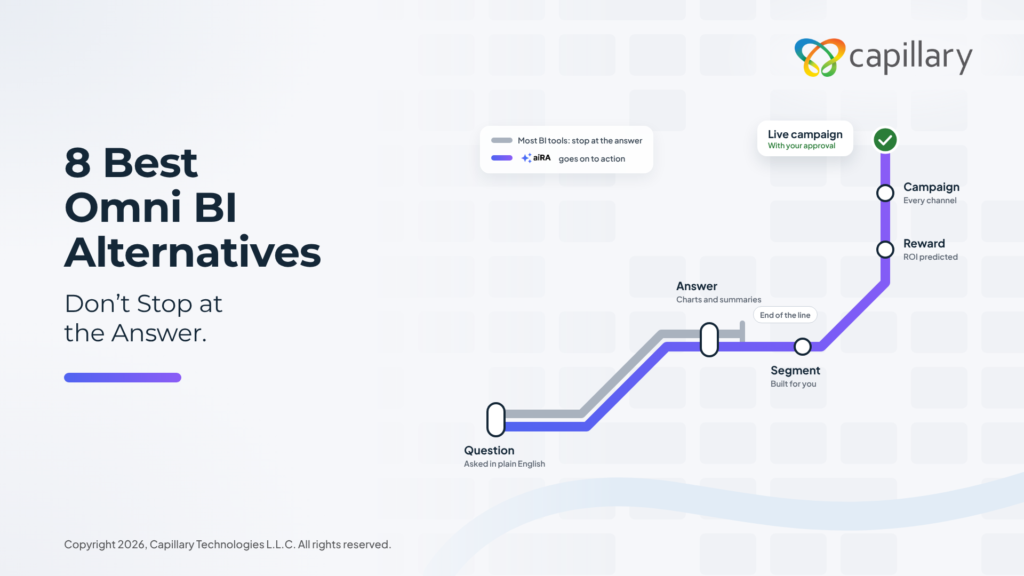
Omni is a capable BI platform. It’s modern, warehouse-native, and well liked by data teams that already live in a semantic layer. Teams don’t usually go looking for alternatives because Omni is broken. They go looking because the fit stops working somewhere between the data team and everyone else. Three friction points come up again and again in buyer research:
Who this guide is for: Business, marketing and loyalty teams who want answers and action, plus the data leaders who support them. If you’re a data team picking a governed internal BI layer, much of this still applies. You’ll just weigh the criteria differently.
How we evaluated each platform:
Omni is a strong unified BI platform for data teams, but it’s engineer-oriented, sales-priced and stops at insight. The eight alternatives below range from action-oriented agentic tools to Microsoft-native BI to open-source self-hosting.
aiRA by Capillary is the best fit for marketing and loyalty teams. Among the tools in this list, it’s the one built to take a plain-English question through to a segment and a live, human-approved campaign in a single conversation. For general-purpose BI, ThoughtSpot, Power BI and Looker compete most directly with Omni. Metabase is the budget pick, and Databricks Genie suits lakehouse teams.
Pick by need:
Platform | Best for | How you ask | Governance model | Where it stops | Pricing model | Key limitation |
aiRA by Capillary | Marketing and loyalty teams at enterprise retail, FMCG, fashion, hospitality | Conversational, plain English, no SQL | PII masked before the LLM, cross-brand isolation, human approval on every action, full audit trail | Action: question → segment → campaign | Quote-based, via a 2-4 week pilot | Built for customer and loyalty data in the Capillary ecosystem |
ThoughtSpot | Search-led enterprise analytics | Search and Spotter AI agent | Governed, modeled data | Insight, with workflow integrations | Tiered plans; sales-led at higher tiers | Modeling work and metered AI usage can add cost |
Power BI | Microsoft 365 / Azure organizations | Copilot (capacity- gated) | Microsoft identity and Fabric governance | Insight, plus Power Platform links | Per-user plus capacity | Copilot tied to higher capacity tiers |
Looker | Governed semantic layer on Google Cloud | Conversational Analytics (Gemini) | LookML semantic layer | Insight | Sales-led platform fee plus user types | LookML expertise and heavier setup |
Databricks AI/BI (Genie) | Lakehouse teams | Genie conversational interface | Unity Catalog governance | Insight and data apps | Consumption (LLM DBUs plus compute) | Requires Databricks; costs scale with usage |
Tableau (Pulse/Next) | Visualization and Salesforce shops | Tableau Agent, Pulse | Role-based licensing, Salesforce- aligned | Insight, with Agentforce actions in Tableau Next | Creator/ Explorer/ Viewer seats | Premium agentic features sit in higher bundles |
Sigma | Spreadsheet-style BI on cloud warehouses | Spreadsheet UI plus AI features | Warehouse- native | Insight, with writeback | Sales-led | Pricing not published |
Metabase | Budget- conscious and self-hosted teams | Metabot AI, query builder | Lighter on the free tier; row/column permissions on Pro | Insight | Free open source; paid cloud tiers | Lighter governance and AI depth |
aiRA is Capillary’s agentic AI co-pilot for marketing and loyalty teams. You describe what you want in plain English, and aiRA by Capillary works through audience, rewards, messaging and multi-channel setup. Capillary Technologies’ own framing is “marketing at the speed of a conversation.” It’s built into the Capillary platform and trained on your brand’s context from the first day.
Best for: Enterprise retail, FMCG, fashion and hospitality loyalty and marketing teams. In practice that means marketing managers who need to launch fast, CMOs who need ROI visibility on rewards, and heads of analytics who are tired of being a segmentation help desk.
How it compares to Omni: Omni answers the question. aiRA by Capillary answers it and acts on it: question → segment → campaign in one conversation. Consider what a typical enterprise campaign cycle looks like without it. Capillary breaks it into five phases across three or more teams and 26+ days:
Phase | Typical time |
Strategy definition | 5-8 days |
Analytics and segmentation | 4-7 days |
Campaign setup | 8-12 days |
Review and launch | 2-4 days |
Analytics feedback | 7-10 days |
Standout features:
Governance:
Proof points: A global fashion retailer (400+ stores) went from days of multi-team coordination to nine personalized push notifications created within minutes. A leading electrical and consumer goods conglomerate operating in 25+ countries let its marketing team build segments and create campaigns without analyst tickets.
Pricing: aiRA by Capillary is quote-based. Capillary Technologies offer a structured pilot that takes you from first conversation to full deployment in 2-4 weeks, in four phases: business requirements, training and testing, brand testing in a sandbox, and go-live. A dedicated success manager is included, and minimal brand involvement is required. You can budget from the pilot scope.
Limitation: aiRA by Capillary is purpose-built for customer and loyalty data within the Capillary ecosystem. It isn’t a general-purpose BI tool for finance, supply chain or product analytics. If you need one platform for every department’s dashboards, pair aiRA by Capillary with a horizontal BI tool or choose one from the list below.
See aiRA by Capillary in action. Request a demo.
ThoughtSpot is the original search-based analytics platform, and it now frames itself around agentic analytics. Its AI analyst, Spotter, is positioned as an always-on AI analyst that learns, adapts and proactively guides users.
Best for: Enterprise data teams that want business users to ask questions in natural language on top of modeled data in Snowflake, Databricks or similar warehouses.
How it compares to Omni: Both put a conversational layer on governed data. ThoughtSpot has the longer enterprise heritage in natural-language querying and leans harder into AI agents. Omni has a tighter fit with a lighter-weight feel.
Standout features:
Governance: Governance depends on the underlying model and permissions you configure, as with most semantic-layer tools.
Pricing: ThoughtSpot publishes plan tiers (Essentials, Pro, Enterprise), but AI and analytics activity can be metered through credits or tokens, so costs can grow with adoption. Confirm how usage is metered before signing.
Limitation: It’s still analytics-first. It surfaces insights, and acting on them happens elsewhere.
Power BI is the default BI choice for Microsoft shops. Its draw is the low entry price and deep integration with Excel, Teams, Azure and Fabric.
Best for: Organizations already standardized on Microsoft 365 and Azure.
How it compares to Omni: Power BI is far cheaper per seat and far more familiar to most business users. Omni is more flexible with modern cloud warehouses and offers a more integrated semantic and AI experience for a modern data stack.
Standout features:
Governance: Microsoft identity, permissions and Fabric governance carry over. That’s a real advantage if you’re already managing security in that ecosystem.
Pricing: List pricing is public, which is a big contrast with Omni. Power BI Pro is $14 per user per month and Premium Per User is $24, with Fabric capacity starting at a lower base tier. The catch is Copilot. Sources describe it as included with Fabric F64 and above, and one estimate puts F64 at roughly $8,400 a month.
Limitation: You’re tied to the Microsoft ecosystem, and the AI features can require capacity-level spend that dwarfs the per-seat price.
Looker is the governed semantic-layer pioneer. Omni’s founders came out of the Looker world, so the architectural DNA is similar: define metrics once, reuse them everywhere.
Best for: Data teams on Google Cloud and BigQuery that want a strict, centrally governed model.
How it compares to Omni: Looker is the heavier, more established option. Omni tends to feel more flexible and quicker to start. Looker gives you a mature, battle-tested semantic layer.
Standout features:
Governance: Strong, and centrally modeled. This is Looker’s main selling point.
Pricing: Sales-led. Google’s pricing page splits platform pricing and conversational analytics usage measured in data tokens. A launch promotion gave users unlimited conversational access through September 30, 2026, so confirm what quotas apply now. One third-party estimate puts Standard edition at around $60,000 per year, which is an estimate.
Limitation: LookML is proprietary and a specific skill, and some companies report spending months getting models production-ready. That’s the same modeling burden that sends people away from Omni, in a heavier form.
Genie is Databricks’ conversational analytics layer, running directly on lakehouse data. It was rebuilt at the June 2026 Data + AI Summit into six components, including Genie One, Genie Agents and Genie Code.
Best for: Teams are already running their data on Databricks and Unity Catalog.
How it compares to Omni: Genie is warehouse-native and tightly governed within Databricks, with no separate BI stack. Omni is more of a full-featured BI product that connects to many warehouses.
Standout features:
Governance: Inherited from Databricks’ own data governance, which is a strength if you’ve already invested there.
Pricing: Consumption-based. There’s no per-seat fee, and free usage applies to Genie LLM usage only, while Genie compute is billed separately. Each user gets 150 free DBUs a month, with overage at $0.070 per DBU, and Genie One and Genie Agents are listed as free through January 31, 2027.
Limitation: It’s best for technical teams already on Databricks, and spend grows with usage and warehouse activity.
Tableau remains the benchmark for visualization. Its newer AI story is Pulse for proactive insights and Tableau Next, the agentic analytics layer built on Agentforce 360.
Best for: Visualization-heavy teams and Salesforce-centric organizations.
How it compares to Omni: Tableau gives you richer, more polished visuals and a huge community. Omni offers a more modern, modeling-first workflow.
Standout features:
Governance: Role-based licensing (Creator, Explorer, Viewer) with stronger governance features at the Enterprise tier.
Pricing: Seat-based, and fairly visible. One 2026 breakdown lists Standard Creator at $75, Explorer at $42 and Viewer at $15 per user per month. Tableau Next is sold standalone or bundled with Tableau Cloud in the Tableau+ bundle, with contact-sales pricing.
Limitation: The agentic features sit in the higher bundles, and the real value assumes you’re invested in Salesforce.
Sigma is a cloud-warehouse-native BI tool with a spreadsheet-style interface, aimed at people who think in Excel but need live data.
Best for: Business users and analysts on Snowflake, BigQuery or Databricks who want spreadsheet familiarity without extracts.
How it compares to Omni: Both are cloud-native and modern. Sigma leans on the spreadsheet metaphor, which flattens the learning curve for business users. Omni leans on a semantic layer.
Standout features:
Governance: Warehouse-native, so it inherits your warehouse permissions.
Pricing: Like Omni, Sigma doesn’t disclose pricing publicly, and buyers must negotiate with sales.
Limitation: It shares Omni’s pricing opacity, and it’s built for analytics workflows.
Metabase is the open-source option, simple to stand up and cheap to start with.
Best for: Startups, smaller teams and anyone who wants to self-host or test BI cheaply.
How it compares to Omni: Metabase has far lower cost and complexity, with lighter governance and AI depth.
Standout features:
Governance: Basic on the lower tiers. Row- and column-level permissions and SSO arrive on Pro and Enterprise.
Pricing: Open source is free, though you pay in hosting and engineering time.
Limitation: Lighter governance and AI depth than the enterprise platforms, and no path from insight to action.
Most “best BI tool” comparisons rank dashboards and charting. The more useful question is where you want the tool to stop. If it stops at the answer, you’re choosing a BI platform. ThoughtSpot, Power BI, Looker, Sigma, Tableau and Genie all compete here, and the decision turns on your stack (Microsoft, Google, Databricks, Salesforce, or a neutral warehouse), your modeling appetite and your budget model.
If it stops at the action, you’re choosing something different. The bottleneck for a marketing or loyalty team is rarely “I can’t see the data.” It’s the chain of hand-offs between question and campaign: analyst, segment build, campaign setup, review, launch. That’s the 26-day chain aiRA by Capillary was designed to collapse.
A quick self-test:
The best Omni alternative depends on where you want the tool to stop. For data teams building governed internal BI, ThoughtSpot, Looker and Power BI compete directly, with Genie, Tableau, Sigma and Metabase each fitting a particular stack or budget.
But for marketing and loyalty teams who want to go from a plain-English question to a live, approved campaign without an analyst queue, aiRA by Capillary is in a category of one. It answers the question, builds the segment, optimizes the reward and launches the campaign, with a human approving every step and PII masked before it ever reaches the model.
If your biggest cost isn’t getting answers but getting from answers to action, that’s the gap to close.
See how aiRA by Capillary takes a question to a live campaign. Request a demo.
What is the best Omni BI alternative in 2026?
It depends on your use case. ThoughtSpot and Power BI suit general BI. aiRA by Capillary is the better fit for marketing and loyalty teams that want action.
Why do teams look for Omni alternatives?
Mainly sales-led pricing with no public rate card, a modeling learning curve, and an AI assistant that stops at insight rather than action.
Does Omni have transparent pricing?
No, Omni is quote-based, like Looker and Sigma, so budget scoping needs a sales conversation.
What makes aiRA by Capillary different from Omni?
aiRA by Capillary goes from question to segment to live campaign in one conversation, with human approval at each step. Omni delivers the answer and you take it from there.
Is aiRA by Capillary a replacement for a general BI tool?
Not entirely, aiRA by Capillary is purpose-built for customer and loyalty data within the Capillary ecosystem. Teams that need cross-department dashboards typically keep a horizontal BI tool alongside it.
How long does it take to get started with aiRA by Capillary?
Capillary’s structured pilot runs about 2-4 weeks, from requirements through training, brand testing and go-live.
Are there free Omni alternatives?
Yes, Metabase’s open-source edition is free and self-hosted, and Power BI has a free desktop tier. Both come with trade-offs in governance and AI depth.
Share

Blogs
What makes shoppers choose one retailer over another? 5 lessons for growthA shopper walks into your store every weekend. They know your aisles, use your app,
News
Capillary Strengthens US Leadership, Names Bill Swift as President, AmericasCapillary Marcom
Latest News
Capillary Strengthens US Leadership, Names Bill Swift as President, AmericasDallas, TX, October 29, 2026 — Capillary Technologies, a leading provider of AI-powered loyalty and