Get the best loyalty & customer engagement platform out there!
- Design industry shaping loyalty programs
- Integrate easily and go live quicker
- Deliver hyper-personalized consumer experiences
Capillary Named a Leader in The Forrester Wave™ Loyalty Platforms, Q4 2025 Report. Read more >
Capillary: Recognized as a Leader in Everest Group’s PEAK Matrix® 2025 Read more >
The Balanced Loyalty Quotient Report 2026 is now live — our largest and most in-depth loyalty report yet. Download Report >

What Is API-First Loyalty? How It Works and Why It’s Replacing Monolithic Platforms in 2026
API-first loyalty enables brands to build flexible, real-time loyalty programs that integrate anywhere. Learn how it works, its benefits, and when it outperforms traditional platforms.
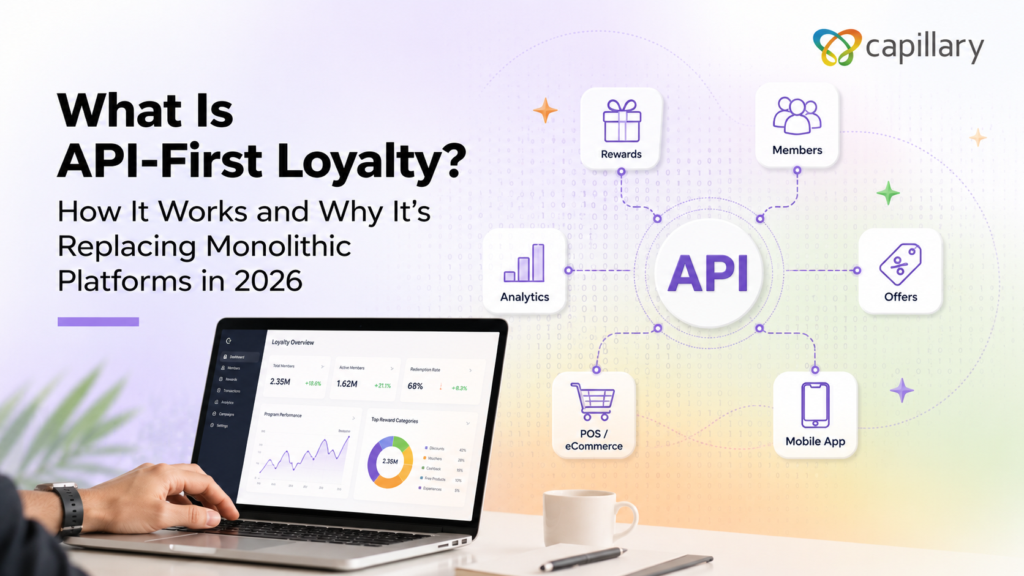
API-first loyalty is a software architecture where loyalty capabilities—earning, redemption, tiers, member data—are exposed primarily through APIs rather than locked inside a vendor’s interface. It’s the difference between renting a pre-furnished apartment and building your own home on a foundation someone else poured.
Monolithic loyalty platforms dominated enterprise deployments for years, but they’re increasingly misaligned with how modern brands operate. This guide covers how API-first loyalty works, where it outperforms legacy systems, and how to evaluate whether it’s the right architecture for your program.
API-first loyalty is a modern software architecture where loyalty program features—point accumulation, rewards, tiers, and member data—are built as independent, modular services accessed through Application Programming Interfaces (APIs). Unlike traditional all-in-one platforms that bundle everything into a single system, API-first loyalty engines expose core capabilities programmatically. Developers can integrate loyalty logic into any customer touchpoint: mobile apps, websites, POS systems, kiosks, even smart devices.
The key difference? You’re not locked into a vendor’s pre-built interface. Your team calls the loyalty engine directly, and the backend handles the logic while you control the experience.
REST APIs expose discrete loyalty actions as callable endpoints. Awarding points, checking balances, redeeming rewards, updating tiers—each becomes a simple API call. Your systems trigger these from wherever the customer interacts, whether that’s web checkout, a mobile app, or an in-store terminal.
A single API call can credit points the moment a purchase completes, regardless of channel.
API-first platforms process member actions—purchases, check-ins, referrals—in real time. Sub-second latency is the baseline expectation, not a premium feature. When a customer completes a transaction, points appear in the app before the receipt prints.
Webhooks are automated notifications pushed from the loyalty engine when specific events occur. Tier upgrades, reward expiry warnings, milestone achievements—downstream systems react instantly without polling for updates.
When a member hits Gold status, for example, a webhook can trigger a personalized congratulations message through your marketing automation platform within seconds.
Because loyalty logic lives in the backend, brands build custom front-end experiences for every touchpoint. Your app, website, POS, and partner channels all pull from the same loyalty engine, ensuring consistency without sacrificing design flexibility.
Monolithic platforms bundle UI, logic, and data together into a single system. A decade ago, that made sense. Today, it creates friction at every turn.
The core problem is rigidity. When everything is tightly coupled, changing one element often requires changing everything—or waiting for your vendor to do it for you.
| Criteria | API-First Loyalty | Monolithic Loyalty |
| Speed of change | Brand-controlled releases | Vendor-dependent roadmap |
| Omnichannel consistency | Unified backend, custom frontends | Fragmented channel experiences |
| Data and AI readiness | Open data access for CDP/ML | Data locked in platform |
| Total cost of ownership | Higher upfront, lower long-term | Lower upfront, higher switching cost |
API-first lets brands ship loyalty updates on their own release schedule. Want to launch a flash promotion tomorrow? You can. Monolithic platforms often require weeks of vendor coordination for similar changes.
With API-first, every touchpoint pulls from the same loyalty engine. A customer’s point balance, tier status, and available rewards stay consistent whether they’re on your app, website, or standing at a register.
API-first exposes member data for use in CDPs and AI models. You can feed real-time loyalty signals into predictive analytics and personalization engines without waiting for batch exports.
API-first requires more engineering investment upfront. However, it reduces long-term vendor dependency and switching costs. Monolithic platforms often appear cheaper initially but accumulate hidden costs through customization fees and eventual migration expenses.
Brands launch and iterate loyalty features without waiting on vendor queues. New promotions, tiers, or rewards can go live in days rather than months.
A single loyalty backend powers consistent earn/burn mechanics across app, web, POS, and partner channels. Members see the same point balance everywhere.
API-first architectures feed member data to AI engines and CDPs in real time, enabling instant, context-aware offers. Platforms like our Loyalty Program Software integrate natively with our CDP Software to enable real-time decisioning without custom middleware.
Brands can swap components—reward catalog, communication layer, analytics engine—without rebuilding the entire loyalty stack.
This distinction trips up many buyers during vendor evaluation. The terms sound similar but describe fundamentally different architectures.
API-first platforms are built from the ground up with APIs as the primary interface. Every function available in the admin dashboard is also accessible programmatically.
API-enabled platforms bolt APIs onto a legacy core. Some functionality is exposed, but core operations still require the vendor UI.
When evaluating vendors, ask: “Can I do everything through the API that I can do through your dashboard?” If the answer is no, you’re looking at API-enabled, not API-first.
Headless loyalty separates the backend loyalty engine from any built-in frontend. The platform handles logic—points, tiers, rewards—while your team builds the member-facing experience.
Composable loyalty assembles a loyalty stack from best-of-breed components that integrate via APIs. Instead of one vendor providing everything, you select specialized tools for each function.
API-first isn’t universally superior. For some organizations, it introduces complexity without proportional benefit.
The loyalty engine receives transaction data at checkout and returns earn/burn responses in real time. Points accrue instantly, and redemptions apply before payment processing completes.
Loyalty data syncs to CRM platforms like Salesforce and marketing tools like Braze. Member tier, point balance, and engagement history become available for segmentation and campaign targeting.
Bidirectional data flow between the loyalty engine and CDP enables advanced segmentation and predictive analytics. Capillary Technologies’ native CDP Software integration creates a unified member profile that powers both loyalty mechanics and personalization.
Brands call loyalty APIs from native apps or web frontends to render custom loyalty experiences. The API returns member data; your UI decides how to display it.
Real-time loyalty requires response times under one second, even at peak transaction volume.
Enterprise programs require 99.99% availability. Capillary Technologies reports a 99.99% system uptime across 1.95 billion+ annual transactions.
Platforms handling member data typically meet GDPR, SOC 2, and regional data residency requirements.
The platform supports multiple loyalty models—points, tiers, coalitions, gamified structures—without requiring custom development for each.
Review API documentation for coverage. Confirm whether every loyalty function can be accessed programmatically.
Run load tests to verify the platform handles your transaction volume at peak without latency spikes.
Confirm pre-built connectors or proven integrations with your existing tech stack.
Look for independent validation from firms like Forrester and Everest Group. Capillary Technologies’ recognition as a Leader in The Forrester Wave™: Loyalty Platforms, Q4 2025 provides third-party validation of platform capabilities.
Capillary Technologies Loyalty Program Software is built on API-first principles, with native CDP integration, real-time event processing, and support for complex loyalty constructs across consumer, channel, and coalition programs. The platform serves 1.2 billion+ loyalty members across 415+ brands, including 20+ Fortune 500 brands.
API-first platforms often require more engineering investment upfront but reduce long-term costs by eliminating vendor lock-in and enabling faster iteration.
Most enterprise API-first platforms include marketer-facing tools for campaign configuration and reporting. Initial setup typically requires developer involvement, but day-to-day management often doesn’t.
Brands with existing development resources can often go live within 8–12 weeks using pre-built connectors and documented APIs.
The first modern loyalty program is often attributed to frequent flyer programs launched by airlines in the early 1980s, though merchants have offered loyalty incentives for over a century.
MVC (Model-View-Controller) is a software design pattern for organizing code within an application. API-first is an architectural approach that prioritizes programmatic access to functionality. They address different concerns and are not mutually exclusive.
Share

Blogs
Power BI vs Tableau vs aiRAYour Dashboard Shows the Drop. aiRA Shows Why, & What to Do About It. Power
News
PLDT and Smart partner with Capillary to unify loyalty programsCapillary Marcom
Latest News
PLDT and Smart partner with Capillary to unify loyalty programsManila, Philippines — PLDT Inc. (PLDT) and its wireless subsidiary Smart Communications, Inc (Smart) have