Get the best loyalty & customer engagement platform out there!
- Design industry shaping loyalty programs
- Integrate easily and go live quicker
- Deliver hyper-personalized consumer experiences
Capillary Named a Leader in The Forrester Wave™ Loyalty Platforms, Q4 2025 Report. Read more >
Capillary: Recognized as a Leader in Everest Group’s PEAK Matrix® 2025 Read more >
The Balanced Loyalty Quotient Report 2026 is now live — our largest and most in-depth loyalty report yet. Download Report >

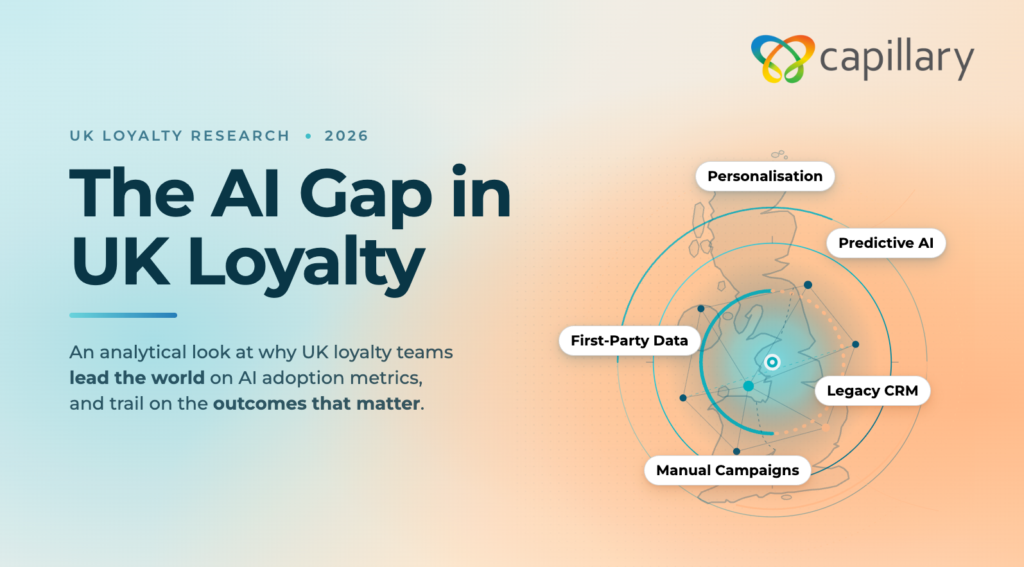
The AI Gap in UK Loyalty: Who’s Really Ready?
An analytical look at why UK loyalty teams lead the world on AI adoption metrics, and trail on the outcomes that matter.
Share
On paper, the UK is one of the most AI-forward loyalty markets in the world, and the pace of investment now spans sectors. In financial services, Santander and NatWest Group are embedding generative AI across customer engagement, with NatWest extending its Cora+ assistant to more retail banking customers [1]. In telecoms, Vodafone has scaled its TOBi generative AI customer experience platform [2], and, in retail, C&A is rolling out AI-driven personalisation across its European customer base [5].
The sector numbers reinforce this. A 2025 Censuswide/monday.com survey of 500 UK retail decision-makers found 99% report using AI in business decision-making, 61% have dedicated AI leaders, and 74% expect AI to drive more personalised experiences [6]. Gartner’s October 2025 martech survey goes further: 81% of leaders are already piloting or implementing AI agents, and just 1% have no plans to invest in generative AI [7].
And yet, when you look at what that adoption is actually producing, the picture changes sharply. The UK loyalty programmes market is forecast to keep compounding through 2030, with Mordor Intelligence sizing it well above USD 4 billion by the end of the decade [8]. Mando-Connect and YouGov’s 2025 “Power of Loyalty” study finds British adults belong to more loyalty programmes than ever, but actively use only a fraction of them [9]. Forrester’s 2026 loyalty predictions are blunt: programme usage is still growing, but emotional loyalty is declining, brands are getting transactions, not affinity [10]. Deloitte’s 2025 ConsumerSignals work reaches a similar conclusion: most consumers say the personalisation they receive falls short of what they actually want [11].
This is the UK loyalty paradox of 2026: enormous adoption, enormous investment, and stubbornly average outcomes.
The AI–loyalty gap is not about model access or compute. It sits in four places.
While platforms wrestle with operationalisation, UK consumers have raised the bar. Deloitte’s 2025 UK Digital Consumer Trends study shows personalisation expectations are highest among Gen Z and Millennials, who are also the cohorts most willing to share data in return for relevant offers [14]. Twilio Segment’s 2025 data corroborates: consumers consistently report they would spend more with brands that personalise effectively, and businesses that invest in personalisation continue to report measurable revenue uplift [12].
UK consumers will trade data for value when trust is present. The Data & Marketing Association’s 2025 privacy tracker shows UK consumers remain willing to share information for clear, fair benefits — but concern about how data is used has not gone away, and Ofcom’s 2025 Online Nation report confirms tracking and consent remain top-of-mind for British adults [15]. Capgemini Research Institute’s 2025 work on generative AI in enterprises finds embedding AI into core operations is now delivering double-digit cost reductions, savings that can be redeployed into richer rewards [16]. The headroom to deliver what UK consumers want is there. The question is operationalising it.
Translated into loyalty terms, the bar is specific:
This is the gap Capillary Technologies has built aiRA and its broader martech suite to close.
Capillary was named a Leader in The Forrester Wave™: Loyalty Platforms, Q4 2025, receiving the highest scores among all 11 evaluated vendors in both Current Offering and Strategy, with 5/5 scores on 22 of the 27 criteria, the highest of any vendor evaluated. Forrester noted Capillary has “a clear vision for adaptive, AI-powered loyalty ecosystems” [19]. The platform powers loyalty for 390+ brands, 1.2 billion+ members, and 1.95 billion+ annual transactions.
The differentiator is architectural. aiRA isn’t a generative-AI module bolted onto a loyalty product; it’s the intelligence layer beneath a full loyalty suite, Loyalty+, Engage+, Insights+, CDP+, and Rewards+, built for loyalty use cases over more than a decade.
Loyalty-native data unification. The Capillary CDP ingests online, offline, kiosk, and third-party signals into a 360° member view, exposed as actionable insight to marketers, the exact “data stack readiness” gap Gartner identifies [7].
Purpose-built models, not generic LLMs. aiRA includes propensity models, intelligent fraud detection, a headless audience-segmentation engine, and a Nudge Framework, an AI-driven next-best-action system designed for loyalty decisions like tier upgrades, campaign adjustments, and point-threshold modifications [18].
Agentic execution, measured in loyalty outcomes. At one large conglomerate, aiRA now resolves 30% of support queries end-to-end; brands using the platform have seen a 70%+ reduction in campaign execution time, a 60% increase in retention, and a 50% increase in customer satisfaction. The operational-to-financial layer, as McKinsey’s 2025 State of AI argues, most martech investments cannot yet evidence [17].
An interface marketers actually use. Ask aiRA, Capillary’s content-assistant layer, was built after an internal survey of 250+ enterprise customers found more than 50% of marketers spend the majority of their time writing, editing, and optimising content. aiRA acts as a no-code workspace suggesting tone, messaging, and multilingual variants in the context of a live loyalty programme, the 70% people-and-process layer of the 10-20-70 rule translated into product.
The UK is not behind on loyalty AI adoption. By almost every measurable input, it’s among the most AI-forward loyalty markets in the world. But adoption is the start of the story, not the end.
The 2025 outcomes data from McKinsey, Gartner, Forrester, BCG and Deloitte converges on the same uncomfortable finding: most AI investment in marketing and loyalty isn’t translating into measurable business value. Few organisations can evidence meaningful bottom-line impact. Nearly half say vendor AI doesn’t meet expectations. Half say their data stack isn’t ready [7][17].
The gap is not an AI gap. It’s an operationalisation gap, data readiness, workflow-native modelling, execution tied to loyalty KPIs, and an interface loyalty marketers can actually run a programme on.
That’s the problem Capillary built aiRA to solve: not another generic AI wrapper, but loyalty-native intelligence designed for the specific economics, workflows, and measurement realities of a UK market moving from programme creation to programme optimisation. In a market where loyalty membership keeps growing while emotional loyalty declines, the next point of competitive leverage isn’t a bigger campaign. It’s a smarter one, operationalised end-to-end.
Who’s really ready? The teams that stop buying AI and start operationalising it.
[1] NatWest Group, “NatWest expands Cora+ generative-AI assistant for retail banking customers,” 2025. https://www.natwestgroup.com/news-and-insights/news-room.html
[2] Vodafone, “Vodafone scales TOBi generative-AI customer experience platform,” 2025. https://www.vodafone.com/news
[5] Fashion Network / C&A corporate newsroom, “C&A rolls out AI-driven personalisation across European customer base,” 2025. https://www.c-and-a.com/uk/en/corporate/company/newsroom/
[6] Retail Technology Innovation Hub (Censuswide / monday.com), “AI Technology Adoption Surges as Majority of UK Retailers Now Have Chief AI Officers,” 2025. https://retailtechinnovationhub.com/home/2025/8/18/ai-technology-adoption-surges-as-majority-of-uk-retailers-now-have-chief-ai-officers-to-drive-strategy
[7] Gartner, “Survey Finds 45% of Martech Leaders Say Existing Vendor-Offered AI Agents Fail to Meet Their Expectations,” October 2025. https://www.gartner.com/en/newsroom/press-releases/2025-10-29-gartner-survey-finds-45-percent-of-martech-leaders-say-existing-vendor-offered-ai-agents-fail-to-meet-their-expectations-of-promised-business-performance
[8] Mordor Intelligence, “United Kingdom Loyalty Programs Market — 2025 Refresh.” https://www.mordorintelligence.com/industry-reports/united-kingdom-loyalty-programs-market
[9] Mando-Connect × YouGov, “The Power of Loyalty in the UK, 2025.” https://mando-connect.co.uk/insights/
[10] Forrester, “Predictions 2026: Customer Loyalty,” 2025. https://www.forrester.com/blogs/category/loyalty/
[11] Deloitte, “ConsumerSignals 2025: Personalisation and Loyalty.” https://www.deloitte.com/global/en/services/consulting/research.html
[12] Twilio Segment, “The State of Personalization Report, 2025.” https://segment.com/state-of-personalization-report/
[13] BCG, “Closing the AI Impact Gap / 10-20-70,” 2025. https://www.bcg.com/publications/2025/closing-the-ai-impact-gap
[14] Deloitte UK, “Digital Consumer Trends 2025.” https://www.deloitte.com/uk/en/Industries/tmt/research/digital-consumer-trends.html
[15] Data & Marketing Association (DMA) UK, “Data Privacy: What the Consumer Really Thinks, 2025” and Ofcom, “Online Nation 2025.” https://dma.org.uk/research
[16] Capgemini Research Institute, “Generative AI in Organisations: Pursuing Value at Scale, 2025.” https://www.capgemini.com/insights/research-library/
[17] McKinsey & Company, “The State of AI, 2025.” https://www.mckinsey.com/capabilities/quantumblack/our-insights/the-state-of-ai
[18] Forrester, “Key Takeaways from The Forrester Wave: Loyalty Platforms, Q4 2025.” https://www.forrester.com/blogs/key-takeaways-from-the-forrester-wave-loyalty-platforms-q4-2025/
[19] Capillary Technologies, “Forrester Wave 2025 Loyalty Report.” https://www.capillarytech.com/forrester-wave-2025-loyalty-report/

Blogs
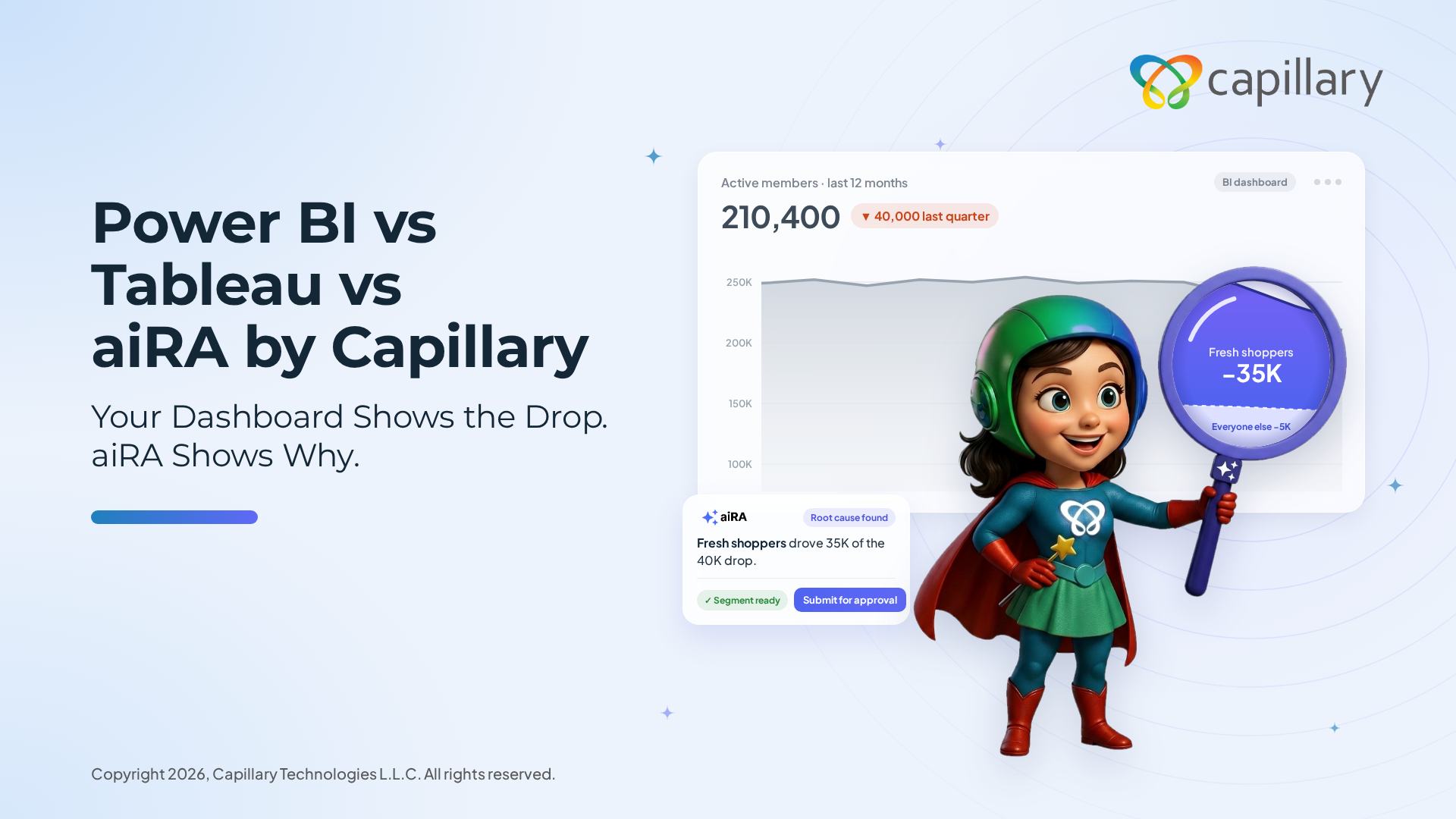
Power BI vs Tableau vs aiRAYour Dashboard Shows the Drop. aiRA Shows Why, & What to Do About It. Power
News
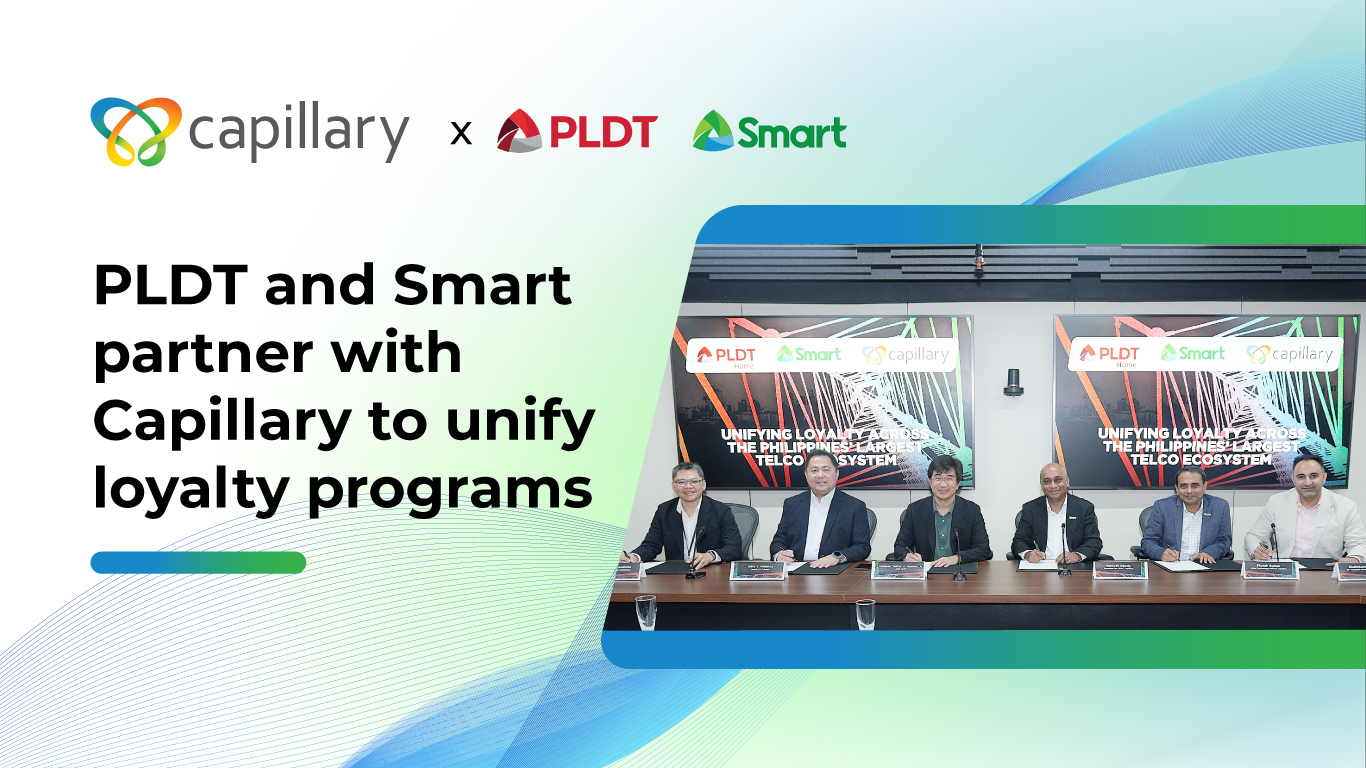
PLDT and Smart partner with Capillary to unify loyalty programsCapillary Marcom
Latest News
PLDT and Smart partner with Capillary to unify loyalty programsManila, Philippines — PLDT Inc. (PLDT) and its wireless subsidiary Smart Communications, Inc (Smart) have