- Design industry shaping loyalty programs
- Integrate easily and go live quicker
- Deliver hyper-personalized consumer experiences

Capillary Named a Leader in The Forrester Wave™ Loyalty Platforms, Q4 2025 Report. Read more >
Capillary: Recognized as a Leader in Everest Group’s PEAK Matrix® 2025 Read more >
The Balanced Loyalty Quotient Report 2026 is now live — our largest and most in-depth loyalty report yet. Download Report >
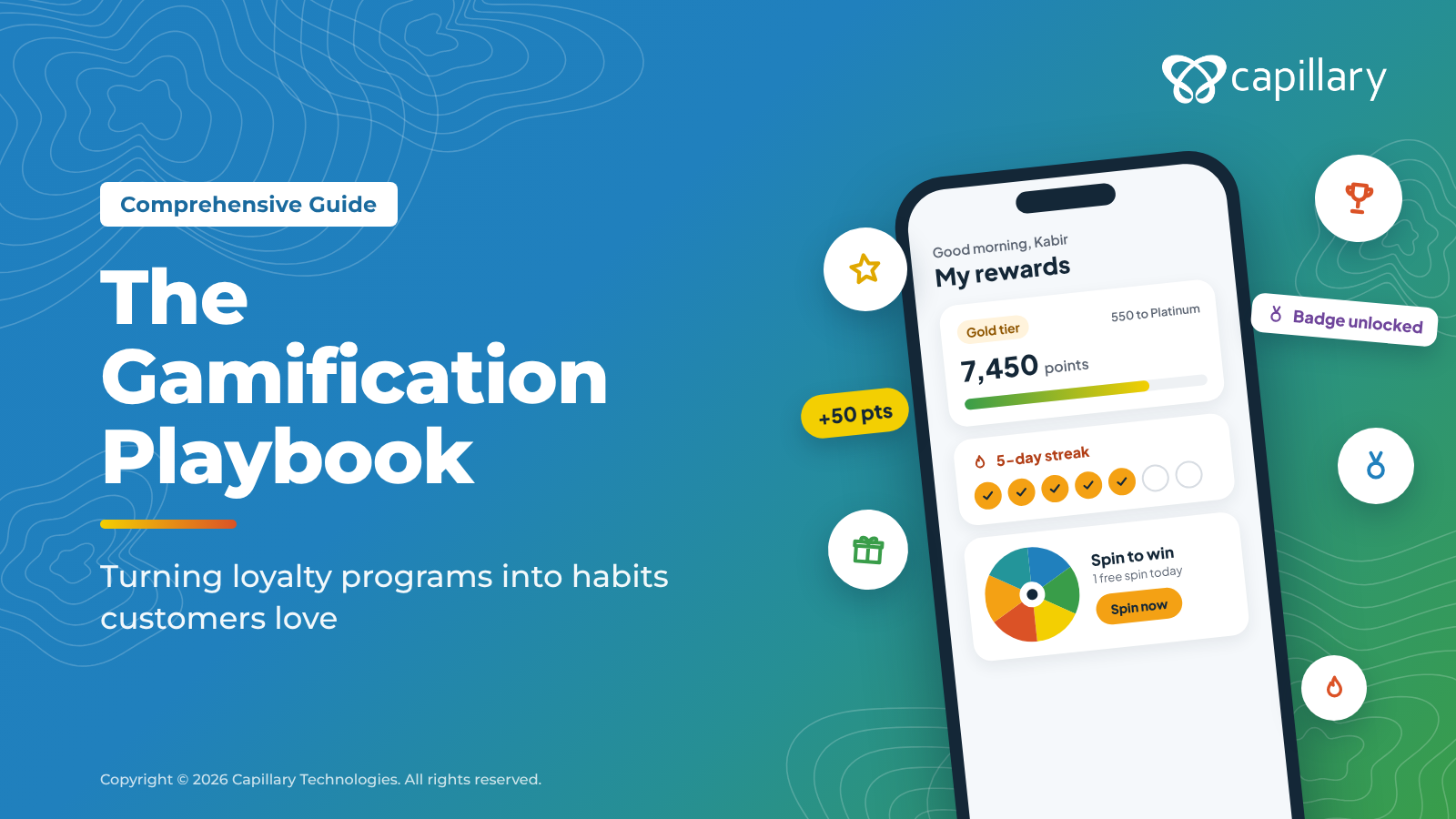
The Gamification Playbook: Turning Loyalty Programs Into Habits Customers Love
Have you ever looked up from a game and realized hours have disappeared? Monopoly night ran long, a co-op session with friends turned into three, and somewhere in there, time just stopped mattering. That is one of the most reliable things about human behavior, and it starts long before board games and consoles. It starts with a simple game of peek-a-boo, then moves on to trading A’s in math for a new PlayStation. We’re wired to turn things into games; whether or not we notice, we’re doing it.
Brands noticed. And for the last two decades, the smartest ones have built entire loyalty strategies around it.
At its core, gamification is the practice of taking game elements like competition, rewards, and challenges, and applying them to a context that isn’t a game at all — guiding people toward a specific set of actions through progressions, milestones, and competition.
In a loyalty setting, that usually means weaving game mechanics into an existing rewards program, turning routine actions like app logins, product trials, or a social share into something a customer actually wants to do, not just something they’re asked to do.
Leaderboards and tiers do part of the job, but the real hook is something behavioral economics explains well: nobody wants to lose progress they’ve already made. Once a customer sees a bar half full or a streak underway, tracking it starts to matter more than the reward at the end.
That said, gamification done carelessly can backfire. Psychologists call it overjustification when people start caring only about the prize and stop caring about the task itself. Push too hard, and you’re building a habit that has nothing to do with your brand. Good gamification design respects that line, and it took the better part of a century to learn where it sits.
The word gamification didn’t exist until 2002. The instinct behind it is much older, and tracing it tells you a lot about how it made its way into loyalty strategies today.
Every stop on that timeline added something brands still use: the badge, the scoreboard, the tier, the platform, the leaderboard. Gartner’s warning is the one worth remembering most.
Points and badges without real design underneath are exactly how gamified programs fail.
Gartner’s 2012 warning, still the one to remember
The backlash since then — criticism of “pointsification” and manipulative dark patterns — is the same failure mode wearing a different outfit.
The short answer is dopamine. Game mechanics tap directly into it, forming a loop that’s hard to look away from: anticipate, act, get rewarded, anticipate again. It’s built on drivers that run much deeper than fun ever could: recognition, encouragement, and the simple human need to see ourselves getting better at something.
Social Comparison Theory explains a piece of this too. We’re built to measure ourselves against others, constantly. Maybe it’s how you stack up against the best players at your local turf ground, or where you land against the top 10% of Counter-Strike players in your city.
Then there’s the reward itself. Fixed rewards are predictable, and the brain gets used to them. Variable rewards — the mystery spin, the surprise upgrade — trigger the strongest dopamine response precisely because you don’t know what’s coming. Two frameworks explain how brands put all of this to work.
Yu-kai Chou’s Octalysis Framework starts from a blunt observation: points, badges, and leaderboards are the easy, obvious tools, and on their own, they’re not enough. Chou breaks motivation into eight core drivers that explain why people actually take action.
Original diagram inspired by Yu-kai Chou’s Octalysis Framework.
Good gamification isn’t about manipulating people into behavior they don’t want. It’s about designing something people genuinely want to be part of, which happens to make the mundane feel a little more meaningful.
Nir Eyal’s Hooked Model looks at the same problem from a habit-building angle. It moves through four phases: a trigger that brings someone to the product, an action that satisfies a need, a variable reward that keeps things interesting, and an investment that raises the odds they’ll come back.
Early on, brands have to do the inviting: a campaign, a nudge, a reason to show up. Over time, if the loop is designed well, customers return on their own, no prompt required.
Frameworks explain why people engage. Mechanics are what they actually tap on. Here are the ones that show up most in loyalty programs, and the job each one does best.
None of these work in isolation. The strongest programs stack two or three: a points backbone, a progress bar to make it visible, and the occasional instant win to keep it from going flat.
Keeping a customer has never been harder, and a discount alone rarely does it anymore. Customers are weighing service, experience, and whether a rewards program actually feels worth their time. Gamification gives them a reason to stay.
Gaming is one of the most popular leisure activities there is. A survey by Prosper Insights & Analytics found that more than half of Americans enjoy playing video games, with Gen Z and Millennials leading the way. These two generations hold a growing share of buying power, and gamification is already a way of life for them.
Wanting to win is in our nature, whether that means finishing a task before time runs out, earning a badge, or simply being recognized for doing something well. Tap into that one instinct, and healthy competition and community tend to follow.
Most brands want to personalize, and most fall short. Generic coupons and blanket discounts don’t build the kind of recall brands are after. Gamification lets each segment get a challenge and a reward built around what it actually values, without losing the personal touch.
This one is a no-brainer. Gamification done right opens the door to word of mouth, social mentions, and brand advocates, and keeps the brand top of mind between purchases.
Most loyalty teams quietly live with satisfied zombies: members technically enrolled, technically “loyal” by the numbers, who barely engage at all. A large membership count looks great on a dashboard, but it doesn’t tell you whether those members would notice if you disappeared tomorrow. Gamification, targeted well, is one of the more reliable ways to turn a zombie into an actual participant.
It’s easy to treat gamification as a nice-to-have. The data says otherwise. More than 70% of Global 2000 companies now use some form of gamification, and gamified experiences have been shown to lift engagement by as much as 150% over traditional approaches.
A few results make the case better than any single statistic:
Sources: [add a citation for each figure before publishing]
The pattern holding all of this together is the gap between effort and reward, closed just tightly enough to keep people coming back.
Frameworks are easy to nod along to. Building something people actually come back to is the hard part. What better way to show gamification in action than brands doing it? A few of them we helped build.
| Brand | Mechanic | Core loop | Result |
|---|---|---|---|
| Alipay’s Ant Forest | Eco-action tracking + real-world reward | Low-carbon actions grow a virtual tree; a fully grown tree gets planted for real in China. | Hundreds of millions of users; a landmark case study |
| Starbucks Rewards | Points + tiers + limited-time games | Purchases earn Stars toward free drinks and tier status; Double Star Days add spikes. | Drives well over half of U.S. sales |
| Duolingo | Streaks, XP, leagues | Daily streaks and variable rewards plus weekly leagues against other users. | Hundreds of millions of users, many returning daily |
| Metro Shoes | Spin-the-wheel + AI-tuned win odds | Members spin for one of six offers; odds rebalance after every spin to protect margin. | ₹80M+ incremental sales; 30%+ lift in ATV |
| KFC Rewards Arcade | In-app mini-games layered on loyalty | Rotating mini-games for extra rewards on top of earn-and-redeem basics. | +107% rewards redeemed, +53% app engagement |
| Shell Go+ Indonesia | Tiered prize-draw entries | Fuel or retail spend unlocks entries to a movie-themed grand prize draw. | 4X+ new member registrations in 10 weeks |
| Jotun Vietnam | Scan-to-win for B2B painters | Painters scan cans for instant points; Fridays became lucky days with gold prizes. | 10X+ more paint purchased; ~30% more Friday sign-ups |
| Sephora Beauty Insider | Challenges layered on tiers | Points for purchases and non-purchase actions via Beauty Insider Challenges. | Reached ~30% of members in 18 months; engagement up nearly half |
You don’t need Duolingo’s budget to build a habit. You need the right mechanic at the right moment, and a few design rules that keep it from feeling like a gimmick.
Before any mechanic comes into play, a handful of rules decide whether a gamified program has a chance at working. Pin these somewhere you’ll see them.
Picture two regulars at the same coffee chain. After ten visits, Rebecca gets a free latte. After the same ten visits, Aaron gets an invite to a Saturday tasting with the head roaster.
Once you’ve decided to gamify, the next question is what you’re actually rewarding people with. “Fun” is vague and hard to design toward. Curiosity, anticipation, pride: those are specific, and the reward you choose decides which one you’re building. Keep the effort you ask for roughly equal to the payoff, then weigh three choices.
Think about the last time you bought yourself something nice. Chances are you told yourself you’d earned it. Research from Kivetz and Simonson’s “Earning the Right to Indulge” found that effort dissolves the guilt that usually holds back indulgent choices. A spa day or a designer upgrade is harder to justify than a practical reward, which is exactly why it needs to be earned.
CPG brands will likely see more traction with functional rewards, while beauty, travel, and hospitality brands can lean into indulgence.
That’s Aaron’s tasting. A product loses its shine fast. An experience keeps paying out emotionally before it happens, during it, and long after, in the retelling. That retelling matters: experiences carry far more conversational value, which is exactly what drives word of mouth.
Your morning coffee is a fixed reward: you know exactly what you’re getting, and that’s the point. The extra cake the stall owner slips onto your saucer one random Tuesday is the variable one, and it’s the part you’ll mention at work.
Fixed rewards, like a guaranteed point per visit, build a habit customers can count on. Variable rewards, like a mystery spin or a surprise upgrade, keep that habit alive. The most sophisticated programs use fixed rewards as the backbone and variable rewards as the occasional surprise that keeps things from going flat.
And a reward doesn’t have to be a discount. It can be a donation in the customer’s name, public recognition, or early access — anything that says the brand understands what this customer values, not just what they buy.
A loyalty program is not a static holding pen; it is an evolving relationship. What captures attention on day one will feel trivial by month six, and the mechanics that drive repeat purchases won’t necessarily turn someone into an advocate.
Picture Kabir, a consultant who flies twice a month.
Six stages, six different mechanics, one customer. Here’s what each stage looks like in practice.
First impressions set the tone. Registration needs to take two minutes or less, because a complex onboarding flow is the fastest way to drive drop-offs.
Shell doesn’t expect immediate devotion. It guides new app users through a three-visit ladder where each visit delivers more value, ending in a free coffee on the third stop. Paired with partner activations like T-Mobile Tuesdays, it helped convert nearly 10 million fuel customers into active app users.
The takeaway: replace transactional friction with light entertainment, and skip the multi-page rules catalog.
Once someone joins, point them toward the fun stuff. IndiGo, one of the largest domestic airlines in the world and a Capillary partner, replaced static booking confirmations with home-screen widgets that tell flyers when they’re one or two flights from their first milestone badge. Routine app opens became a countdown.
Surfacing progress early, without demanding a big upfront investment, taps the need for completion and builds emotional investment before the customer even takes their seat.
Micro-perks work for early steps, but sustaining repeat purchases needs meaningful, guaranteed value. Tata Neu runs time-bound, cross-category quests: buy across electronics, fashion, and grocery in a month, and unlock 500 bonus NeuCoins, which pulls members into Tata’s broader ecosystem instead of one vertical.
It also fixed the exchange rate at 1 NeuCoin to ₹1, so shoppers never do conversion math. Rewards feel spendable, and redemption and repeat orders follow.
In commodity categories, proximity usually decides where people spend. Shell Fuel Rewards updates points the moment a card is scanned, and once a driver earns Gold status, a 90-day fill-up threshold keeps it.
Losing something hurts roughly twice as much as gaining it, so drivers start bypassing closer rival stations to protect what they’ve built.
Airline status usually hides in an account settings screen. IndiGo turned flight data into 32 collectible badges, like Red-Eye Warrior and Weekend Explorer, designed for LinkedIn and Instagram. 74% of flyers said they intended to share theirs: a high-trust acquisition channel that costs nothing.
Give people a reason to celebrate a milestone publicly, and everyday customers become brand champions.
A multi-step quest that excites a veteran will overwhelm a newcomer, and a daily check-in prompt won’t keep a frustrated, dormant customer. High-urgency surprise-and-delight will: a time-limited mystery box or instant-win scratch card, triggered automatically the moment inactivity crosses your dormancy threshold.
Gamification without personalization is just noise.
Why one mechanic never fits every member
A Gen Z customer might be motivated by climbing a leaderboard to unlock rewards for a cause they care about. A Boomer might respond far better to a simple spin-the-wheel chance at a spa day. Neither is wrong, and no single mechanic covers both.
Personalization is what decides whether a challenge feels like it was made for you or blasted at everyone. Most programs break in one of three places:
| Where it breaks | What goes wrong | The fix |
|---|---|---|
| Uniform targets | “Spend $100 this month” feels out of reach for light shoppers and asks nothing of VIPs already spending $120. Effort rises as people near a goal (the Goal Gradient Effect), so distance matters. | Scale goals to each member’s history: a sprint challenge for those near the line, an endowed head start for those starting at zero. |
| Blanket incentives | A flat 15% coupon for an already loyal customer erodes margin without growing the basket. | Price promotions for lower tiers; early access and priority perks for top tiers. Set stretch targets 15% to 25% above each shopper’s average order value. |
| Irrelevant challenges | A “Buy Two Formal Suits” quest sent to an activewear fan reads like a banner ad, and users learn to tune them all out. | Build challenges from stated preferences and browsing affinity: trail-running streaks for runners, HIIT quests for gym regulars. |
This is exactly why segment-aware platforms matter. Capillary’s Experience+ is built to recognize which mechanic fits which customer, instead of forcing everyone through the same funnel. Of course, personalization is only as good as the data behind it.
Picture this: you’ve just downloaded a new beauty app. Before you see a single product, it wants your name, email, phone number, birthday, skin type, and address. You close it.
Now picture a different app. The first screen asks, “What does your skin feel like on a Monday morning?” with four illustrated options. Three taps later you’ve got a routine built for you, and the brand knows your skin type, your concerns, and your budget. You never once felt like you filled in a form.
That’s the whole idea. Multi-field registration forms, survey pop-ups, and mandatory profile screens create instant friction, with abandonment as high as 90%. The answer isn’t to collect less data. It’s to make giving it worth the customer’s while.
| Tactic | What it looks like | What you get |
|---|---|---|
| Gamified quizzes | “Find Your Travel Persona” or “Build Your Skincare Routine” | Explicit preferences and intent, with completion rates far above web forms |
| Micro-missions | “Tell us your birthday month to unlock 100 bonus points” | Richer profiles built over time, without survey fatigue |
| Rewarded micro-surveys | One question, then a scratch card or mystery spin | Real-time sentiment that can trigger service recovery or promoter perks |
Stretch that across the journey. A month after the quiz, the app offers 100 points for your birthday month. After your first order arrives, one question, “How did the serum feel?”, unlocks a scratch card. Nobody asked for twenty fields up front, and the profile still got built.
With Experience+, quiz responses and mission data sync straight to profile attributes in the CDP, triggering personalized offers without waiting on engineering. Privacy rules don’t mean flying blind. They just ask for a fairer value exchange.
Any loyalty strategy lives or dies by its impact on cash flow. A campaign that doubles daily app opens looks impressive on a dashboard, but if a member logs in five times a day to harvest points and never buys anything, that engagement is a cost center, not a win. To measure real return, you need an unbroken bridge from activity to revenue.
Activity metrics tell you the loop is holding attention. Behavioral metrics tell you a habit is forming. Financial metrics tell you it’s paying the bills. Strong activity without the other two is just a busy dashboard.
The most common barrier to gamification ROI isn’t a shortage of ideas. It’s execution friction. In most loyalty setups, launching a simple streak challenge means specs, developer tickets, and weeks of sprints, and every week pushes breakeven further out.
Capillary’s Experience+ removes that bottleneck. Marketers can configure and launch these in minutes rather than waiting on IT cycles:
Cutting custom development directly protects program margins. Pairing milestone nudges with time-sensitive rewards keeps members clear on their next best action, and brands running on Experience+ see higher DAU/MAU ratios, stronger repeat purchase rates, and point redemption velocity that doubles.
Getting the mechanic right is only half the job. The other half is making sure it reaches people wherever they are. Some members are mobile-first, some prefer desktop, some only really engage in-store. A gamified reward that lives in one channel only reaches part of your audience, no matter how well it’s designed.
Omnichannel gets you reach. 1:you — an experience specific enough to feel personal, delivered wherever that customer happens to be — gets you relevance. Gamification is what makes both feel like fun instead of friction, and data is what keeps it tuned to the individual. That combination is what turns a loyalty program into something customers actually want to be part of, not just enrolled in.
At Capillary, this is our specialty: understanding what actually drives your customers and turning it into gamified, omnichannel experiences that hold their attention and earn their loyalty. If you’re ready to see what that looks like for your brand, our team is happy to walk you through it.
Gamification in loyalty means weaving game mechanics like points, tiers, streaks, badges, and challenges into a rewards program, so routine actions like app logins, product trials, or social shares become something customers want to do, not just something they’re asked to do.
Game mechanics tap into dopamine through a loop of anticipation, action, and reward. They also draw on loss aversion, since nobody wants to lose progress they’ve already made, and on social comparison, our instinct to measure ourselves against others.
Alipay’s Ant Forest, Starbucks Rewards, Duolingo, KFC’s Rewards Arcade, and Sephora Beauty Insider are well-known examples, along with campaigns like Metro Shoes’ spin-the-wheel, Shell Go+ Indonesia’s movie promo, and Jotun’s scan-and-win program for painters.
Pick one objective, start where the customer is in their journey, reward actions that drive revenue rather than logins, refresh mechanics regularly, make your ask right after a win, and evaluate results over 6 to 12 months.
Track a metric bridge from clicks to cash: activity metrics like DAU/MAU, behavioral metrics like 30/60/90-day retention and redemption velocity, and financial metrics like average order value, purchase frequency, and customer lifetime value.
Yes. When people care only about the prize — a problem called overjustification — the habit has nothing to do with your brand. Gartner predicted in 2012 that 80% of gamified apps would miss business goals because brands relied on points and badges without real design underneath.
Interactive quizzes, micro-missions like “tell us your birthday month to unlock bonus points,” and rewarded one-question surveys replace static forms, giving customers fun or instant value in exchange for preferences and feedback.

Bharat is a content and social media marketer at Capillary Technologies, where he turns trends in loyalty and customer engagement into content brands can act on. From research-led blogs to social campaigns, he focuses on work that’s built to be found, read, and shared, linking industry insight to enterprise growth. Away from his desk, he’s usually behind a drum kit with one of his bands or out on his motorcycle, chasing the open road.
Share


Capillary Marcom 4 Min Read