- Design industry shaping loyalty programs
- Integrate easily and go live quicker
- Deliver hyper-personalized consumer experiences

Capillary Named a Leader in The Forrester Wave™ Loyalty Platforms, Q4 2025 Report. Read more >
Capillary: Recognized as a Leader in Everest Group’s PEAK Matrix® 2025 Read more >
The Balanced Loyalty Quotient Report 2026 is now live — our largest and most in-depth loyalty report yet. Download Report >
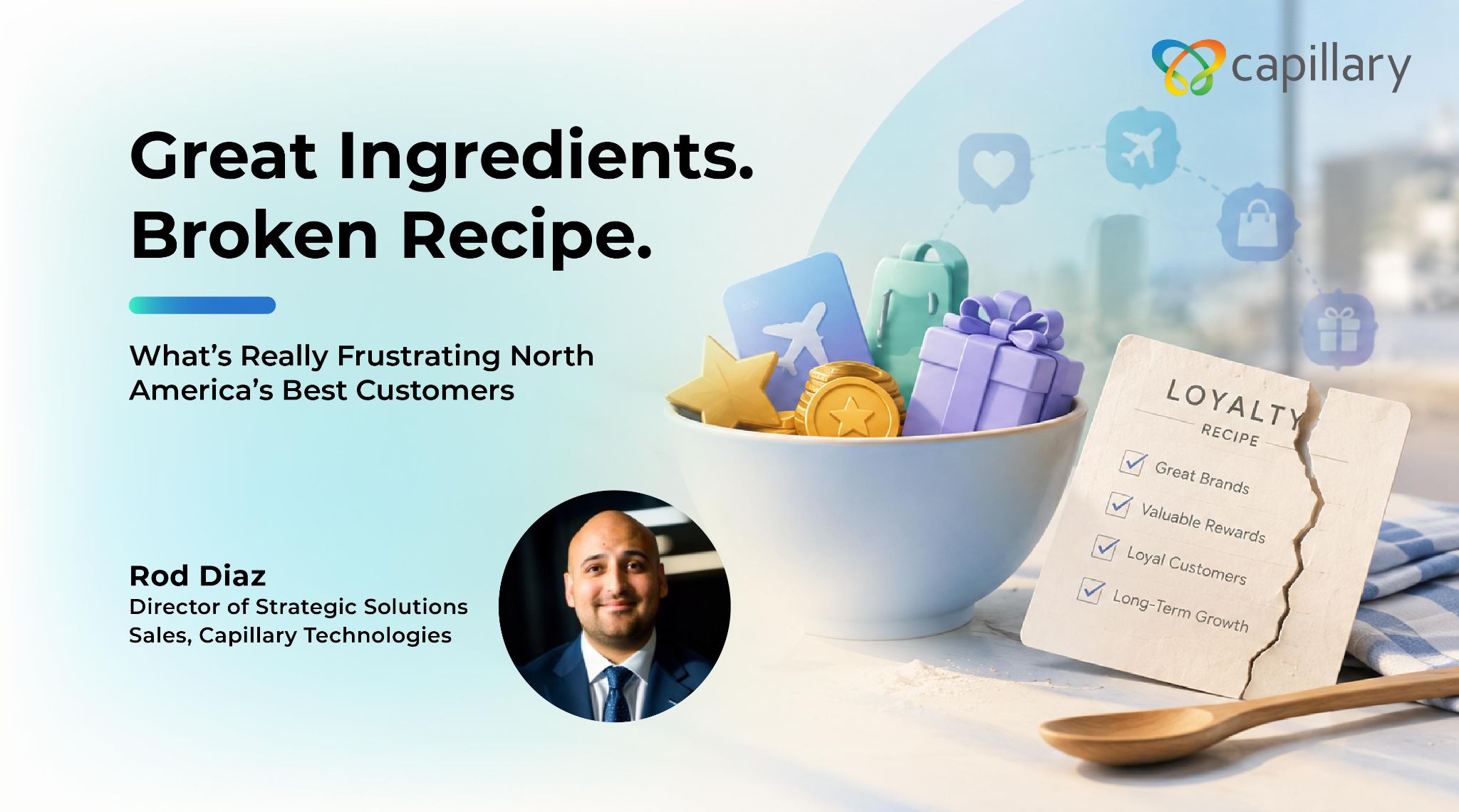
Great Ingredients, Broken Recipes: Why North America’s Biggest Loyalty Programs Are Failing Their Best Customers
A few weeks ago, I set out to answer a question that had been nagging at me: Which loyalty programs in North America are members actually unhappy with, and why?
Nobody assigned me this. I run strategic sales for a loyalty technology company, so I hear complaints about programs constantly, but always secondhand and always filtered through whoever is telling me. I wanted to see the raw signal.
So I spent my evenings building a picture of the loyalty programs run by some of the largest travel and retail companies across Mexico, the United States, and Canada. I ranked them by member sentiment, drawing on consumer review platforms, app store ratings, regulatory complaint data in all three countries, news coverage, and the communities where the most engaged members gather to talk about points.
It is one person’s analysis, not a peer-reviewed index, and I would encourage anyone to challenge my rankings. But the patterns were consistent enough that I think they are worth sharing.
The results were sobering. Some of the most recognizable programs on the continent—programs with tens of millions of members, billions of dollars in annual redemptions, and brands people genuinely love—generate some of the most persistent customer frustration associated with those brands. In several cases, the loyalty program appears to be a major source of negative sentiment.
Here is the paradox: Almost none of these programs are failing for lack of ingredients.
They have the scale. They have the data. They have members who want to be loyal, sometimes desperately so.
People do not write angry reviews about programs they do not care about. Every one-star rating I read is, in a strange way, a love letter from a customer who wanted the relationship to work.
So why are they failing?
Across everything I read, the breakdowns fell into three categories.
The most painful stories I found were not about stingy rewards. They were about members locked out of accounts holding years of accumulated value, flagged by blunt fraud rules that could not tell a family’s shared account from a criminal ring.
They were about points that vanished during a migration, apps that crashed at the register, and login loops that turned a two-second scan into a customer service ticket.
These are not primarily program-design failures. They are technology failures.
Legacy loyalty stacks were built to count points, not to understand people. When fraud detection runs on rigid rules instead of behavioral context, the system can struggle to distinguish an enthusiastic top-decile shopper from an actual abuse pattern. The result can be legitimate members getting caught in controls designed to protect the program.
When member identity lives in fragments across the app, the store, and the website, points can disappear during migrations and a brand can end up treating someone like a stranger even when they visit three times a week.
The technology exists to do this differently: fraud detection that evaluates behavior in context; a unified view of the member across every touchpoint; and infrastructure designed to operate at real-time scale.
Once a system is engineered to recognize people rather than simply police transactions, the member experience changes with it.
The second pattern was operational.
Members described accounts being frozen with no notification and no explanation. Terms and conditions could be vague enough that value was removed under clauses members struggled to understand. Devaluations sometimes happened with little visibility, discovered by members only when a planned redemption suddenly cost more.
A program is a promise, and a promise managed carelessly can do more damage than no promise at all.
What strikes me, having spent years working with loyalty programs, is how much of this operational discipline is really a tooling question in disguise.
When earning, redemption, tiers, and expiry live in a transparent rules engine that behaves consistently across every channel, there is less room for ambiguity: what the member sees is what the system does.
When proactive communication is the default, members hear about a change, an expiring balance, or an account issue from the brand—in their channel of choice—before discovering it at the register.
And when program health and member sentiment feed into a live operating view, a policy that is quietly eroding trust can surface internally long before it becomes a public problem.
The strongest programs are not necessarily staffed by more disciplined people. They are supported by systems that make disciplined execution easier.
The third and deepest category is design.
Over the past few years, many large programs have shifted from published, predictable value toward more dynamic models. Earning rates have been cut, thresholds raised, and currencies revalued, often in pursuit of short-term economics.
Each individual change can look defensible on a spreadsheet.
Together, they can rewrite the deal members thought they had signed up for.
The result is a trust deficit.
Across countries and categories, one of the most consistent sentiments I encountered was not anger about any single change. It was the feeling of being taken for granted: of giving a brand years of data and spend while receiving less and less in return.
The uncomfortable truth is that many mature loyalty programs were not designed as the systems they have eventually become. They accumulated complexity one quarterly adjustment at a time.
The strongest programs take the opposite approach. They model the economics upstream so that generosity and margin are engineered together rather than traded against each other every quarter.
They widen the value equation beyond discounts into experiences, partnerships, recognition, and rewards that feel personal, allowing members to perceive greater richness without making the program prohibitively expensive.
And increasingly, AI gives brands the ability to shape value member by member, adapting offers and rewards to individual behavior in real time.
That is the quiet paradox of modern loyalty design: A program can feel more generous to individual members while improving its economics at the same time.
But only if it is designed to.
Here is what makes this moment interesting rather than depressing.
The programs at the bottom of the sentiment spectrum are not dead. Their members have not all left. The membership bases, redemption volumes, and brand equity are still there.
What has eroded is trust.
And unlike scale, trust does not necessarily take years to begin rebuilding. Members notice when a company starts communicating clearly, resolving problems fairly, recognizing them consistently, and delivering value they can understand.
At Capillary, this is the work we do every day. We help large brands modernize loyalty programs when the underlying ingredients are strong but the experience has fallen out of step with both the business and its members.
Capillary has been named a Leader in The Forrester Wave™: Loyalty Platforms, Q4 2025, and our technology supports loyalty programs across more than 30 countries.
The research behind this article reinforced something I see in my work constantly: Many struggling programs do not need a new reason for customers to care. Their customers already care.
They need technology, processes, and program economics worthy of that loyalty.
If any of the patterns above sound familiar, the ingredients for a comeback may already be in your kitchen.
The next step is fixing the recipe.

Director of Strategic Solutions Sales, Capillary Technologies
Rod is a senior executive with 20 years of experience leading growth across Latin America in Airlines, Travel and Tourism, Loyalty Technology, Financial Services partnerships, and B2B SaaS. He has managed a USD $2.5B sales operation across 20 countries at Aeromexico, negotiated with Mexico’s largest banks, and represented Mexico’s tourism interests with leading airlines and tour operators across Western Canada. Today, as Director of Strategic Solutions Sales at Capillary Technologies, he applies that regional depth to enterprise loyalty and go-to-market strategy. Fully bilingual, he is a trusted advisor on partnerships, revenue strategy, and market expansion in LATAM and beyond.
Share


Capillary Marcom 4 Min Read