- Design industry shaping loyalty programs
- Integrate easily and go live quicker
- Deliver hyper-personalized consumer experiences

Capillary: Recognized as a Leader in Everest Group’s PEAK Matrix® 2025 Read more >
The Balanced Loyalty Quotient Report 2026 is now live — our largest and most in-depth loyalty report yet. Download Report >
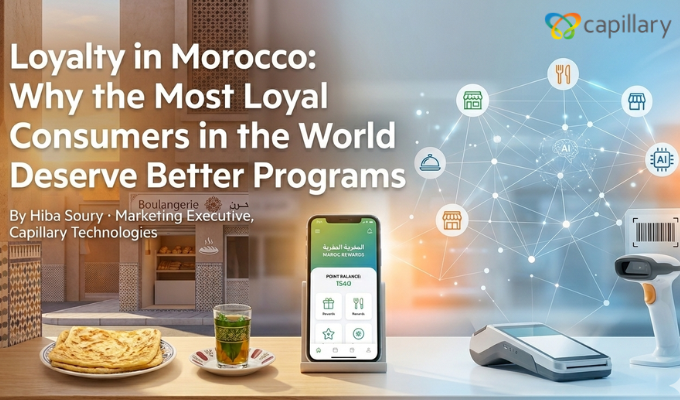
I currently work at Capillary Technologies, which powers some of the loyalty programs mentioned in this article.
I grew up in Morocco. And like most Moroccans, I had what you might call a loyalty program long before I knew what one was.
There was the same bakery at the corner of our street that my mother had been going to for fifteen years not because it was the cheapest, but because the owner knew her order, asked after our family, and always slipped in an extra msemen on Fridays. There was the neighbourhood épicerie where you could buy on credit and pay at the end of the month no paperwork, no contract, just trust built over years. In Morocco, loyalty is not a points system. It is a relationship.
When I joined Capillary Technologies a global loyalty and customer engagement platform and began looking closely at how structured loyalty programs have developed in Morocco, my first instinct was: Moroccans have always been loyal. The question is whether brands have been keeping up.
“In Morocco, loyalty is not a points system. It is a relationship built over years.”
Ask any Moroccan in their twenties to name a loyalty app they actually use, and the answer comes instantly: the MacDo app. McDonald’s in Morocco affectionately called MacDo is not just a restaurant. It is a cultural institution. It is where you go after your bac exam results come in, where friends meet on weekday evenings in Casablanca, where families celebrate on weekends. Everyone I know has the app on their phone.
What many people do not know is that this app the one millions of Moroccans open before they even decide what to order runs on Capillary’s ecosystem. That connection between a global loyalty platform and something so embedded in everyday Moroccan life is what pushed me to look more carefully at what loyalty actually means in this market.
Morocco sits at an unusual intersection. It has a deeply loyalty-oriented consumer culture rooted in community, habit, and trust and a fast-growing, mobile-first young population. The median age is around 30. Most people have a smartphone. And unlike the persistent stereotype of a cash-only market that cannot support digital programs, the reality is more nuanced and more advanced than outsiders assume.
Loyalty programs in Morocco figured out long ago that payment method and loyalty participation are two entirely separate things. You simply scan your card or show your app barcode at the till the way you pay is irrelevant to how your loyalty is recorded. Cash, card, mobile: it does not matter. That design choice enabled mass adoption that purely payment-linked programs could never have achieved here, and it reflects a genuine understanding of the local consumer.
“Payment method and loyalty are two separate things in Morocco. You scan your code, pay however you like, and the program does the rest a smarter design than most markets give Morocco credit for.”
Let me take you through the landscape not from a market report, but from the perspective of someone who grew up there.
Aswak Assalam the pioneer. Most people outside Morocco do not know that Aswak Assalam launched the first structured loyalty program in Moroccan large-scale retail back in 2009. Today the program counts over 1.3 million members [1], with a tiered structure: a Blue card for everyday shoppers, a Gold card for the most frequent buyers, and a credit option called L’Carnet for end-of-month payment with no interest. Perhaps the most telling figure: 50% of their original 2009 members were still active a decade later [2] a retention rate that most Western programs would envy.
Marjane scale meets cashback. Morocco’s largest hypermarket chain, with 133 stores across 30 cities [3], Marjane offers cashback of up to 20% on selected products, personalised coupons, and immediate discounts. Scan your barcode at the checkout, pay however you want. What makes Marjane especially interesting from a data perspective is the breadth of what people buy there food, electronics, clothing, household goods giving the program an unusually rich cross-category picture of purchasing behaviour that, with the right investment in personalisation, could be genuinely powerful.
McDonald’s emotional loyalty at scale. The MacDo app works because it layers a functional mechanic (points → free food) onto an existing emotional relationship. People were already going to MacDo regularly; the app formalises and deepens that habit. Globally, McDonald’s loyalty has reached over 210 million active users across 70 markets [4]. Morocco is part of that story and a demonstration of what happens when a loyalty program meets genuine cultural affinity.
Starbucks & Caribou the aspirational gap. In Morocco’s urban centres, the Starbucks Rewards model appeals to students and young professionals who associate the brand with a certain lifestyle. The tier system is less about discounts and more about identity you are not just a customer, you are a Gold member. That aspirational layer, where loyalty becomes a social signal rather than just savings, is something that most Moroccan-born programs have yet to explore seriously. Local chains have the customer base to build it. The opportunity is there; the design ambition is not yet.
Tookeez the homegrown startup building Morocco’s loyalty future. Tookeez is a Moroccan startup that lets consumers aggregate loyalty points from multiple retailers into a single digital wallet and exchange them for services or discounts. They raised $1.5 million in March 2024 [5] and are targeting 4 million users by 2028. The model a coalition loyalty platform built natively for Morocco, by Moroccans is exactly what mature markets have had for years. Its emergence signals that the market is ready for the next level.
Every market research report on Morocco will tell you about smartphone penetration, urbanisation trends, and the growing middle class. What none of them will tell you is what Moroccan consumer loyalty actually feels like from the inside.
It feels like my mother never once considering switching butchers, even when a cheaper one opened down the street. It feels like the neighbourhood café where the owner starts making your coffee the moment he sees you walk in. It feels like what Aswak Assalam’s own leadership articulated when they built their program: loyalty is never given, it is earned over time.
Moroccan consumers are not disloyal people waiting to be won over by better discounts. They are deeply, habitually loyal to the places and brands that have treated them with respect. The opportunity for structured loyalty programs is not to manufacture loyalty from scratch. It is to meet, formalise, and reward a loyalty disposition that was always there.
“The opportunity is not to create loyalty from scratch. It is to build programs worthy of the loyalty Moroccan consumers already give naturally.”
Living in Dubai, I can see what a fully mature loyalty market looks like. Programs like SHARE by Al-Futtaim, Shukran Rewards, and Etihad Guest are sophisticated multi-brand ecosystems with tens of millions of active members, real-time personalisation, and redemption spanning travel, retail, dining, and entertainment. The Middle East loyalty management market is projected to reach
$3.27 billion in 2025 [6], growing at nearly 14% annually through 2029.
Morocco is not there yet but the gap is closing, and in some ways Morocco has structural advantages the Gulf does not. It has a larger domestic consumer base with deeply ingrained shopping habits. It has retail anchors that have been building loyalty infrastructure for over a decade. And it has a generation of young, digital-native consumers who respond to personalised experiences.
What that means in practice: Moroccan brands do not need to start from zero. They need to close specific gaps moving from generic cashback to behavioural personalisation, from single-brand programs to coalition ecosystems, and from purely functional rewards to the aspirational layer that makes a loyalty program something people are genuinely proud to be part of. The building blocks are there. The ambition is the missing ingredient.
Coalition programs will emerge. Tookeez is already building this. Earning points at Marjane and redeeming them at a local restaurant, managed from one app, is not a futuristic idea it is standard in mature markets. Morocco will get there, and likely faster than most expect.
Personalisation will deepen. Most programs today are still transactional spend here, get a discount there. The next level is AI-driven personalisation: offers that respond to individual behaviour, seasonal patterns, and real-time context. The data already exists in Morocco’s largest retail programs. The question is whether brands invest in using it.
Local brands will close the gap. International brands have set the benchmark for what a good loyalty experience feels like. But Moroccan retailers have deeper roots and far larger customer bases. When they match that quality of experience and add the aspirational dimension that has so far been left unexplored they will be formidable.
Morocco is one of the most interesting loyalty markets in the world not despite its unique characteristics, but because of them: a culture of deep, relational loyalty, a young mobile-first generation, and a retail sector that has been quietly building loyalty infrastructure for fifteen years.
The bakery on the corner already knew how to earn loyalty. The opportunity now is for brands to learn what it knew.
Sources
Aswak Assalam Programme fidélité (1.3M members)
Media Marketing Aswak Assalam dépasse 1 million d’abonnés à la carte fidélité (50% retention figure)
GetCata Catalogue Marjane Maroc (133 stores, 30 cities)
CX Dive McDonald’s loyalty app reaches 210M active users across 70 markets
We Are Tech Africa Tookeez raises $1.5M (March 2024)
Business Wire Middle East Loyalty Programs Market: $3.27B in 2025, 13.8% CAGR to 2029


