- Design industry shaping loyalty programs
- Integrate easily and go live quicker
- Deliver hyper-personalized consumer experiences

Capillary Named a Leader in The Forrester Wave™ Loyalty Platforms, Q4 2025 Report. Read more >
Capillary: Recognized as a Leader in Everest Group’s PEAK Matrix® 2025 Read more >
The Balanced Loyalty Quotient Report 2026 is now live — our largest and most in-depth loyalty report yet. Download Report >
Loyalty Programs in South Africa: Top Trends for 2026
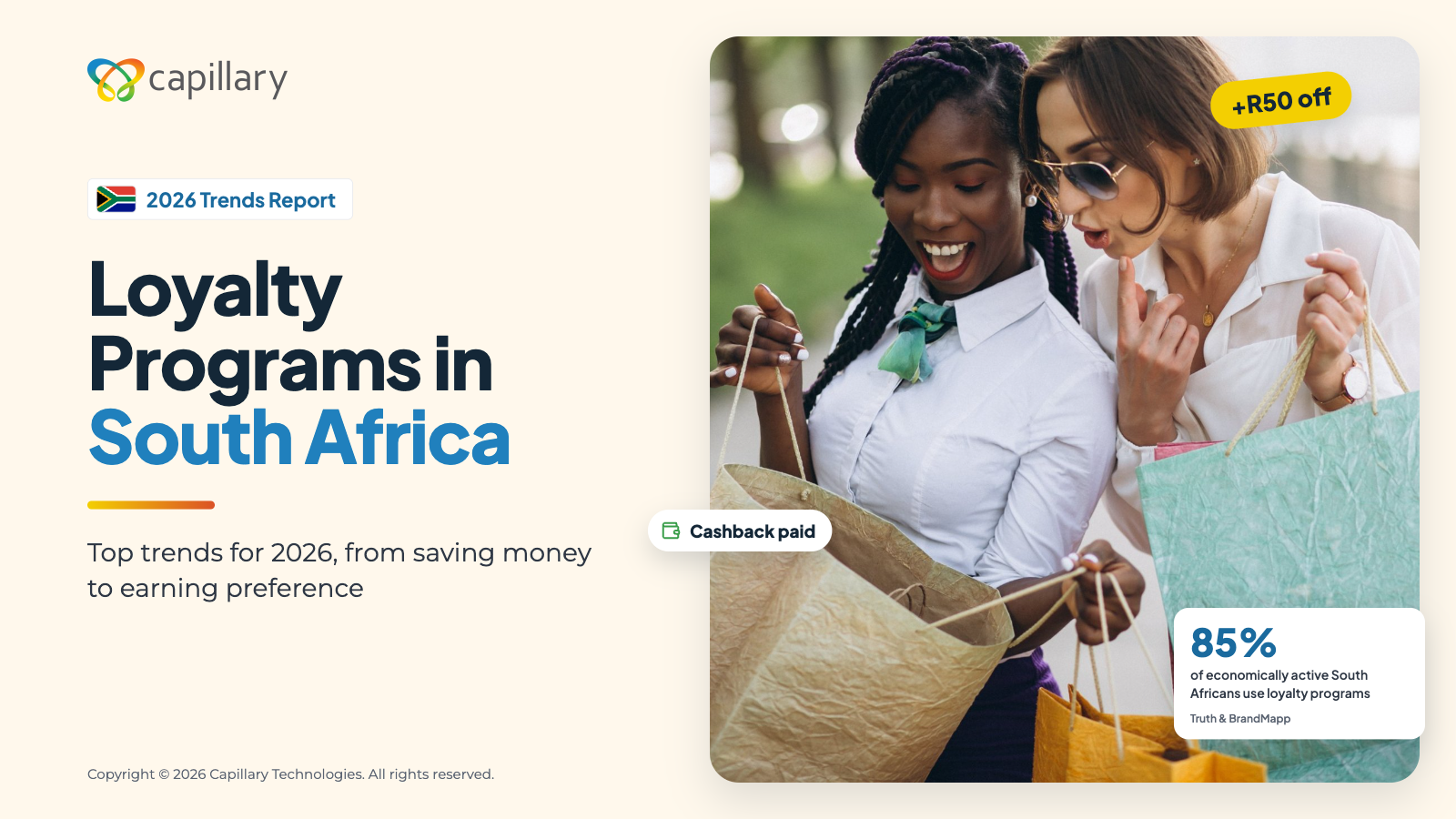
Walk into almost any supermarket, pharmacy, or petrol station in South Africa, and you’ll hear the same question at the counter: “Do you have our card?” Most shoppers do. In fact, most carry several.
That’s what makes South Africa one of the most interesting loyalty markets in the world. Loyalty programs are a part of everyday life. Brands are competing for share of wallet, not sign-ups.
of economically active South Africans use loyalty programs.
Truth & BrandMapp
programs actively used by the average consumer in this group, up from 4.6 in 2015.
Truth & BrandMapp
Participation has more than doubled in a decade. But that raises a bigger question.
If shoppers belong to more loyalty programs than ever, are they becoming more loyal to brands, or just better at saving money?
The answer is playing out on both sides of the till: in how shoppers use rewards, and in how brands are redesigning programs to win their spend.
So what are the trends shaping loyalty programs in South Africa?
Part 1 · The pressure
The story starts with the shopper. Rising living costs have turned loyalty programs into a budgeting tool, and that shapes what members expect from every program they join.
South African shoppers are under real pressure. Food, fuel and electricity keep getting more expensive, and loyalty programs have become one of the main ways people cope.
NielsenIQ’s Consumer Outlook: Guide to 2026 shows how carefully South Africans are spending:
plan ahead before shopping.
compare prices before buying.
buy only what they expect to use.
Truth & BrandMapp found that 85% of economically active South Africans now use loyalty programs. The reason is simple: rewards help stretch the budget. This changes what a good reward looks like. A free spa voucher is nice. R50 off this week’s groceries is better.
returned to Shoprite and Checkers shoppers as instant Xtra Savings rewards at the till in FY2026, up from R16.5bn the year before.
Shoprite Holdings, FY2026 results
Brands need to show the value of their rewards. If members can’t see how your program saves them money this month, they’ll favour one that does.
Lead with savings members can see, then aim them carefully.
Blanket discounts drain margin fast. Focus rewards on the everyday categories that drive visit frequency, and judge success by share of wallet rather than by how much you give away.
South African shoppers have made their choice clear. They want cashback and instant discounts. They don’t want to collect points for months, work out how much a point is worth, or watch their points expire.
of loyalty users want to be rewarded instantly.
Truth & BrandMapp
want a mix of instant rewards and points they can save up for something bigger.
Truth & BrandMapp
The programs people use most tend to be the easiest to understand. You swipe, you save, and you see it on your slip. No maths needed.
If you can’t explain how your program works in one sentence, it’s too complicated. Simplicity is key; it’s what keeps members coming back.
Simple programs cost less to run and are easier to grow.
Every extra step between a purchase and a reward costs you redemptions and repeat visits. Where it suits your customers, offer both instant savings and something to save up for, so you keep the bargain hunters and the planners.
Part 2 · The response
Brands have noticed. With most shoppers already signed up somewhere, growth now comes from redesigning programs to win a bigger share of spend, without simply giving away more margin.
Some of South Africa’s biggest retailers have stopped tweaking their loyalty programs and started rebuilding them. Dis-Chem swapped its long-running points scheme for instant discounts linked to customers’ health habits. One of the country’s biggest retailers brought several of its reward offers together into one program.
The stakes are high because, for many retailers, the loyalty program now drives most of the business.
in cashback paid to Clicks ClubCard’s 13.1 million active members, who account for more than four-fifths of Clicks’ sales.
Clicks Group, year ended August 2026
These aren’t small updates. They change how members earn, how they’re rewarded and how the brand uses its customer data.
The hardest part of a rebuild is legacy systems and messy customer data. Brands need a loyalty platform that connects with their POS system and lets them change the rules quickly, without waiting months for IT.
Treat a rebuild as a growth project, not a refresh.
When members drive most of your sales, the flexibility of your loyalty platform directly affects revenue. The faster you can test and change rules, the faster you can respond to competitors.
Free loyalty programs are everywhere, so some brands are adding a paid tier on top. Checkers, for example, offers a monthly paid add-on to Xtra Savings that bundles delivery perks with extra personalised deals. Among those subscribers, Checkers’ share of grocery spend has climbed to 50% of their monthly basket.
a month for Xtra Savings Plus, which adds unlimited Sixty60 deliveries, extra in-store discounts and more personalised offers.
Shoprite Group, 2025
This works for two reasons. It turns loyalty from a cost into a source of income. And it shows the brand exactly which customers are most committed.
A paid tier only works if members get something they can’t get for free elsewhere, like free delivery, early access, or genuinely better prices. Charging more for the same discounts won’t last.
A paid tier is both a revenue stream and a loyalty signal.
Price it against benefits that cost you less to deliver than members value them, like delivery or early access. Then track whether subscribers actually move more of their spend to you, not just whether they sign up.
In South Africa, the strongest loyalty programs rarely work alone. Banks team up with fuel brands through card-linked loyalty. Retailers team up with insurers. Telcos team up with almost everyone. Members earn in one place and spend in another.
Fuel is a good example. Because fuel prices are regulated and can’t simply be discounted, fuel loyalty programs lean on partnerships with banks and retailers to reward their customers.
Payment partnerships show how this works at the till.
Dis-Chem Better Rewards members get 10% off selected brands, rising to a combined 15% when they pay with a Capitec card. On an illustrative R500 basket of qualifying products, that’s R75 saved at checkout, with no points to track.
Dis-Chem, Better Rewards and Capitec partnership, October 2025
Your program is up against whole networks. Think about which partners would make your rewards more useful in your members’ everyday lives.
Partnerships let you offer more value without carrying the full cost.
Co-funded rewards reduce your discount bill, introduce you to a partner’s customers and keep your program in daily use. Choose partners based on where your members already spend.
Brands have talked about personalisation for years. Now it’s becoming part of how programs run every day, not just a feature for special campaigns.
The idea is simple. Instead of sending every member the same offer, use what you know about each person, such as what they buy, how often and when, to give them something that actually fits. AI makes this possible for millions of members at once.
Picture two members of the same supermarket program:
Buys household basics every week and responds to grocery discounts.
Prefers premium products and likes trying new items.
Sending both the same promotion wastes budget on at least one of them. A shopper who already visits every week may not need a big discount at all, while one whose visits are slipping may respond to a timely, relevant offer.
But it only works if your data is in good shape. If customer records are spread across different systems, even the smartest AI can’t do much.
Fix your data first. Personalisation is a data problem before it’s an AI problem.
Personalisation is how you protect margin.
Spending incentives only where they change behaviour cuts wasted discounts and lifts the return on every rand of loyalty investment. Start with clean, connected data, then test offers against a control group.
Part 3 · The next chapter
Savings bring members in. The brands that grow from here will give customers reasons to stay that a rival’s discount can’t match, and reach the shoppers today’s programs miss.
Games, challenges and spin-to-win features are now a serious part of loyalty in South Africa. Vodacom’s VodaBucks was named Best Gamification Worldwide at the 2026 International Loyalty Awards, which shows how far local brands have come.
The real value of games is that they give members a reason to open your app even when they’re not buying. Every visit is a chance to learn a little more about them and to build emotional loyalty that discounts alone can’t.
Price isn’t the only thing South Africans weigh up.
of South Africans say brand trust is very important when deciding what to buy.
NielsenIQ, Consumer Outlook 2026
A game should lead somewhere useful, like a store visit, a new product tried, or a clearer picture of what the customer wants. Fun with no purpose just costs money.
Engagement between purchases builds lifetime value.
Tie every game or challenge to a measurable outcome, like more visits, a new category tried or better customer data. That turns gamification from a marketing cost into a growth lever.
Behind the high sign-up numbers, there are three gaps brands should keep an eye on.
Younger shoppers. Gen Z use loyalty programs far less than older generations, and many programs simply aren’t built with them in mind.
Cards versus apps. Many South Africans still prefer to swipe a physical loyalty card. In fact, 66% would rather use a card, compared with 34% who prefer an app. That limits how much brands can do with app-only features.
AI shopping assistants. As more people let AI tools shop for them, those tools will hunt for the best price and may skip loyalty rewards altogether.
Check who your program isn’t reaching today. And start thinking about how your rewards will work when the “shopper” is a piece of software.
Today’s gaps are tomorrow’s growth.
Younger shoppers are your future core customers, and AI assistants may soon decide where baskets go. Programs that work across cards, apps and new channels will keep growing as habits change.
Many global loyalty reports put green or sustainability rewards near the top of their trend lists. In South Africa, shoppers show much less interest in these than in practical savings. Causes like education tend to matter more to them.
The same goes for going fully digital. Many markets assume physical loyalty cards are on the way out. South African shoppers still like them.
Don’t copy a global trend report and expect it to work locally. Test new ideas with your own customers first, and let their behaviour guide your roadmap.
Local relevance protects your loyalty budget.
A benefit your members don’t value is cost with no return. Check trends against your own data before they reach the roadmap, and put the money behind what moves local behaviour.
South Africa has built a loyalty market where almost everyone takes part and rewards have become part of everyday financial decisions.
Shoppers know how to use loyalty programs to their advantage. They compare benefits, redeem discounts and carry several cards to get the most value.
For brands, that’s both an achievement and a challenge. As more businesses compete on savings, a discount alone is no longer enough to stand out.
So, are South Africans becoming more loyal, or just better at saving money? For many brands today, it’s the second. That’s the opportunity.
The brands that grow from here will deliver savings customers can see, rewards that are easy to use, offers shaped by real customer data and relationships built on trust. Most importantly, they’ll know the difference between customers who use their program and customers who genuinely prefer their brand.
Because a customer who returns for the discount may leave for a better one. A customer who values the relationship has more reasons to stay.
For South African businesses, the opportunity isn’t to move away from cashback, discounts or practical benefits. It’s to build on them.
As loyalty programs across Africa become more sophisticated, Capillary Technologies is expanding its regional focus to help enterprise brands build stronger customer relationships and accelerate loyalty-led growth.
Capillary is also supporting loyalty modernisation in Africa through its partnership with Zen Petroleum in Ghana, announced in April 2026, to introduce a data-driven loyalty program in the country’s fuel retail market.
Through its AI-powered loyalty and customer engagement platform, Capillary helps enterprise brands connect customer data, personalise experiences and design loyalty programs that deliver meaningful customer value and measurable business growth.
As South African brands look to balance immediate savings with stronger customer relationships, that combination of data, personalisation and flexible loyalty technology will become increasingly important.
The main trends are simpler rewards like cashback and instant discounts, full program rebuilds, paid membership tiers, partner networks, AI-led personalisation and gamification. Brands are also starting to think about younger shoppers and AI shopping assistants.
Mostly because of the cost of living. Shoppers use loyalty programs to save money on everyday things like groceries, fuel and medicine. For many households, rewards are now part of the monthly budget.
It depends on where you shop, but the most widely used include Clicks ClubCard, Checkers Xtra Savings, Pick n Pay Smart Shopper and FNB eBucks. What the best ones have in common is simple earning, rewards members can use quickly, and partners that make those rewards useful in everyday life.
Rewards they can see and use quickly. Cashback and discounts at the till are the clear favourites. Shoppers also dislike points that expire or rewards that are hard to understand.
Only if you can offer something members truly value and can’t get for free, such as free delivery, early access, or better prices. A paid tier that just repeats your free benefits is unlikely to keep members for long.
AI helps brands send the right offer to the right person at the right time, instead of the same deal to everyone. It can also spot members who are about to drift away. But it needs clean, connected customer data to work well, which is where a platform like Capillary’s Loyalty+ can help.

Bharat is a content and social media marketer at Capillary Technologies, where he turns trends in loyalty and customer engagement into content brands can act on. From research-led blogs to social campaigns, he focuses on work that’s built to be found, read, and shared, linking industry insight to enterprise growth. Away from his desk, he’s usually behind a drum kit with one of his bands or out on his motorcycle, chasing the open road.
Share


Capillary Marcom 4 Min Read