- Design industry shaping loyalty programs
- Integrate easily and go live quicker
- Deliver hyper-personalized consumer experiences

Capillary Named a Leader in The Forrester Wave™ Loyalty Platforms, Q4 2025 Report. Read more >
Capillary: Recognized as a Leader in Everest Group’s PEAK Matrix® 2025 Read more >
The Balanced Loyalty Quotient Report 2026 is now live — our largest and most in-depth loyalty report yet. Download Report >
What Is aiRA by Capillary Technologies? Agentic AI for Loyalty Marketing
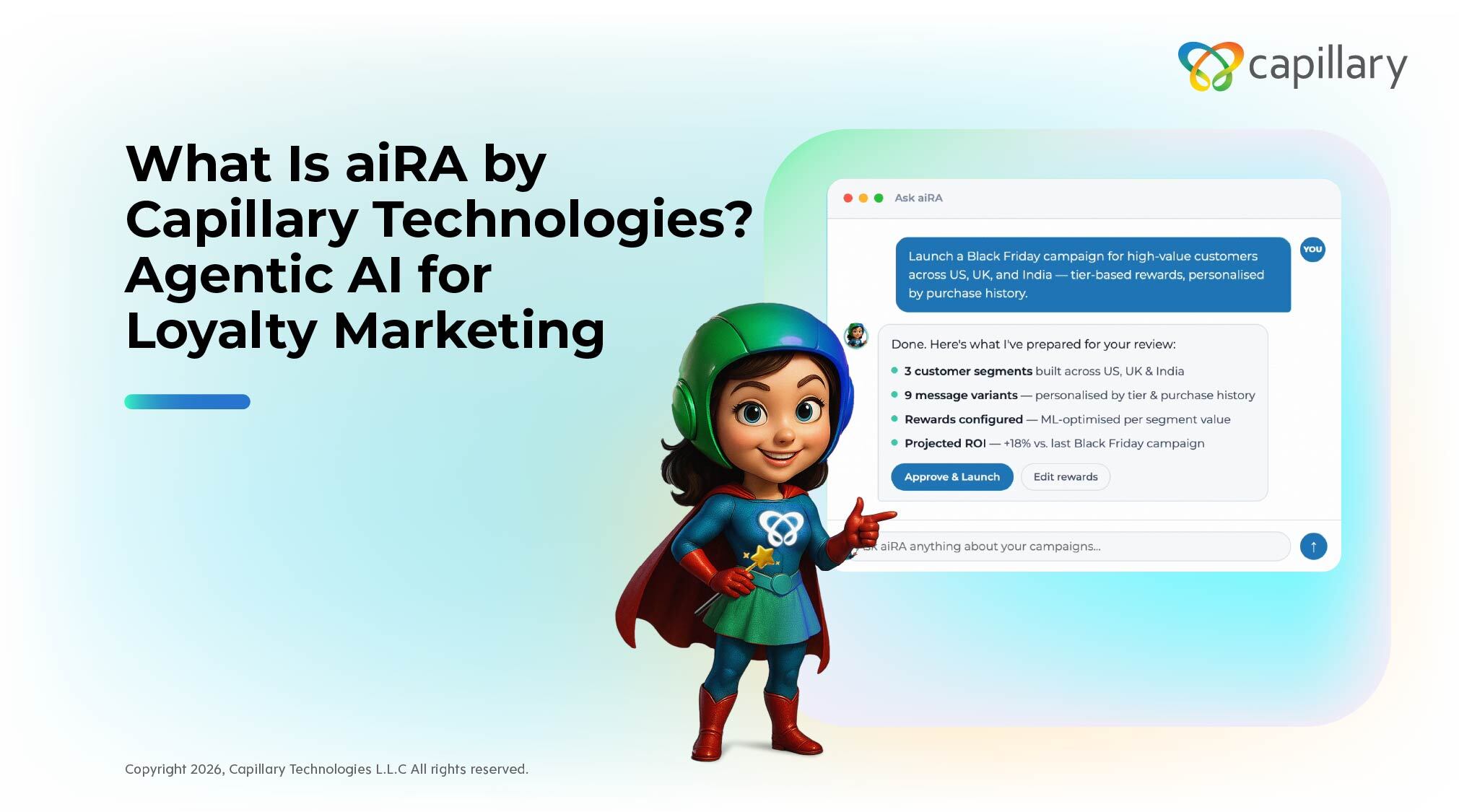
Personalization has moved beyond predicting what a customer might do next.
Enterprise brands already have more customer data, behavioral signals and analytical models than ever before. Yet converting that intelligence into a relevant campaign can still take days or weeks. Strategy, audience creation, reward planning, content development, channel configuration, approvals and measurement often sit across different teams and tools.
By the time everything comes together, the customer moment may have passed.
That is the challenge aiRA by Capillary Technologies is designed to solve.
aiRA is our agentic AI for enterprise loyalty and marketing. Built into the Capillary platform, it understands a campaign brief in natural language and coordinates customer analysis, segmentation, reward optimization, messaging, channel setup and measurement within one conversational workflow.
It does not remove marketers from the process. It removes the operational friction surrounding them.
The original personalization paradox was relatively straightforward: customers wanted brands to understand them, but disliked irrelevant, excessive or poorly timed communication.
Solving that problem required better customer data and more accurate predictive models. Marketers needed to understand who was likely to purchase, lapse, respond to an offer or prefer a particular product, store or time of engagement.
Those questions remain important. But enterprise marketing now faces a second paradox.
Brands can identify customer opportunities with increasing precision, yet still struggle to act on them at the required speed.
A marketing team may know which customers are approaching a reward threshold, which members are showing signs of lapsing or which segment is likely to respond to a particular category. But acting on that insight can require several separate steps:
1. Define the campaign objective
2. Request customer analysis
3. Build and validate the audience
4. Design the reward strategy
5. Develop campaign content
6. Configure channels and journeys
7. Secure approvals
8. Launch and measure the campaign
Each handoff adds time. Each tool adds context switching. Each dependency puts distance between customer intelligence and customer action.
The problem is no longer just personalization.
It is orchestration.
aiRA is a full-stack marketing intelligence partner embedded within Capillary Technologies’ loyalty and customer engagement platform.
A marketer can describe the objective in plain language, such as: Build a campaign for high-intent members who are close to their next reward milestone, recommend an appropriate incentive and prepare personalized communication for each market.
aiRA can then coordinate the underlying work required to turn that brief into a campaign. This includes analysing customers, identifying behavioral patterns, creating the audience, recommending rewards, generating messages, configuring the channel strategy and defining how success will be measured.
Instead of moving between dashboards, tickets, SQL requests and creative workflows, the marketer works through one connected conversation.
Most importantly, the workflow remains governed. aiRA recommends and orchestrates, while the marketer reviews and approves customer-impacting decisions.
The earlier version of aiRA was primarily presented as an artificial intelligence framework for audience segmentation and predictive personalization.
It helped marketers answer questions such as:
• Which customers are likely to transact?
• When could a customer lapse?
• Which store is a customer likely to visit?
• Which product category might they purchase?
• When is a customer most likely to engage?
These are valuable predictions, but a prediction alone does not create a campaign.
The current aiRA product has evolved beyond generating insight. It connects intelligence to the broader marketing workflow.
That evolution can be understood in three stages.
Predictive models help marketers understand propensity, customer value, behavioral patterns and potential outcomes.
They answer: What is likely to happen?
Generative AI can produce campaign ideas, copy, subject lines or creative variations.
It answers: What could we say?
Agentic AI interprets the objective, determines the steps required and works across connected capabilities to move the campaign forward.
It answers: What needs to happen next, and how do we bring it together?
This is the role aiRA now plays within Capillary Technologies’ loyalty management system.
It brings customer understanding, decisioning, creation and campaign orchestration into one governed workflow.
The distinction between an AI assistant and an agentic AI system is important.
A conventional AI assistant typically operates at the edge of the workflow. It might answer a question, summarize a dashboard or suggest campaign copy. The marketer still needs to move that output into other systems and coordinate the remaining work.
Traditional automation goes further, but usually depends on predefined rules and workflows. It can execute known processes efficiently, provided the conditions and sequence have already been configured.
aiRA combines conversational intelligence with connected execution capabilities.
It can understand the campaign objective, analyse the relevant customer context, build a segment, recommend the reward strategy, generate content variations, prepare the channel setup and define measurement parameters.
It does not simply suggest what the marketer could do.
It helps assemble what the marketer needs to do.
At the same time, agentic does not mean uncontrolled. No customer-impacting campaign is intended to go live without explicit human approval.
The objective is controlled autonomy: reducing repetitive coordination while preserving strategic and operational accountability.
The aiRA workflow connects five critical stages of enterprise campaign planning and execution.
aiRA begins by understanding the available customer context.
This can include customer profiles, loyalty activity, transactions, engagement history, preferences and other signals available within our enterprise loyalty platform.
The objective is not merely to retrieve data, but to establish which customer attributes and behaviors matter for the campaign brief.
The next step is understanding how customers have behaved.
aiRA can help surface patterns such as seasonal behavior, engagement signals, purchase preferences and changes in activity. This gives the campaign a behavioral foundation rather than relying only on static demographic groups.
Marketers can describe an audience in plain English instead of translating every business question into SQL or waiting in an analyst queue.
For example: Find members in the premium tier who have purchased twice in the last six months, have not transacted in the last 45 days and are reachable through digital channels.
aiRA converts the business description into the required audience logic and builds the segment within the connected platform.
This allows marketing teams to explore and activate audiences more independently while reducing repetitive requests placed on analytics teams.
Once the audience is understood, aiRA can recommend the appropriate campaign strategy.
This may include:
• The offer or reward structure
• The communication approach
• The appropriate channel mix
• Market-level variations
• Campaign objectives and measurement criteria
Rather than applying the same discount to every segment, marketers can use AI-supported reward recommendations and projected outcomes to make more informed decisions.
The recommendation is also explainable. The marketer can understand why a particular reward or approach was proposed before approving it.
aiRA can create segment-specific campaign messaging and localize it across countries, regions and languages while maintaining the intended brand context.
The audience, reward, message and channel strategy are therefore developed as connected parts of the same campaign rather than as separate downstream tasks.
The marketer reviews the proposed setup, makes any required changes and approves the campaign before execution.
Marketers can begin with a campaign objective rather than a technical workflow.
aiRA interprets the brief and brings together the audience, rewards, messages and channel setup required to move the campaign towards launch.
Marketing teams can ask questions about their customers in natural language and receive relevant analysis without having to navigate multiple dashboards or write queries.
This can reduce the delay between identifying a business question and receiving an actionable answer.
Audience creation becomes a marketer-led process.
Teams can describe the intended customer group conversationally, review the resulting logic and refine the segment without beginning every request with an analyst ticket.
aiRA can support a move away from blanket discounting by recommending rewards based on the campaign context, customer segment and projected outcome.
This gives marketing leaders greater visibility into the expected implications of an incentive before it is approved.
Different regions can require different customer segments, offers, messages and communication approaches. aiRA helps coordinate these variations within one workflow while preserving the intended brand voice.
Global campaigns often require more than translation.
aiRA is designed to keep people accountable for customer-impacting decisions.
The system can analyse, recommend and prepare. The marketer remains responsible for reviewing and approving the campaign.
The value of agentic AI is not identical for every role.
Marketing managers frequently coordinate across analytics, creative, campaign operations and regional teams to launch a single campaign.
With aiRA, more of this work can be initiated and coordinated through one conversational interface. A multi-region campaign with several audience and message variations can be prepared without manually moving the brief through every team and system.
The benefit is not simply faster content generation. It is faster campaign readiness.
Marketing leaders need to balance customer relevance with commercial performance.
A flat discount may be easy to deploy, but it can erode margin and provide limited visibility into why the offer is appropriate for a particular audience.
aiRA supports more intelligent reward recommendations, projected outcomes and market-level explanations. This helps leaders evaluate the strategy before approving the spend.
Analytics teams should be focused on high-value analysis, model development and complex business questions.
In many organizations, however, significant time is consumed by recurring audience queries and campaign extracts.
Natural-language segmentation allows marketers to manage more standard segmentation requirements independently, while analytics teams retain control of the data environment and underlying governance.
For a global fashion retailer, campaign creation previously required multiple teams to coordinate push-notification variations across customer segments.
Using aiRA, nine personalized push-notification messages were created within minutes, reducing the operational time required to prepare the campaign.
For a leading electrical and consumer-goods conglomerate operating across more than 25 countries, audience creation depended on deep SQL knowledge and analyst involvement.
aiRA enabled the marketing team to build segments and prepare campaigns independently, reducing analyst tickets and accelerating turnaround.
These examples illustrate the broader change aiRA is designed to create.
The output is not just another AI-generated message. The output is a coordinated, reviewable campaign workflow.
Speed cannot come at the expense of customer privacy, brand control or operational accountability.
aiRA is built with enterprise governance considerations across the workflow.
Personally identifiable information is masked before inputs are processed by the large language model. The architecture also prevents customer data from being analysed across different brands.
aiRA can recommend the audience, strategy, rewards and content, but customer-impacting actions remain subject to human review and approval.
AI interactions and decisions can be logged, giving enterprise teams greater visibility into how recommendations were generated and how the workflow progressed.
Governance mechanisms such as data isolation, drift monitoring, incident-response processes and responsible AI guardrails help organizations adopt AI without treating it as an uncontrolled black box.
This combination of orchestration and oversight is essential for enterprise loyalty marketing.
For years, the personalization conversation focused on whether a brand could identify the right customer, offer or moment.
The next competitive question is whether the organization can operationalize that understanding at scale.
A relevant customer experience depends on more than a strong predictive model. It requires customer data, behavioral intelligence, audience creation, reward decisioning, content, channels and measurement to work as one connected system.
aiRA brings these elements closer together.
It turns personalization from a collection of disconnected tools and specialist tasks into a more coordinated marketing capability.
aiRA’s evolution reflects a broader shift in enterprise AI.
Predictive AI helped marketers understand what could happen.
Generative AI helped them create individual outputs.
Agentic AI is beginning to connect understanding, decisioning and execution.
For loyalty marketers, that means moving beyond dashboards that surface opportunities and assistants that offer suggestions. It means having an intelligence layer that can help convert a business objective into a governed, ready-to-launch campaign.
That is the current role of aiRA: helping enterprise teams move from customer data to customer action, at the speed of a conversation.
Explore aiRA by Capillary Technologies and see how an enterprise campaign can move from brief to launch within one connected workflow.
aiRA is Capillary Technologies’ agentic AI for enterprise loyalty and marketing. It helps teams coordinate customer analysis, audience segmentation, rewards, campaign messaging, omnichannel setup and measurement within a conversational workflow.
A conventional AI assistant typically answers questions or generates individual outputs. aiRA goes further by coordinating multiple stages of the campaign workflow, including customer analysis, segmentation, reward recommendations, content creation and campaign setup.
aiRA uses customer and loyalty-program context to help identify relevant audiences, understand behavioral patterns, recommend rewards and prepare personalized campaigns. It is built into the broader Capillary loyalty and customer engagement platform.
Yes. aiRA supports natural-language segmentation, allowing marketers to describe an audience in plain language. The system converts that description into audience logic that can be reviewed and refined before activation.
aiRA supports multi-country and multilingual campaign preparation. It can create regional and segment-level message variations while maintaining the required brand context.
No customer-impacting action is intended to go live without explicit human approval. aiRA analyses, recommends and prepares the workflow, while authorized users remain responsible for reviewing and approving campaign decisions.
aiRA includes enterprise controls such as PII masking, data isolation, restrictions on cross-brand analysis, audit trails and responsible AI guardrails.
Capillary’s structured aiRA pilot is designed to move from requirements and training through brand testing and deployment in approximately two to four weeks, depending on the implementation scope.

Share


Capillary Marcom 4 Min Read