- Design industry shaping loyalty programs
- Integrate easily and go live quicker
- Deliver hyper-personalized consumer experiences

Capillary Named a Leader in The Forrester Wave™ Loyalty Platforms, Q4 2025 Report. Read more >
Capillary: Recognized as a Leader in Everest Group’s PEAK Matrix® 2025 Read more >
The Balanced Loyalty Quotient Report 2026 is now live — our largest and most in-depth loyalty report yet. Download Report >
What Is the Balanced Loyalty Quotient (BLQ)? A Complete Guide to Rational and Emotional Loyalty
A customer who returns because your store is convenient can look almost identical in the data to one who returns because they trust your brand. A customer chasing the best rewards can generate the same purchase frequency as someone who would actively choose you even if a competitor offered a slightly better deal. Same transactions. Similar engagement. Completely different relationships.
Those differences tend to become visible only when something changes — a competitor lowers its price, rewards become less generous, service slips, switching becomes easier. That’s when brands discover whether they had built loyalty, or simply created favorable conditions for repeat behavior.
What is the customer’s loyalty built on? That is the question at the heart of the Balanced Loyalty Quotient, or BLQ.
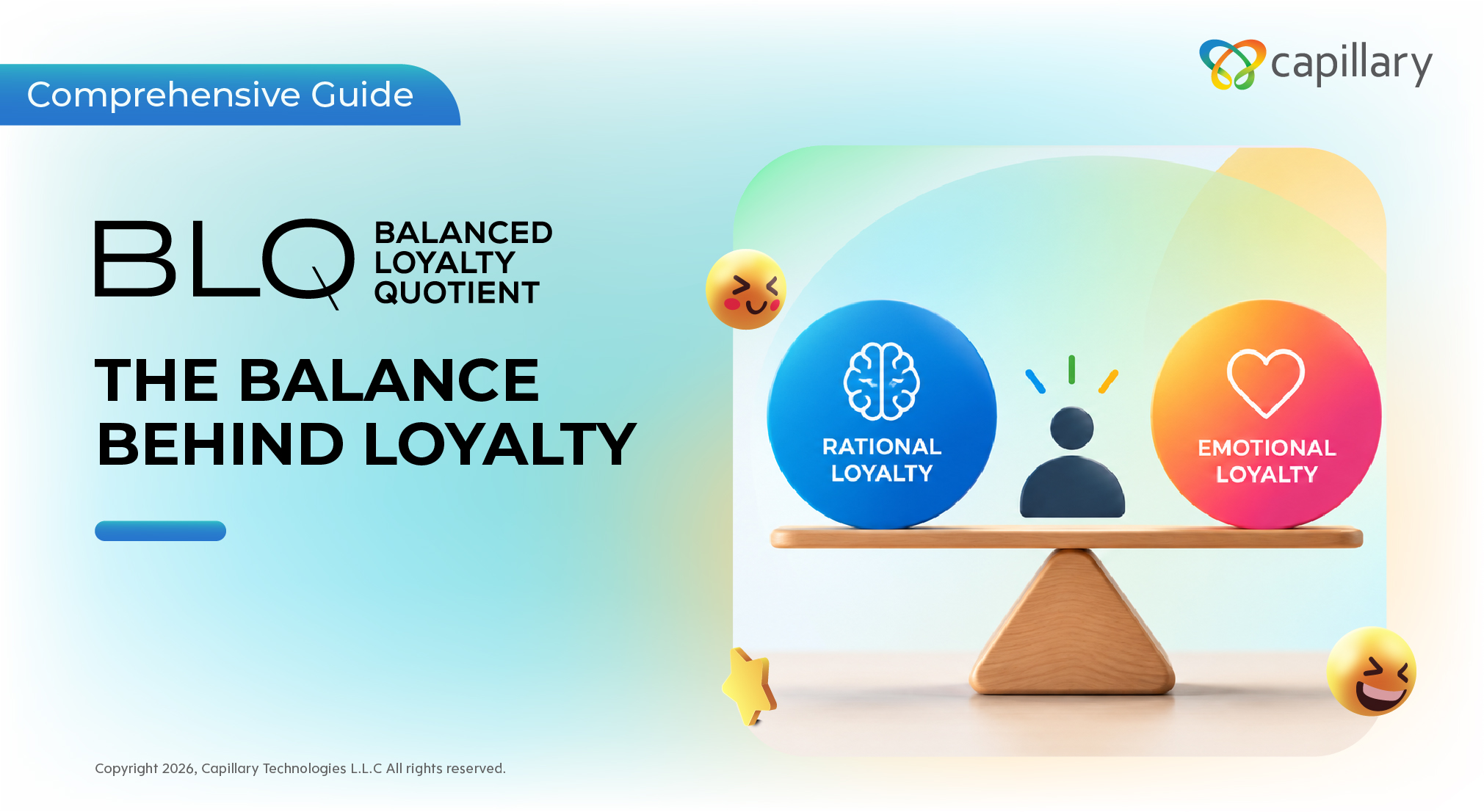
The Balanced Loyalty Quotient (BLQ) is Capillary Technologies’ proprietary framework for measuring the rational and emotional forces behind customer loyalty. BLQ looks at loyalty across two analytically independent dimensions.
Rational Loyalty — the Head — captures the practical reasons customers continue choosing a brand: value, convenience, utility, ease, and rewards.
Emotional Loyalty — the Heart — captures the deeper reasons customers feel connected to a brand: trust, recognition, affinity, identification, and emotional connection.
At its simplest, BLQ asks two different questions — Rational: does choosing this brand make sense for me? Emotional: do I genuinely want to choose this brand? A customer can score high on one and low on the other, high on both, or low on both — and that combination tells brands far more than behavior alone.
Customer loyalty already has an abundance of metrics — purchase frequency, retention, CLV, redemption, CSAT, NPS. Each answers an important question. The problem begins when the outcome being measured becomes synonymous with loyalty itself.
A customer may repeatedly choose a brand because they genuinely prefer it — or because the nearest alternative is inconvenient, switching requires effort, or the loyalty program makes leaving economically unattractive. The transaction looks the same; the underlying relationship does not. Behavior remains critical, but behavior without context leaves the important question unanswered: why did the customer behave that way? BLQ is designed to add that layer of understanding.
Loyalty programs can have a powerful effect on commercial behavior. Deloitte’s 2025 Consumer Loyalty Program Survey found that 72% of consumers said loyalty programs made them more likely to spend with their preferred brand, and 56% said a loyalty program caused them to increase their spending.
But the same study found the average consumer was enrolled in eight loyalty programs and actively participated in only five. Membership isn’t necessarily engagement, and engagement isn’t necessarily preference — a customer may participate because rewards are financially attractive, because the program creates genuine belonging, or simply because membership has become part of checkout. All three count as members. They don’t represent the same kind of loyalty.

Rational Loyalty is the practical case a customer makes for continuing to choose a brand — value, convenience, utility, ease, and rewards. A rationally loyal customer may stay because the brand saves them time, offers reliable quality, delivers better value, or simply fits naturally into their life. These aren’t inferior forms of loyalty; in many categories they’re the foundation of the relationship.
Rational loyalty is much broader than discount loyalty. A customer can rationally prefer a premium brand because the quality is better, or rationally remain with a retailer because its ecosystem makes shopping easier. Price is one component of value, not the whole of it.
The strategic issue emerges when almost the entire relationship depends on advantages competitors can reproduce. If convenience is the main reason customers stay, what happens when a competitor becomes more convenient? If points are doing most of the work, what happens when another program offers a richer earn rate? Rational advantages can be extremely powerful — but many are also substitutable. A brand needs to understand not only whether rational loyalty is strong, but what’s creating that strength and how defensible it is.
Emotional Loyalty reflects the deeper connection a customer develops with a brand — beyond liking a product or being satisfied with a transaction. It includes trust, recognition, affinity, identification, and emotional connection. An emotionally loyal customer may feel the brand understands them, trusts it to do the right thing, or believes it has become part of how they experience a category.
What makes this dimension interesting is that customers may not consciously describe their decisions as emotional. Merkle’s 2026 Loyalty Barometer found only 10% of consumers explicitly cited emotional attachment as a brand-choice driver — yet when asked about the brand they felt most loyal to, 71% said they trusted it to do the right thing, 69% said they’d be disappointed if they could no longer buy from it, and 64% said they felt understood and valued. Customers may tell you they choose on value or convenience while exhibiting trust and attachment underneath. That’s one reason emotional loyalty needs to be measured rather than assumed.

BLQ doesn’t argue that emotional loyalty should replace rational loyalty, or that emotion is inherently superior to function and value. The framework recognizes that both can independently contribute to the strength of a relationship — creating four conceptually different loyalty profiles.

This customer has compelling practical reasons to stay and a meaningful emotional reason to stay. The strength doesn’t come from emotion alone — it comes from having multiple foundations for loyalty. When loyalty has several foundations, the relationship has more ways to withstand the pressures of price changes, improving competitors, and the occasional failed experience.
This is one of the most strategically interesting profiles. The customer might purchase frequently, respond to offers, and redeem rewards — on a behavioral dashboard, the relationship looks healthy. But the reason for staying may essentially be “you work well for me,” and the important question is whether the advantages creating that relationship are defensible. BLQ can reveal a vulnerability transaction data alone doesn’t make obvious.
This customer may genuinely want to choose the brand but find the relationship increasingly difficult to maintain — the brand has become too expensive, service inconsistent, and rewards hard to earn. That’s a very different problem from indifference, and it demands a different response: not another emotional campaign, but fixing the fundamentals.
When both dimensions are weak, customers lack a strong practical and a strong emotional reason to remain. Habit or lack of alternatives can continue producing transactions for a while, but the underlying relationship is fragile — and the problem may run deeper than rewards or messaging. The customer proposition itself may need attention.
No. Different categories naturally create different customer dynamics — the reasons someone chooses a fuel station differ from the reasons they choose a hotel. The goal isn’t mathematical symmetry; it’s visibility. A better question than “are we 50/50?” is: do we understand what our loyalty is built on, and is that combination strong enough for the market we compete in?
Suppose a brand has a BLQ score of 72. Is that good? Without context, the number can only tell part of the story — perhaps the category norm is lower, perhaps every competitor scores higher, perhaps the score is strong but almost entirely rational. Each interpretation produces a different strategic conclusion, which is why BLQ is meant to be understood in the context of the competitive set rather than in a vacuum.

BLQ is a voice-of-customer measure designed to quantify both Rational and Emotional Loyalty. Capillary Technologies has publicly described the framework as a 14-question measure — seven rational, seven emotional — expressed as an index from 0 to 100, with up to 50 points per dimension.
The architecture matters because the overall number is only one part of the insight.

See the BLQ framework applied across 54 brands — get first access to the 2026 Balanced Loyalty Quotient Report.
BLQ isn’t designed to make every existing customer metric obsolete — it adds a different layer of insight. If retention declines, BLQ can help add perspective on whether the underlying weakness is rational, emotional, or both. If a loyalty program increases spend, BLQ introduces a different question: is the program only influencing behavior, or is it contributing to a stronger customer relationship as well?

Yes — and this may be one of the most important implications of BLQ. A program can have millions of members, healthy redemption, and increasing transaction frequency without proving the underlying customer relationship has grown stronger. A program may be extremely effective at incentivizing behavior; that isn’t the same as saying it has created trust, affinity, or emotional attachment. The question shifts from “is our program driving activity?” to “what kind of loyalty is that activity helping us build?”
Transactional incentives remain essential — points, discounts, cashback, and offers can create legitimate reasons to participate. The problem begins when a brand assumes that increasing the incentive indefinitely will necessarily deepen loyalty. Once the rational proposition is working, the larger opportunity lies in experiences harder for competitors to replicate by simply increasing an earn rate: meaningful recognition, relevant personalization, exclusive access, status and progression, unexpected rewards, community and belonging, and differentiated service. These mechanisms shouldn’t replace practical value — they should complement it. Another discount may generate the next transaction without creating any real reason to prefer the brand once the discount disappears. Strong loyalty strategy requires both sides of the equation.
A measurement framework is valuable only when it changes what a business does. If Rational Loyalty is high but Emotional Loyalty is weak, giving customers more points may just reinforce a dimension that’s already strong — the more meaningful opportunity is recognition, service, or personalization. If Emotional Loyalty is high while Rational is weak, customers already want the relationship; what they need is for the brand to make it easier to maintain. If both are weak, incremental optimization may not be enough — the customer proposition itself may require more fundamental work.

Good personalization strengthens Rational Loyalty by making the relationship more useful — reducing search effort, simplifying journeys, helping customers get more from a program. But the same experience can affect Emotional Loyalty when the customer interprets relevance as recognition: “this made my life easier” can become “this brand understands me.” Salesforce’s State of the AI Connected Customer reports 73% of customers now say companies treat them like individuals rather than numbers, up from 39% in 2023 — yet 71% say they’re increasingly protective of their personal information, and 61% say AI advances make trustworthiness even more important. Personalization without utility becomes noise; personalization without trust can become intrusive. But useful personalization delivered within a trusted relationship can strengthen both Head and Heart.
No. A customer forms their relationship with a brand through products, prices, stores, employees, digital experiences, deliveries, service, and how the brand responds when something goes wrong. Every interaction can affect Rational Loyalty, Emotional Loyalty, or both — which means BLQ has implications beyond a traditional loyalty team, informing CX, CRM, lifecycle marketing, brand strategy, and retention initiatives. Loyalty may have a team responsible for managing it, but the entire organization participates in creating it.
Instead of stopping at “how many members do we have?”, leaders can ask “how many customers have strong reasons to remain?” Instead of only asking “did redemption increase?”, they can investigate what kind of relationship sits behind that redemption. Perhaps the most provocative question is also the simplest: are customers loyal to the brand, or are they loyal to the conditions the brand currently provides?
Retention matters. Frequency matters. Share of wallet and CLV matter. BLQ doesn’t diminish those outcomes — it helps brands understand the customer relationship beneath them. Prices can be matched, points can be matched, features can be copied. The question is whether customers have multiple reasons to continue choosing the brand — some practical, some emotional, and some difficult for competitors to reproduce. That is a more durable way to think about loyalty than relying on any single mechanism.
Brands already possess extraordinary amounts of behavioral data. The next frontier isn’t collecting another signal — it’s understanding what the signals mean. Two customers with the same purchases and similar program activity can be staying for entirely different reasons; traditional behavioral data may struggle to distinguish them. The most important question in customer loyalty may no longer be “did the customer come back?” It may be: why did they come back, and how strong is that reason? That is what the Balanced Loyalty Quotient is built to reveal.
BLQ stands for Balanced Loyalty Quotient. It is Capillary Technologies’ proprietary framework for measuring the rational and emotional forces that contribute to customer loyalty.
BLQ measures Rational Loyalty, or the Head, and Emotional Loyalty, or the Heart. Rational Loyalty captures practical reasons to stay, while Emotional Loyalty measures deeper forces such as trust, recognition, affinity, identification, and emotional connection.
NPS primarily captures a customer’s stated likelihood to recommend a brand. BLQ asks a different question: what is the customer’s loyalty actually built on? It separately evaluates rational and emotional loyalty, giving brands another diagnostic view of the relationship.
Capillary has described BLQ as a 14-question voice-of-customer measure, with seven rational and seven emotional questions. The resulting index ranges from 0 to 100, with up to 50 points associated with each dimension.
No. “Balanced” does not mean every brand needs a 50/50 relationship. The optimal profile can vary by brand and category. The purpose is to understand both dimensions and interpret them within relevant competitive context.
Yes. BLQ can add another layer to loyalty-program evaluation by helping brands understand whether program participation sits alongside strong rational loyalty, emotional loyalty, or both. It can complement behavioral metrics such as enrollment, redemption, frequency, retention, and incremental spend.
A loyalty score becomes more meaningful when brands understand how it compares with realistic alternatives. Competitive benchmarking can reveal whether strengths or weaknesses are specific to a brand or reflect broader characteristics of the category.


Share


Capillary Marcom 4 Min Read