
Generative AI has fundamentally changed how we interact with the internet. Large Language Models (LLMs) and agents are quickly becoming the first interface people turn to—whether they want an answer, a recommendation, or even an action executed. The once omnipresent Google search bar is steadily being replaced by conversational, ChatGPT-like interfaces. And loyalty is evolving in the same direction.
At Capillary, we’ve been on this journey for years. Long before generative AI hit the mainstream, we built our AI-powered nudge framework—a system designed to guide loyalty managers toward the “next best action.” The result? Faster decision-making, smarter engagement strategies, and tangible benefits for brands and their customers.
From Nudges to AI-First Workflows
The next phase of loyalty is no longer about dashboards and drop-downs. It’s about agents and bots that make interactions with the platform more intuitive, natural, and human-like. We’re building an AI-first ecosystem where point-solution bots and domain-specific agents work seamlessly to drive loyalty operations.
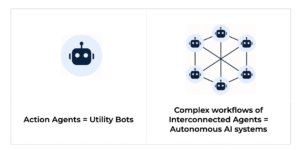
Action Agents = Utility Bots
- Think of these as single-purpose helpers
- They are designed to perform one task efficiently and reliably — like answering documentation questions, generating content, or converting an image into HTML
- They operate independently, without needing to coordinate with others
Analogy: Like individual tools in a toolbox (a hammer, a screwdriver, a tape measure) — each solves one job really well.
Complex Workflows of Interconnected Agents = Autonomous AI Systems
- Here, multiple agents work together as a coordinated system
- Instead of doing one action, they chain their capabilities to solve an end-to-end workflow
- One agent’s output feeds into another’s input, allowing for decision-making, adaptation, and automation at scale
Examples:
- Loyalty Promotion Configurator: one agent designs the promotion, another validates rules, another tests outcomes before launch.
- Engagement Campaign Setup: copy is generated by a Content Bot, visuals converted by Image-to-HTML Bot, targeting handled by Segmentation Bot, and everything orchestrated by a Campaign Orchestration Agent.
Analogy: Like an entire factory assembly line — each station (bot) does its part, but the overall system runs automatically to build the finished product.
Together, these bots and agents aren’t just add-ons. They’re redefining how loyalty managers work with the platform, making workflows faster, simpler, and more intuitive—just as the rest of technology is moving.
Real Impact for Enterprises
This isn’t just theory. Enterprises are already seeing the benefits of AI-first loyalty:
- A large conglomerate now resolves 30% of its support queries end-to-end with aiRA, freeing up human teams for higher-value work
- Brands have reported over 70% reduction in campaign execution time, accelerating speed to market, and improving campaign ROI
These early wins show how AI isn’t just enhancing loyalty platforms—it’s transforming them into proactive, profit-driving engines.
The Future of Loyalty is AI-First
As the digital world pivots toward conversational, AI-driven experiences, loyalty will no longer be about static tiers and transactional rewards. It will be about intelligent, adaptive systems that anticipate customer needs, personalize at scale, and enable managers to operate with unprecedented efficiency.
For brands, the opportunity is immense: to create meaningful customer engagements, boost retention, and turn loyalty into a true profit center. And for us at Capillary, this is just the beginning of building AI-first loyalty for the next decade.
Reach out to us to setup a meeting to talk through enterprise loyalty solutions in this age of AI.

Aneesh Reddy is the Founder & CEO of Capillary Technologies. An alumnus of IIT-Kharagpur, Aneesh has been recognized a “Forty Under 40” leader by Fortune Magazine and the Economic Times. He is an active contributor to the start-up ecosystem, mentoring several upcoming SaaS startups. Also a big proponent of meditation, Aneesh guides workshops on Inner Peace for corporate leaders.
Capillary Technologies Now Available on AWS Marketplace
Capillary Technologies Now Available on AWS Marketplace, Enabling Seamless Access to AI-Powered Loyalty Solutions for Enterprises Worldwide
Capillary Technologies, a global leader in customer loyalty and engagement solutions, today announced the availability of its award-winning loyalty platform on AWS Marketplace, a curated digital catalog that makes it easy for organizations to discover, procure, and deploy third-party software.
With this listing, enterprise customers across industries can now easily access Capillary’s AIpowered loyalty technology—streamlining procurement processes, accelerating implementation, and enabling the use of pre-committed AWS spend.
“We’re excited to bring Capillary’s enterprise-grade loyalty solutions to AWS Marketplace,” said Siddhant Jain, Chief Customer Officer at Capillary Technologies. “This listing helps us meet enterprises where they are—making it easier than ever to deploy scalable, secure, and future-ready loyalty programs built on AI and real-time engagement.”
Capillary’s solutions are already trusted by over 400 brands across 30+ countries, delivering measurable outcomes in customer retention, emotional loyalty, and revenue growth. From traditional retail to travel, QSR, and CPG industries, Capillary empowers brands to build programs that move beyond points and promotions—toward personalized, emotionally resonant experiences.
Key benefits of the AWS Marketplace listing include:
- Streamlined procurement through AWS billing and terms
- Rapid deployment of loyalty solutions within AWS-native environments
- Support for AWS Marketplace Private Offers and CPPO
- Scalability, compliance, and security with AWS infrastructure
This milestone also underscores Capillary’s continued momentum following its recent global expansion and strategic acquisitions, including Kognitiv which significantly increased Capillary’s presence in North America, Middle East and ANZ.
For more information, visit Capillary Technologies on AWS Marketplace.
Australia’s Loyalty Wake-Up Call: What’s Broken, What’s Working, What’s Next
Australia’s loyalty market is heating up—set to grow 15.5% annually and reach US$1.20 billion by the end of 2025 (Herald Sun, Business Wire). On paper, it’s a marketer’s dream: over 95% of Australians belong to at least one loyalty program, and ~61% are signed up for several. However, beneath that impressive reach lies a more sobering reality—only about 50% of members are active, and just about 30% feel a genuine emotional connection to the brands rewarding them.
For decades, the “earn-and-burn” model—spend, collect points, redeem—was enough to keep customers coming back. Not anymore. In 2025, Australians are data-conscious, emotionally motivated, and values-led. They’re asking for more than discounts; they want programs that feel personal, relevant, and aligned with their lifestyle.
The economic backdrop only sharpens this demand. Inflation is easing within the Reserve Bank’s target range, interest rates have dipped to 4.1% from 4.35%, and consumer sentiment is cautiously improving. But optimism doesn’t erase the reality of high living costs and sky-high property prices. People are still careful with their spending, gravitating toward brands that deliver tangible value and memorable experiences.
In this environment, loyalty is no longer a side tactic—it’s a strategic pillar. The question isn’t “Should we invest in loyalty?”—it’s “Are we designing it to truly matter?”
The New Loyalty Equation: ROI + Emotion + Trust
As loyalty shifts from transactional perks to strategic value, Australian brands are facing a critical inflection point. Loyalty can no longer be a marketing afterthought—it must prove its business impact, foster emotional connection, and earn consumer trust in a crowded, hyper-digitized market.
1. Loyalty Must Prove Its Business Impact
The accountability gap is widening. Nearly 45% of Australian loyalty professionals say they’re under growing pressure to demonstrate financial value (The Point of Loyalty, 2024). With budgets under scrutiny, internal buy-in now hinges on results. Success metrics are evolving—from program size to business outcomes like repeat purchase rates, customer lifetime value (CLV), and churn reduction.
This is driving a shift toward AI-powered platforms and CDPs (Customer Data Platforms) that unify scattered data, enabling smarter targeting and real-time engagement, enabling higher ROI.
The results are hard to ignore:
- 25% average lift in marketing ROI
- 20% increase in sales
- 28% reduction in churn
- 2x customer engagement
Modern loyalty is a revenue engine—and in 2025, measuring its performance is no longer optional. Brands that fail to align loyalty KPIs with core business outcomes risk losing both budget and boardroom buy-in.
2. Emotional Loyalty > Transactional Loyalty
Points and discounts are losing power. The real differentiator in 2025? Emotional loyalty—where customers feel seen, valued, and aligned with the brand’s values. Australian consumers are now gravitating toward programs that reward shared values, personalized engagement, and experience-led recognition.
Consumers increasingly favor programs that:
- Provide exclusive access (VIP events, early product drops)
- Deliver personalized experiences based on behavior and preferences
- Promote shared values which rewards sustainable travel
As one Australian brand strategist put it: “In 2025, community is currency. Loyalty needs to feel human—not automated.”
And the numbers support this shift. Brands cultivating emotional loyalty see significantly higher engagement and retention, with 2.5x customer lifetime value compared to purely transactional programs (Dentsu, 2024). The lesson: emotional loyalty isn’t a soft goal—it’s a strategic moat.
3. Trust Is the Foundation—And It’s Fragile
As programs become more personalized and data-driven, trust has become both a catalyst and a risk. Consumers want relevance—but not at the cost of feeling surveilled.
In Australia, fewer than 60% of consumers feel comfortable sharing personal data with brands. Yet nearly half expect personalized experiences tailored to their needs (BI Worldwide Australia, 2024).
This puts loyalty leaders in a bind: deliver tailored experiences while honoring rising privacy expectations and stricter regulations.
To navigate this, brands must embrace radical transparency:
- Clearly communicate what data is collected and why
- Reassure customers on how it’s protected
- Demonstrate the value exchange in return
With privacy law reforms underway in Australia, data governance is now core to loyalty strategy—not just a legal checkbox.
Trust, in 2025, isn’t a marketing value—it’s the enabling currency of loyalty. Brands that treat data as a relationship asset—earned through transparency and respect—will lead.
4. Technology: A Game-Changer with Guardrails
AI is transforming loyalty—driving precision, efficiency, and personalization at scale. From churn prediction and dynamic rewards to smart segmentation, AI is making loyalty smarter and faster.
But this opportunity comes with responsibility.
Australian marketers now rank AI as both their top priority and greatest challenge for loyalty innovation. The tension? Delivering personalized experiences without breaching ethical or privacy boundaries.
This is where AI-powered CDPs are game-changers. They unify customer data across touchpoints and enable compliant, real-time activation.
Consider this:
- Brands using AI-enhanced CDPs report 2x the engagement
- And 1.7x higher conversion rates in loyalty campaigns (SuperAGI, 2024)
Yet, success isn’t just about tech—it’s about how it’s applied. Ethical AI adoption requires explainability, accountability, and human oversight.
The brands that win will be those that use AI not just to optimize—but to respect and resonate.
5. Loyalty Isn’t One-Size-Fits-All: Sector-Specific Shakeups
While the pillars of loyalty—value, trust, and relevance—are universal, their application varies across industries.
Retail: The Value Equation Is Being Redrawn
Retailers are battling rising costs.
- Standard delivery now averages AUD $10.39
- Only 14% of retailers offer free returns, down from nearly 50% in 2018 (Power Retail, 2024)
Meanwhile, nearly half of shoppers factor sustainability into purchases. This has pushed retailers to rethink loyalty beyond discounts—offering green delivery, ESG rewards, and flexible experiences.
QSR & Fuel: Loyalty at the Speed of Convenience
In quick-service and fuel, loyalty is going digital-first. Mobile apps now embed loyalty features, gamification, and seamless payment-linked rewards—making loyalty feel like a built-in benefit of daily life.
Banking & Fintech: Loyalty Meets Payments
Some emerging platforms are simplifying the loyalty experience by linking rewards directly to debit or credit card transactions. These card-linked models enable seamless redemption, cleaner data capture, and stronger engagement—making them increasingly popular across APAC markets.
B2B: The Quiet Revolution
In sectors like construction, tech, and agriculture, B2B loyalty is quietly gaining momentum. Specialized platforms are offering targeted incentives for resellers, partners, and professional buyers. When combined with elements like product education, volume-based rewards, and co-branded experiences, these B2B programs often outperform their B2C counterparts in engagement and retention.
6. From Programs to Platforms: Coalition Is the New Competitive Edge
Loyalty is evolving from single-brand programs to multi-brand ecosystems. Forward-thinking Australian businesses are no longer asking how to build loyalty alone—but how to build it better together.
With 83% of ANZ brands prioritizing global expansion in 2025 (ANZ, 2024), coalition models are becoming a strategic enabler.
We’re seeing:
- Banks and supermarkets uniting to offer joint points and cashback
- Airlines are integrating with ESG initiatives to promote responsible travel
- Retailers and fintechs collaborating on wider redemption options
These ecosystems offer:
- Expanded value for customers
- Richer data for brands
- Reduced acquisition costs and stronger engagement
What matters most, however, is seamlessness. The next wave of loyalty innovation will center on platforms that deliver:
- A unified journey across brands
- Consistent recognition across ecosystems
- And adaptability to new currencies and behaviors
The brands that lead will be those that move from walled gardens to open bridges.

Final Thought: Loyalty Is a Strategy, Not a Scheme
In 2025, loyalty is no longer just about retention—it’s about relevance.
The brands that win won’t be the ones with the biggest budgets or flashiest perks, but those that treat loyalty as a core business strategy—rooted in purpose, powered by technology, and designed for evolving human behavior.
The opportunity for Australian brands is clear: reimagine loyalty for a more demanding, digital, and discerning era—and transform it into your most powerful competitive advantage.