December 2025
Discover 10 AI predictions set to redefine customer loyalty and engagement in 2026, from NBX decision engines and behavioral loyalty to AI agents, churn prevention, and privacy-forward personalization.
Loyalty is having a moment. Customers today join loyalty programs at record levels—over 90% of US online adults and nearly 9 in 10 European shoppers participate in at least one. These programs genuinely influence what they buy and where they shop.
Yet loyalty has never been shakier. A recent analysis found that 75% of customers would switch brands for a single compelling discount.
Brands know the ground is shifting. In Deloitte’s retail outlook, leaders named loyalty their number-one growth priority, outranking supply chain, expansion, even margin improvement.
And into this fragile moment enters AI—an accelerant, a disruptor, and a forcing function. What we’re watching is not incremental evolution. AI is quietly rebuilding the architecture of loyalty: how it’s earned, measured, predicted, and defended.
Here are the 10 major AI-led shifts that will redefine customer loyalty and engagement in 2026. Not predictions for the sake of futurism, but a synthesis of what the data already shows, and where the trajectories unmistakably point.
1. Loyalty Evolves From a Program Into an Intelligent Operating System
For years, loyalty lived in its own silo—a points platform, an email cadence, a redemption catalog.
AI is collapsing that separation.
The emerging model—what McKinsey calls the Next Best Experience (NBX) engine—treats every interaction, not just purchases, as a moment to move the relationship forward. When brands adopt NBX logic across digital and physical touch points, they see:
- 15–20% increases in customer satisfaction
- 5–8% revenue growth
- 20–30% lower cost-to-serve
These aren’t loyalty metrics. They are business metrics born from loyalty architecture.
Example narrative: A hotel chain sees a storm inbound. NBX triggers automated room extensions for stranded travelers, offers free Wi-Fi vouchers to loyalty members, and adjusts housekeeping schedules—all before guests even approach the front desk.
In 2026, this is foundational:
Loyalty isn’t a set of rewards. It becomes the logic the business uses to interact with the customer at every touchpoint.
Executive takeaway:
Loyalty is the decision logic of the entire customer journey. Stop thinking “program.” Start thinking “platform that predicts and orchestrates.”
2. Behavioral Loyalty Replaces Transaction Loyalty
Traditional loyalty programs reward dollars spent. AI-driven loyalty rewards future value potential—a very different thing.
Customers demonstrate loyalty long before they buy:
- What they browse
- How they review
- Whether they refer
- Which content do they return to
- How they engage in brand communities
AI can measure these micro-signals at scale and with predictive accuracy. It can identify that a customer who watches sustainability videos, writes detailed reviews, and interacts with brand content is far more valuable over time than someone who buys twice a year during sales.
Brands already tapping this approach:
- Starbucks: Personalized, AI-driven offer sequencing increases frequency and ticket size.
- Nike: Uses behavior data to determine which customers should receive early access drops.
- Netflix: Predictive engagement signals guide retention interventions.
Deep insight:
AI shows that loyalty is not something you earn at checkout—it’s something customers express through thousands of micro-behaviors long before they transact.
Framework: The New Loyalty Ladder
- Attention → browsing, saving, watching
- Engagement → reviews, user-generated content
- Participation → events, challenges, community
- Advocacy → referrals, social reinforcement
- Transaction → the lagging indicator
In 2026, behavior becomes a currency—and loyalty becomes a story customers build with the brand, not points they extract from it.
3. Personalization Gets So Good It Stops Feeling Like Marketing
Personalization used to mean putting someone’s name in a subject line.
AI personalizes at the level of timing, motif, narrative, persuasion style, and economic sensitivity.
Customers will no longer receive “offers”—they will receive interpretations of their behavior.
AI tailors not only what a person sees, but why and when they see it. It predicts whether a customer prefers discounts over freebies, early access over savings, bundles over standalone items.
AI-powered personalization is already delivering strong commercial outcomes across industries. Academic reviews and business case studies show it improves engagement, conversion, and loyalty when executed responsibly.
But because AI can personalize with surgical precision, regulators will inevitably step in.
2026 will be the year brands must articulate why different customers receive different prices, perks, or incentives.
Example narrative: A customer browsing hiking boots at 11 p.m. receives no immediate promo—which would feel intrusive. Instead, the next day the app highlights a “Complete Your Trail Kit” bundle, featuring socks and a hydration pack, dynamically priced based on the customer’s lifetime sensitivity and replenishment cycles.
The 2026 challenge:
Customers will reward brands that personalize intelligently—and punish those that personalize clumsily.
Executive takeaway:
Personalization moves from “nice to have” to a trust contract with customers. The brands that win will treat personalization like craftsmanship, not automation—transparent, respectful, and designed around customer agency.
4. AI Agents Become the Front Door to Loyalty—Not Just to Support
We often talk about AI in support as if it’s simply replacing call centers.
What’s actually happening is more profound: AI is becoming the guardian of loyalty moments.
Consider the scale already achieved:
- 100% of service leaders plan to use generative AI; 67% already are.
- Salesforce’s AI manages 1.5 million+ customer interactions, delivering human-level satisfaction while enabling a 45% workforce reduction.
- Lyft’s AI assistant reduced driver issue-resolution times by 87%.
When AI becomes the first responder, loyalty becomes real-time.
Not “Please wait 3–5 days for a response.” But: “We fixed this for you. Here’s what we did. Here’s what you gained.”
What changes for loyalty:
AI concierges will not just answer questions. They will:
- Recommend optimal point redemptions
- Identify account anomalies
- Proactively resolve friction
- Offer personalized recovery gestures
- Elevate VIP-quality treatment to everyday customers
The new loyalty battleground is the micro-moments customers expect brands to get right without being asked.
5. Churn Prediction Becomes a Live Feed, Not a Monthly Report
Every loyalty leader knows the stat: reducing churn by 5% can expand profits between 25–95%.
But churn prediction historically lived in dashboards no one checked frequently enough.
AI moves churn prediction into the bloodstream.
Example narrative: A telecom customer begins comparing competitor plans online. AI detects this behavior, flags churn risk, and orchestrates a personalized offer: a right-sized plan, waiver of a minor fee, and a follow-up call from a specialist.
Modern models process:
- Drop-offs in engagement
- Delays in replenishment cycles
- Service friction
- Negative sentiment in conversations or reviews
- Changes in purchase frequency
- Shifts in browsing patterns
And the best part: real-time churn scores trigger real-time interventions.
Platforms from CDPs to AI orchestration engines are already making this operational—an automatic retention playbook connected to behavioral signals.
By 2026, churn prediction will be so woven into loyalty systems that a customer rarely “seems at risk”—the system acts before the customer reaches the point of drift.
6. AI Learns Emotional Intelligence—and Loyalty Starts Depending on It
One of the most surprising findings of the last two years:
AI can express empathy with consistency humans struggle to deliver. Empathy used to be the one human quality AI couldn’t touch. But when Allstate tested AI-written customer emails, they found they were more empathetic and clearer than those written by human reps.
Yet the human instinct remains mixed:
- 42% of customers admit they’re ruder to chatbots
- 54% insist only humans resolve issues effectively
- 40% would pay more to avoid bots entirely
This tension defines the next era of loyalty:
AI must be emotionally literate enough to:
- Detect frustration
- Modulate tone
- Know when not to push
- Hand off at the right moment
- Record context so humans rejoin the conversation seamlessly
Empathy becomes a design challenge, not just a training data challenge.
And in 2026, the loyalty differentiator will not be how fast AI responds—but how human the experience feels when it does.
The opportunity:
AI becomes emotionally intelligent and self-aware—knowing when to escalate to a human.
2026 loyalty standard:
A brand’s tone, responsiveness, and emotional intelligence are consistent across all touchpoints—because AI writes, senses, and adapts the experience at scale.
7. AI Turns Loyalty Content Into an Ecosystem, Not a Stream
Content is emerging as the new currency of loyalty.
AI enables brands to create, adapt, and personalize content faster than marketing teams ever could.
Generative models can now produce:
- Personalized loyalty digests summarizing your progress
- Dynamic stories about your habits (“You’ve earned more green credits this month than 87% of customers in your city”)
- Community-driven micro-hubs (e.g., runners, new parents, eco-focused shoppers) curated by AI
- Localized offers and narratives tailored to specific cities or even neighborhoods
Already, brands are using AI to:
- Draft FAQs
- Generate personalized offers
- Produce targeted recommendations
In 2026, loyalty becomes less about promotions and more about meaningful participation and will expand into:
- Personalized monthly loyalty scorecards
- Micro-community spaces (e.g., “sneakerheads in Chicago” or “eco-conscious parents”)
- Location-specific offers driven by local behavior signals
- Content that evolves with each customer’s journey, not static campaigns
Brands using AI-driven personalization today—from QSR to retail to streaming—have already reported higher retention and faster campaign execution cycles.
Executive insight:
Loyalty becomes a media ecosystem, not a coupon database.
8. Privacy Becomes the Heart of Loyalty Value, Not the Fine Print
Consumers are not naïve.
70% expect AI to transform their experience, but only 40% feel AI improves it today.
The disconnect is not ability—it’s trust.
Multiple studies confirm that privacy concerns directly shape whether customers embrace or reject AI-powered personalization.
By 2026, loyalty programs will increasingly differentiate based on:
- Control (“Tune my personalization level”)
- Transparency (“Why am I seeing this?”)
- Consent (“Here’s what I share, here’s what I get”)
- On-device AI processing to prevent over-collection
- Zero-party data exchanges that feel mutually beneficial
The brands customers trust with their data will own the loyalty conversation.
9. AI Rewrites the Loyalty Scorecard
For years, NPS and CSAT dominated loyalty reporting.
But customer expectations are changing faster than those metrics can capture.
Service professionals already report:
- 82% feel customer expectations have increased
- 81% say customers now demand a more personal touch
At the same time, AI’s rise is shifting what matters:
Resolution time, containment rate, and conversation quality are becoming more predictive of loyalty than blanket satisfaction scores.
By 2026, the loyalty dashboard will track:
- Predicted LTV (updated continuously)
- Propensity to advocate (a blend of sentiment + engagement)
- AI influence on retention and frequency
- Experience consistency across channels
- Fairness and transparency metrics
Loyalty moves from measuring what happened to predicting what will happen—and influencing it.
10. Autonomous Experimentation Becomes the New Loyalty Growth Engine
Historically, loyalty experiments looked like:
A/B test: two subject lines, two offers, one winner and see what sticks.
Agentic AI transforms thousands of micro-experiments into a continuous loop. Early enterprise deployments show hundreds of thousands of hours saved and productivity increases near 20%, thanks to AI agents capable of running tasks, analyzing results, and refining strategies.
Applied to loyalty, this means:
- Dozens of micro-variants of onboarding flows generated automatically
- Offer mixes tested in real time on micro-cohorts
- Personalization models are fine-tuned hourly, not quarterly
- Engagement journeys that rewrite themselves based on live performance
By 2026, the best loyalty programs won’t be the ones with the best ideas.
They’ll be the ones with systems capable of discovering better ideas every day.
What This All Means for Loyalty Leaders in 2026
Loyalty is no longer a marketing accessory. It is becoming the central nervous system of customer experience.
To prepare, brands must:
- Unify data across engagement, service, and transaction layers
- Invest in predictive models tied to real actions, not dashboards
- Map NBX journeys that blend personalization with empathy
- Reward behaviors, not just transactions
- Build privacy-forward experiences to strengthen trust
- Adopt metrics that look forward, not backward
- Experiment continuously, not seasonally
2026 will not reward brands with the loudest loyalty programs.
It will reward brands with the smartest, most responsive, and most emotionally aware systems.
Loyalty won’t be won by points. It will be won by prediction, personalization, fairness, and how a brand shows up in the moments that matter.
Share

Summaya
Trending Topics
Ecommerce in Malaysia: Growth, Trends & Opportunities
Capillary Technologies acquires Brierley
Similar Articles
Great Ingredients, Broken Recipes: Why North America’s Biggest Loyalty Programs Are Failing Their Best Customers
A few weeks ago, I set out to answer a question that had been nagging
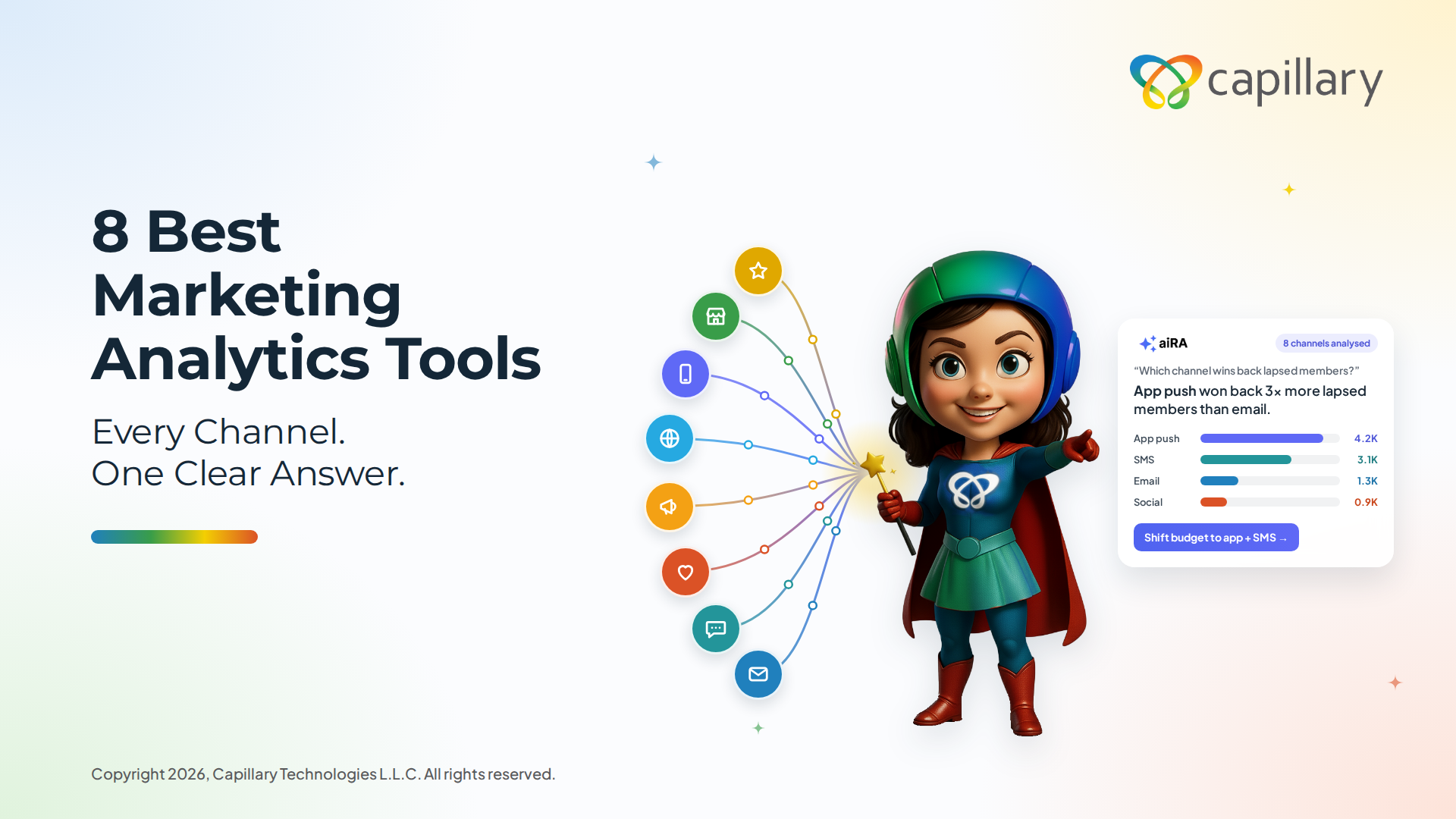
8 Best Marketing Analytics Tools for 2026 (Self-Service & AI-Powered Compared)
Introduction Marketers are drowning in channel data, yet most still wait days for a simple
Tableau Alternatives: 6 No-Code & AI-Powered BI Tools Worth Switching To in 2026
Introduction Tableau is powerful, but it is also heavy. The learning curve is steep, most
Contact Us
Get the best loyalty & customer engagement platform out there!
- Design industry shaping loyalty programs
- Integrate easily and go live quicker
- Deliver hyper-personalized consumer experiences