Loyalty management is the end-to-end process of designing, running, and optimizing programs that reward customers for repeat engagement — combining strategy, technology, and data to build lasting brand relationships and measurable revenue outcomes. It is not a points program. It is a business system: one that connects a loyalty platform, a customer data foundation, omnichannel engagement, and a measurement framework into a single operating discipline.
For enterprise CMOs, CRM leaders, and digital transformation executives, the stakes are concrete. Legacy point systems and bolt-on CRM modules cannot process real-time behavioral data, support multi-brand program governance, or deliver the personalized engagement that drives customer lifetime value at scale. The gap between a functional loyalty program and one that measurably moves retention and revenue is, in most cases, an architecture problem. Capillary Technologies works with 415+ enterprise brands, including 20+ Fortune 500 companies, across this exact challenge.
This guide covers what loyalty management is, how modern loyalty management systems are built, which KPIs matter, and what to evaluate in a platform.
What Is Loyalty Management?
Loyalty management is the end-to-end process of designing, running, and optimizing programs that reward customers for repeat engagement — combining strategy, technology, and data to build lasting brand relationships and measurable business outcomes.
It is not a points program. It is not a CRM module. It is a business discipline that requires a connected platform, a data foundation, and a measurement framework working together.
Loyalty Management as a Business System
Loyalty management operates across three interdependent layers: strategy (program design, tier structure, reward mechanics), technology (platform, rules engine, customer data platform), and operations (governance, measurement, continuous optimization). All three must function together. A well-designed program running on fragmented data delivers inconsistent experiences. A technically sophisticated platform with no clear strategy generates activity without outcomes.
Enterprise brands that treat loyalty as a standalone campaign — rather than a system — consistently underperform on retention and lifetime value metrics.
The Difference Between a Loyalty Program and Loyalty Management
A loyalty program is the customer-facing construct: the points, the tiers, the rewards. Loyalty management is the full operational and technology discipline that designs, runs, and improves that program over time.
Think of it this way: the loyalty program is the product. Loyalty management is the factory. One is what customers see; the other is what makes it work at scale.
Why Loyalty Management Has Become Non-Negotiable for Enterprise Brands
The customer loyalty management market is projected to reach $44 billion by 2032 (Allied Market Research). Loyal customers spend more, churn less, and refer more — and 41% of consumers say rewards are the primary reason they stay with a brand, ahead of product quality.
For enterprise brands operating across multiple channels and markets, running loyalty as an afterthought is no longer a viable option.
What Is a Loyalty Management System?
A loyalty management system is the software platform that manages every element of a loyalty program — member enrollment, points and tiers, reward fulfillment, omnichannel engagement, and performance analytics — in a single connected environment built for enterprise scale.
Modern systems go far beyond basic point tracking. They integrate with CRM, POS, eCommerce, and CDP infrastructure, process transactions in real time, and apply AI-driven logic to personalize engagement at the individual level.
Core Functions of a Loyalty Management System
A complete loyalty management system handles:
- Member enrollment and profile management — capturing and maintaining individual member records across all channels
- Points and currency management — tracking accrual, redemption, expiry, and liability in real time
- Tier and status management — assigning and updating member tiers based on configurable behavioral rules
- Reward catalog and fulfillment — managing the inventory, eligibility, and delivery of rewards
- Rules engine — defining how points are earned, how tiers are triggered, and how exceptions are handled
- Reporting and analytics — measuring program performance against defined KPIs and business outcomes
How a Loyalty Management System Differs from a Basic Rewards Tool
A basic rewards tool handles simple point accrual and redemption. That is where its capability ends. An enterprise loyalty management system integrates across the full technology stack, processes millions of transactions without latency, supports multiple program constructs simultaneously, and delivers personalized engagement based on real-time behavioral data.
The gap between the two is not incremental. It is architectural.
On-Premise vs. Cloud-Based vs. Managed SaaS Loyalty Systems
Three deployment models exist for enterprise loyalty systems:
- On-premise — full control, high maintenance burden, slow to update
- Cloud-based — more flexible, but still requires significant internal engineering to manage
- Managed SaaS — combines cloud flexibility with managed operations, continuous platform updates, and embedded loyalty expertise
Managed SaaS is increasingly the enterprise standard. It gives brands a faster path to production without requiring them to build and maintain a dedicated loyalty engineering team. Capillary Technologies operates on this model — managing the platform, the infrastructure, and the program operations so enterprise teams can focus on strategy and outcomes.
Loyalty Management Platform vs. CRM: What’s the Difference?
A CRM manages customer records and sales relationships. A loyalty management platform actively orchestrates rewards, behavioral rules, and real-time personalized engagement to drive repeat purchase and emotional loyalty. They are complementary systems — not substitutes.
This distinction matters because many enterprise buyers assume their existing CRM investment covers loyalty. It does not. The two systems serve fundamentally different functions.
| Dimension | CRM | Loyalty Management Platform |
| Primary Function | Manage customer records and sales pipeline | Orchestrate rewards, tiers, and engagement to drive repeat behavior |
| Data Model | Contact and account records | Unified member profiles with behavioral and transactional data |
| Personalization | Segment-based email and outreach | Real-time, event-triggered rewards and communication |
| Loyalty-Specific Features | Limited or module-based | Native rules engine, points engine, tier management, rewards catalog |
| Integration Role | System of record | System of action and engagement |
What CRM Does Well — and Where It Stops
CRM excels at managing relationships, tracking sales activity, and supporting service interactions. Salesforce Loyalty Management, for example, works well for brands already deeply embedded in the Salesforce ecosystem. But CRM is not designed to manage points liability, process real-time loyalty transactions, run complex tier logic, or deliver personalized rewards at the moment of engagement.
What a Loyalty Management Platform Adds
A loyalty management platform adds the action layer. It takes the customer data that CRM holds and uses it to trigger rewards, advance tier status, deliver personalized offers, and measure program impact — in real time, across every channel. This is what separates a system of record from a system of engagement.
How CRM and Loyalty Platforms Work Together
The most effective enterprise architecture uses both. CRM serves as the system of record for customer relationships; the loyalty platform serves as the system of action for engagement and rewards. Data flows bidirectionally — loyalty behavior enriches CRM profiles, and CRM data informs loyalty segmentation and targeting.
The Core Components of an Enterprise Loyalty Management Platform
Enterprise loyalty management requires a connected stack of functional components. The quality and integration of those components determines program performance. A platform that is strong on rules logic but weak on data infrastructure will consistently fail to personalize at scale.
Rules Engine — The Logic Layer
The rules engine is the brain of a loyalty management platform. It defines how points are earned (by transaction type, channel, product category, or non-purchase behavior), how tiers are assigned and maintained, how rewards are triggered, and how exceptions are handled.
Enterprise programs require a rules engine capable of processing thousands of concurrent rules across multiple brands, channels, and geographies — without performance degradation. Configuration flexibility matters as much as processing power.
Customer Data Platform (CDP) — The Data Foundation
A customer data platform (CDP) in loyalty management aggregates member data from every channel, resolves identity across devices and touchpoints, and creates a unified 360-degree customer profile — the data foundation that makes real-time personalization and predictive targeting possible.
Identity resolution is the mechanism that makes this work: linking multiple data signals — email addresses, device IDs, loyalty card numbers, purchase histories — into one persistent member profile. Without it, loyalty programs operate on fragmented data that limits personalization and produces inconsistent member experiences.
Capillary Technologies CDP Software is purpose-built for this function, designed to support loyalty-specific data models and real-time segmentation at enterprise scale.
Omnichannel Engagement Layer — The Communication Engine
The engagement layer delivers personalized messages, offers, and rewards to members across every channel — email, SMS, push notification, in-app, in-store — at the right moment in the customer journey.
The distinction between batch campaign tools and real-time, event-triggered engagement is critical. Batch tools send the same message to a segment on a schedule. A real-time engagement engine responds to individual behavior as it happens — a purchase, a lapse, a milestone — and triggers the appropriate response immediately. Capillary Technologies Customer Engagement Platform operates as this omnichannel engagement layer, connecting loyalty events to personalized outreach across every channel a member uses.
AI and Predictive Targeting — The Intelligence Layer
Static segmentation assigns customers to groups and treats everyone in the group the same way. Predictive targeting uses machine learning to identify which individual customers are most likely to respond to a specific offer, lapse before their next purchase, or qualify for a tier upgrade — and act on that signal before the moment passes.
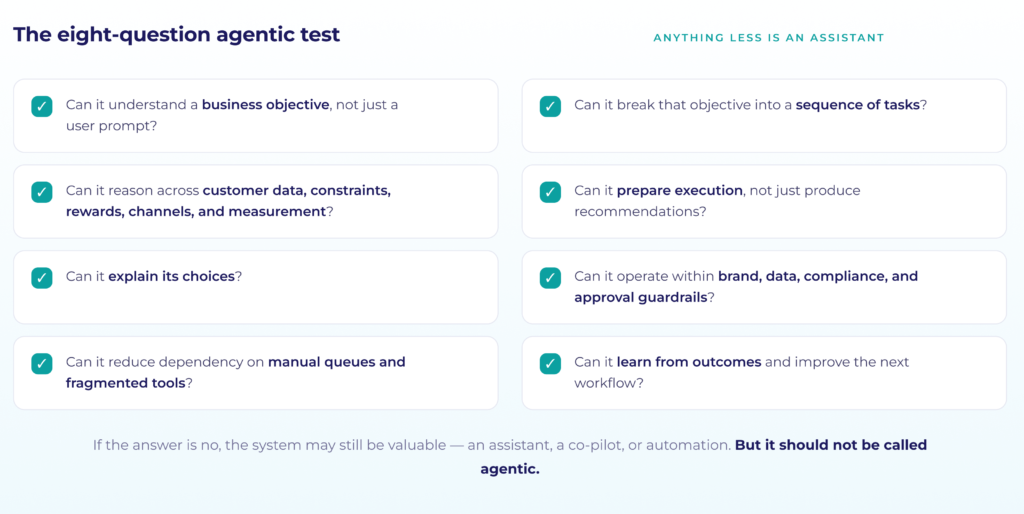
Capillary Technologies’ aiRA engine and Nudge Framework operate at this layer within the Loyalty Platform, delivering continuous, automated engagement triggers that have been shown to drive up to 5x program performance improvement and up to 20% revenue growth for enterprise clients.
Rewards Catalog and Fulfillment Engine
The rewards catalog defines what members can earn and redeem — points, vouchers, experiences, partner offers, merchandise. The fulfillment engine manages eligibility, inventory, delivery, and reconciliation.
At enterprise scale, rewards catalog management is operationally complex. Multi-brand programs, partner integrations, and regional reward variations all require a fulfillment infrastructure that can handle high transaction volumes without errors or delays. This is where Capillary Technologies Customer Rewards Platform plays a crucial role, allowing large businesses to give personalized rewards and experiences to their multitude of loyal customers, at the right time.
Analytics and Measurement Module
The analytics module connects loyalty activity to business outcomes. It tracks program KPIs, measures member behavior over time, quantifies program-attributed revenue, and surfaces the insights that inform program optimization decisions.
Capillary Technologies Customer Insights Platform provides this reporting layer, giving enterprise teams visibility into the metrics that matter — from active member rate and redemption trends to segment-level CLV and program ROI. Without a dedicated analytics module, loyalty programs operate on intuition rather than evidence.
How Loyalty Management Works in an Enterprise Environment
Loyalty management in an enterprise environment is not a single workflow. It is a continuous cycle: data collection, profile unification, rules processing, engagement delivery, reward fulfillment, and performance measurement — running simultaneously across millions of members and multiple channels.
Step 1: Member Enrollment and Identity Resolution
Every loyalty interaction begins with member identification. At enrollment, the platform captures core profile data — name, contact details, channel preferences — and assigns a unique member ID. As the member interacts across touchpoints, identity resolution links those interactions (a web session, an in-store purchase, an app login) to the same profile.
This is the step most legacy systems fail. Without consistent identity resolution, the same customer appears as multiple records, and personalization becomes impossible.
Step 2: Behavioral Data Capture Across Channels
Once a member is enrolled, every interaction generates data: purchase transactions, app activity, redemption events, referral actions, social engagement. The loyalty platform — integrated with POS, eCommerce, mobile, and CRM systems — captures this data in real time and feeds it into the member profile.
The breadth of data capture directly determines the quality of personalization. Programs that capture only purchase data miss the behavioral signals that predict future engagement.
Step 3: Rules Processing and Reward Triggering
With each new interaction, the rules engine evaluates the member’s activity against the program’s earning and redemption logic. Points are accrued, tier thresholds are checked, and reward triggers are evaluated — all in real time.
Enterprise programs often run hundreds of concurrent rules: base earn rates, bonus multipliers, partner earn events, tier-specific benefits, and time-limited promotions. The rules engine must process all of these simultaneously without latency.
Step 4: Personalized Engagement Delivery
After rules processing, the engagement layer delivers the appropriate response: a points confirmation, a tier upgrade notification, a personalized offer, or a re-engagement nudge. The channel, timing, and content of that message are determined by the member’s profile, behavioral history, and predicted preferences.
This is where the difference between a basic loyalty system and a modern loyalty management platform becomes visible to the customer.
Step 5: Redemption and Reward Fulfillment
When a member redeems points or claims a reward, the fulfillment engine processes the transaction, updates the points balance, and delivers the reward — whether that is a discount voucher, a physical product, an experience, or a partner offer.
Redemption friction is one of the most common drivers of program disengagement. Enterprise platforms must make redemption fast, intuitive, and consistent across every channel.
Step 6: Analytics, Measurement, and Optimization
After each program cycle, the analytics module aggregates performance data and surfaces insights: which segments are most active, which rewards drive the highest redemption, which engagement triggers produce the strongest repeat purchase lift.
These insights feed back into program design — adjusting rules, refining offers, reallocating rewards budget — creating the continuous optimization loop that separates high-performing programs from static ones.
Omnichannel Loyalty Management: Delivering a Unified Member Experience
Omnichannel loyalty management is the practice of delivering a consistent, connected loyalty experience across every channel a customer uses — in-store, online, mobile, and social — by recognizing the same member and applying the same rules and rewards regardless of where the interaction happens.
The operational challenge is not channel coverage. It is consistency. A member who earns points in-store should see those points reflected immediately in their app. A reward triggered by an online purchase should be redeemable at the physical checkout. Without a unified member profile and a real-time rules engine, these experiences break.
Why Channel Silos Kill Loyalty Programs
When loyalty programs run in channel silos — a separate in-store program, a different online rewards system, a disconnected mobile app — members experience inconsistency that erodes trust. They earn points they cannot find. They receive offers that do not reflect their actual purchase history. They disengage.
Research consistently confirms the cost of this fragmentation: companies with strong omnichannel strategies retain 89% of their customers on average, compared to 33% for those with weak strategies (Aberdeen Group).
How a Unified Member Profile Enables Omnichannel Consistency
The unified member profile — built and maintained by the CDP layer — is what makes omnichannel loyalty operationally possible. Every channel writes to the same profile and reads from it. The rules engine applies the same logic regardless of channel. The engagement layer delivers the appropriate message through whichever channel the member last used.
Capillary’s omnichannel loyalty management architecture connects the Loyalty Program Software, CDP Software, and Customer Engagement Platform into a single operating environment — so that a member’s interaction at a fuel station, on an eCommerce site, or through a branded app all feed the same profile and trigger the same rules.
Channel Loyalty Management: Extending the Program to Partners and Dealers
For brands that operate through dealer networks, distributors, or franchise partners, channel loyalty management adds another dimension. These programs reward not just end consumers but the intermediaries who influence purchase decisions — dealers, agents, contractors.
Channel loyalty programs require the same core infrastructure as consumer programs — rules engine, member profiles, reward fulfillment — but with additional governance layers to manage partner onboarding, earn structures, and compliance across a distributed network.
Multi-Brand and Coalition Loyalty: Managing Complexity at Scale
Single-brand loyalty is straightforward by comparison. Multi-brand loyalty — where a conglomerate or partner ecosystem runs a shared program across multiple brands — introduces governance, data, and technology challenges that most platforms are not designed to handle.
A coalition loyalty program is a multi-brand program in which customers earn and redeem rewards across a network of partner brands, increasing program value and cross-brand engagement.
The Governance Challenge in Multi-Brand Loyalty
Multi-brand loyalty programs require centralized governance — consistent earn and redemption rules, shared member data standards, unified fraud controls — while maintaining local brand relevance. A fashion brand within a conglomerate should not feel like it is running the same program as a fuel retailer in the same group.
The platform architecture must support both: a centralized rules engine and data layer with configurable brand-level program parameters.
Data Architecture for Multi-Brand Programs
In a multi-brand environment, the CDP must aggregate member data across all participating brands while maintaining appropriate data separation. A member who shops across three brands in a conglomerate should have a single unified profile — but each brand’s marketing team should only access the data relevant to their program.
This requires role-based data governance, cross-brand identity resolution, and a member data model designed for multi-entity environments from the outset — not retrofitted onto a single-brand architecture.
How Conglomerates Use Loyalty to Drive Cross-Brand Engagement
When multi-brand loyalty programs are well-executed, the commercial upside is significant. One Capillary conglomerate client saw a 60% rise in cross-brand promotions after integrating experiences across multiple brands — and another saw 2x growth in reactivated customer numbers by delivering relevant rewards across its brand portfolio.
The mechanism is straightforward: a member who earns points with one brand and redeems them with another has a reason to engage with both. Cross-brand earn and redemption structures create stickiness that no single-brand program can replicate.
Measuring Loyalty Program ROI: KPIs and Frameworks
Loyalty program ROI is not self-evident. Without a structured measurement framework, it is easy to confuse activity (enrollment numbers, points issued) with outcomes (repeat purchase, incremental revenue, retention improvement).
The most critical loyalty management KPIs are repeat purchase rate, customer retention rate, active member rate, redemption rate, customer lifetime value (CLV), and program-attributed revenue — together, these metrics show whether a loyalty program is changing customer behavior and generating measurable ROI.
The KPIs That Actually Matter
Track these metrics at the program level and by segment:
- Active member rate — the percentage of enrolled members who have engaged with the program in a defined period (typically 90 days)
- Repeat purchase rate — the percentage of customers who make more than one purchase within a defined timeframe
- Redemption rate — the percentage of earned points or rewards that members actually redeem; low redemption signals low perceived value
- Customer retention rate — the percentage of customers retained over a period, compared between loyalty members and non-members
- Customer lifetime value (CLV) — the total projected revenue from a customer over the duration of their relationship with the brand
- Average order value (AOV) — members vs. non-members — a direct measure of whether loyalty membership changes spend behavior
- Program-attributed revenue — incremental revenue directly linked to loyalty program activity, isolated from baseline purchase behavior
How to Calculate Loyalty Program ROI
A structured approach to loyalty ROI calculation:
- Establish a control group — compare loyalty members against a matched cohort of non-members with similar purchase histories
- Measure incremental revenue — calculate the revenue difference between the two groups over a defined period
- Account for program costs — include points liability, reward fulfillment costs, platform fees, and operational overhead
- Calculate net program contribution — incremental revenue minus total program costs
- Track CLV over time — measure whether loyalty members’ lifetime value increases relative to the control group as program tenure grows
Loyalty Delivered Sales: A Proprietary ROI Framework
Generic retention metrics tell you whether customers stayed. They do not tell you why, or which specific program activities drove the outcome.
Capillary Technologies’ Loyalty Delivered Sales (LDS) framework addresses this directly. LDS quantifies the direct revenue contribution of loyalty program activity by isolating and attributing sales outcomes to specific program behaviors — a tier upgrade, a targeted offer, a re-engagement nudge. It gives CMOs and CFOs a defensible, science-backed ROI calculation rather than a correlation.
Security, Compliance, and Data Governance in Loyalty Management
Loyalty programs are data-intensive by design. Every member interaction generates personal data — purchase history, behavioral patterns, contact details, device identifiers. For enterprise brands, the security and governance of that data is not a secondary concern. It is a procurement requirement.
Data Privacy Regulations That Apply to Loyalty Programs
Loyalty programs operating across multiple markets must comply with a range of data privacy regulations: GDPR in Europe, CCPA in California, PDPA across Southeast Asian markets, and sector-specific requirements in industries like financial services and healthcare.
Compliance is not just a legal obligation. It is a trust signal. Members who understand how their data is used — and who can control it — are more likely to share it, and more likely to stay engaged.
What Enterprise Buyers Should Require from a Loyalty Platform
When evaluating a loyalty management platform on security and compliance, enterprise procurement teams should require:
- Data residency options — the ability to store member data in specific geographic regions to meet local regulatory requirements
- Role-based access controls — granular permissions that limit data access to authorized users and teams
- Audit logging — a complete record of data access and modification events for compliance reporting
- Encryption standards — data encrypted at rest and in transit, with documented key management practices
- Consent management — built-in mechanisms for capturing, storing, and honoring member consent preferences
- Third-party security certifications — SOC 2, ISO 27001, or equivalent independent validation of security practices
How Capillary Technologies Approaches Data Security and Governance
Capillary Technologies treats data security as a foundational platform requirement, not a feature. The platform maintains 99.99% system uptime and is built to enterprise security standards, with compliance and governance frameworks designed to meet the requirements of regulated industries and multi-market deployments.
For enterprise buyers who need to satisfy IT, legal, and procurement stakeholders alongside marketing requirements, this matters as much as program functionality.
How to Evaluate a Loyalty Management Platform: An Enterprise Buyer’s Framework
The loyalty management market includes a wide range of platforms — from API-first rules engines to full-stack Managed SaaS solutions. Choosing the right one depends on your program complexity, internal engineering capacity, and the scale at which you need to operate.
The Eight Dimensions of Enterprise Platform Evaluation
When shortlisting loyalty management software, evaluate each vendor across these dimensions:
- Scalability — can the platform handle your transaction volume and member count without performance degradation? Capillary processes 1.95 billion+ annual transactions across 1.2 billion+ loyalty members.
- Integration depth — does the platform connect natively with your CRM, POS, eCommerce stack, and mobile infrastructure?
- Omnichannel engagement capabilities — does it support real-time, event-triggered communication across email, SMS, push, in-app, and in-store channels?
- AI-driven personalization — does the platform use machine learning for predictive targeting and automated engagement, or only static segmentation?
- Multi-brand and coalition support — if you operate across multiple brands or partner networks, is multi-entity loyalty a core capability or an afterthought?
- Security and compliance certifications — does the vendor meet your data residency, privacy, and security requirements?
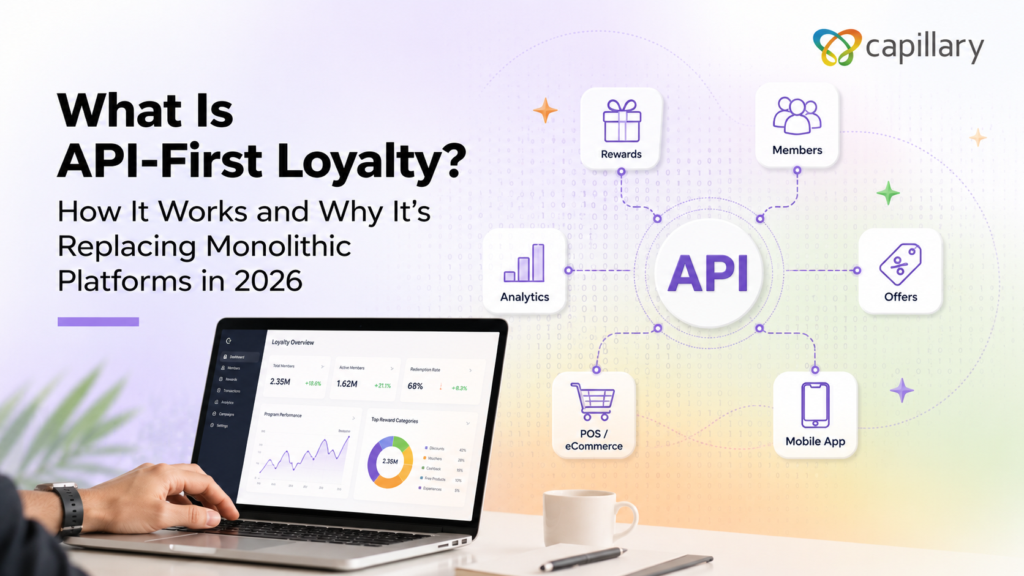
- Deployment model — API-first (maximum flexibility, high engineering overhead) vs. Managed SaaS (faster deployment, lower internal resource requirement)
- Analyst validation — has the platform been independently evaluated by recognized analysts? Capillary Technologies was named a Leader in both the Forrester Wave™: Loyalty Platforms, Q4 2025 and the Everest Group PEAK Matrix® 2025.
Comparing Platform Models: Managed SaaS vs. API-First
| Dimension | API-First Loyalty Engine (e.g., Antavo) | Managed SaaS Loyalty Platform (e.g., Capillary Technologies) |
| Deployment Speed | Slower — requires significant engineering build | Faster — pre-built constructs, managed rollout |
| Internal Resource Requirement | High — needs a dedicated loyalty engineering team | Lower — platform managed by vendor |
| Flexibility | Maximum — configure everything from scratch | High — configurable within a proven enterprise framework |
| Total Cost of Ownership | Higher over time (build + maintain) | More predictable — included in managed service |
| Best For | Engineering-led teams building custom loyalty infrastructure | Enterprise brands that want to move fast without building from scratch |
Where Purpose-Built Loyalty Platforms Outperform CRM Modules
Salesforce Loyalty Management works well for brands already operating within the Salesforce ecosystem. But a CRM module is optimized for relationship management, not loyalty orchestration. It does not natively handle points liability at scale, multi-brand tier logic, or the kind of AI-driven behavioral engagement that enterprise loyalty programs now require.
Purpose-built platforms like Capillary Technologies Loyalty Program Software are designed from the ground up for loyalty program management — with native AI (aiRA), a proprietary engagement framework (Nudge), and a measurement methodology (LDS) that goes beyond what a CRM module can deliver.
Antavo is another platform that serves enterprise loyalty use cases well, particularly in Europe. The differentiation at the top of the market comes down to global scale, vertical depth, and the breadth of the managed services layer — areas where Capillary’s track record across 415+ brands and dedicated solutions for Airlines, Fuel Retail, CPG, Hospitality, and Food & Beverage creates a meaningful operational advantage.
Frequently Asked Questions