USD 72.48B by 2035 Signals a Shift: Loyalty Is Becoming Enterprise Infrastructure

March 2026

The Loyalty Market’s Next Decade Will Be Measured in Billions and Milliseconds
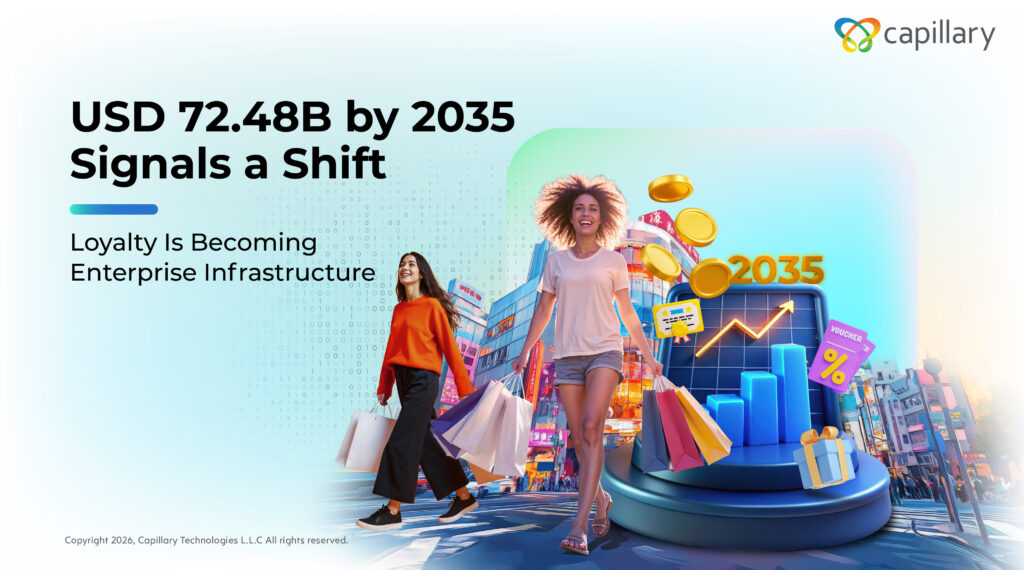
In 2024, the global loyalty management market was valued at USD 6.8 billion. By 2025, it is projected to reach USD 8.432 billion. And by 2035, it is expected to expand to USD 72.48 billion, growing at a CAGR of 24 percent. (Source)

Most headlines will frame this as momentum.
It is more accurate to read it as reclassification.

Markets do not compound at this rate for a decade because buyers want marginal upgrades. They grow like this when what is being purchased fundamentally changes. In loyalty, enterprises are no longer buying programs, points engines, or campaign tooling. They are buying capability.

A new layer of enterprise logic.

The ability to recognize customers across channels, decide the next best action in real time, and govern value exchange with precision, trust, and economic accountability.

That is what this number is actually signaling.

Loyalty is shifting from a program layer to an operating layer.

The Loyalty Model Enterprises Are Quietly Leaving Behind

For years, enterprise loyalty lived in a predictable box. It was scoped as a marketing initiative, operated like a promotions system, and justified as a cost line. Earn rules. Burn rules. Tier thresholds. Catalog refreshes. Quarterly campaigns.

That model assumed stable journeys and patient customers.

Neither exists anymore.

Customer behavior is fluid. Identity is fragmented. Channels bleed into one another. Signals arrive continuously. Expectations reset faster than planning cycles. And trust has become a binding constraint, not a soft metric.

A single customer might browse in the morning, abandon by noon, purchase in-store after work, contact support the next day, and leave a review days later. Static logic cannot keep up with a journey that behaves like a live system.

So enterprises are repurposing loyalty, often without announcing it.

Not as something customers opt into, but as something the business relies on. A system that helps decide how to engage, when to intervene, what to reward, and when to step back, across the entire lifecycle.

That is the infrastructure shift.

Why “Enterprise Infrastructure” Is a Precise Description, Not a Metaphor

True enterprise infrastructure has three defining traits.

It is always on.
It is cross-functional.
And it is accountable to outcomes.

That is exactly what loyalty is now expected to be.

Always on, because relevance windows have collapsed. The most effective retention actions happen before churn is visible. The most valuable experience upgrades occur mid-journey, not after a segmentation refresh.

Cross-functional, because loyalty decisions now touch pricing discipline, margin protection, service prioritization, partner benefits, identity resolution, returns logic, and omnichannel orchestration. Loyalty is no longer supporting marketing alone. It is feeding decisioning across growth, commerce, and experience.

Accountable, because financial scrutiny has sharpened. Engagement without incrementality is no longer acceptable. Enterprises want proof that loyalty drives profitable behavior, not subsidized demand.

Viewed through this lens, USD 72.48B stops being abstract. It reflects enterprises investing in loyalty platforms as durable systems for decisioning, orchestration, and measurement at scale.

The Real Constraint Is Not Ideas. It Is Velocity With Control.

There is a persistent myth that loyalty performance suffers from lack of creativity. In reality, most enterprises are overflowing with ideas.

The bottleneck is operational.

How quickly insight becomes action.
Across channels.
With governance.

Loyalty still moves at campaign speed in most organizations. That cadence is incompatible with customers who behave in real time. Over the next decade, the gap will widen between brands that build fast, governed loyalty systems and those that rely on periodic execution.

Speed without governance creates risk.
Governance without speed creates irrelevance.

The winners will master both.

The Capillary Technologies Thesis: Loyalty as an Intelligent Operating System

This is the context in which Capillary Technologies has been building.

Not to modernize legacy loyalty, but to re-architect loyalty for enterprise reality. Real-time intelligence. Orchestration at scale. Measurable business impact.

Capillary Technologies works with 390+ global brands across 45+ countries, powers 100+ enterprise loyalty programs, and manages engagement for 1.2 billion loyalty members worldwide, supported by 650+ employees.

These numbers matter because they reflect operational exposure, not positioning.

Running loyalty at billion-member scale is not a feature challenge. It is a systems challenge. It forces hard choices around real-time decisioning, identity resolution, experimentation discipline, and cost governance. It exposes the limits of batch processing, static rulebooks, and siloed data.

This is why “future-ready” is not branding. It is architecture.

It means responding to behavior as it happens, not retroactively.
It means activating loyalty logic consistently across channels.
It means scaling personalization without manual complexity.
And it means measuring economics rigorously enough that loyalty earns its place as a growth investment, not a discretionary expense.

This is also why the AI conversation in loyalty has matured. The objective is not novelty. It is cycle-time compression between signal and action, without losing control over trust, brand intent, or cost discipline.

Capillary’s AI-first direction and aiRA are expressions of that operating model shift.

At Scale, Loyalty Stops Being Marketing. It Becomes Infrastructure.

There is a difference between building loyalty software and operating loyalty at scale.

Platforms that support hundreds of enterprise brands across markets must navigate regulatory complexity, identity fragmentation, omnichannel execution, and vastly different consumer behaviors. Supporting brands like Tata Digital, NASCAR, Shell, Domino’s, and Dell is not about edge cases. It is about uptime, revenue sensitivity, and mission-critical decisioning.

At that level, loyalty is no longer an experiment.

It is infrastructure.

Which brings us back to USD 72.48B by 2035.

The loyalty market is scaling faster than most loyalty stacks are evolving. That gap between expectation, need, and execution will not be closed with better catalogs or richer rewards.

It will be closed by re-architecting loyalty as enterprise infrastructure.

A Clearer Way to Read USD 72.48B

If the market truly reaches USD 72.48B by 2035, the implication is not that every brand will run a larger program.

It is that more enterprises will treat loyalty the way they treat CDPs, commerce engines, and marketing automation. As a core capability, not a periodic initiative.

That shift will reward platforms designed for modularity, real-time execution, governance, and measurement. It will penalize those built for relaunch cycles.

Growth will not be evenly distributed. It will accrue to systems that scale relevance and trust, not generosity.

Closing POV

The loyalty category is being repriced because the enterprise problem has changed.

Retention is harder.
Attention is scarcer.
Data expectations are higher.
And growth teams are under pressure to prove efficiency, not activity.

Yes, USD 72.48B by 2035 represents opportunity.

But the deeper message is this:

The future of loyalty belongs to platforms that behave like enterprise infrastructure.

Capillary Technologies is future-ready because it is building loyalty as a system, not a program.

In a world where loyalty is becoming enterprise logic, that distinction is not philosophical.

It is decisive.

Share

Similar Articles

Contact Us

Get the best loyalty & customer engagement platform out there!

  • Design industry shaping loyalty programs
  • Integrate easily and go live quicker
  • Deliver hyper-personalized consumer experiences
Request A Call

From Month-Long Campaign Planning to Same-Day Execution: How AI Is Changing CRM Operations

March 2026

AI transforms loyalty campaign planning by compressing weeks of strategy, segmentation, and execution into hours, enabling CRM teams to launch faster, optimize in real time, and focus on strategic decision-making rather than operational bottlenecks.

The Challenge Loyalty Teams Know Too Well

If you have managed a CRM or loyalty program for any meaningful period of time, the campaign planning cycle will feel familiar.

A major retail moment approaches. Ramadan across the Middle East. An End-of-Season Sale in fashion. Black Friday in the United States. Boxing Day across Europe.

The planning process typically unfolds in predictable stages.

First comes strategy definition: identifying the target audience, allocating budgets, and determining offer mechanics. This alone can take five to eight days.

Next comes analytics and segmentation. Data models are built, customer cohorts are scored, and segments are validated against historical behavior. Depending on data complexity, this step can take another seven to ten days.

Then the campaign setup phase begins. Variants are created across markets and languages, incentives are configured, messages are drafted, and journeys are tested. This stage often consumes eight to twelve days.

Finally, the campaign moves through review and launch, including stakeholder approvals, QA checks, and deployment. Even under optimal circumstances, this adds another two to four days.

End-to-end, the cycle easily stretches to 20–30+ man-days of effort. And that estimate assumes minimal rework or iteration.

The issue is rarely the team. Most CRM teams are highly capable.

The challenge lies in the process itself. By the time the campaign launches, the window of opportunity it was designed for may already be narrowing.

The Shift Toward AI-Orchestrated Campaign Planning

Artificial intelligence is not replacing CRM teams. Instead, it is removing operational bottlenecks that have historically slowed campaign execution.

When integrated correctly, AI-driven CRM operations transform how campaigns are designed, built, and optimized.

The most effective implementations start with something simple but powerful: encoding real business constraints into the planning process.

Instead of asking AI to “generate a campaign,” marketers can input the actual parameters that govern campaign decisions:

  • Budget limits
  • ROI thresholds
  • Margin guardrails
  • Incentive caps
  • Channel spend limits across SMS, email, and push notifications
  • Regional promotion rules

With these constraints in place, the output is no longer a generic campaign proposal. It becomes a structured plan aligned with the realities of the business.

What previously required multiple rounds of planning and stakeholder revisions can often be resolved in a single iteration.

Platforms that combine AI with a unified customer data platform enable this shift by allowing marketers to operate on real-time customer intelligence rather than fragmented campaign data.

From Blank Page to Campaign Framework in Hours

One of the most time-consuming steps in campaign planning has always been the strategy phase.

AI can now accelerate this dramatically.

By analyzing historical campaign performance, member behavior, tier structures, and margin thresholds, AI-powered systems can generate a complete campaign framework within hours.

This includes:

  • Segment-level targeting recommendations
  • Offer structures aligned with business objectives
  • KPI projections such as basket size, transaction value, and purchase frequency
  • Incentive mechanics tailored to different customer cohorts

Consider a Ramadan promotion spanning six markets, or a three-week end-of-season markdown campaign across multiple store locations.

Traditionally, developing the strategy alone might require week-long workshops across marketing, analytics, and merchandising teams.

With AI-powered campaign planning, the first structured draft can emerge within an afternoon.

The team’s role shifts from building the strategy to validating and refining it.

Accelerating Segmentation and Targeting

Segmentation is another area where campaign timelines typically expand.

Analysts often spend days identifying behavioral patterns, scoring customers, and validating segments across markets.

AI can compress this process significantly.

With a unified customer data foundation, customer behavior can be analyzed in a single pass to identify patterns such as:

  • Seasonal purchasing behaviors
  • Ramadan-specific shopping signals
  • Lapsed-customer reactivation opportunities
  • Cross-category purchase correlations

Segments can be generated with propensity scores and projected performance metrics, allowing stakeholders to review targeting strategies immediately.

Importantly, these systems are not black boxes. The logic behind each segment remains transparent, allowing teams to adjust, challenge, or refine the recommendations with full context.

What previously required seven to ten days of analytical effort can often be completed in a single working session.

From Reporting to Real-Time Decision Support

Campaign analytics has traditionally been retrospective.

Before launch, teams prepare projections based on historical performance. After launch, analysts compile results into dashboards or spreadsheets that may take weeks to interpret.

AI changes the role of analytics from reporting to real-time decision support.

Before a campaign goes live, AI can generate projected impact models estimating expected uplift across key metrics such as:

  • Conversion rates
  • Average transaction value
  • Incremental revenue

After launch, performance analysis can be produced as a structured narrative rather than raw data tables.

Instead of navigating dozens of spreadsheet tabs, teams receive clear insights on:

  • What worked
  • What underperformed
  • What adjustments should be made

This allows CRM teams to spend less time assembling reports and more time acting on insights.

Mid-Campaign Optimization Becomes Practical

The most transformative shift occurs once campaigns are live.

Historically, performance reviews occurred weekly or even monthly. By the time issues were identified, the campaign window was often already closing.

With AI integrated into campaign execution, teams can analyze performance within hours rather than weeks.

If results begin to decline, the system can quickly diagnose possible causes:

  • Incorrect segment targeting
  • Offer fatigue
  • Underperforming channels
  • Messaging inefficiencies

This allows teams to revise strategy mid-campaign by adjusting segments, modifying incentives, or reallocating budget while the campaign is still active.

Campaign execution moves from static planning to dynamic optimization.

What AI Cannot Replace

Despite its advantages, AI does not eliminate the need for human judgment.

Brand context still matters.

AI may identify high-value segments, but it cannot determine how a brand should express itself during culturally significant moments such as Ramadan or Black Friday. A luxury retailer and a value retailer may interpret the same data very differently.

Organizational alignment remains essential.

Many campaign delays are caused not by analytics but by coordination across marketing, merchandising, procurement, and finance. AI cannot replace those decision-making processes.

The most effective systems therefore adopt a human-in-the-loop model.

AI generates recommendations and accelerates analysis, but final approval and strategic judgment remain with the team.

The Competitive Advantage: Speed of Learning

In modern loyalty and CRM environments, differentiation is increasingly defined by operational speed.

The brands that outperform are not simply those with the most sophisticated programs. They are the ones that can:

  • Plan faster
  • Launch faster
  • Learn faster
  • Adjust faster

In markets where consumer behavior shifts weekly, a 30-day campaign planning cycle becomes a structural disadvantage.

AI is fundamentally changing that equation.

By compressing campaign planning from weeks to hours and enabling real-time optimization, organizations can operate with a level of agility that was previously impossible.

The gap between teams that adopt AI-powered CRM and loyalty platforms and those that rely on traditional workflows will only continue to widen.


See How AI Can Accelerate Your CRM Operations

Modern CRM teams need the ability to move from strategy to execution in hours rather than weeks.

With AI-powered loyalty and customer engagement platforms, brands can design campaigns faster, analyze performance instantly, and optimize customer engagement in real time.

Explore how Capillary Technologies helps brands transform CRM operations with AI-powered loyalty and customer engagement platforms.

Share

Similar Articles

Contact Us

Get the best loyalty & customer engagement platform out there!

  • Design industry shaping loyalty programs
  • Integrate easily and go live quicker
  • Deliver hyper-personalized consumer experiences
Request A Call