Gamify or Get Left Behind: How Interactive Loyalty is Winning the DACH Region

June 2026

Gamified, personalized loyalty programs are becoming the key differentiator in the DACH region, helping brands boost engagement, retention, and customer lifetime value by turning passive rewards into interactive experiences.
The foundational architecture of customer loyalty is shifting across Germany, Austria, and Switzerland. The days of plastic loyalty cards and generic paper coupons are fading. Today’s consumers expect seamless, highly personalized digital experiences, but then again –  merely offering an app is no longer enough to secure their attention.

The DACH Loyalty Paradox: High Enrollment, Low Engagement

On paper, the digital transformation of loyalty in the DACH region looks highly successful. Recent data from the DACH Loyalty Report 2026 shows that 73.8% of DACH shoppers would switch to a digital loyalty solution, and 61% explicitly demand personally tailored offers. The financial upside of meeting this demand is massive, as customers spend an average of 27.9% more after engaging with a targeted loyalty program. (1)

However, a closer look reveals a significant “experience gap.” While the average European consumer belongs to around nine different loyalty programs, they actively use only a fraction of them. The modern digital marketplace is saturated with “sameness,” predictable earn-and-burn points systems, and static discount tiers. To prevent app fatigue and customer churn, brands must transition their loyalty propositions from passive, points-based programs to active, personalised engagement that also recognises broad behaviour as well.

The most powerful mechanism to achieve this is gamification.

The Psychological Architecture of Gamification

The DACH market is not completely alien to the concept of gamification, and there are companies such as Deutsche Bahn that frequently have games on the mobile app during the Christmas season, Easter break, etc., that offer their members easy-to-play games with tangible rewards. These are highly contextual and offer members a chance to play when they have the time – during travel.

That said, gamification does not have the widespread adoption that brands would benefit from.

It is worth noting that gamification is not merely a marketing trend; it is also a proven behavioral strategy supported by extensive academic research. Studies published in the Journal of Theoretical and Applied Electronic Commerce Research confirm that gamification fulfills fundamental human psychological needs, such as autonomy, competence, and social relatedness, which leads directly to higher brand engagement and deep-rooted loyalty. (2)

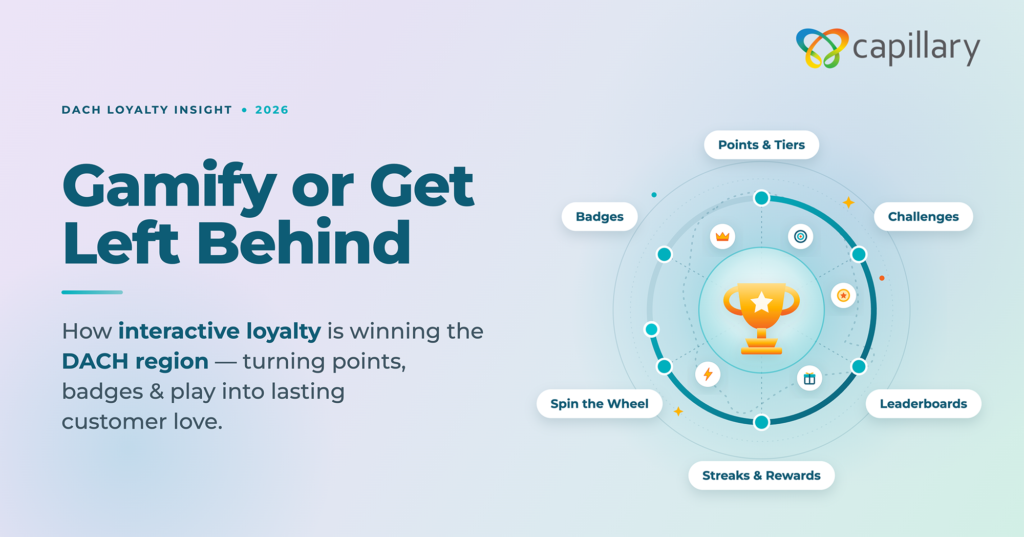
By weaving game design elements, such as tiered milestones, digital badges, interactive quizzes, and chance-based “spin-to-win” wheels, into the customer journey, brands trigger intrinsic motivation. Customers stay engaged because they genuinely enjoy the interactive process, rather than just waiting for a delayed financial discount.

Retailers such as Rewe, through its “Rewe Bonus” program, have started offering its members the opportunity to redeem vouchers, earn cashbacks, and also collect digital stamps on the mobile app. This ensures that customers get short-term/immediate benefit, and also accumulate something for a long-term reward as well.

The business impact is undeniable. The global gamification market, valued at $36.86 billion in 2025, is projected to scale aggressively to $308.85 billion by 2034. (3) Implementing gamified features leads directly to a 30% increase in customer retention and can boost overall brand engagement by 47%. (4) Furthermore, 73% of consumers report viewing a brand more favorably when quality rewards are presented through gamified experiences. (4)

How the Shift Looks in Practice and what does it mean for your brand?

Putting the data together gives us a composite diagnosis of how loyalty programs are evolving:

      Layer

Traditional Loyalty

Gamified Loyalty

      Strategy

Points strictly for financial transactions

Engagement via daily interactions and interactive challenges

      Reward Structure

Static discounts and predictable coupons

Variable rewards, digital badges, and exclusive status tiers

      Customer Motivation

Extrinsic (chasing financial gain)

Intrinsic (autonomy, competence, social relatedness)

      Data Gathering

Transactional purchase history only

Behavioral tracking, zero-party data, and real-time interaction

DACH Region Case Studies: Real-World ROI

We are already seeing this approach benefit brands and retailers across Germany, Austria, and Switzerland as they use these tools to drive measurable ROI:

  • A Leading Swiss Grocery Retailer: When this supermarket chain needed to boost sign-ups for its new loyalty program, it implemented an interactive digital memory game. The engagement was so successful that more than 50% of the players signed up for the loyalty program after completing the challenge. (5) Later, their gamified 24-day digital Advent Calendar generated over 150,000 visits and captured more than 86,000 highly qualified leads. (5)

  • A Global Automotive Brand: This brand’s regional loyalty app utilizes digital “lootboxes” filled with randomized rewards to gamify the driving experience. By rewarding users with digital items for their vehicle avatars, they transformed an infrequent automotive transaction into a daily brand interaction. (6)

  • A Major Coalition Loyalty Program: The region’s absolute largest coalition program recently launched a “Games World” directly inside its app, completely shifting user session duration by allowing members to earn loyalty currency simply by playing vetted mobile games. (7)

  • A Quick-Service Restaurant Chain (Global Innovation): Showcasing the future of location-based gamification, this fast-casual brand triggered a “Spin & Win” digital wheel on users’ phones the exact moment they walked near a retail location. This frictionless, proximity-based gamification resulted in a 20% engagement rate and a massive 23% lift in new loyalty user sign-ups. (8)

 Level Up with Capillary’s Gamification Specialty Services

Technology alone isn’t enough; strategy is what makes gamification stick. At Capillary Technologies, we believe that to stand out in a saturated market, your brand must build a deep emotional connection with your consumers. With our dedicated DACH regional team in Munich, we are committed to bringing our advanced loyalty infrastructure to local enterprises.

Recently named a Leader with the highest scores in both current offering and strategy in The Forrester Wave™: Loyalty Platforms, Q4 2025, Capillary’s modular SaaS suite empowers brands to orchestrate these complex journeys. (9) Utilizing platforms like Loyalty+ alongside our aiRA generative AI assistants, brands can rapidly deploy hyper-personalized, gamified campaigns at scale.

Beyond the software, Capillary offers specialized Gamification and Loyalty Consulting Services. Our team provides bespoke Program Design and Redesign services to build highly engaging, gamified initiatives from the ground up. We don’t just add arbitrary leaderboards; we apply proven behavioral mechanics to your specific audience, ensuring that every challenge and reward is scientifically engineered to boost your Balanced Loyalty Quotient (BLQ) and drive measurable revenue.

Adding a gamified layer to your loyalty ecosystem is no longer optional; it is a baseline requirement to secure customer lifetime value in the modern economy. It is time to let Capillary’s technology and consulting experts level up your loyalty strategy and turn passive shoppers into lifelong brand advocates.

Case in point

Working with Jotun in Vietnam, Capillary’s AI models surfaced a recurring dip in weekly sales every Friday, right in the middle of the end-of-year refurbishment boom, when painters were busiest. Instead of discounting their way out of it, the brand turned the soft spot into a game. “Golden Friday” let painters scan a QR code on their paint purchase, win instantly, and share the moment, three mechanics (gameplay, instant gratification, and word-of-mouth) compressed into a few taps. Simple enough that anyone could play, sticky enough that they came back week after week.

The real edge was in the prize, not just the play. Gold carries deep cultural weight in Vietnam, where receiving it around the New Year is considered highly auspicious, so the rewards didn’t just feel valuable, they plugged straight into sentiment painters already held. The payoff: a 1,250% lift in Friday sales, 12X more paint purchased, and a 30% jump in registrations, amplified by Facebook and Zalo campaigns that reached 1.25M. It’s proof that the best gamification isn’t about points and confetti, it’s about reading behavior, finding the dead day, and rewarding people in a way that genuinely means something to them.

Where to start, and what are the risks of getting it wrong

So where do you begin, and how do you avoid the traps? Gamification is easy to get wrong. Bolt a spin-to-win wheel onto an app with no behavioural rationale and you just add another notification to ignore, feeding the fatigue and “sameness” that already drive churn. Done badly it can feel manipulative, reward the wrong behaviours, burn margin on giveaways that don’t lift engagement, and erode hard-won trust in a privacy-conscious DACH market. The fix is to start with a diagnosis, not a feature. 

As Jotun showed, the win came from spotting one specific soft spot, a dead sales day, and rewarding something the audience genuinely cared about. So begin small: pick one high-friction moment, match it to what actually motivates your customers, and pilot a single mechanic with clear metrics before scaling. That’s where strategy beats technology, and where Capillary comes in: our consulting team engineers each mechanic against your audience and Balanced Loyalty Quotient (BLQ), then uses Loyalty+, gamification, and aiRA to deploy and refine it at scale.

Sources and further reading:

(1) Hello Again. (2025). DACH Loyalty Report 2026. Hello Again Whitepapers.

(2) Li, N., & Aumeboonsuke, V. (2025). How Gamification Features Drive Brand Loyalty: The Mediating Roles of Consumer Experience and Brand Engagement. Journal of Theoretical and Applied Electronic Commerce Research, 20(2), 113.

(3) Fortune Business Insights. (2025). Gamification Market Size, Share & Industry Analysis, 2026-2034.

(4) Fluent. (2025). How Gamified Loyalty Programs Engage Customers Beyond the Checkout. Fluentco Insights.

(5) Brame. (2025). Loyalty Reloaded: How SPAR Switzerland Innovated Customer Engagement Through Gamification. Brame Customer Stories.

(6) Lindemann, T. (2024). Gamification Examples in the Automotive Sector: Porsche Austria BONEO. Thomas Lindemann Gamification.

(7) PAYBACK Group. (2025). Mit Spiele-Apps Punkte sammeln! PAYBACK Spielewelt. PAYBACK.de.

(8) Flybuy. (2026). Flybuy powers new location-triggered gamification experiences that increase app downloads and loyalty adoption. PR Web.

(9) Capillary Technologies. (2025). The Forrester Wave™: Loyalty Platforms, Q4 2025.


Share

Similar Articles

Contact Us

Get the best loyalty & customer engagement platform out there!

  • Design industry shaping loyalty programs
  • Integrate easily and go live quicker
  • Deliver hyper-personalized consumer experiences
Request A Call

Beyond Engagement: Why Healthcare Needs a Member Action Platform

Healthcare organizations today are confronting an uncomfortable reality.

They have more data than ever. More predictive insight than ever. More engagement channels than ever. And still, not enough completed care.

Care gaps remain open. Medication adherence lags. Preventive screenings are missed. Annual Wellness Visits go unscheduled. Risk adjustment opportunities remain incomplete. Members disengage. Avoidable utilization continues. And care teams are stretched thin trying to manually bridge the gap between what analytics identify and what members actually complete in the real world.

That gap is not a data problem.

It is not even only an engagement problem.

It is an orchestration problem.

Healthcare has made tremendous progress identifying risk. Across Medicare Advantage, Medicaid, and Commercial populations, organizations increasingly know which members are overdue for care, which populations are driving avoidable utilization, where quality performance is under pressure, and where intervention opportunities exist.

But insight alone does not improve outcomes.

A health plan may know which diabetic members are overdue for an A1C test. It may know which Medicare Advantage members need an Annual Wellness Visit. It may know which members are at risk of medication non-adherence, postpartum care dropout, or avoidable emergency department use.

But unless those members understand the next step, overcome friction, schedule the appointment, attend the visit, refill the prescription, complete the screening, or follow through on the care plan, the insight never becomes impactful.

The challenge is no longer visibility.

The challenge is conversion.

Healthcare organizations have spent the last decade investing in analytics platforms, population health tools, digital front doors, care management systems, CRM platforms, communication engines, provider enablement, and engagement programs. These investments were necessary. They gave healthcare organizations a clearer view of who needs what, when, and why.

But this is where many organizations have stalled.

They have built sophisticated systems to identify risk, but not equally sophisticated systems to convert identified opportunities into completed member action.

One platform identifies the care gap. Another sends the communication. Another manages the incentive. Another coordinates the provider. Another tracks the outcome. Each system may perform its function. But members do not experience healthcare as a stack of disconnected technologies.

They experience it as one journey.

And when that journey is fragmented, value leaks at every handoff.

Healthcare Has a Completion Problem

For years, healthcare organizations have treated engagement as the primary lever for improving outcomes.

Send more reminders. Launch more campaigns. Increase portal adoption. Improve open rates. Drive app usage. Promote rewards. Encourage members to complete Health Risk Assessments.

These efforts matter. But engagement was never the outcome. It was only meant to be the mechanism.

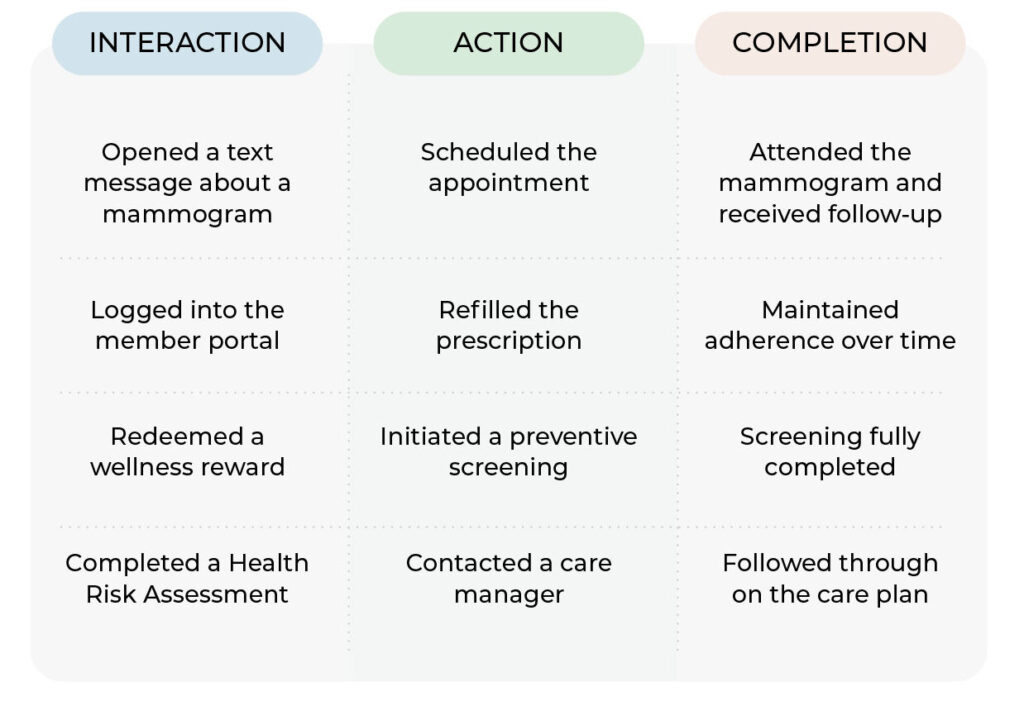
A member opening a text message about a mammogram does not mean the appointment was scheduled. A portal login does not mean medication adherence is improved. A reward redemption does not mean a preventive screening was completed. A completed Health Risk Assessment does not guarantee follow-through on care.

Healthcare has become very good at measuring interaction.

But interaction is not the same as action.

And action is not the same as completion.

The metric that ultimately matters is not whether the member is engaged. It is whether the member completed the healthcare action that improves quality, reduces risk, lowers avoidable cost, or supports better health.

That distinction is critical.

In Medicare Advantage, completed action may mean an Annual Wellness Visit is finished, a medication is refilled on time, a diabetes care gap is closed, a mammogram is completed, or a provider visit results in accurate documentation for RAF capture.

In Medicaid, completed action may mean a postpartum visit occurs despite transportation barriers, a pediatric preventive visit is scheduled, or a member receives the right guidance before choosing the emergency department.

In Commercial populations, completed action may mean a member chooses virtual care or an in-network provider, participates in chronic condition management, completes a preventive screening, or navigates benefits before costs escalate.

Across all populations, the pattern is the same.

Healthcare organizations know what needs to happen.

But members still struggle to complete it.

The Real Barrier Is Friction

Healthcare actions are rarely one step.

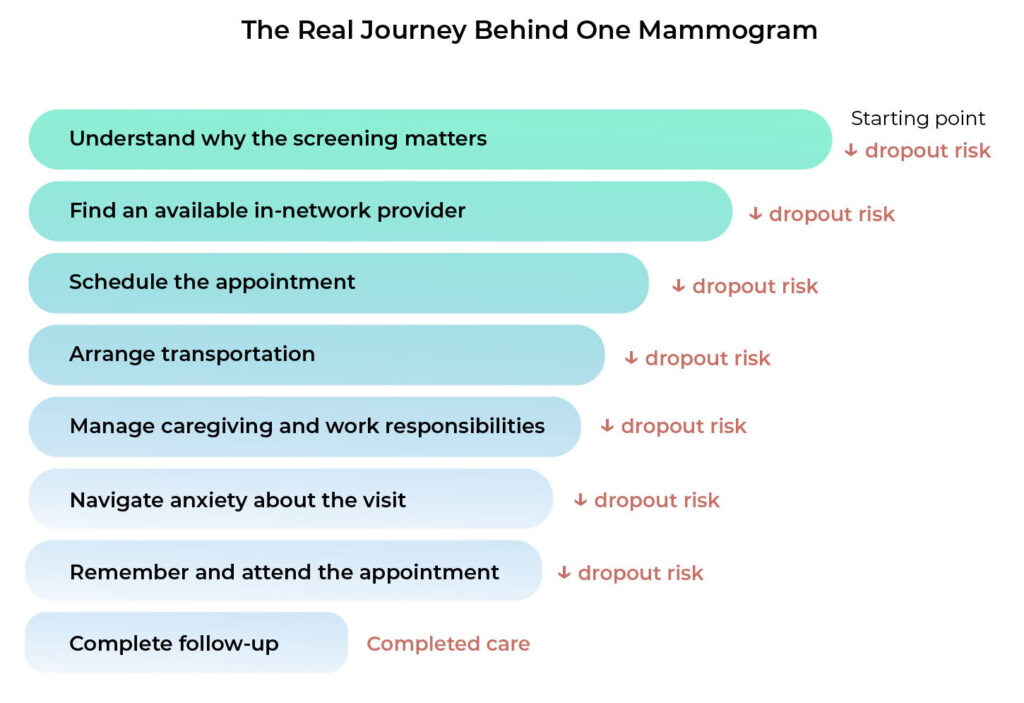
A mammogram is not simply a mammogram. It may require understanding why the screening matters, finding an available provider, scheduling the appointment, arranging transportation, managing work or caregiving responsibilities, navigating anxiety, remembering to attend, and completing follow-up if needed. It may also require understanding the costs and risks of inaction.

A medication refill is not simply a reminder. It may involve affordability concerns, pharmacy access, side effects, confusion about instructions, or lack of perceived urgency. Again, understanding the costs and risks associated with inaction are significant to driving completion.

A postpartum visit is not simply an appointment. It may involve childcare, transportation, language access, trust, cultural context, scheduling limitations, and competing life priorities.

Every additional step creates dropout risk.

And friction compounds.

Members often do not fail to act because they are unwilling. They fail because healthcare remains too difficult to navigate. They fail because they don’t understand the costs and risks of inaction.

At the same time, outreach saturation has made the problem worse. Most health plans now operate multiple independent engagement motions across quality, pharmacy, care management, disease management, behavioral health, wellness, provider engagement, maternal health, and rewards.

A single member may receive several communications in a week. Each message may be individually valid. Collectively, they may feel fragmented, repetitive, or overwhelming.

The healthcare system unintentionally competes with itself for member attention.

The issue is not communication volume.

It is communication coordination.

Healthcare does not need more disconnected outreach. It needs a coordinated activation model that helps members move from identified need to completed action.

Introducing the Member Action Platform

The next evolution of healthcare performance requires a new orchestration layer.

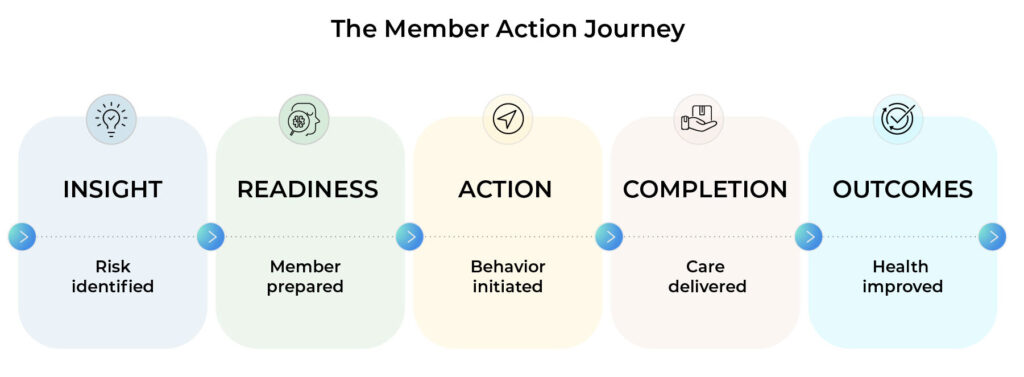
A Member Action Platform is an end-to-end, modular, AI-driven orchestration layer designed to help healthcare organizations move members from:

Insight → Readiness → Action → Completion → Outcomes

It is not another communication tool. It is not another engagement application. It is not another isolated care management workflow.

It is a coordination layer that connects predictive intelligence, behavioral science, personalized engagement, incentive orchestration, navigation support, provider workflow alignment, and outcomes attribution into one activation model.

The Member Action Platform does not replace the infrastructure healthcare organizations have already built. It connects and activates it.

It helps existing systems work together so that more of what healthcare already identifies actually gets done.

Traditional engagement systems ask:

Did we reach the member?

A Member Action Platform asks:

Did the member complete the healthcare action?

That shift changes everything.

It moves healthcare from campaign execution to journey orchestration. From awareness to readiness. From communication to completion. From activity metrics to measurable outcomes.

The Architecture of Action

To convert insight into outcomes, healthcare organizations need more than communication. They need coordinated capabilities that work together across the member journey.

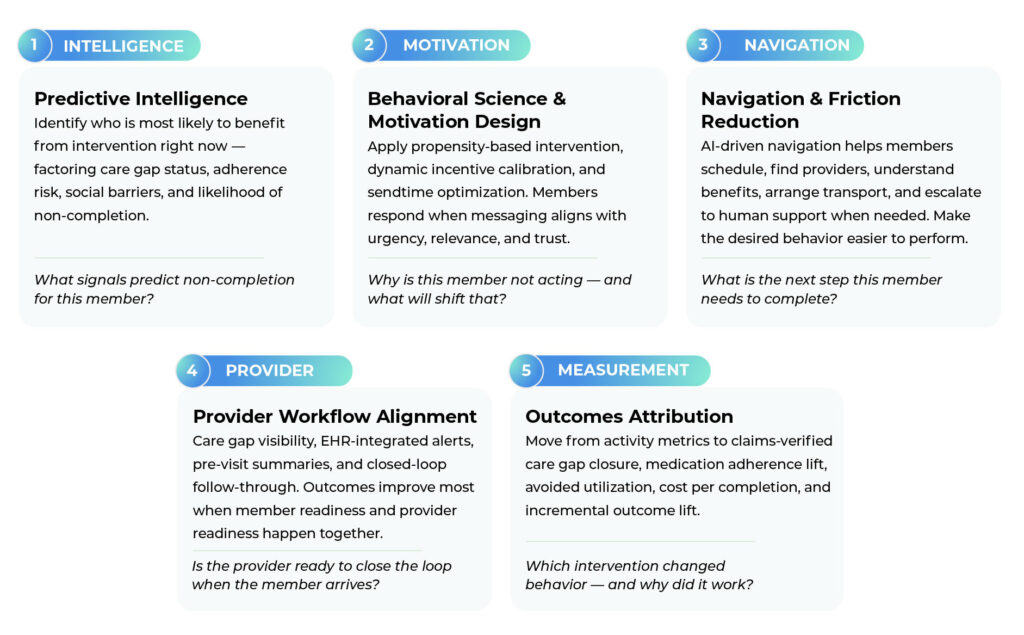
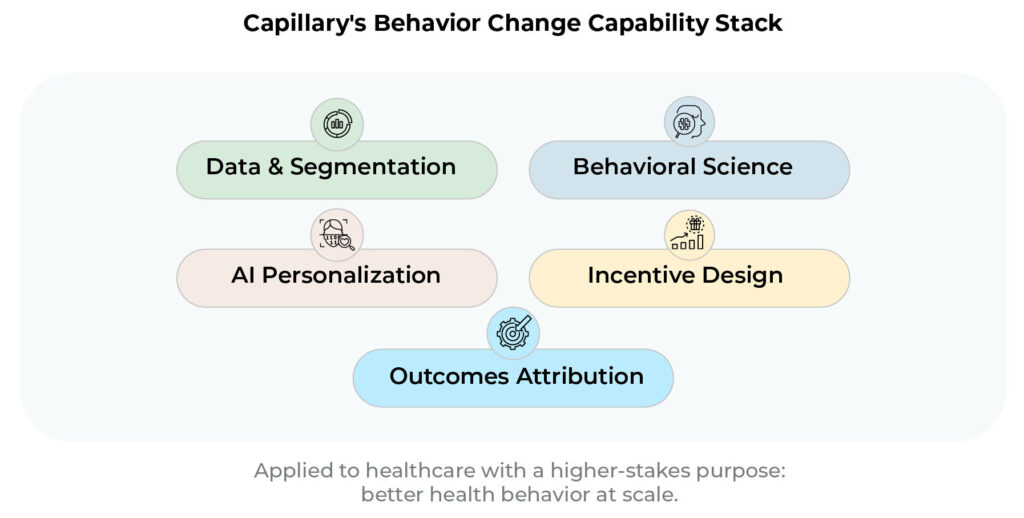
A Member Action Platform brings together five essential functions.

1. Predictive Intelligence

Healthcare organizations already possess rich data assets across claims, pharmacy, clinical, lab, behavioral, provider, and engagement systems.

But action requires prioritization.

The goal is not simply identifying risk. It is identifying who is most likely to benefit from intervention right now, what action matters most, and which barriers may prevent completion.

This includes signals such as care gap status, RAF opportunity, medication adherence risk, utilization history, engagement behavior, social barriers, provider access, and likelihood of non-completion.

2. Behavioral Science and Motivation Design

Healthcare often assumes that information changes behavior. In reality, completion depends on motivation, ability, timing, trust, and context.

Members may ignore generic reminders but respond when messaging aligns with urgency, personal relevance, convenience, progress, rewards proximity, or trusted relationships.

A Member Action Platform applies behavioral science to personalize when to intervene, how to intervene, which channel to use, and what nudge or incentive is most likely to drive completion.

This includes milestone motivation, propensity-based intervention, dynamic incentive calibration, send-time optimization, preferred channel orchestration, and journey-based nudges.

The objective is simple: fewer abandoned journeys and more completed care.

3. Navigation and Friction Reduction

Most members do not need another reminder. They need help completing the next step.

Navigation is where AI can have one of its most practical and powerful roles in healthcare.

AI-driven healthcare activation can help members understand what care is needed, why it matters, where to go, how benefits apply, which provider to choose, how to schedule, what to prepare, and when to escalate to human support.

This may include appointment scheduling, provider matching, transportation coordination, multilingual support, benefits navigation, pre-visit preparation, virtual care connection, urgent versus emergency care guidance, and nurse or care manager escalation when needed.

The opportunity is not automation for its own sake.

It is intelligent navigation.

Make healthcare easier to complete, because when healthcare becomes easier to navigate, outcomes improve.

4. Provider Workflow Alignment

Completion does not depend only on member readiness. It also depends on provider readiness.

A member may arrive for a visit, but if the provider lacks care gap visibility, pre-visit context, documentation prompts, referral visibility, or follow-up workflows, value can still leak from the journey.

A Member Action Platform extends orchestration into provider environments by supporting care gap visibility, EHR-integrated alerts, pre-visit summaries, documentation readiness, referral coordination, and closed-loop follow-through.

This matters especially for Medicare Advantage, risk adjustment, HEDIS performance, Annual Wellness Visits, chronic condition documentation, and value-based care.

Healthcare outcomes improve most when member action and provider readiness occur at the same time.

5. Outcomes Attribution

Healthcare has historically measured activity because activity is easy to see.

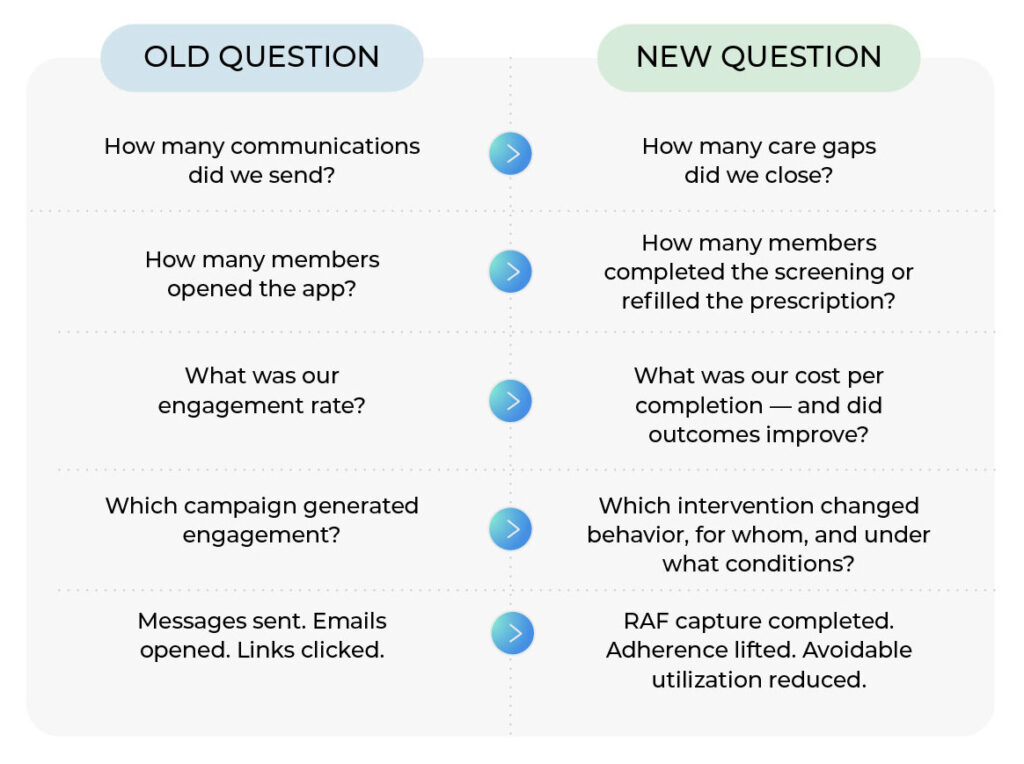
Messages sent. Emails opened. Links clicked. App sessions completed. Rewards redeemed.

But future-performing healthcare organizations will measure incremental outcomes.

The question is no longer:


Which campaign generated engagement?

The question is:

Which intervention changed behavior?

A Member Action Platform should help organizations measure claims-verified care gap closure, medication adherence lift, Annual Wellness Visit completion, preventive screening completion, RAF opportunity completion, avoided utilization, cost-per-completion, incremental lift, quality performance improvement, retention impact, and return on incentive investment.

This level of measurement allows healthcare organizations to understand not only what happened, but why it happened.

Why Modularity Matters

Healthcare ecosystems are complex. No two organizations operate the same way.

Health plans, providers, PBMs, care management teams, retail health organizations, digital health companies, and value-based care organizations all have different workflows, systems, data maturity, regulatory needs, and member populations.

No technology platform should require healthcare organizations to abandon investments they have already made.

That is why the future of healthcare activation must be modular by design.

Organizations need the ability to adopt orchestration capabilities incrementally based on where the greatest opportunity exists today.

For one organization, that may mean closing medication adherence gaps. For another, it may mean improving preventive screening completion, supporting maternal health journeys, increasing RAF capture, reducing avoidable utilization, or improving member retention.

A modular Member Action Platform allows healthcare organizations to start with high-priority use cases while building toward a broader activation infrastructure.

Immediate priorities may include:

  • Closing medication adherence gaps
  • Completing preventive screenings
  • Improving RAF capture and documentation readiness
  • Supporting Annual Wellness Visits
  • Activating maternal and chronic care journeys
  • Reducing avoidable emergency department utilization
  • Improving access and navigation for vulnerable populations
  • Driving retention through meaningful member engagement
  • Personalizing incentives based on action complexity and member readiness
  • Connecting digital and human-assisted journeys
  • Measuring cost-per-completion and incremental outcome lift

The goal is not disruption for the sake of disruption.

It is acceleration.

Healthcare organizations do not need another disconnected system. They need an orchestration layer that helps the systems they already have work harder, smarter, and more cohesively.

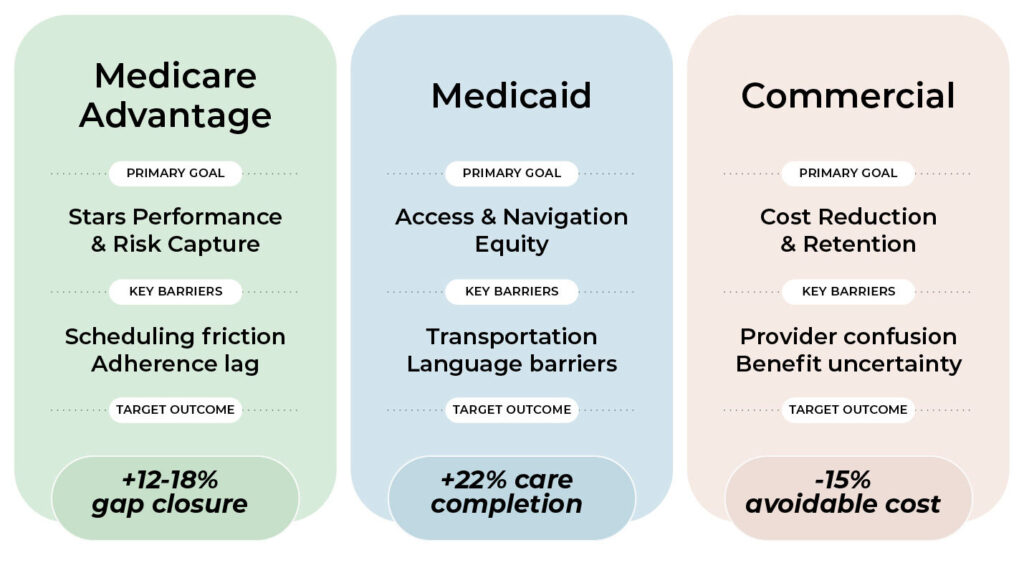
One Core Challenge Across Medicare Advantage, Medicaid, and Commercial Populations

Healthcare organizations often treat Medicare Advantage, Medicaid, and Commercial populations as separate engagement challenges.

Operationally, they are different.

Strategically, they share the same activation problem.

Identified opportunities frequently fail to convert into completed healthcare action.

Medicare Advantage: Quality, Risk Capture, and Retention

In Medicare Advantage, the stakes are especially high. Plans must improve Stars performance, medication adherence, preventive screening rates, Annual Wellness Visit completion, chronic condition management, member retention, and risk adjustment accuracy.

Most plans already know which members are overdue for care, where adherence risk exists, which care gaps are open, and where quality performance is under pressure.

The challenge is helping members complete the action and ensuring providers are ready to document and close the loop.

A Member Action Platform can support Medicare Advantage organizations through predictive prioritization, Health Buddy navigation, personalized incentives, scheduling support, transportation coordination, pre-visit readiness, provider workflow alignment, RAF documentation support, and claims-verified outcome measurement.

The result is stronger quality performance, improved medication adherence, better preventive care completion, more complete risk capture, and stronger member retention.

Medicaid: Access, Navigation, and Equity at Scale

For Medicaid populations, care completion often fails not because of awareness, but because of access.

Members may face transportation barriers, housing instability, language barriers, provider access limitations, digital inequity, fragmented care coordination, and competing life priorities.

In these populations, even simple care actions can become operationally difficult.

A Medicaid member may understand the importance of postpartum care but still miss the visit because transportation falls through. A diabetic member may know an A1C is overdue but struggle with scheduling, childcare, provider navigation, or time off work.

A Member Action Platform can support Medicaid programs through multichannel access, SMS and voice journeys, multilingual communication, low-bandwidth digital experiences, transportation coordination, provider navigation, benefits guidance, maternal health support, chronic condition journeys, and intelligent escalation to human care teams.

The result is improved preventive participation, stronger continuity of care, reduced avoidable utilization, and better support for vulnerable populations.

Commercial: Navigation, Cost Management, and Experience

Commercial populations face a different set of pressures.

Members increasingly expect healthcare to be personalized, convenient, and easy to navigate. Yet they often encounter provider confusion, scheduling friction, benefit uncertainty, fragmented digital experiences, and unclear next steps.

As a result, preventive care is delayed, chronic conditions worsen, lower-cost care options go underused, and avoidable costs rise.

A Member Action Platform can support Commercial populations by helping members find care faster, understand benefits, access virtual care, choose appropriate care settings, participate in chronic condition programs, complete preventive screenings, and stay engaged with their plan or employer-sponsored health experience.

The result is lower avoidable cost, stronger member experience, increased preventive participation, and healthier populations over time.

Different populations. Different barriers. Same core challenge.

Healthcare organizations know what members need.

But members still need help completing it.

From Engagement Metrics to Outcome Metrics

The most forward-thinking healthcare organizations are beginning to make a critical shift.

From measuring activity to measuring outcomes.

Not:

How many communications did we send?

But:

How many care gaps did we close?

Not:

How many members opened the app?

But:

How many members completed the screening, refilled the prescription, scheduled the visit, or followed through on the care plan?

Not:

What was our engagement rate?

But:

What was our cost-per-completion, and did outcomes improve?

This is a profound and necessary evolution.

For years, engagement has been treated as a proxy for success. Opens, clicks, logins, impressions, and redemptions matter, but they are not the final measure of healthcare impact.

The real measure is whether the member took the action that improved health, reduced risk, improved quality performance, strengthened retention, or lowered avoidable cost.

This is where Capillary’s experience in loyalty science becomes especially relevant.

The most effective loyalty programs are not built around points alone. They are built around behavioral understanding. They combine segmentation, motivation, timing, incentives, habit formation, experience design, and attribution to move people toward valuable actions.

Healthcare can apply the same discipline with a higher-stakes purpose.

By combining behavioral economics, AI-led personalization, intelligent journey orchestration, incentive design, and real-time measurement, healthcare organizations can move from broad outreach to precision activation.

That means understanding not only who needs care, but what will help them complete it.

Loyalty Science Has a Responsible Role to Play in Healthcare

Healthcare has historically approached engagement through reminders, education, and outreach. These are necessary, but often insufficient.

Behavior change is complex.

Members need relevance. They need trust. They need timely nudges. They need friction removed. Sometimes they need incentives that make the next step feel easier or more worthwhile. Often, they need repeated support across a journey, not a single message.

This is where loyalty science can bring a new operating discipline to healthcare.

Capillary’s expertise sits at the intersection of data, behavior, personalization, incentives, and measurable outcomes. Across industries, Capillary has helped enterprises design systems that motivate people to take action, build habits, deepen relationships, and create long-term value.

In healthcare, that same expertise can be applied responsibly to member activation journeys such as:

  • Encouraging Annual Wellness Visits
  • Driving preventive screening completion
  • Supporting medication adherence
  • Motivating chronic condition management
  • Nudging members toward appropriate, lower-cost care settings
  • Rewarding healthy behaviors
  • Improving plan engagement and retention
  • Supporting value-based care objectives
  • Measuring which incentives actually drive completion

The objective is not to “consumerize” healthcare in a superficial way.

It is to make healthcare more actionable, navigable, and rewarding for the people it serves.

The next generation of healthcare incentives will not be one-size-fits-all rewards. It will be dynamic incentive orchestration: calibrating the right reward, nudge, timing, milestone, and message based on member propensity, action complexity, expected outcome value, and completion likelihood.

When loyalty science is applied responsibly to healthcare, it can help organizations design member experiences that are not only more engaging, but more effective.

Why Now

The timing for this shift is critical.

Healthcare organizations are facing rising medical costs, growing quality pressure, workforce constraints, fragmented engagement ecosystems, tightening reimbursement dynamics, and higher member expectations.

The answer cannot simply be more outreach.

It cannot be more disconnected point solutions.

Healthcare increasingly requires infrastructure that coordinates what already exists and ensures more identified opportunities result in completed action.

The infrastructure for insight is largely built.

The next competitive frontier is the infrastructure for action.

That means connecting analytics to orchestration. Communications to incentives. Member journeys to provider workflows. Digital engagement to human escalation. Activity metrics to outcome metrics. And every intervention back to measurable impact.

Healthcare’s Next Frontier Is Activation

The future of healthcare is not simply personalized.

It is participatory.

Not simply predictive, but actionable.

Not simply engaged, but completed.

Healthcare’s greatest opportunity now lies in closing the gap between what organizations know and what they successfully get done.

The organizations that outperform in the next decade will not necessarily be those that identify risk first. They will be those that convert identified opportunities into completed action most effectively.

At Capillary, we believe the next era of healthcare engagement will be defined by organizations that can turn intelligence into action at scale.

With the Member Action Platform, healthcare organizations can move beyond fragmented outreach and build a connected activation model designed to close gaps, improve outcomes, reduce friction, and create more meaningful member experiences.

Insight alone does not improve outcomes.

Action does.

Ready to close the gap between insight and outcomes?

Connect with the Capillary healthcare team to learn how the Member Action Platform can work for your organization.

11 Best Loyalty Management Software in the US for 2026

The US loyalty management market is projected to reach $44.73B by 2029, with over 90% of companies now deploying loyalty solutions to drive customer retention and lifetime value. Whether you’re a Fortune 500 enterprise seeking AI-driven personalization or a growing restaurant chain needing industry-specific workflows, choosing the right loyalty platform is absolutely critical.


This comprehensive guide evaluates the top 11 loyalty management vendors serving US businesses that you should consider for 2026. Our selection criteria prioritize proven enterprise capabilities, industry specialization, technical innovation, and measurable ROI across retail, hospitality, B2B, and e-commerce sectors.


[Click Here to Jump to our Loyalty Vendors’ Evaluations]

What is Loyalty Management Software?

Loyalty management software is a platform that enables businesses to design, manage, and optimize customer loyalty programs by tracking customer behavior, personalizing rewards, and measuring incremental revenue across online and offline channels.


The Great Shift in the Loyalty Game: How Loyalty Management Software Evolved

The loyalty management software industry has undergone a seismic transformation over the past four decades. From simple punch cards to AI-powered predictive engines, today’s best loyalty solutions bear virtually no resemblance to the programs of the 1980s.


Shows the timeline of loyalty programs and loyalty software offerings. From 1980s punch cards to 2010s mobile apps with gamification to the now, AI-native and predictive loyalty software.


Loyalty Software Timeline


The 1980s-2000s: From Punch Cards to Digital Loyalty Platforms

The modern loyalty program era began in 1981 when American Airlines launched AAdvantage—the world’s first frequent flyer program. This revolutionary loyalty platform introduced data-driven customer tracking at scale, proving that sophisticated loyalty software had become essential to competitive advantage.


The 1990s-2000s brought point-of-sale (POS) integration to loyalty solutions, replacing paper cards with digital loyalty management software. Email personalization, centralized customer data, and multi-location management transformed loyalty programs from simple reward systems into strategic business tools.


2010s: Mobile Apps and Gamification

The smartphone revolution fundamentally disrupted loyalty software. Mobile-based loyalty platforms replaced physical cards, enabling real-time notifications and mobile-exclusive offers. Starbucks Rewards exemplified this shift, showing how top loyalty management software could drive unprecedented engagement through app-based experiences. Gamification, advanced segmentation, and social sharing rewards emerged during this era.


2020-2025: The AI-Powered Loyalty Era

Modern best loyalty management software is fundamentally AI-native. Today’s top loyalty solutions feature predictive personalization (anticipating customer needs weeks in advance), omnichannel orchestration (seamless experiences across stores, web, mobile, and partnerships), and flexible reward architectures—far beyond the transactional loyalty programs of the past.


What Matters Now: 5 Non-Negotiable Features of Modern Loyalty Management Software

Showing the five non-negotiables of a modern customer loyalty solution which are AI-Powered Personalization; Omnichannel Orchestration; Flexible Reward Architectures; Real-Time Analytics; Modern API-First Infrastructure.

When evaluating loyalty management platforms in 2025, these capabilities separate leading loyalty solutions from outdated systems:


  1. AI-Powered Personalization – Machine learning for churn prediction and reward optimization, not rule-based segmentation
  2. Omnichannel Orchestration – Unified data across online, in-store, mobile, and partnerships
  3. Flexible Reward Architectures – Support for points, tiers, experiences, and hybrid models
  4. Real-Time Analytics – Live dashboards, not monthly reports
  5. Modern API-First Infrastructure – Cloud-native platforms that integrate seamlessly with existing systems


The bottom line: When you evaluate the 11 loyalty management software vendors in this guide, prioritize platforms built for this AI-driven era—not legacy systems anchored to yesterday’s technology.


Why Capillary Technologies Is the Leading Enterprise Loyalty Platform in the US

Capillary Technologies is the leading enterprise loyalty management platform for large, multi-vertical organizations in the US. The following features are just few of the reasons why Capillary Technologies stands out:


  • Built for Fortune 500 scale
  • Proven across retail, F&B, travel, automotive
  • AI-native personalization, not bolt-on
  • Modular architecture vs monolithic platforms
  • Backed by Brierley’s 30+ years of loyalty strategy


Quick Comparison: 11 Best Loyalty Management Software

11 Best Loyalty Management Software in the US for 2026. Shows a digital US map, with various holographic buildings rising up, which represent the best loyalty vendors in the United States of America.


Top 11 US Loyalty Vendors


Vendor Primary Focus Pricing Tier Best Use Case Key Differentiator
Capillary Technologies Enterprise Multi-Vertical Enterprise Fortune 500 brands AI-led personalization + modular design
SessionM Enterprise Data-Driven Enterprise Banking & Retail Customer insights, real-time analytics
PassKit Mobile Wallet SMB/Mid-Market Retail & Events No app required, wallet integration
Antavo Emotional Loyalty Enterprise Retail & Fashion Lifestyle/experiential rewards
Punchh Restaurant Industry Mid-Market/Enterprise Restaurant Chains 40% of top 100 US restaurants
Kognitiv AI-Native Personalization Enterprise Travel & Hospitality Kognition AI/ML engine
LoyaltyXpert B2B Channel Partners Mid-Market Manufacturers Territory reward schemes
CardFree Restaurant/QSR Mid-Market Multi-unit restos Order/pay/loyalty in one
Fishbowl GRM Restaurant CRM Mid-Market Restaurant groups Guest data, AI segmentation
Extole Referral Marketing Mid-Market/Enterprise Consumer Brands Enterprise referral platform
Kangaroo Rewards SMB Loyalty SMB Small Businesses Affordable, easy setup


Top Loyalty Software Picks by Business Type:

Here are the best loyalty management software for every industry!


For Enterprise Retailers & Multi-Brand Organizations:

Our top pick is Capillary Technologies for AI-powered personalization at Fortune 500 scale.


For Restaurant Chains & QSR:

Our top pick is SessionM which powers many brands, including McDonald’s and Starbucks.


For E-Commerce & Digital-Native Brands:

Our top pick is Antavo for strong API-centric, headless loyalty.


For B2B Manufacturers & Distributors:

Our top pick is LoyaltyXpert, a channel partner engagement specialist.


For Small to Medium-Sized Businesses:

Our top pick is Kangaroo Rewards, packed with affordable enterprise features for SMBs.


Our Methodology: How We Evaluated These Top Loyalty Management Platforms

This comparison analyzes customer loyalty solutions based on:

  • Enterprise Readiness: Scalability, API architecture, and Fortune 500 adoption
  • Feature Depth: AI personalization, omnichannel support, and gamification
  • Industry Specialization: Vertical-specific workflows for restaurants, retail, and B2B
  • Integration Ecosystem: Compatibility with POS, CRM, and marketing automation systems
  • Proven ROI: Case studies demonstrating measurable improvements in retention and engagement


Each loyalty vendor was evaluated through product documentation, customer case studies, analyst reports (Forrester, Gartner), and hands-on loyalty platform assessments where available.


Best Loyalty Management Software: In-Depth Reviews of Top 11 Solutions

1. Capillary Technologies

AI-Powered Enterprise Loyalty for Fortune 500 Brands


Capillary Technologies stands as the leading enterprise loyalty platform for customer loyalty management in the US, serving large enterprises across retail, food & beverage, travel, and automotive sectors. With its AI-driven Loyalty Program Software, Capillary Technologies delivers end-to-end loyalty solutions built to scale across diverse verticals and geographic markets.


Key Capabilities:

  • AI-Led Personalization: Behavioral segmentation with predictive models that optimize offer timing and relevance to boost customer lifetime value (CLTV)
  • Configurable Modular Architecture: Activate specific capabilities like Nudge Framework (actionable insights for loyalty managers) or Loyalty Delivered Sales (LDS) based on program maturity stage
  • Omnichannel Engagement: Unified experiences across in-store, online, social media, and mobile with real-time reward fulfillment
  • Gamified Tiering: Smart nudges, challenge-based rewards, and milestone achievements that drive repeat engagement
  • Rapid Migrations: Quick deployment with minimal disruption, backed by dedicated support teams


Capillary Technologies’ predictive AI ensures offers are both timely and contextually relevant, transforming passive loyalty programs into dynamic engagement engines. The platform’s flexibility allows brands to start with core loyalty mechanics and progressively add advanced features as programs mature.


Notable Clients: NASCAR, Royal Caribbean, Indigo, Optum


Best For: Large enterprises requiring deep integrations, scalable performance, and full-stack loyalty engines built for long-term growth across multiple markets.


Headquarters: Bangalore, India with significant US operations


2. SessionM

Mastercard’s Data-Driven Customer Engagement Platform


SessionM brings financial-grade data intelligence to loyalty management, unifying transaction data, behavioral insights, and preferences into a comprehensive intelligence layer. The platform excels at managing over 1.3 trillion loyalty points and real-time profile updates for millions of members.


Key Capabilities:

  • Unified Intelligence Layer: Comprehensive member profiles
  • Real-Time Decision Engine: Context-aware loyalty campaigns
  • Modular Rules-Based System: Concurrent programs, tier management
  • Scheduled and Triggered Marketing: Omnichannel coordination
  • Financial-Grade Compliance: Data governance for banking/retail


Notable Clients: Restaurant chains, QSR brands, airlines, telecom


Best For: Enterprises in banking, retail, travel—intersecting data and engagement.


Headquarters: USA


3. PassKit

Mobile Wallet Loyalty Without App Downloads


PassKit leverages Apple Wallet and Google Wallet for digital loyalty cards, removing app download barriers.


Key Capabilities:

  • Graphical Pass Designer
  • Points/Tiers with Automatic Updates
  • Geofenced Location-Based Notifications
  • API + SDK Integrations
  • Zero App Install: Wallet-based loyalty


Notable Clients: Retail, fitness, beauty, events


Best For: Businesses seeking frictionless digital loyalty, easy customer adoption.


Headquarters: UK (US operations)


4. Antavo

Pure-Play Loyalty Technology for Emotional Engagement


Antavo is recognized by Gartner and Forrester for building emotional connections through lifestyle rewards—rewarding not just purchases but activities like social sharing, recycling, and workouts.


Key Capabilities:

  • API-Centric Architecture: Headless platform, omnichannel deployment
  • No-Code Workflows: Drag-and-drop campaign creation
  • Experiential Rewards: Rewards for lifestyle activities
  • White-Label Solutions: Fully branded integrations
  • Continuous Innovation: 60% of revenue to R&D, quarterly releases


Notable Clients: Retail, fashion, beauty, hospitality leaders


Best For: Brands seeking emotional loyalty via experiential programs.


Headquarters: Europe (US client base)


5. Punchh (PAR Engagement)

Restaurant-Focused Loyalty Platform by PAR Technology


Punchh powers loyalty for 40% of the top 100 US restaurant brands. It specializes in hospitality workflows, AI-powered personalization, and deep POS integration.


Key Capabilities:

  • AI-Powered Segmentation: Clustering by daypart, visit frequency, menu preferences
  • Modern Tiered Rewards: Personalized progression paths
  • Campaign Builder: SMS, email, app messaging
  • Restaurant Analytics: Visit frequency, average check, menu mix, location
  • Dedicated CSM: Quarterly strategy reviews


Notable Clients: Casey’s, IHOP, Zaxby’s (Newsweek-recognized)


Best For: Chains needing targeted retention, operational analytics, hospitality focus.


Headquarters: United States


6. Kognitiv

AI-Native Loyalty Technology for Modern Personalization


Kognitiv is recognized for its sophisticated, AI-powered loyalty platform that helps global brands deliver personalized experiences and maximize customer lifetime value.


Key Capabilities:

    • Kognition AI/ML Engine: Proprietary AI models for CLV, churn, propensity, and reactivation, providing real-time, hyper-personalized offers and measuring true incremental revenue uplift
    • Flexible Loyalty Structures: Points programs, tiers, experiential rewards, surprise/delight offers, and partner network rewards
    • Omnichannel Management: Works across in-store, digital, and cross-brand/partner channels
    • Real-Time Data Analytics: Centralized insights and actionable customer segmentation
    • Rapid Integration: 200+ prebuilt connectors and open APIs for CRM, POS, and marketing automation systems


Notable Clients: Leading brands in travel, retail, hospitality, and financial services


Best For: Enterprises needing advanced personalization, partner network rewards, and measurable ROI from loyalty investments.


Headquarters: Canada (global market presence)


7. LoyaltyXpert

B2B Channel Loyalty for Manufacturers & Distributors


LoyaltyXpert manages channel partner engagement for manufacturers and distributors. It supports volume incentives, certifications, and multi-tier programs.

Key Capabilities:

  • Channel Partner Loyalty: Territory- and volume-based rules
  • Flexible Schemes: Points, cashback, instant rewards
  • Rewards Catalog: Merchandise, travel, gift cards, experiential
  • Security Architecture: Role-based controls, audit, compliance
  • Mobile-First Portals: Real-time partner experiences


Notable Clients: FMCG, financial services, healthcare


Best For: Manufacturers/distributors with complex multi-tier channel needs.


Headquarters: India (US client base)


8. CardFree

Integrated Loyalty Platform for Multi-Unit Restaurants


CardFree’s Loyalty 2.0 integrates multi-tier programs and gamification with order-ahead and payments, delivering unified experiences across all guest-facing channels.


Key Capabilities:

  • Integrated Order + Pay + Loyalty
  • Multi-Tier Program Support
  • Geolocation-Enabled Offers
  • Built-In Marketing Automation
  • Performance Lift: Proven engagement boosts


Notable Clients: QSR chains, fast-casual restaurants


Best For: Restaurants needing seamless order, pay, loyalty integration


Headquarters: United States


9. Fishbowl GRM

Guest Relationship Management Platform for Restaurants


Fishbowl unifies guest profiles from multiple sources, enabling sophisticated, AI-powered marketing automation for restaurants.


Key Capabilities:

  • Unified Profiles: POS, ordering, reservations, WiFi check-in
  • AI Segmentation: Lifecycle, LTV, churn prediction
  • Loyalty Tiers + Gamification
  • Segmentation Builder: Visual audience creation
  • Member Profiler: Deep analytics


Notable Clients: Multilocation chains, independent restaurants


Best For: Restaurant groups wanting analytics + marketing automation.


Headquarters: United States


10. Extole

Enterprise Referral & Customer-Led Growth Platform


Extole transforms happy customers into brand advocates, with enterprise-grade advocate profiling, fraud protection, and attribution.


Key Capabilities:

  • Advocate Profiling
  • Real-Time Reward Engine
  • Advanced Fraud Protection
  • A/B Testing Platform
  • Multilanguage/Multi-currency Support


Notable Clients: Fortune 500 consumer brands


Best For: Brands running referral programs at scale.


Headquarters: United States


11. Kangaroo Rewards

All-in-One Loyalty Platform for SMBs


Kangaroo offers affordable enterprise features for SMBs with points-based programs, automation, and analytics.


Key Capabilities:

  • Points + Tier Programs
  • POS Integrations: Lightspeed, Square, Clover support
  • Branded Mobile App for customers
  • Automated Marketing: Email, SMS, push notifications
  • Analytics Dashboard: Track engagement & ROI


Notable Clients: Independent retailers, small restaurant chains


Best For: SMBs needing affordable, easy loyalty implementation.


Headquarters: Canada (US presence)


Loyalty Management Software Implementation: Best Practices for Success

  1. Define clear business KPIs
  2. Plan for data integration
  3. Roll out in phases (core > tiers > gamification)
  4. Communicate clearly to members
  5. Commit to quarterly program optimizations


Choosing Your Loyalty Solutions Partner: When to Consult Loyalty Experts

Selecting the right loyalty platform is just half the battle! Designing a program that actually drives ROI is where most brands struggle. According to industry research, 63% of loyalty programs fail to deliver expected returns, often due to poor strategy, not poor technology.


The Loyalty Platform vs. Strategy Gap

Technology solves the “how” but strategy answers the “what” and “why.”


Even the most sophisticated loyalty platform (Capillary Technologies, SessionM, Kognitiv) requires:


  • Clear member value proposition aligned with brand positioning
  • Reward economics that balance customer generosity with profitability
  • Engagement cadence that maintains interest without causing fatigue
  • Measurement frameworks proving incremental revenue, not just participation


This is where loyalty consulting experts, such as Brierley, become invaluable.


When You Need a Loyalty Consultant

Consider expert guidance if you:


  • Launching your first loyalty program
  • Migrating from legacy systems
  • Experiencing declining engagement
  • Expanding globally
  • Building coalition programs


Meet Brierley: Pioneers of Modern Loyalty Strategy

Brierley, now part of the Capillary Technologies family, brings over 30 years of loyalty expertise to brands worldwide. As the consulting firm that helped define the modern loyalty industry, Brierley has:


  • Designed award-winning programs for 7-Eleven, Hertz, and leading global brands
  • Pioneered research methodologies like the Brierley Loyalty Quotient (BLQ) measuring rational and emotional loyalty drivers
  • Delivered measurable results through data-driven program optimization and member lifecycle management


Getting Started with Loyalty Consulting

Questions to ask potential consultants:


  1. Have you designed programs in our industry vertical?
  2. What’s your approach to measuring loyalty program ROI?
  3. How do you balance customer generosity with profitability?
  4. Can you provide case studies with measurable results?
  5. Do you offer ongoing support post-launch?


Contact Brierley’s loyalty experts for a consultation


Conclusion

The loyalty management landscape offers solutions for every business size and requirement. Success is driven by strategic alignment of business objectives, customer preferences, and the right technology partner.


For enterprises seeking AI-powered personalization and omnichannel engagement, Capillary Technologies stands out for global scale and modular flexibility. Restaurant-focused brands should consider Punchh, CardFree, or Fishbowl, while SMBs and B2B organizations have suited choices like Kangaroo and LoyaltyXpert.


Begin with clear goals, evaluate these top vendors, and choose a partner committed to innovation and your long-term success.

Frequently Asked Questions

Q: What is the best loyalty platform for enterprise businesses?

A: Capillary Technologies is the best enterprise loyalty platform for US businesses due to its AI-driven personalization, modular architecture, and proven scalability across Fortune 500 brands.


Q: Which loyalty platform is best for restaurants?

A: Punchh is great for restaurant loyalty; Capillary Technologies and Fishbowl are also top choices.


Q: Do I need a separate app for digital loyalty programs?

A: No, PassKit enables loyalty with Apple/Google Wallet, and most enterprise platforms support both app and web-based experiences.


Q: Difference between loyalty and referral platforms?

A: Loyalty rewards engagement; referral rewards customer advocacy/new acquisition. Extole specializes in referrals.


Q: Cost for enterprise loyalty platforms?

A: Ranges from $50,000 (mid-market) to $500,000+ (Fortune 500, custom/dedicated support).


Last Updated: July 2026 (Published on December 2025)


This guide is reviewed quarterly to reflect new product capabilities and market changes.