With a legacy of trust since 1930, Himalaya Wellness has always placed customers at the heart of its mission. But loyalty today demands more than a one-size-fits-all rewards program. The shift in consumer expectations—from transactional interactions to meaningful relationships—called for a reimagined approach.
That’s exactly what Himalaya set out to do with the Smiles Loyalty Program—and Capillary was proud to help bring that vision to life.
Together, we transitioned Smiles into a truly modern loyalty ecosystem: tiered, data-driven, emotionally resonant, and seamlessly integrated across every customer touchpoint—from stores to screens.
A Program Built on Insight, Personalization, and Trust
The reimagined Himalaya Smiles program reflects the very best of modern loyalty design—rooted in intelligence, empathy, and real-time responsiveness. With Capillary as its technology partner, the program delivers on every front:
A tier-based structure that rewards consistent engagement, not just high-value purchases
Advanced analytics that enable real-time, personalized interactions
Predictive tools to identify churn risks and trigger timely retention actions
A dynamic rewards engine integrated across 700+ retail stores, digital platforms, and B2B influencer communities
What truly sets this program apart is its focus on emotional loyalty. From personalized Ayurvedic wellness journeys and one-on-one health consultations to geo-targeted offers and celebrations of meaningful milestones like birthdays and anniversaries—Himalaya is moving beyond transactions to build lasting, trust-based relationships with its customers.
“For us, loyalty isn’t an add-on—it’s integral to how we serve our customers,” said Sarfaraz Rumane, GM – Retail & Customer Care, Himalaya Wellness. “With over 700 stores, building consistency and personalization at scale was critical. Capillary gave us the flexibility, tools, and real-time agility to make every interaction count.”
“Smiles was always about more than discounts,” added Renu Reddy, Senior Manager – Customer Experience & Engagement, Himalaya Wellness. “We wanted it to reflect how deeply we care about every customer’s wellness journey. From wellness tips to birthday surprises, Capillary helped us stitch these moments into a meaningful narrative of trust and connection.”
A Shared Win for a Shared Vision
The ET Retail Award is recognition not just of the program’s innovation, but of the partnership behind it. It reflects a shared belief that loyalty—when done right—can become a core business strategy, not just a marketing lever.
“This award reflects Himalaya’s vision and the trust they placed in us to help deliver it,” said Siddhant Jain, Chief Customer Officer at Capillary Technologies. “Smiles is proof that when you combine purpose with the right technology, loyalty becomes something far more powerful than points—it becomes personal.”
As brands continue to rethink customer connection in a digital-first world, Himalaya’s success sets a compelling example of what’s possible when loyalty is treated not as a function, but as a brand philosophy.
We’re proud to be part of this milestone—and excited for what’s ahead.
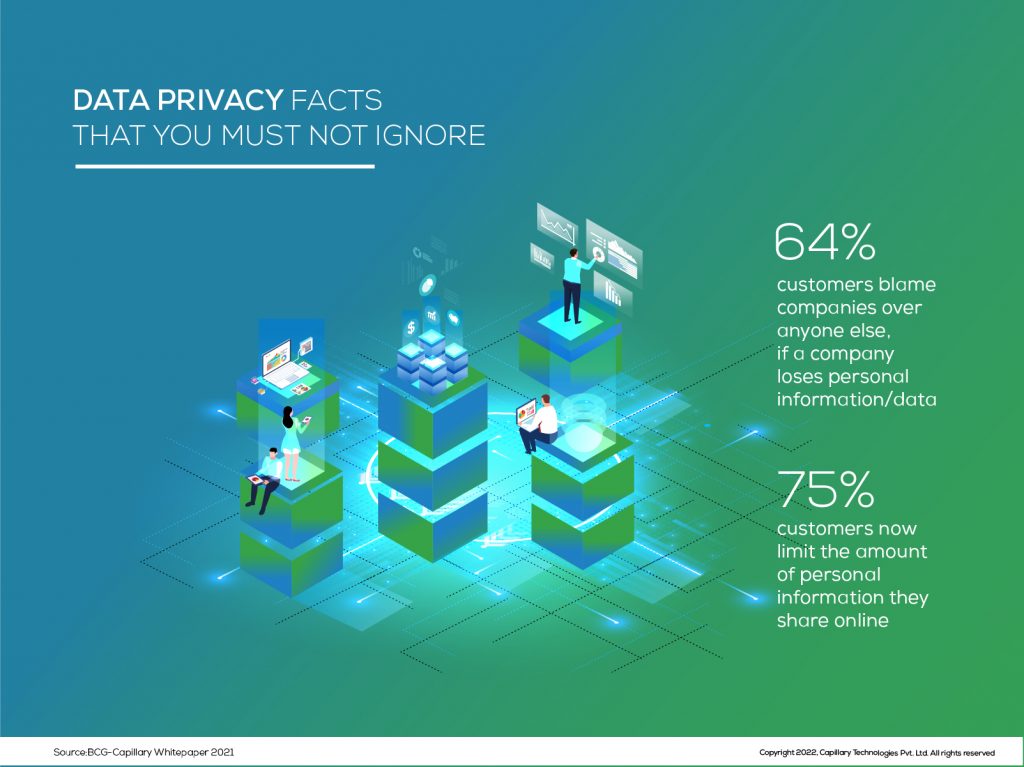
It is often said that the universe is made of atoms. In a digital age, it can feel like it is made of data. Data privacy is the personal locker for that data. It protects how your information is collected, stored, and shared with third parties, and ensures those practices align with laws and regulators across regions.
What Makes Data Protection So Crucial
We live in social, always-on networks where sharing data is routine. Used responsibly, data can power better services, smarter decisions, and stronger economies. Misused, it can cause financial loss, regulatory exposure, and lasting brand damage. Breach volumes and costs remain high across industries, which is why brands now treat security and privacy as core to customer experience, not as an afterthought.
Customers also expect transparency. They want to know what is collected, why it helps them, and how to control or delete it. That expectation sits at the heart of every modern data strategy.
A 2025 View: Privacy, Compliance, and Trust
The last two years raised the bar. Mailbox providers tightened deliverability rules. Consent needs to be portable and machine-readable across analytics and ads. Regional laws and AI requirements have matured. The practical takeaways are simple. Minimize what you collect. Be clear about the benefits. Capture and honor consent everywhere. Prove your controls.
Our Approach: Data Privacy at Capillary
Capillary teams process large, diverse datasets for enterprise clients. Our security and privacy controls are engineered in from day one.
1) Auditing
Our Information Security Management Forum runs periodic internal audits.
Centralized logging and audit trails support investigation and forensics.
We test disaster recovery and business continuity regularly.
Security events are monitored and triaged with defined response playbooks.
2) Client Assessment and Disclosure
We support responsible disclosure through industry bug bounty programs such as SafeHats.
We undergo regular client-led security assessments and third-party testing.
Vulnerabilities are tracked with SLAs for remediation and verification.
3) Platforms and Data Handling
Encryption and transport
Data at rest is encrypted with AES-256.
Data in transit uses TLS 1.2 or TLS 1.3.
Keys are managed and rotated through centralized KMS, with HSM support where required.
Processing and transfers
Data moves via SFTP or HTTPS APIs. Legacy FTP and plain email attachments are not used for sensitive data.
Mutual auth and signed requests are applied where appropriate.
Access control and reporting
Role-based access control with least privilege and just-in-time elevation for sensitive tasks.
Offboarding triggers immediate deprovisioning through our HRIS and identity provider.
Multi-factor authentication is required, with phishing-resistant options such as FIDO2 or passkeys.
Reports and dashboards are delivered through secure portals with role-based access and short-lived signed links. Raw datasets are restricted.
Architecture and operations
Production workloads run in isolated virtual private clouds with network segmentation.
We layer preventive and detective controls such as WAF, EDR, and cloud posture management.
Backups and key materials are protected, and restoration is tested.
4) People and Policies
Access to development, pre-production, and production occurs through dedicated secure channels.
Strong password and passphrase policies are enforced, with compromised-credential checks.
Security awareness, secure coding, and privacy training are part of onboarding and ongoing enablement.
Certifications and Control Frameworks
ISO/IEC 27001:2022 certification.
SOC 2 Type II audits for applicable services.
PCI DSS v4.0 or v4.0.1 compliance where cardholder data is in scope.
GDPR program and regional privacy controls, mapped to NIST CSF 2.0 principles.
No system is immune to risk. Our goal is to reduce likelihood and impact through defense in depth and to respond quickly and transparently if an incident occurs.
Global Privacy Notes for 2025
EU and UK. Mature privacy rights and consent rules continue to apply. AI obligations are phasing in, with growing expectations for transparency and human oversight in automated decisioning.
United States. State privacy laws are shaping loyalty use cases. Programs should keep data limited to the promised benefits and handle sensitive data with extra care.
India. The Digital Personal Data Protection framework is progressing. Consent, purpose limitation, retention, and breach handling must be planned and documented.
The bottom line Privacy and security build trust. Trust builds loyalty. Our commitment is to keep your customers’ data safe, give them meaningful control, and enable you to create value with confidence.
People also ask ⁝
1.What are the key data privacy regulations businesses must comply with in the USA and Europe?
Businesses in the USA and Europe must comply with regulations such as GDPR in Europe and CCPA in California. Ensuring compliance with these laws protects consumer data and avoids hefty fines.
2.How can implementing robust data privacy practices improve customer trust for B2B companies?
Implementing robust data privacy practices helps B2B companies build trust with their clients by protecting sensitive information, leading to stronger business relationships and increased loyalty.
3.What are the best data privacy tools for Singapore and Hong Kong businesses?
In Singapore and Hong Kong, businesses can use tools like OneTrust, TrustArc, and BigID to manage data privacy, ensure compliance, and protect sensitive information.
4.Why is data privacy important for B2B transactions in the UAE and Saudi Arabia?
Data privacy is crucial for B2B transactions in the UAE and Saudi Arabia to safeguard confidential business information, maintain client trust, and comply with regional data protection laws.
5.How can data privacy impact B2B marketing strategies in India and Australia?
Data privacy impacts B2B marketing strategies by necessitating transparent data collection practices, obtaining explicit consent, and ensuring marketing efforts comply with regional data protection laws in India and Australia.
Customer loyalty is harder to earn and easier to lose than ever. Acquisition costs continue to rise, privacy regulations are tightening, and customers are flooded with choices. In 2025, mobile-first loyalty is no longer a competitive advantage—it’s table stakes.
Generative AI, predictive analytics, and real-time engagement through push, WhatsApp, and in-app messaging now define loyalty success. Brands that fail to integrate these capabilities risk losing relevance and retention. Starbucks is a proof point: with 31M+ U.S. active members, its app is as much a commerce and engagement engine as a rewards hub.
As the old adage reminds us, it’s easier to get an existing customer to buy again than to convince a new one to transact. High acquisition costs only reinforce the need to deepen relationships and reward loyalty—directly on mobile.
The Strategic Advantages of a Mobile Loyalty Program
1. AI-Powered Customer Understanding
Modern mobile loyalty apps capture far richer data than any plastic card ever could—location, preferences, buying frequency, and even contextual signals like weather or time of day.
Armed with predictive AI, brands can orchestrate next-best-action offers in real time. Imagine sending a curated recommendation just as a customer walks near your store or personalizing in-app deals based on their last purchase. This hyper-relevance drives repeat visits, higher conversion rates, and advocacy.
2. Mobile Payments and Embedded Finance
Global mobile payment transaction value is projected to exceed $12 trillion in 2025 (Statista). Mobile loyalty sits at the heart of this shift.
From Starbucks’ preloaded balances to Sweetgreen’s wallet that offers a free salad for paying via the app, loyalty is a proven on-ramp to digital wallets, BNPL, and micro-credit options. Integrated payments simplify checkout and create a closed-loop ecosystem where earning and redeeming rewards feel effortless.
3. Differentiation in a Crowded Market
Even with a great product, competitors are one tap away. A well-designed mobile rewards program builds a moat by:
Making experiences stickier through gamification and instant gratification.
Providing a seamless omnichannel journey—from in-store QR codes to social DMs.
When rivals copy your products, your experience-led differentiation—personalized rewards, instant redemptions, frictionless service—becomes your edge.
4. Thought Leadership and Market Leadership
Market leaders aren’t just first to market; they set standards others aspire to. By investing early in AI-first mobile loyalty, brands raise the bar on customer experience, establishing themselves as trendsetters and thought leaders.
5. Convenience Customers Expect
Today’s customers won’t carry punch cards or plastic loyalty cards. Mobile-first programs deliver instant, card-free convenience—single sign-on, instant point updates, and one-tap redemptions.
According to McKinsey, 70% of consumers prefer app-based rewards, and 78% value the ability to redeem instantly on their phones. This level of access keeps customers active and engaged.
6. Boosting Sales and ROI
Mobile loyalty is a proven sales engine. Research shows customers who actively engage with loyalty programs make 90% more frequent purchases, spend 60% more per transaction, and are five times more likely to stick with a brand.
Kohl’s reports loyalty members spend $80 more per transaction than non-members. Globally, brands from Nike to Sephora have replicated similar gains.
7. Lower Operational Costs and Richer Data
Unlike paper-based or card-based schemes, mobile programs are economical and easy to scale. Offers can be updated in seconds and targeted with precision.
More importantly, first-party data collected with consent—purchase patterns, engagement rates, and redemption habits—gives brands the insight to refine campaigns and measure success. In a post-cookie world, this is a critical advantage.
Implementing a Winning Mobile Loyalty Program
Mobile loyalty in 2025 is AI-first, privacy-first, and API-ready. A modern implementation playbook includes:
Customer Discovery: Use focus groups, user interviews, and analytics to map pain points and expectations.
Platform Selection: Choose an AI-first, composable loyalty platform that integrates with POS, CDP, and marketing clouds.
Pilot & Optimize: Test with key customer segments and use predictive insights to fine-tune.
Scale & Evolve: Add gamification, partner offers, and lifestyle rewards to keep members engaged long-term.
2025 Leaders in Mobile Loyalty
The best mobile loyalty programs seamlessly blend commerce, payments, and personalization:
Nike SNKRS gamifies limited-edition drops and rewards fitness achievements.
Sephora Beauty Insider uses AI to recommend products and drive in-app AR try-ons.
Grab and Shopee run super-app ecosystems where ride-hailing, food delivery, and e-commerce loyalty converge.
Earlier pioneers like Best Buy or Cosi paved the way. Today’s leaders are AI-driven, omnichannel, and privacy-centric.
The 2025 Imperative
As Marshal McLuhan foresaw, we shape our tools and thereafter our tools shape us. In 2025, mobile has reshaped customer expectations: on-demand, personalized, and consent-based engagement is the new normal.
Brands that embrace mobile-first loyalty don’t just defend market share; they create it. By combining AI-powered personalization, embedded payments, and first-party data insights, they build lasting emotional connections and measurable business impact.
Get in touch with Capillary today to kicktstart your mobile-first loyalty program. Talk to our experts now.
Omnichannel retail in India has moved far beyond buzzword status, it’s now a strategic imperative. As the lines blur between digital and physical retail, consumer expectations continue to rise. From redefining shopper journeys to driving better ROI across channels, brands in India are embracing omnichannel strategies to stay relevant in a hyper-connected market.
With India’s ecommerce market among the fastest-growing in Asia and consumer behavior shifting toward mobile-first and multi-channel journeys, the stakes are higher than ever.
In this blog, we unpack omnichannel retailing examples in India, explore what “omnichannel retailing” really means in today’s context, and highlight the key drivers behind this transformation, from webrooming trends to the rise of Gen Z shoppers.
What Does Omnichannel Retail Mean in India?
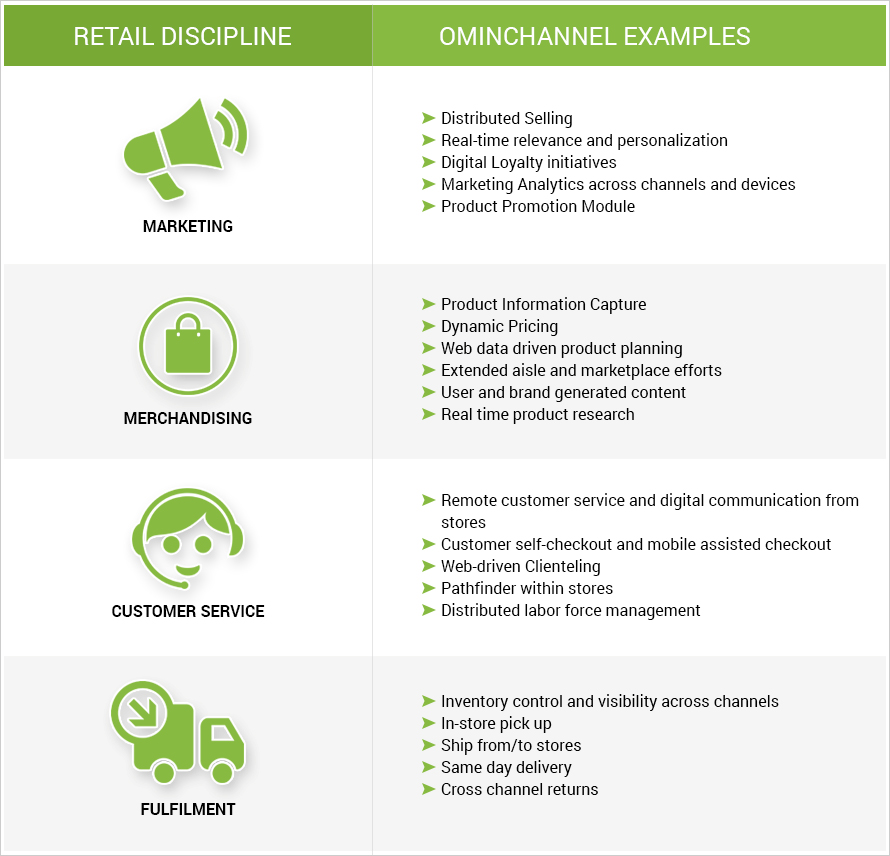
Omnichannel retail in India can mean different things to different businesses. For some, it’s about offering a mobile app alongside a physical store. For others, it’s about connecting offline and online inventories or enabling doorstep returns for items bought in-store. But at the heart of it, omnichannel is about offering customers a seamless shopping experience, regardless of where they begin or end their journey.
In India’s diverse retail environment, this seamlessness becomes even more critical. A customer might browse products on a brand’s Instagram page, check availability on the website, and then walk into a nearby store to complete the purchase. Or they might visit a mall, try something on, and choose to buy it later from the app. True omnichannel retail recognizes this fluidity and aims to remove the friction that typically exists between channels.
India’s Retail Landscape: Then vs Now
India’s retail sector has undergone a dramatic shift in the past decade. What was once a market dominated by unorganized retail and traditional formats is now steadily moving toward organized, tech-enabled experiences. In 2016, modern trade accounted for only a small slice of the retail pie, but that slice has grown significantly with the rise of ecommerce, mobile adoption, and digital payment infrastructure.
Today, retailers are not only building stronger digital storefronts but are also rethinking how their physical spaces fit into the larger customer journey. Store formats have evolved, and many are now playing a dual role: as both brand experience centers and as fulfillment hubs for online orders. This shift reflects how omnichannel retail in India is gaining ground, especially as consumers grow more comfortable toggling between platforms while expecting speed, convenience, and consistency.
Key Drivers of Omnichannel Growth in India
Omnichannel retail in India is not growing in isolation. It’s being propelled by a unique mix of consumer evolution, technology adoption, and market-level shifts that are reshaping how people discover, engage with, and purchase from brands. Let’s look at the key forces driving this change.
Understanding the Indian Target Market
Retailers today are catering to a far more segmented and complex customer base than ever before. India’s retail market includes everything from affluent, urban digital natives to price-conscious, semi-urban families who may only recently have come online. This diversity calls for flexible engagement models and a sharp understanding of how different customer segments behave across platforms.
Omnichannel strategies work best when they are informed by local nuances. A brand’s app might perform better in Tier 1 cities, while WhatsApp or assisted shopping could be more relevant in smaller towns. Recognizing these behavioral shifts at a granular level is key to crafting customer journeys that convert.
Digital Shifts in Indian Consumer Behavior
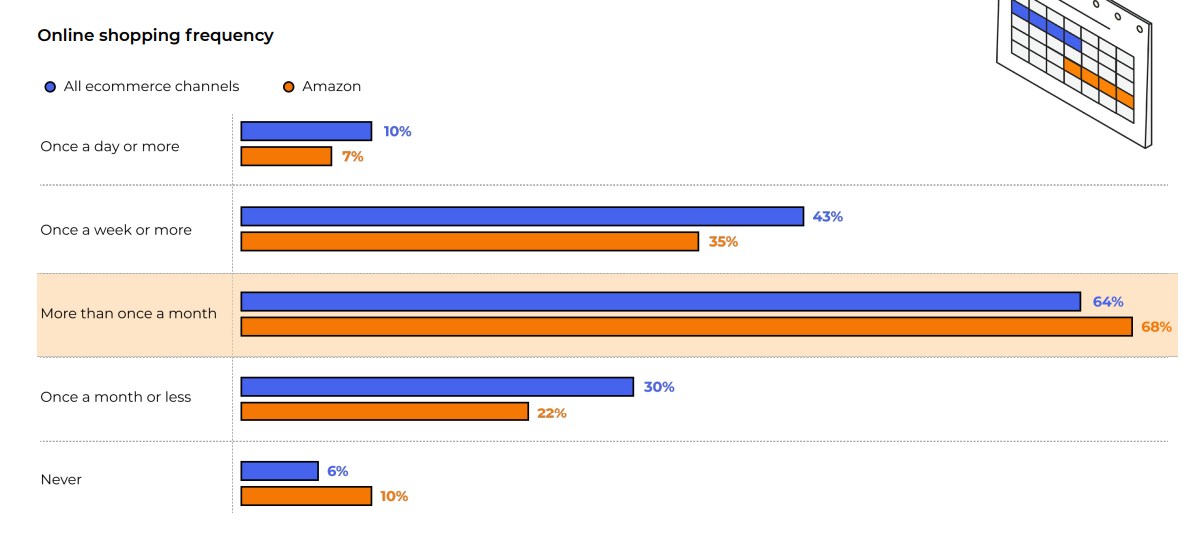
Digital shopping has moved from occasional activity to a regular part of daily life for Indian consumers. According to recent trends, a significant portion of online shoppers in India now buy more than once a month, with many shopping weekly and even daily.
This frequency speaks volumes about the growing trust in ecommerce platforms and the rising comfort with digital payments and deliveries. 43% of consumers shop online at least once a week across all ecommerce channels, and 10% report making purchases daily or more. When looking specifically at Amazon, 68% of users shop more than once a month, with 35% making purchases at least once a week.
For omnichannel retailers, this presents both an opportunity and a challenge. The more frequently customers shop, the higher their expectations for speed, relevance, and consistency across every interaction, whether it’s on an app, a website, or in a store. Meeting these expectations requires integrated systems, agile fulfillment, and a sharp focus on customer experience design.
The Indian shopper is no longer bound to a single touchpoint. Many browse online before buying in-store (webrooming), while others check out a product in-store only to complete the purchase online later (showrooming). These behaviors are a pattern now, and brands need to be equipped to handle both.
Added to this is the growing tension between marketplace presence and building direct-to-consumer (D2C) platforms. While marketplaces offer reach, they often limit control over experience and data. A robust omnichannel strategy helps brands bridge this gap, offering the scale of marketplaces with the personalization and control of a D2C model.
Challenges and Considerations for Indian Retailers
While the case for omnichannel adoption is strong, implementation comes with its share of challenges. Many Indian retailers still operate with fragmented systems, making it difficult to unify customer data or manage real-time inventory across channels. Without this integration, creating consistent experiences becomes a tall order.
Another key consideration is organizational readiness. Building an omnichannel strategy requires cross-functional collaboration across marketing, operations, logistics, and frontline staff. Retailers also need to strike the right balance between driving immediate ROI and investing in long-term customer relationships through smarter loyalty programs and experience-led differentiation.
The retailers who succeed will be the ones who view omnichannel as a transformation effort, not just a digital upgrade.
Conclusion: Navigating the Omnichannel Opportunity in India
As omnichannel retail in India continues to mature, brands that can seamlessly unify offline and online experiences will lead the next wave of growth. From understanding the meaning of omnichannel retailing to applying it through localized strategies, the focus must now shift to integration, personalization, and long-term customer engagement.
The trends clearly show that India’s retail landscape is expanding, customer expectations are evolving, and ecommerce adoption is accelerating. By leaning into omnichannel solutions that adapt to India’s unique consumer behavior, businesses can unlock new growth opportunities, improve customer loyalty, and stay competitive in a rapidly shifting market.
Want to go deeper into the tech, data, and operational building blocks that support omnichannel retail in India?
The Loyalty Shake-Up: Why Brands Are Struggling to Keep Customers
Loyalty has always been a battlefield for brands, but the fight isn’t what it used to be. Consumers are no longer just looking for discounts or collecting points—they want real, meaningful connections with the brands they engage with.
As we move into 2025, businesses face a stark reality: traditional loyalty programs are losing relevance. To gain deeper insights into this shift, we associated with YouGov to survey 200 U.S. consumers, uncovering a growing disconnect between customer expectations and what brands deliver. This article explores the key trends, challenges, and innovative engagement strategies that will define the future of customer loyalty in the coming years.
The Loyalty Crisis: Consumers Are Tuning Out
1. Too Many Loyalty Programs, Too Little Engagement
Loyalty fatigue is real. Consumers are overwhelmed by the sheer number of loyalty programs available today. While many enroll, only a small percentage actively participate.
49% of respondents are part of only 0–2 loyalty programs, despite being frequent shoppers.
Only 5% subscribe to more than 11 loyalty programs, indicating that most people do not engage with multiple brands actively.
Many customers sign up for loyalty programs just for a one-time discount—then never engage again.
Why? Most loyalty programs fail to create an emotional or habitual connection. Instead of driving engagement, they blend into the noise, causing consumers to forget or ignore them altogether.
🔹 The Fix:
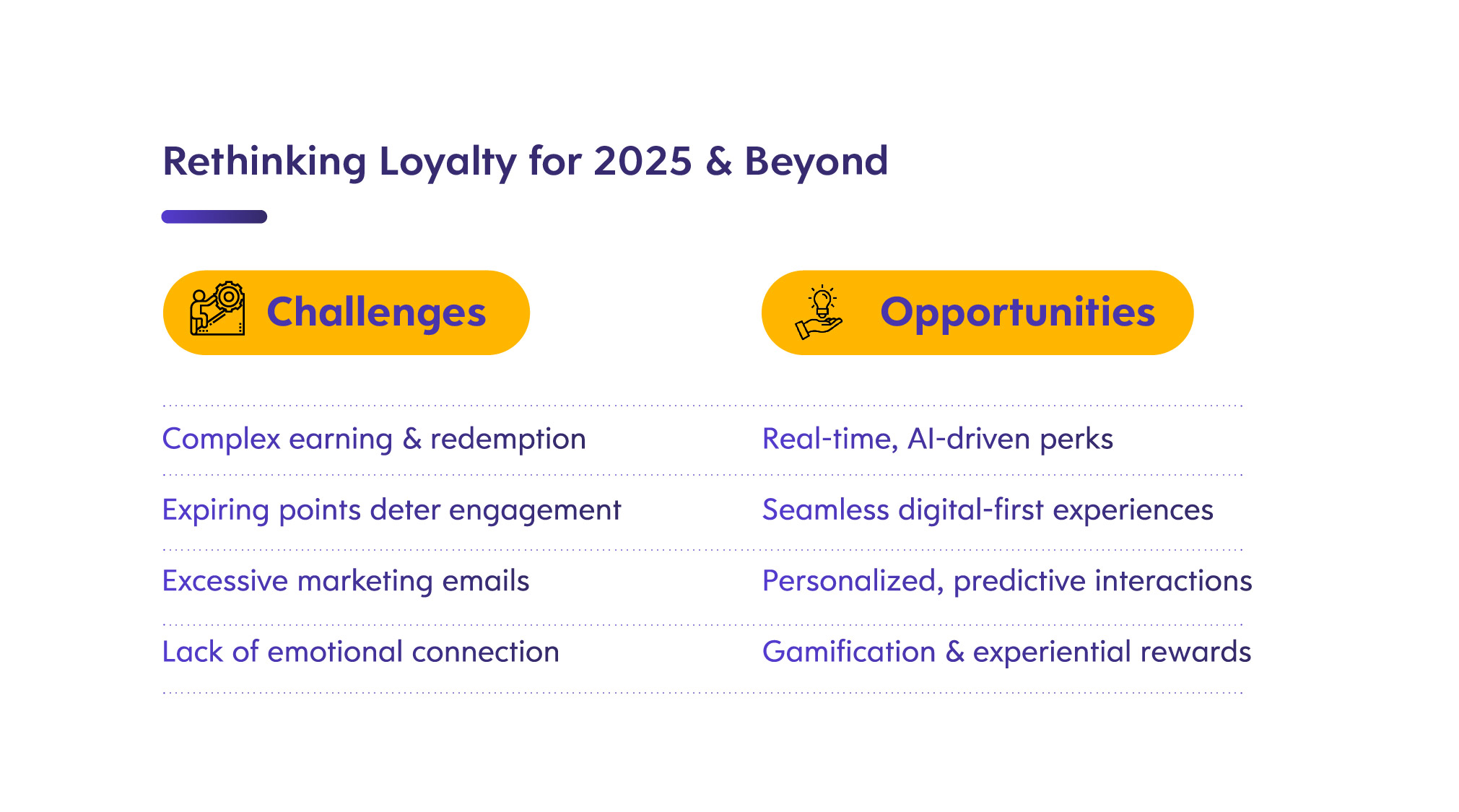
✔ Reduce complexity—make loyalty seamless, not an extra task for customers. ✔ Move beyond transactional rewards—use AI-driven personalization to tailor offers, interactions, and experiences to individual preferences and foster long-term engagement. ✔ Implement habit-forming incentives such as gamification, VIP access, and experiential rewards that seamlessly integrate into the customer’s everyday behavior.
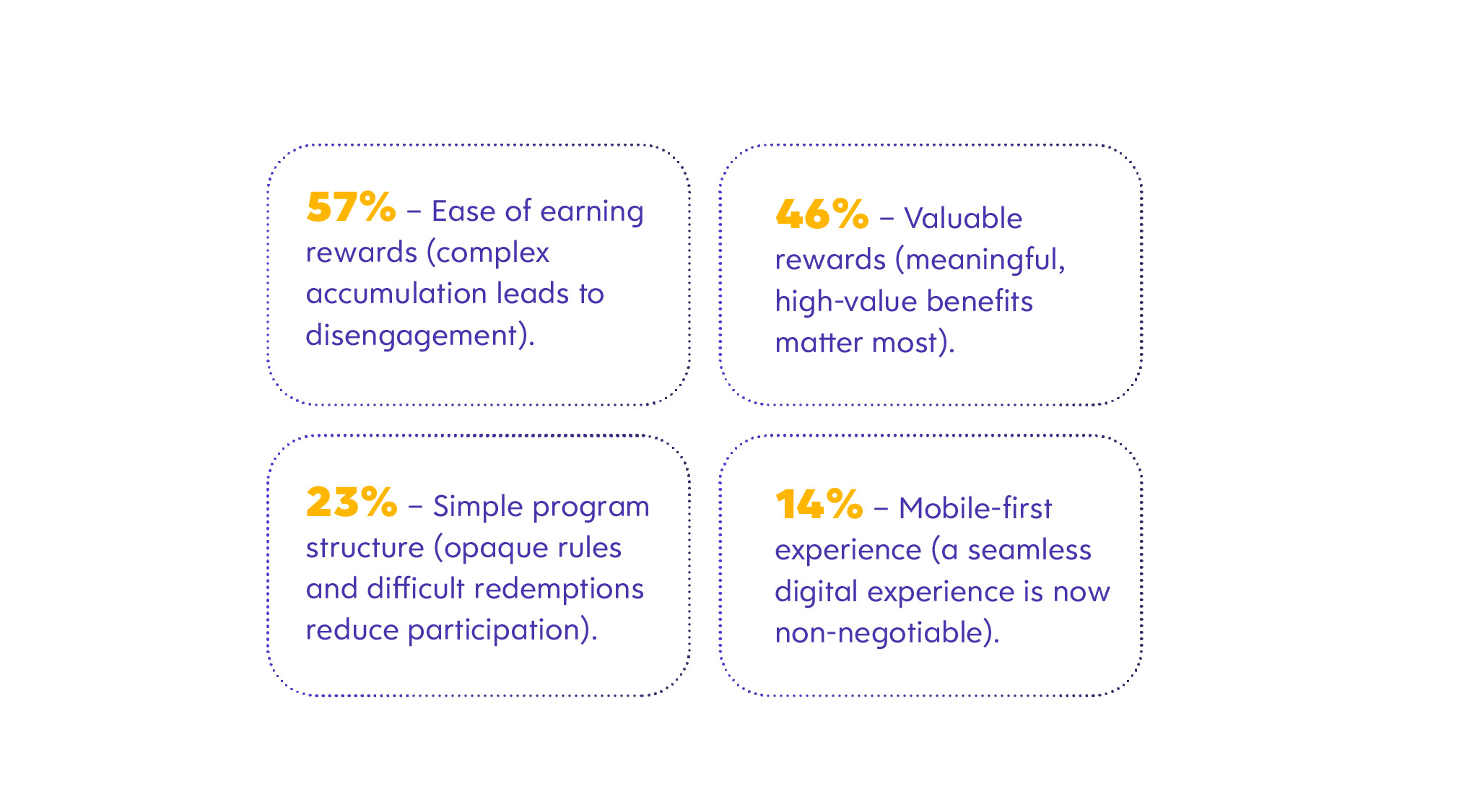
Consumers have little patience for slow rewards. Today’s customers expect immediate benefits, not a system where they accumulate points over months or years. When asked what they value most in a loyalty program, respondents emphasized:
The shift toward instant gratification necessitates a reimagining of loyalty structures.
🔹 The Fix:
✔ AI-driven real-time rewards—deliver personalized offers based on customer behavior and purchase patterns. ✔ Gamification mechanics—challenges, milestones, and exclusive status perks to keep users engaged. ✔ Frictionless mobile-first experiences—one-click redemptions and AI-powered recommendations to keep engagement effortless.
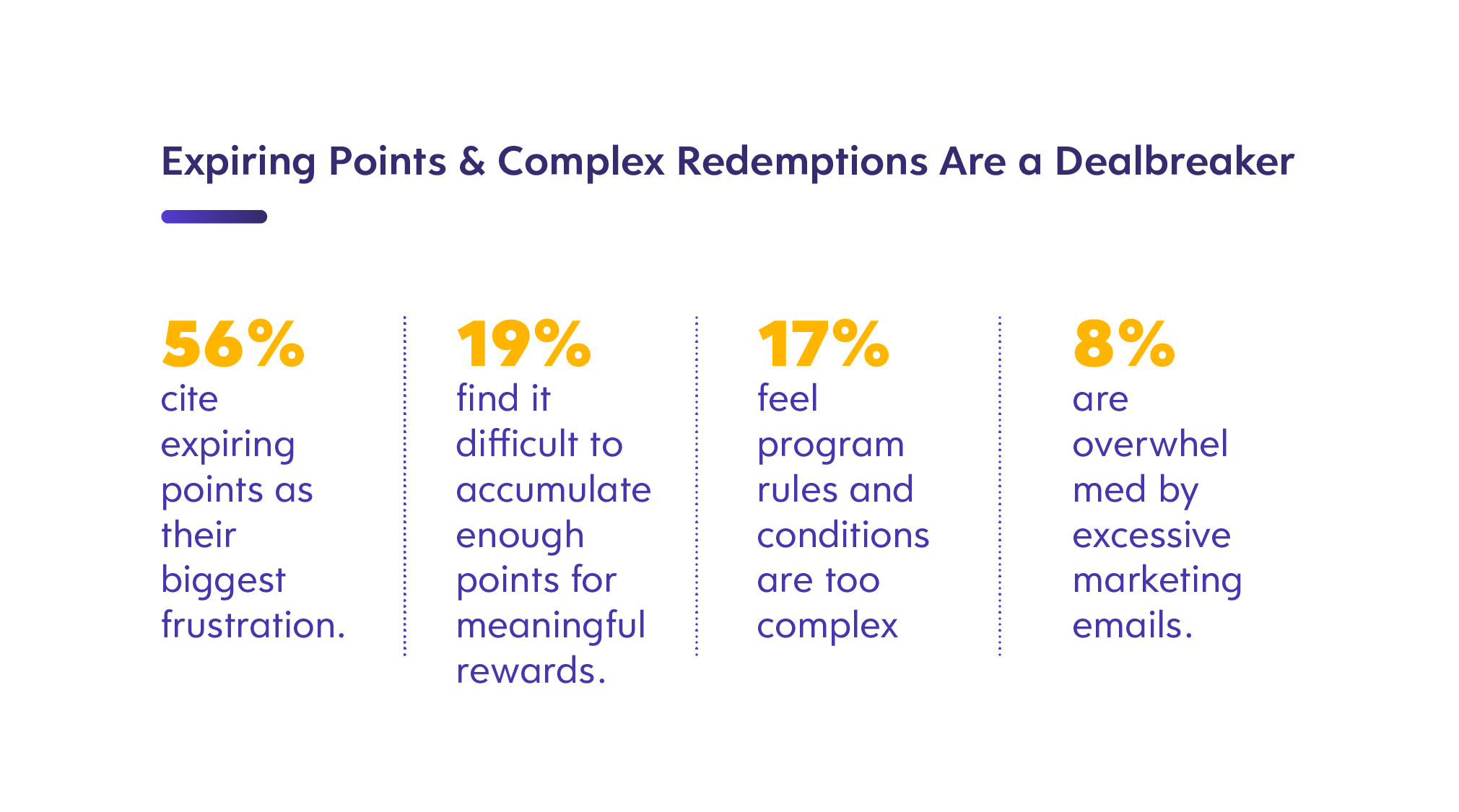
3. Expiring Points & Complex Redemptions Are a Dealbreaker
Another major complaint is the complexity of redemption. Expiring points, long accumulation periods, and convoluted redemption processes cause frustration and disengagement.
🔹 The Fix:
✔ Eliminate friction—simplify reward structures and extend point validity. ✔ AI-driven nudges—reminders and prompts to encourage redemption before points expire. ✔ Seamless omnichannel redemptions—enable customers to redeem rewards online, in-store, or via mobile apps instantly.
The New Loyalty Blueprint: Emotional Engagement Over Transactions
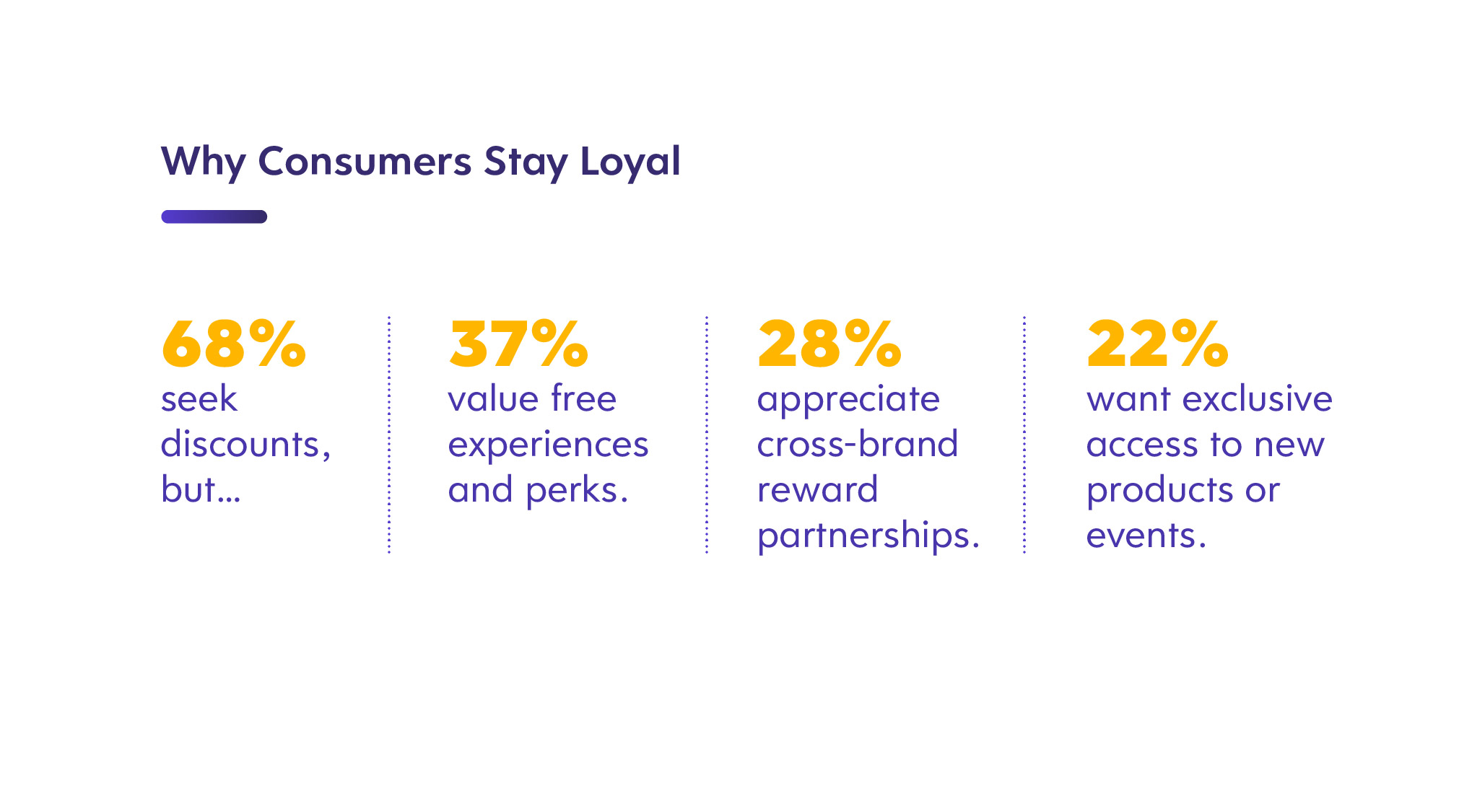
Loyalty isn’t just about saving money—it’s about emotional connection. Understanding why consumers engage in loyalty programs is essential for brands to optimize their retention strategies.
The Problem: Financial Incentives Alone Aren’t Enough
Discounts, cashback, and savings still matter, but they do not drive long-term engagement. Loyalty programs that will succeed in 2025 and beyond will focus on experiences, emotional engagement, and interactivity.
🔹 The Fix:
✔ VIP access & early product releases—loyalty should feel exclusive, not generic. ✔ Gamification beyond purchases—interactive experiences that reward non-transactional behaviors like social sharing, reviews, and referrals. ✔ Cross-brand partnerships—allow customers to use their rewards across multiple brands for greater perceived value.
The Future: AI-Driven, Personalized, and Seamless Loyalty
As digital expectations rise, brands must adopt AI-driven loyalty models that prioritize hyper-personalization, automation, and omnichannel experiences.
📌 Survey Takeaways:
Mobile-first programs are the dominant engagement channel.
25% prefer instant checkout rewards over long-term accumulation.
✔ AI-powered personalization—predictive analytics should deliver real-time, individualized offers.
✔ Gamification & challenges—interactive leaderboards, status levels, and milestone rewards enhance engagement.
✔ Unified omnichannel experiences—seamless loyalty interactions across online, mobile, and physical touchpoints.
Four Steps to Creating a Winning Loyalty Program
1. Leverage Data to Drive Intelligent Engagement
The foundation of a successful loyalty program is deep customer understanding. AI-driven analytics enable brands to: ✔ Segment customers and deliver hyper-personalized rewards. ✔ Execute precision-targeted campaigns based on behavioral insights. ✔ Use predictive modeling to anticipate customer desires before they even express them.
2. Make Rewards Tangible and Progress Visible
✔ Provide real-time point tracking via mobile apps. ✔ Offer tiered loyalty levels with progressively valuable benefits. ✔ Send personalized updates and reminders to encourage engagement.
3. Gamify the Loyalty Experience
Gamification turns passive engagement into active participation. ✔ Introduce badges, achievements, and milestone incentives. ✔ Create personalized challenges that encourage repeat interactions. ✔ Use leaderboards and social-sharing features to foster friendly competition.
4. Build a Community-Centric Loyalty Model
Loyalty is strongest when consumers feel like they’re part of an exclusive community. ✔ Launch VIP memberships and private groups. ✔ Offer early product access and invite-only experiences. ✔ Encourage user-generated content and social advocacy.
How Brands Are Winning with Capillary Technologies
To address these challenges, forward-thinking brands are leveraging AI-driven loyalty solutions. Capillary Technologies has played a pivotal role in helping brands transform their loyalty programs into dynamic, engagement-driven experiences.
1. Simplifying Loyalty for Millions
📌 Vishal Mega Mart Capillary enabled Vishal Mega Mart to create a mobile-first, transparent loyalty program—‘Shop for Free.’ The initiative attracted over 100 million engaged shoppers, underscoring the impact of a user-friendly, frictionless rewards system.
2. Driving Engagement Through Real-Time Rewards
📌 Shell’s Loyalty Overhaul By transitioning from a card-based program to an app-based, AI-driven rewards experience, Shell significantly increased member acquisition and tripled active engagement rates—a testament to the power of real-time, personalized incentives.
3. Creating Seamless Omnichannel Experiences
📌 ASICS Southeast Asia Capillary enabled ASICS to unify online, mobile, and in-store loyalty interactions, allowing customers to seamlessly track and redeem rewards across all touchpoints.
4. Gamifying Engagement for Sustained Participation
📌 Jotun Vietnam By incorporating gamification mechanics such as milestone-based rewards and interactive challenges, Capillary helped Jotun achieve record-breaking engagement levels among customers and partners.
The Future of Loyalty: Intelligent, Experience-Driven, and Data-Powered
The future of loyalty is not just a shift—it’s a transformation. No longer confined to transactional rewards, modern loyalty programs are evolving into intelligent, experience-driven ecosystems fueled by data, AI, and gamification. As customer expectations rise, brands that embrace personalization, seamless omnichannel experiences, and emotional engagement will lead the way in fostering deeper, long-term relationships.
This new era of loyalty demands a mindset shift—from offering mere incentives to creating immersive, habit-forming interactions that drive sustained brand affinity. The brands that succeed will be those that leverage technology to anticipate needs, personalize experiences, and make loyalty feel effortless and rewarding.
As we stand on the cusp of this next-generation loyalty revolution, one question remains: Is your brand ready to move beyond points and perks to build true, data-powered customer devotion?
This survey is just the beginning of an in-depth exploration into the future of loyalty. In our upcoming comprehensive report, we will uncover the key trends, cutting-edge innovations, and actionable strategies that are redefining customer engagement. Stay tuned as we unveil the next chapter of loyalty transformation.
As with any fraud mitigation strategy, it’s important to find the right balance between preventing fraud and maintaining a positive member experience. One challenge many loyalty programs face is return fraud, where members exploit return policies to earn, redeem, and then return products while keeping the redeemed rewards. This not only impacts the bottom line but also diminishes the program’s overall value.
There are several ways to manage return fraud while still ensuring a positive member experience. Each approach has its pros and cons, and the best strategy depends on factors such as financial liability, prioritizing fraud reduction, member satisfaction, and operational complexity.
Delayed Point Issuance Until Returns Clear Away
In this approach, points are not issued immediately but become available only after the return window closes (e.g. 30 days). This prevents members from redeeming points on products they later return. However, delayed point issuance can negatively impact the member experience, especially for those who want to use their points quickly after purchase.
Building Trust with Transparent Pending Points
Similar to the Delayed Point Issuance strategy, pending points allow the delay of point issuance but with full transparency. This is a balanced approach, offering transparency to the member while providing safeguards against fraud. However, it’s essential to clearly communicate the rules around pending points to avoid any confusion.
Deducting Rewards to Ensure Fair Refunds
With this strategy, if a member returns a product after earning points on it, the value of the points is subtracted from the refund. This is a strong deterrent, as it ensures members don’t benefit from points they truly did not earn. While this may be the best member experience, there are high operational complexities in handling this process correctly without disrupting daily commerce activities.
Using Negative Balances to Prevent Future Fraud
In this approach, the program deducts points from the member’s balance if the item is returned. If the member doesn’t have enough points to cover the deduction, future points will be used to balance the account. That is, the member’s account balance may go in the negative. While this method may be more simple operationally, it may discourage future engagement or upset members who see a negative point balance.
Monitoring Returns to Catch Fraud Before It Spreads
Regardless of the chosen return fraud mitigation strategy, it’s essential to have fraud monitoring in place. Programs should closely monitor return and redemption behaviors and implement detection alerts to flag suspicious activity. When repeat offenders are identified, it’s wise to consider blacklisting them from the program to prevent future abuse.
Protect Loyalty, Preserve Trust
Navigating return fraud in loyalty programs requires a delicate balance between protecting your bottom line and maintaining a seamless member experience. While strategies like delayed issuance, pending points, or deductions from returns offer varying levels of protection, the right approach depends on your business’s priorities and operational capabilities. At the core of any strategy lies the need for transparent communication and robust fraud monitoring to maintain trust and ensure members feel valued without compromising program integrity.
Need help to strike that balance? Capillary’s advanced loyalty solutions, coupled with fraud detection capabilities, empower businesses to safeguard against fraud while keeping members engaged. Connect with us today to explore how we can tailor strategies to fit your loyalty program and keep it running smoothly—because loyalty should build trust, not loopholes.
It’s your reward, you’ve earned it. Now use it! Believe it or not, sometimes it can be a challenge to get members to redeem their earned rewards. It doesn’t make sense, but at times it is true.
Reward redemption is one of the best ways to get members to see the value of their program. An expired redemption is a lost opportunity to reinforce the fun and “stickiness” the program was designed to provide. If you find that, for whatever reason, your redemption percentage could use a boost, below you’ll find seven ways to motivate members to use their benefits.
1. Create a Sense of Urgency
Limited-time offers, expiration dates, and limited quantities can encourage members to act now. Creating a sense of urgency can get members to act more quickly.
Techniques to create urgency:
Send reminder emails or push notifications to avoid reward expiration
Use countdown timers on websites or apps, showing time left to redeem
Highlight expiring rewards in bold colors or attention-getting graphics
2. Personalize the Reward Experience
Personalization works wonders in loyalty programs. Tailor rewards to a customer’s preference or purchase history and they become more enticing.
Ways to personalize:
Offer rewards based on buying habits like discounts on their favorite items or categories.
Send personalized emails with customized offers highlighting items they may enjoy.
Use customer data to suggest products or services that align with their interests or past purchases
3. Offer Exclusive and Desirable Rewards
Offer appealing rewards that your members will value. Rewards will need to be enticing to get members motivated to redeem them. Exclusive or limited-edition items can be perceived as highly valuable, especially if they can’t be obtained anywhere else.
For example:
VIP access to new product launches or member-only events
Free services such as home delivery, free upgrades, or VIP customer service
Unique experiences, such as back-stage/behind-the-scenes tours or private shopping sessions
Collaborations with popular brands that offer co-branded rewards
4. Simplify the Redemption Process
Multi-step, complicated, and/or time-consuming processes can discourage members from using their rewards. Make redemption as easy as possible. When possible give the option of redemption online or in-store.
Simplified Tactics:
Offer a one-click redemption option in your mobile app or website
Ensure the redemption process is clear and straightforward, with easy-to-follow instructions
Allow members to use their rewards across multiple channels like online, in-store, or through customer service
Consider integrating rewards with mobile wallets or digital payment systems
5. Communicate Regularly with Members
Keep your program top of mind by communicating frequently with your members. Show them their points balance, new rewards available, and limited-time promotions to encourage them to take action and redeem their rewards.
Communications Strategies:
Send our newsletters that showcase new rewards, special promotions, or exciting program updates
Use SMS or push notifications to remind customers of their available rewards or exclusive offers
Utilize social media to highlight loyal customers, reward milestones, and foster a sense of community
6. Integrate Rewards with Other Marketing Campaigns
Integrating your program with broader marketing campaigns can increase engagement and make rewards feel like part of the overall brand experience. Combining rewards with seasonal campaigns, product launches or sales events can boost excitement.
Integration Ideas:
Tie reward redemptions to holiday promotions, or flash sales to gain attention and make rewards seem even more valuable
Promote rewards during key shopping events such as Black Friday, Cyber Monday, or special anniversary events
Cross-promote with other marketing events such as email or social media ads to highlight attention around rewards
7.Encourage Social Sharing
Encourage members to share their experiences with your program and its rewards on social media. This not only helps increase brand visibility, but it also builds a sense of community and social validation for the program.
Ways to encourage sharing:
Offer bonus points or special incentives for social media posts about rewards or the reward experience
Create shareable moments by designing unique, post-worthy packaging or experiences that members can share
Launch referral programs that reward members for bringing in new members and encouraging them to also redeem their rewards
To obtain the maximum impact of your loyalty program, you have to do more than just offer rewards, you have to motivate your members to redeem them. By using the tactics shown above, like creating urgency, personalizing the experience, and social sharing, brands can effectively encourage their members to use their rewards and stay engaged with the business. After all, a reward is only rewarding, if it is used.
If you are looking to make your loyalty program a profit center, let’s talk!
The fuel retail industry is undergoing a significant transformation, driven by Mobility-as-a-Service (MaaS) and digital innovation. As customers seek more seamless, tech-driven experiences, retailers must embrace mobile loyalty apps, cloud-based platforms, and retail mobility solutions to stay ahead.
From automated fueling to connected MaaS ecosystems, fuel retailers are leveraging digital transformation to enhance convenience and customer loyalty. But what does the future of fuel retail truly look like? This article explores how MaaS technology, fuel retail automation, and innovative mobility solutions are shaping a new era of customer engagement and operational efficiency.
The Rise of Mobility-as-a-Service (MaaS) in Fuel Retail
As advanced electric self-driving technologies transform the motor industry, mobility-as-a-service is at the frontier of fuel retail innovation. With a plethora of efficient digitized ride-hailing or sharing platforms growing globally, both public and private transportation are more convenient than ever.
A recent Grand View Research report forecasts that the shared mobility market will reach $675 billion by 2030, driven by retail mobility solutions that cater to urban demand.
Why Consumers Are Choosing Shared Mobility Over Vehicle Ownership
A major shift in consumer behavior is fueling MaaS adoption, transitioning from costly vehicle ownership to efficient shared mobility solutions. The future of fuel retail is evolving toward sustainable, alternate fuel consumption, where MaaS plays a pivotal role in reducing the carbon footprint.
Younger populations, in particular, are opting for electric and alternate fuel-powered MaaS options, leveraging digitized ride selection and payment integrations. This shift is accelerating the integration of MaaS into fuel retail, particularly in a post-pandemic world where convenience and sustainability take precedence.
With nearly two-thirds of the world’s population expected to live in cities within the next decade, consumers will increasingly prioritize economical fuel expenditure and shared mobility solutions over traditional ownership.
Digital Transformation: The Backbone of MaaS in Fuel Retail
The most significant enabler for fuel retailers in this shift is digital transformation. By embedding Digital Transformation Services and Solutions within the MaaS ecosystem, retailers can streamline operational efficiencies, enhance customer engagement, and create smarter fuel retail solutions.
Let’s explore a few leading global examples that showcase how MaaS is shaping the future of fuel retail.
Leading European Urban MaaS Models & Their Effects on Fuel Retail
Globally, while Uber and Lyft pioneered to set MaaS into motion, Finland and Norway made major strides in terms of disrupting traditional mobility services through apps like Whimin Helsinki and the Public Transportation Authority (PTA) Kolumbusin Stavanger respectively.
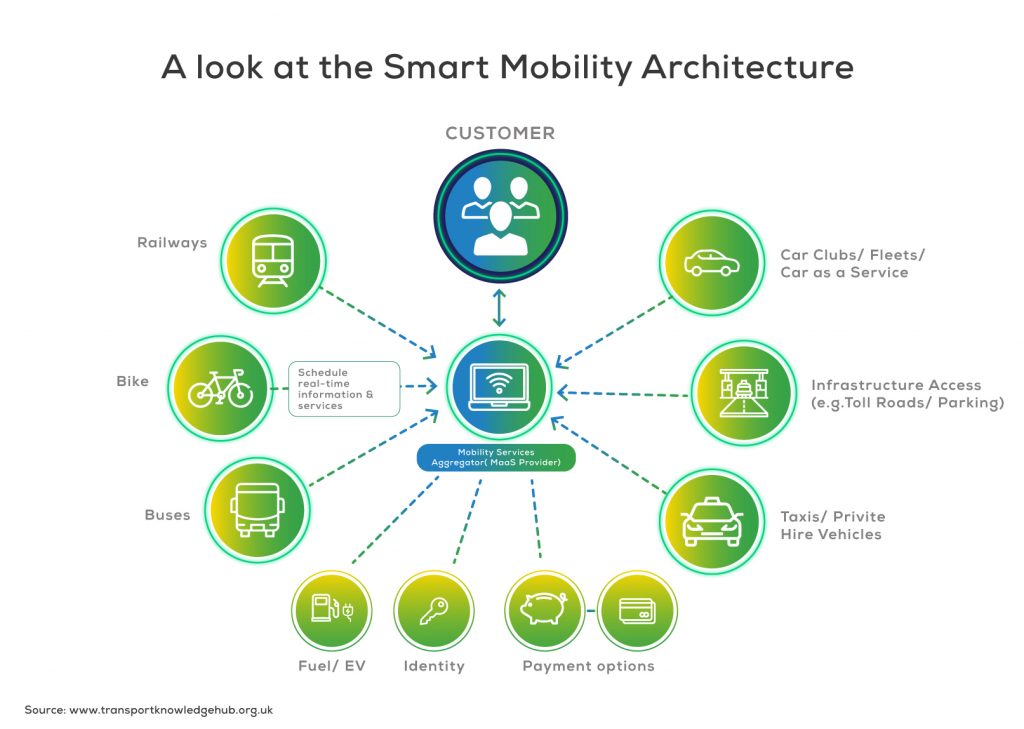
Through smart mobility systems, these nations have integrated not just ride-hailing but multi-modal transport options, including cycling, trains, buses, taxis, and car-sharing networks. Both private as well as public commute options are now at the customers’ disposal, all they have to do is make a selection of pick up and drop locations, timings and mode of payment, before the smart mobility system fulfils the order in a fast and efficient manner.
The principle is to meet varied mobility and transport needs with maximum choice, convenience, and flexibility.
Seamless Integration: How MaaS Apps Enhance Fuel Retail
MaaS platforms like Whim offer end-to-end trip planning, seamless booking, and optimized route execution, making it easier for users to leave behind private vehicle ownership.
Additionally, electronic ticketing and payment services now account for real-time fuel requirements, enabling users to track consumption versus expenditure. This integration benefits both:
MaaS platforms: By providing predictive fuel pricing estimates
Fuel retailers: By leveraging data-driven insights for customer engagement
Security remains a top priority, with unique identity tokens for transactions, and a robust loyalty rewards engine to encourage repeat purchases and customer retention.
Across Europe, cities like Paris, Eindhoven, Barcelona, and Vienna are advancing peer-to-peer MaaS networks, strengthening omnichannel customer experiences.
How MaaS is Revolutionizing Fuel Retail Forecourts
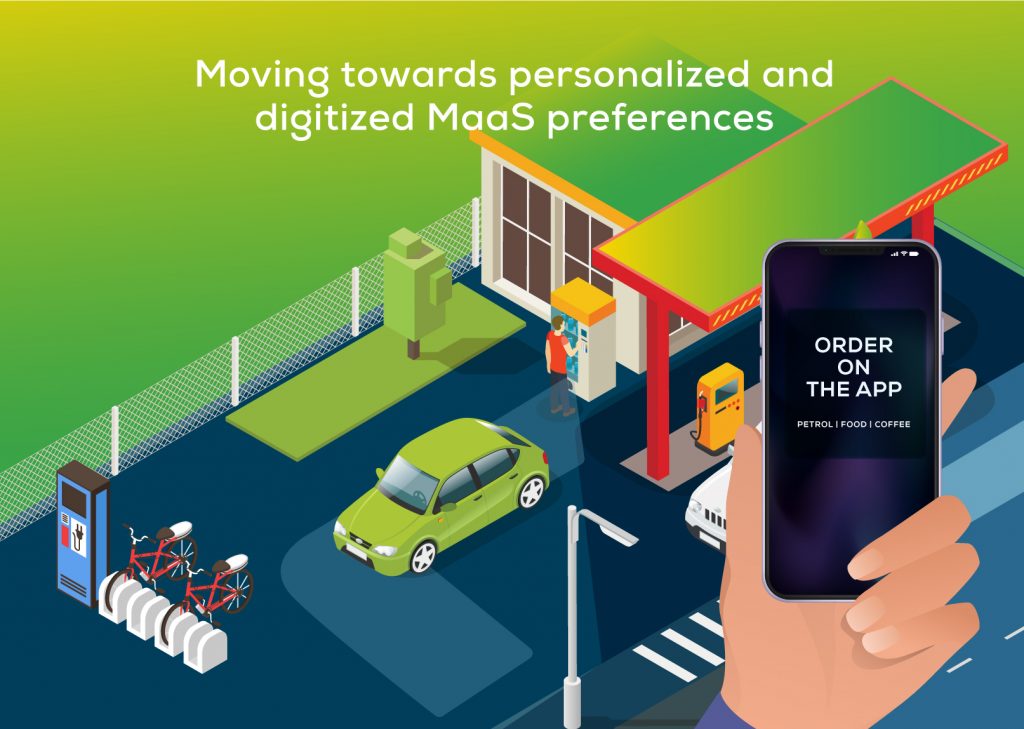
To facilitate a strong CRM and a user-centric mass mobility paradigm, fuel retailers are also jumping onto the bandwagon. Their integration within the ecosystem ensures that forecourts serve as one-stop destinations for varied MaaS-related services.
The idea is to equip apps like Whim with smoother operations so that the customer journey is optimized for faster refills. Alongside making fuel an app offering, a host of loyalty benefits, such as targeted bundle offers, promoting private label products, etc., are activated in tandem. This determines the future of fuel retail as more rewarding and tailor-made as per changing customer MaaS preferences.
The Role of Autonomous Vehicles in MaaS and Fuel Retail
Self-Driving Technology: A Catalyst for MaaS Growth
The rise of autonomous vehicles (AVs) is accelerating the evolution of Mobility-as-a-Service (MaaS). Both new-age disruptors like Uber and traditional OEMs such as Toyota are pioneering self-driving innovations to redefine urban transportation.
A significant portion of these autonomous shared vehicles will be electric, making transportation more cost-efficient and reducing dependence on traditional fuel sources. This shift presents both challenges and opportunities for fuel retailers.
Fuel Retailers Must Adapt to an EV-Dominated MaaS Landscape
This means that fuel retailers will have to quickly adapt by transforming fuel stations into recharging facilities for electric vehicles. And a host of personalized loyalty programs will improve the customer journey to ensure that the integration of MaaS with AVs is seamless.
Retail Mobility Solutions: Beyond Just Fueling and Charging
As fuel retail evolves, customization and omnichannel experiences will become more crucial for MaaS providers. E-commerce integration and data-driven insights can help fuel retailers cater to the unique needs of MaaS customers by offering:
On-demand products such as food and beverages for long-haul AV commuters
C-store (convenience store) expansions tailored to the needs of shared mobility users
Seamless digital payments through MaaS-integrated platforms
By leveraging the right tech stack, fuel retailers can establish an agile, omnichannel presence that keeps pace with the evolving MaaS-driven consumer behavior.
Smart City Logistics: Mapping the Future of MaaS and Fuel Retail
To maximize profitability in the MaaS era, fuel retailers must tap into new value pools by transforming their existing asset networks. Key areas of growth include:
Smart city logistics hubs, which will analyze unique consumer needs based on city locations and frequent AV routes
Loyalty-driven strategies, enabling fuel retailers to build brand advocacy and drive repeat engagement
Enhanced ride-sharing experiences, supported by convenience store offerings and automated service stations
The future of fuel retail is electric, automated, and mobile—far beyond its traditional role. To stay ahead, fuel retailers must align with the MaaS revolution, ensuring their services evolve alongside the next generation of urban mobility.
The New Future of Fuel Retail
The future of fuel retail is electric, automated, and mobile; far beyond its traditional role. To stay ahead, fuel retailers must align with the MaaS revolution, ensuring their services evolve alongside the next generation of urban mobility.
To know more about the fuel retail industry and the dynamics of fuel retail loyalty in future, connect with our team of experts here.
1.What is Mobility as a Service (MaaS), and how does it benefit fuel retail businesses in Europe and the USA?
Mobility as a Service (MaaS) integrates various transportation services into a single accessible platform, benefiting fuel retail businesses in Europe and the USA by enhancing customer convenience and streamlining operations.
2.How can B2B fuel retailers in the UAE leverage MaaS for operational efficiency?
B2B fuel retailers in the UAE can leverage MaaS to improve operational efficiency by optimizing fuel delivery routes, reducing costs, and providing better service to customers.
3.What are the key features of MaaS platforms for fuel retail businesses in India and Singapore?
Key features of MaaS platforms for fuel retail businesses in India and Singapore include real-time data analytics, route optimization, mobile payment integration, and customer engagement tools.
4.How does MaaS impact the fuel retail market in Saudi Arabia and Qatar?
MaaS impacts the fuel retail market in Saudi Arabia and Qatar by enabling seamless integration of transportation services, enhancing customer satisfaction, and driving business growth through innovative service offerings.
5.What are the commercial benefits of MaaS for fuel retail businesses in Australia and Canada?
The commercial benefits of MaaS for fuel retail businesses in Australia and Canada include increased customer loyalty, higher sales through personalized offers, and improved operational efficiency through technology-driven solutions.
Mobile loyalty apps have taken center stage as fuel retailers are using them to enhance customer engagement. With digital payments, real-time rewards, and personalized offers, mobile apps make loyalty programs more convenient. Customers expect instant access to benefits without extra effort.
Features like contactless payments, in-app rewards, and location-based promotions help fuel brands stay competitive in 2025. Mobile-first fuel retail loyalty programsgive customers a reason to return, improving brand loyalty and boosting sales. The shift to mobile is creating stronger connections between fuel retailers and their customers.
Why Mobile Apps Are Essential for Fuel Retail Loyalty
A mobile app loyalty program can be defined as a digital loyalty initiative designed to engage and reward customers through a smartphone application. These apps are powerful tools that help fuel retailers:
Enhance customer engagement by offering seamless rewards and incentives
Differentiate their brands in a competitive fuel retail market
Provide personalized experiences by gathering valuable customer data and delivering targeted offers
According to a study by Google, 53% of users prefer using a mobile app to retrieve account and loyalty card information, giving a strong reason for fuel brands to switch from the traditional loyalty structure to this digitized approach. Almost 65% of brands across industries are already on this transition with many reporting significant improvements in customer retention and loyalty-driven revenue.
Capillary has worked with several fuel retailers over the years and has observed a rapid shift in fuel retail loyalty. Mobile loyalty apps, often developed in collaboration with the best app development companies, are becoming essential for brands looking to keep pace with changing customer expectations. Many fuel retailers in Asia have already transitioned to a digital loyalty program, leveraging mobile-first solutions to drive customer engagement and retention.
How Mobile Loyalty Apps Are Reshaping Fuel Retail
This transformation is driven by several key factors. Firstly, the rise of Electric Vehicles (EVs) has forced fuel retailers to rethink their strategies, adapting to changing mobility trends and evolving consumer expectations. Secondly, technological advancements have enabled mobile-first loyalty solutions, transforming how customers interact with fuel stations and convenience stores. Additionally, consumer behavior is shifting, with an increasing demand for personalized rewards and seamless app-based experiences.
Leveraging expert mobile app developers, these loyalty apps provide fuel brands with a competitive edge, offering customers convenience in fuel and non-fuel purchases, including lubricants, car-wash services, and food and beverage options. Using data analytics, brands can personalize offers, creating more meaningful customer interactions.
Looking closer, here’s how mobile loyalty apps are reshaping fuel retail engagement:
Expanding Non-Fuel Retail: Fuel retailers can expand their offerings beyond fuel, providing customers with a one-stop shop for various products and services.
Simplifying Reward Redemption: Mobile apps simplify the process of redeeming loyalty rewards, making it hassle-free for customers.
Gamification: Games and other interactive features within the app enhance customer engagement.
Localization: Customizing the app’s content and offers to match local preferences and market nuances.
Brand partnerships: Collaborating with other brands to offer exciting incentives and cross-promotions.
Streamlining Data Collection: Gathering valuable customer data to inform marketing strategies and enhance the overall customer experience.
Capillary’s loyalty management platform equips fuel retail loyalty apps with all these features (and more!) for customer engagement. By bringing in the best of advanced technology and customer-focused loyalty solutions, Capillary enables fuel retailers to craft individualized and rewarding experiences for their customers.
How Capillary Helped a Global Fuel Retailer Add 2 Million New Users with a Mobile App – Case Study
A leading fuel retailer in Indonesia, with whom Capillary has a long-standing partnership, wanted to improve their fuel retail loyalty program. The brand aimed to:
Digitize its loyalty strategy and move beyond traditional methods
Gain a unified understanding of customer behavior through data-driven insights
Shift from a vehicle-centric to a consumer-focused loyalty model
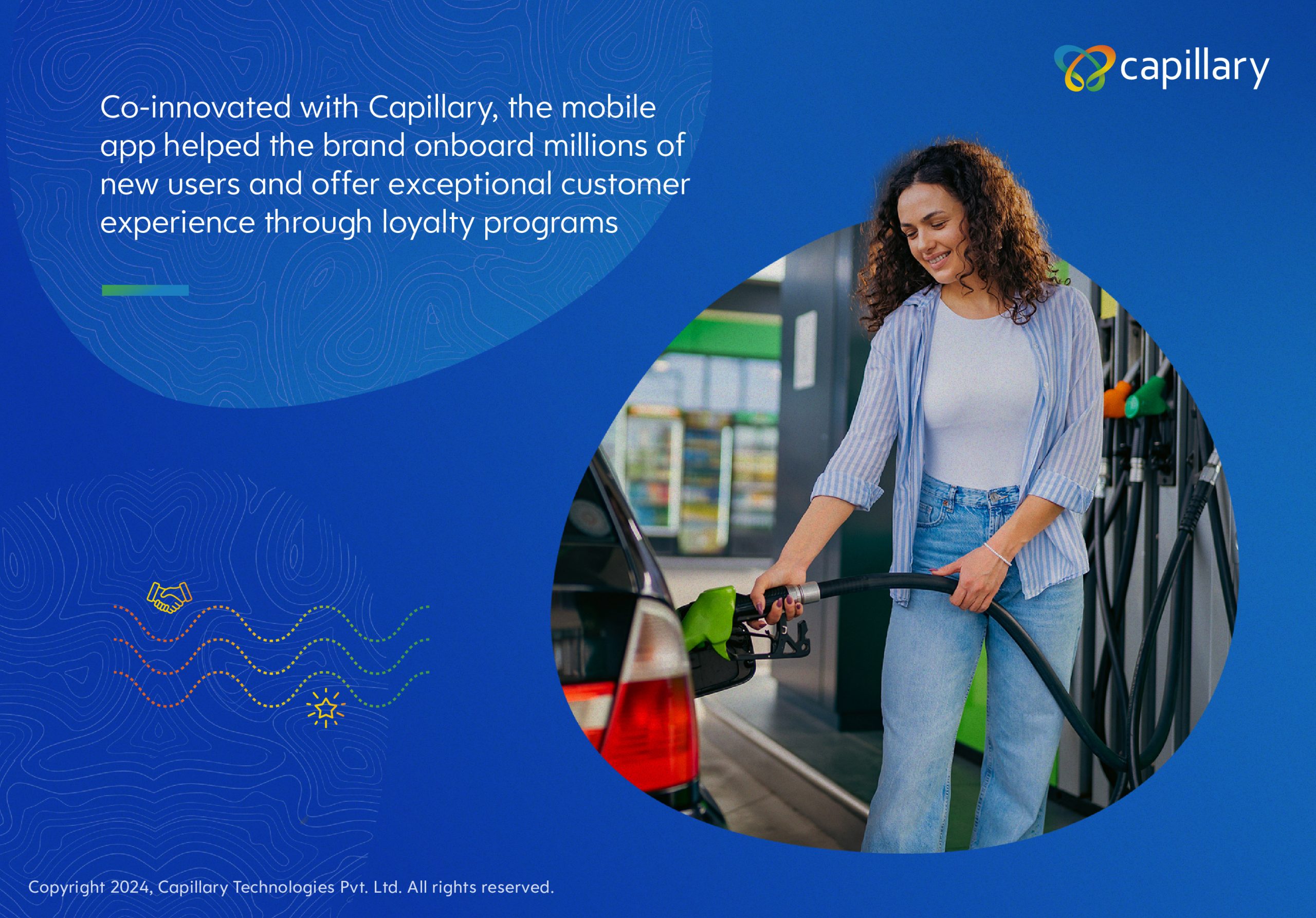
With Capillary they co-developed their mobile loyalty app, thus smoothly shifting from a traditional card-based loyalty program to a mobile-first engagement platform. And the results? Within nine months, the mobile app onboarded 1.7 million users, with over 60% active members.
How Capillary’s Partnership Transformed the Brand’s Loyalty Program
Fully Integrated Mobile Loyalty App
The success of the mobile app was attributed to its customer-centric approach, offering user-friendly interfaces, a versatile reward catalog, and store locators—features commonly developed in collaboration with a trusted Mobile app development company.
Advanced Customer Segmentation & Communication
Additionally, Capillary’s advanced data-driven insightsand analytics were used to identify valuable customer segments, create personalized journeys, and implement effective communication strategies. Capillary’s Promo engine was critical in identifying the right incentives and nudging users toward repeat purchases.
Enhancing Convenience & Engagement
Local language support and a focus on non-fuel retail further endeared the brand to its customers and contributed to business growth.
The mobile app that the fuel retail brand co-innovated with Capillary, effectively unified fuel and non-fuel retail streams, streamlined the purchase experience and enhanced loyalty program engagement.
Want to learn more about this success story? Reach out to us here, and we would love to share more details with you on how we are helping our clients redefine their loyalty programs.
Future of Fuel Loyalty & Mobile App-Based Loyalty
The shift towards mobile apps for fuel retail loyalty is not isolated but part of a larger trend. Other fuel retail brands worldwide are recognizing the potential of mobile apps to redefine customer engagement , drive customer retention, and strengthen loyalty.
Consumers today expect effortless, app-based loyalty programs that integrate with their everyday fuel purchases. By providing convenience, personalization, and seamless experiences, mobile apps are revolutionizing the way fuel retailers connect with their customers and drive business growth. The road ahead for fuel loyalty is mobile, and the brands that embrace this shift will lead the industry in 2025 and beyond. To learn more about mobile engagement strategies, talk to one of our experts today!
Without Big Data Analytics, companies are blind and deaf, wandering out onto the web like deer on a freeway.
– Geoffrey Moore, Organizational Theorist.
Data analytics is a strategic advantage that all brands must leverage for a successful customer engagement and loyalty. As third-party cookies phase out, brands are shifting to zero-party and first-party data to maintain personalized customer engagement while ensuring transparency. But what exactly do these data types mean, and how do they compare?
From zero-party data, where customers willingly share preferences, to third-party data gathered from external sources, understanding these distinctions is crucial for businesses navigating today’s data-driven world. In this blog, we break down zero, first, second, and third-party data, highlighting their impact on privacy, marketing, and consumer trust in 2025.
Zero-Party, First-Party, Second-Party, & Third-Party Data: What’s the Difference?
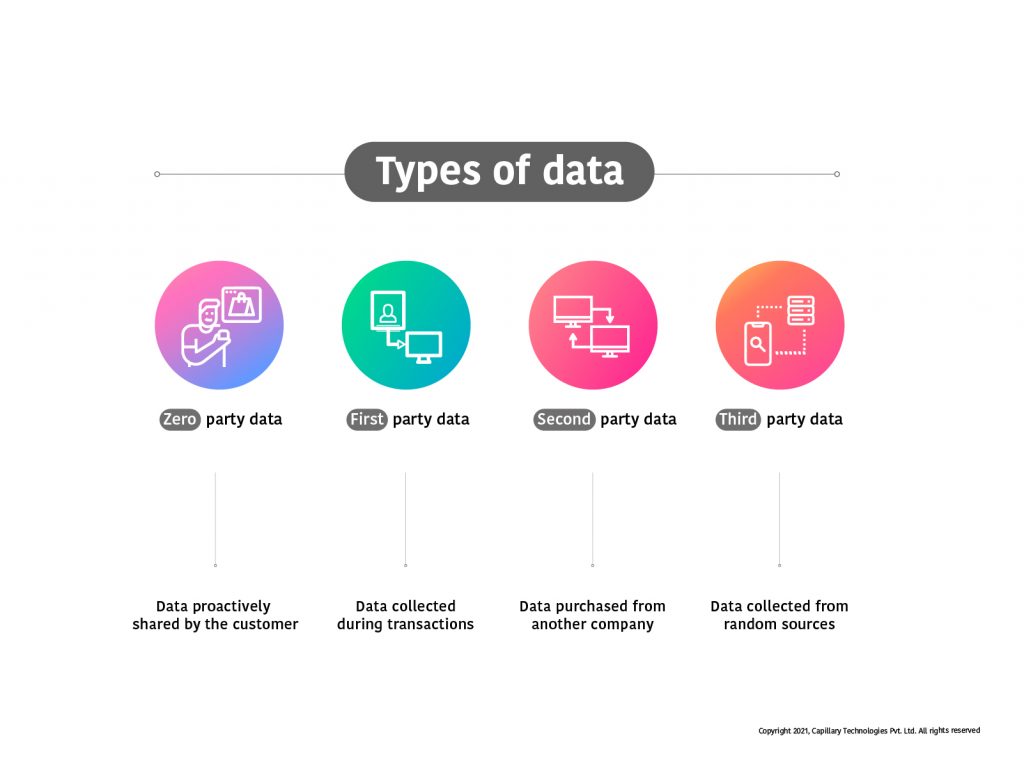
Understanding the different types of data (zero-party, first-party, second-party, and third-party data) is crucial for marketers looking to enhance customer engagement, improve personalization, and maintain data privacy compliance. Choosing the right data collection strategy helps brands build trust and transparency while improving targeting efforts. Let’s break down the key differences:
Zero-Party Data:
Zero-party data, also known as self-reported data, is explicitly shared by customers in exchange for personalized experiences. Coined by Forrester, it refers to highly valuable, consent-driven data that brands collect directly from consumers.
For example, businesses can deploy interactive surveys, preference centers, and quizzes to gather zero-party data for hyper-personalized marketing. Consumers willingly provide this data because they benefit from better recommendations and tailored experiences.
First-Party Data:
First-party data consists of customer data collected directly by brands through owned channels such as point-of-sale (POS) systems, loyalty programs, CRM platforms, and customer feedback forms. This data may include a consumer’s name, email, phone number, and purchase history.
With the decline of third-party cookies, brands are increasingly leveraging first-party data strategies for better customer insights and marketing personalization. Social media platforms also contribute to first-party data, provided users grant permission via privacy settings and preferences.
Second-Party Data:
Second-party data is essentially another company’s first-party data that is shared through direct partnerships. Unlike third-party data, which is aggregated from various sources, second-party data is acquired from trusted collaborators, ensuring better accuracy and reliability. Retail media networks and co-branded partnerships often use second-party data to expand audience reach while staying compliant with data regulations.
Third-Party Data:
Third-party data is collected from external sources and often aggregated across various websites and platforms. While it provides insights into customer demographics and online behaviors, its effectiveness is diminishing due to privacy concerns, data inaccuracies, and regulatory shifts like GDPR (General Data Protection Regulation) and CCPA (California Consumer Privacy Act).
With major browsers phasing out third-party cookies, brands must shift towards zero-party and first-party data strategies to maintain customer trust and data privacy compliance.
How Brands Can Leverage Zero-Party and First-Party Data Effectively
Now that we understand the role of zero-party and first-party data, it’s clear that direct consumer data is the most valuable asset for modern marketers. With consumer privacy laws tightening and third-party cookies disappearing, businesses need to adopt a data-driven strategy that prioritizes transparency and customer preferences.
A Customer Data Platform (CDP) is a powerful solution that helps unify data across multiple touchpoints. By leveraging AI-driven data analysis, a CDP enables brands to eliminate duplicates, segment audiences, and create personalized marketing campaigns that remain compliant with privacy laws. If your brand is looking for an effective data-collection strategy, contact our experts to explore how a CDP can help.
But while a CDP helps brands centralize customer data, an important question remains, should your brand prioritize zero-party or first-party data?
Zero-Party Data vs. First-Party Data: Which One Should You Focus On?
Both zero-party and first-party data are valuable, but they serve different purposes. Zero-party data is explicitly provided by customers, making it ideal for hyper-personalization and consent-driven marketing. However, it requires active participation, meaning brands must create compelling touchpoints to encourage data sharing.
First-party data, on the other hand, is passively collected from customer interactions, such as website behavior, purchase history, and CRM records. While it provides strong behavioral insights, it lacks the direct intent clarity that zero-party data offers.
The best strategy is to combine both, using zero-party data to understand preferences and first-party data to track real-world actions. Together, they create a powerful, privacy-compliant approach that strengthens personalization, customer engagement, and long-term customer trust.
Zero-Party Data: The Key to Consumer Privacy and Trust
While first-party data is valuable for businesses, many consumers remain concerned about how their data is used. Wunderkind’s ‘Kindness in Advertising’ report showed that 70% of consumers believe advertisers don’t respect their digital experience, with a further 95% reporting that they are bothered by intrusive ads. Consumers increasingly prefer brands that prioritize transparency in data collection.
Second-party data, though sourced from trusted business partners, still raises privacy concerns since consumers are often unaware that their data is being shared. Similarly, third-party data faces credibility issues due to its aggregated nature and lack of direct consumer consent.
This is why zero-party data is emerging as the future of privacy-first marketing. Consumers willingly share personalized insights such as shopping preferences, interests, and brand affinities, this consent-driven approach fosters trust and engagement. However, brands must ensure a frictionless opt-out process to respect consumer autonomy and uphold ethical data collection practices.
By shifting towards zero-party data collection strategies, businesses not only enhance customer relationships but also future-proof their marketing efforts against evolving privacy regulations.
Loyalty Programs: A Goldmine for Customer Insights
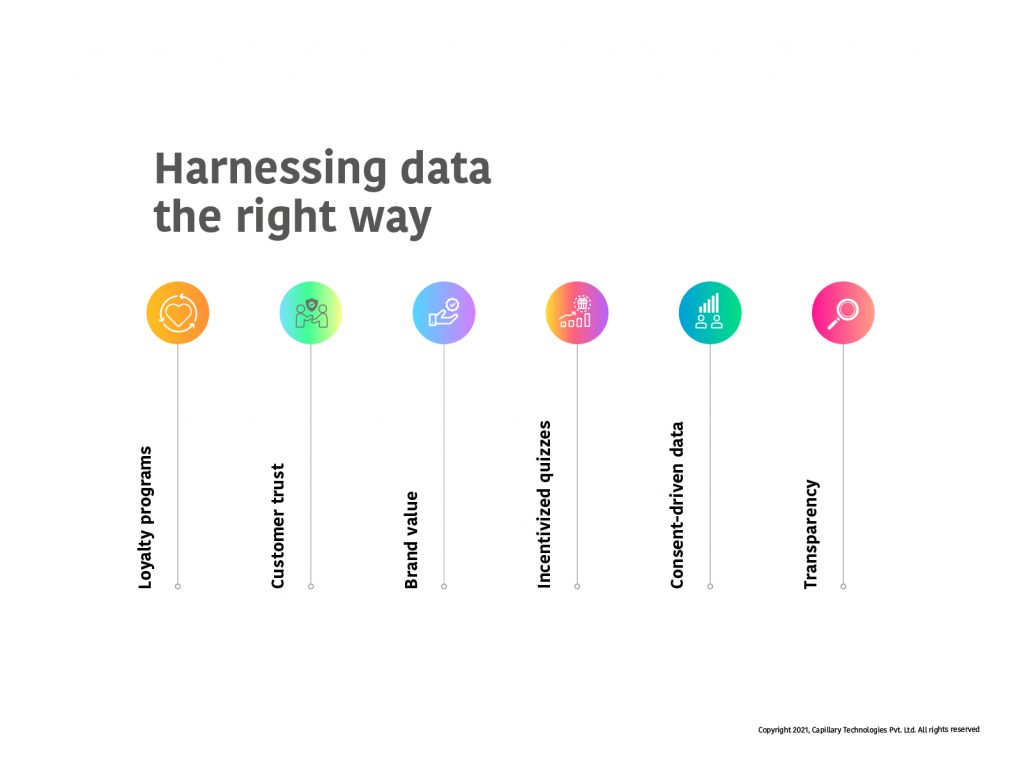
Loyalty programs are more than just retention tools, they also act as a goldmine for zero-party data. With global data privacy regulations tightening, brands must shift toward consent-driven strategies, and loyalty programs naturally encourage consumers to share valuable information in exchange for rewards, discounts, and personalized experiences.
By integrating quizzes, preference centers, and gamified surveys into loyalty programs, brands can gather high-quality customer insights while leading to more tailored recommendations and meaningful customer engagement. For instance, an apparel retailer offering loyalty points for sharing size, style, or shopping habits can create a more personalized shopping experience while ensuring compliance with evolving privacy laws.
Conclusion
In a privacy-first world, brands that balance personalization with transparency will earn customer trust and long-term loyalty. Zero-party and first-party data offer a compliant and ethical approach to collecting valuable insights while ensuring customers remain in control of their data.
The key to success lies in adopting data strategies that respect consumer privacy while delivering meaningful value. Loyalty programs, preference-based marketing, and responsible data collection are essential for staying ahead in the future of meaningful customer engagement.
Ready to future-proof your customer data strategy? Get in touch with our experts today.