Capillary Technologies Reinforces Global Loyalty Management Leadership with Acquisition of SessionM from Mastercard

February 2026

Capillary Technologies has entered into a definitive agreement to acquire SessionM from Mastercard, significantly strengthening its position as a global leader in AI-powered, enterprise-grade customer loyalty and engagement solutions.

Capillary Technologies, a global leader in AI-powered customer loyalty and engagement solutions, today announced it has entered into a definitive agreement to acquire SessionM, the customer engagement and loyalty company, from Mastercard.

This strategic acquisition marks Capillary’s most ambitious move to date, following its successful integrations of Brierley and Kognitiv. With SessionM in its portfolio, Capillary reinforces its position as a global leader in enterprise loyalty, offering a leading platform to the world’s most sophisticated enterprise brands.

Enhancing the Enterprise Customer Experience

Mastercard has identified Capillary Technologies—consistently recognized as a Leader in The Forrester Wave™—as the ideal partner to lead SessionM into its next era of growth.

Building on the momentum of the Brierley and Kognitiv integrations, this acquisition serves as a key step in Capillary’s mission to bring together complementary loyalty technologies to deliver an enhanced platform for clients.

As part of the agreement, a specialized team within SessionM will transition to Capillary, ensuring that the platform’s deep technical expertise is preserved. SessionM’s esteemed global customer base—which includes Fortune 500 retailers, airlines, and CPG brands—will continue to receive the same high-caliber support and service they experienced before the acquisition.

Delivering on Public Company Growth Strategy

The acquisition of SessionM is the latest in a series of strategic moves by Capillary, following its successful listing on the Indian Stock Exchange in November 2025. 

“M&A has been a key growth strategy for Capillary over the years, and as a public company, we are delivering on that promise to our shareholders and the market,” said Aneesh Reddy, founder & CEO of Capillary Technologies. “By bringing SessionM into our portfolio, we are not just expanding our footprint across the globe; we are further strengthening our loyalty capabilities to deliver one of the industry’s most comprehensive offerings. Our mission remains to provide enterprises across industries with specialized, AI-native loyalty technology solutions.”

About Capillary Technologies India Ltd:

Founded in 2012, Capillary Technologies India Limited, a software product company offering artificial intelligence (AI)-based cloud-native Software-as-a-Service (SaaS) products and solutions primarily to enterprise customers globally to develop loyalty of its consumer and channel partners. The Company is among one of the few players in the loyalty management space that offer end-to-end loyalty solutions. Its diversified product suite, which includes its advanced loyalty management platform (Loyalty+), connected engagement platform (Engage+), predictive analytics platform (Insights+), rewards management platform (Rewards+) and customer data platform (CDP) allows its customers to run end-to-end loyalty programs, get a comprehensive view of consumers and offer unified, cross-channel strategies that deliver a real-time omni-channel, personalized, and consistent experience for customers. The Company serves 115 customers including 20 Fortune 500 customers across 47 countries with the aim that businesses build consumer value using Company’s innovative solutions. For more information, please visit www.capillarytech.com

Share

Similar Articles

Contact Us

Get the best loyalty & customer engagement platform out there!

  • Design industry shaping loyalty programs
  • Integrate easily and go live quicker
  • Deliver hyper-personalized consumer experiences
Request A Call

Show Your Loyalty Program Some Love: An Executive POV on Loyalty Health, Not Just Loyalty Growth

February 2026

See how Capillary bakes privacy, security, and global compliance so you can protect customer data, earn trust, and turn it into an advantage.

Loyalty for Valentine's Day

Valentine’s Day is a reminder, not the point

As Valentine’s Day approaches, brands inevitably start talking about relationships, appreciation, and loyalty. It’s a convenient seasonal metaphor—but it also exposes an uncomfortable reality. Most companies spend far more time acquiring customers and launching promotions than they do systematically evaluating the health of their loyalty program. February 14 may not belong in your strategic planning calendar, but it is a useful reminder that loyalty is not a “set it and forget it” asset. Like any long-term relationship, it either deepens through intentional care or slowly decays through neglect.

The questions leaders should actually be asking

In nearly every loyalty review I’ve participated in, the same surface metrics dominate the conversation: total members, enrollment growth, and redemption rates. Those numbers feel reassuring, but they rarely answer the questions that actually matter. Is the membership base still growing because the program is compelling—or simply because enrollment is defaulted at checkout? Are members actively engaging with benefits, or just accumulating dormant points? Is the program reducing churn, increasing frequency, or driving a mix shift toward higher-margin categories? And most importantly, is it still competitive in a market where loyalty programs have become table stakes?

If those questions feel uncomfortable, that’s usually a sign they haven’t been examined rigorously. Programs rarely fail dramatically. They drift. They become bloated with underused benefits, misaligned tiers, outdated earn-and-burn economics, and experiences that no longer feel distinctive. Over time, what was once a strategic advantage turns into an expensive maintenance obligation.

Loyalty health is not the same as loyalty size

One of the biggest mistakes companies make is equating loyalty program “health” with membership growth. A large loyalty base is not inherently valuable if a meaningful portion of those members are inactive, disengaged, or behaviorally unchanged. In fact, a fast-growing but weakly engaged program often masks deeper structural problems: overly generous enrollment incentives, shallow differentiation versus competitors, or benefits that don’t align with what customers actually value.

A healthy loyalty program has three characteristics. First, it meaningfully changes customer behavior in ways that improve unit economics—frequency, retention, mix, or share of wallet. Second, it delivers benefits that feel emotionally resonant, not just financially rational. Third, it evolves as customer expectations, competitive benchmarks, and business priorities shift. Most programs satisfy only one of these conditions. Very few satisfy all three.

The competitive reality most brands underestimate

Loyalty is no longer a differentiator by default. In most categories, your customers belong to three to six programs already. They are constantly comparing your benefits, tiers, thresholds, and experiences—whether consciously or not—against what they get elsewhere. Free shipping thresholds, birthday rewards, points expiration policies, early access, and VIP perks are no longer novel. They are hygiene factors.

This means that loyalty design must be treated as a competitive strategy, not a marketing tactic. If your tier thresholds are meaningfully higher than your peers’, or your rewards feel less attainable, or your experiential benefits are generic, customers will notice—even if they never explicitly complain. The result isn’t immediate churn. It’s gradual disengagement, lower redemption intent, and declining emotional attachment.

Why emotional loyalty matters more than most dashboards admit

Most loyalty programs are built around rational incentives: points, discounts, and transactional rewards. Those mechanics are necessary, but they are not sufficient. Emotional loyalty—how customers feel about your brand, how recognized they feel, how valued they believe they are—drives long-term retention far more than incremental discounts.

This is the dimension most programs under-measure. Engagement metrics tell you whether customers are clicking and redeeming. They don’t tell you whether customers feel appreciated, understood, or proud to associate with your brand. Those emotional drivers are often the difference between a customer who defects for a 10% discount elsewhere and a customer who stays even when your price isn’t the lowest.

The uncomfortable truth is that many loyalty programs unintentionally commoditize the brand by training customers to anchor on discounts instead of attachment. When that happens, loyalty stops being a relationship engine and becomes a margin drain.

What a real loyalty health assessment should include

A serious loyalty health review goes far beyond counting members and redemptions. It should evaluate four dimensions in parallel.

First, behavioral impact: Is the program demonstrably improving frequency, retention, mix, or share of wallet versus a comparable non-member baseline? Second, economic efficiency: Are earn-and-burn rates, tier thresholds, and benefit funding aligned with margin structure and profitability targets? Third, experiential differentiation: Do benefits feel distinctive and valued, or interchangeable with competitors? Fourth, emotional resonance: Do customers feel recognized, appreciated, and emotionally connected to the brand?

Most programs are only measured on the first dimension—and even that measurement is often superficial. Without a holistic view, teams end up optimizing tactics in isolation rather than redesigning the system that produces those outcomes.

Why competitive benchmarking is not optional anymore

Internal performance trends are meaningless without external context. A flat engagement rate might be acceptable—or it might signal that competitors have leapfrogged you on benefits and experience. A rising enrollment curve might reflect organic growth—or simply frictionless sign-ups with no real commitment.

Competitive benchmarking forces uncomfortable but necessary questions. Are your tier thresholds materially higher than your peers? Are your rewards less attainable? Are your experiential benefits weaker? Are your earn rates out of step with category norms? Without those answers, loyalty design decisions are being made in a vacuum.

This is where most brands underestimate the speed of loyalty inflation. What felt generous three years ago is often merely average today.

What to do when the diagnosis isn’t flattering

The point of a loyalty health assessment isn’t to confirm that everything is fine. It’s to identify what no longer works and what should be rebalanced. In practice, that usually leads to one of three strategic moves.

First, rebalance earn-and-burn economics so rewards feel attainable without overfunding discounts. Second, consider adding or re-aligning tiers that reward and recognize profitable behaviors, not just raw spend. Third, introduce emotionally resonant benefits—recognition, access, personalization, gamification and surprise & delights —that deepen attachment rather than just subsidizing transactions.

The strongest programs are not the biggest or most generous ones. They are the most intentionally designed ones.

A more useful Valentine’s Day takeaway

So yes, Valentine’s Day is a contrived hook. But the underlying point is real. Loyalty is not a campaign. It is an operating system for customer relationships. And like any system, it degrades if it isn’t periodically audited, refreshed, and realigned with strategy and competition.

Most brands don’t need a bigger loyalty program. They need a healthier one.

That means measuring what actually matters, understanding how customers really feel, benchmarking against competitors honestly, and redesigning benefits with both emotional resonance and financial performance in mind. We have decades of experience building, enhancing and benchmarking loyalty programs across nearly every industry, and can also field our Balanced Loyalty Quotient (BLQ) research to your customers, giving you insights into their rational and emotional loyalty toward your brand vs. key competitors. 

If your loyalty program hasn’t had a serious health check in the last 18–24 months, it’s probably overdue—whether Cupid is watching or not.  

Share

Similar Articles

Contact Us

Get the best loyalty & customer engagement platform out there!

  • Design industry shaping loyalty programs
  • Integrate easily and go live quicker
  • Deliver hyper-personalized consumer experiences
Request A Call

The Future of Data Reporting & Analytics in a GenAI World: A Realistic View for Enterprise Marketers

February 2026

See how Capillary bakes privacy, security, and global compliance so you can protect customer data, earn trust, and turn it into an advantage.

GenAI Data Reporting

For years, enterprise marketers have lived inside dashboards — juggling BI tools, chasing analysts, exporting CSVs, and deciphering charts that often raise more questions than answers.

But the rise of GenAI is reshaping how marketing teams consume and act on data. And this shift is not theoretical for us — it’s something we are watching unfold across global energy leaders, major sports leagues, diversified manufacturing conglomerates, and large CPG organizations in real time.

This blog offers a realistic, evidence-backed view of what’s actually changing, grounded in recent market conversations, enterprise deployments, and lessons from real adoption journeys.

1. The Current Reality: Dashboards Are Necessary… But Insufficient

Dashboards remain essential because they provide:

  • a governed single source of truth
  • consistent KPIs
  • audit trails
  • organizational alignment

But they continue to struggle with three long-standing issues:

(1) Dashboards do not explain why something happened

Marketing leaders still feel dashboards don’t deliver actionable insights — they surface data but rarely the reasons behind it.

This aligns with what we see in the field: Shell teams often came to us with questions like “Why did premium fuel redemptions dip in South India last month?”, even though the dashboards technically showed the trend. Marketers want causality, not charts.

(2) They require specialized interpretation

Teams spend 20–30% of analytics time interpreting dashboards, not acting on them.

Real-world confirmation? In an early APAC rollout for a major client, regional managers needed analyst help even for basic comparisons. Once conversational analytics launched, query volume increased 3× overnight—not because data changed, but because accessibility did.

(3) They operate on fixed, predefined questions

Dashboards solve expected questions. Marketers care about unexpected ones. In majority of our demo’s the first reaction of the executives is –  “When can we turn this on?”

Their excitement wasn’t about charts — it was about finally being able to ask:

  • Show badge-level engagement and remove duplicates automatically
  • Compare registration trends month-over-month
  • Diagnose drop-offs in specific tracks or events

This is the unmet demand traditional BI never solved.

2. What GenAI Actually Changes: From Reporting to Explanation

GenAI finally addresses the gaps dashboard-era tools could not.

1. Conversational Analytics 

Marketers increasingly want to ask questions naturally:

  • “Why did redeemers drop?”
  • “Which segments responded best last week?”

Major vendors support this transition:

  • Salesforce Einstein Copilot
  • Adobe GenStudio
  • ThoughtSpot Sage
  • Google Gemini for BigQuery
  • AWS Q for Analytics
  • Snowflake Cortex
  • Capillary aiRA Analytics Agent (brand-aware SQL + insights)

Across enterprise brands, this is proving to be the breakthrough moment. For Shell, conversational analytics resulted in:

  • 3× increase in daily queries
  • super-user patterns emerging (Shelby in India, Joyce in Singapore)
  • 15–16 monthly analytics tickets instead of the expected hundreds, thanks to self-service

These shifts cannot be explained by “better BI.” They are the impact of lowering the barrier to inquiry.


2. Automated Insight Narratives 

GenAI summarises, explains, and highlights drivers — something dashboards never did well.

BCG’s 2023 CMO Study (North America, Europe, Asia, 200+ CMOs) reports: 93% believe GenAI will significantly accelerate insight discovery.

In practice, leaders now expect:

  • weekly business summaries
  • MoM comparisons
  • anomaly flags
  • segment-level narratives

In practice, the CMO from a major professional sports organization explicitly called out the value of auto-generated MoM comparisons—something analysts previously produced manually.

3. Insight → Action Integration 

GenAI is bridging analytics and activation by enabling:

  • segment creation
  • offer recommendations
  • campaign suggestions
  • uplift projections

Capillary’s aiRA is already connecting analytics → audience → promotion configuration in one interface, which directly addresses Shell leadership’s priorities:

  1. Market autonomy
  2. Cost savings through self-service
  3. Brand-aware customer chatbot integrations

This is where enterprise adoption is headed.

3. What Will NOT Happen (No Matter What Vendors Claim)

Marketers appreciate ambition — but respect realism more.

Fully Autonomous Campaigns (Low Certainty, 5+ Years)

Compliance, approval chains, and brand governance mean full automation remains aspirational.

Dashboards Becoming Obsolete

Dashboards are not dying. They remain the institutional memory: financial truth, KPI governance, benchmarking.

In every enterprise conversation — Shell, Optum, Polycab, AFG — this has been consistent.

AI Making Decisions Without Human Oversight

Between GDPR, DPDP India, and the EU AI Act, human-in-loop remains mandatory — especially across BFSI, pharma, and energy.

4. The Real Future: A Hybrid Analytics Paradigm

A dual-layer model is emerging:

Layer 1: Dashboards → Institutional Memory

Still essential for:

  • governed metrics
  • finance alignment
  • historical visibility
  • standardized reporting

Layer 2: GenAI Insight Layer → Institutional Intelligence

Built atop warehouses and BI systems, acting as the marketer’s reasoning engine:

  • ask complex questions
  • diagnose changes
  • compare segments
  • test hypotheses
  • generate narratives
  • trigger recommended actions

A turning point for adoption occurred during a recent context-mapping demo where the AI automatically interpreted complex SKU codes, store hierarchies, and fuel grades without user input. This level of brand awareness makes GenAI usable for the enterprise.

5. The Most Practical Enterprise Use Cases Emerging Today

1. “Explain This” Queries

The strongest GenAI adoption pattern across all our enterprise brands.

2. Rapid Ad-Hoc Reporting

ThoughtSpot and BCG benchmark studies show 60–80% reduction in ad-hoc requests.

3. Insight Summaries for Leadership

Executives now prefer:

  • AI-written weekly summaries
  • anomaly reports
  • commentary

NASCAR’s leadership explicitly cited this as the primary unlock.

4. AI-Assisted Audience Creation

Marketers describe the segment. AI writes the logic.

Platforms like Adobe, Salesforce, and aiRA operationalize this today.

5. Predictive Scenarios & Forecasting

Enterprises aren’t looking for “autonomous marketing.” They want:

  • uplift simulations
  • budget impact scenarios
  • offer recommendation models

Capillary is already doing pilots that include brand-aware forecasting and recommendation engines.

6. The Hard Truth: None of This Works Without Data Readiness

Every enterprise marketer already knows: AI is only as good as the data foundation.

Roadblocks observed across clients:

  • fragmented CRM + offline + retailer + partner data
  • inconsistent schemas
  • missing event-level granularity
  • uneven quality across markets
  • limited metadata & governance

For a large-scale B2B2C ecosystem, the challenge is perfect evidence: to deliver meaningful insights, the system must ingest distributor orders, sales officer visits, and retailer inventory.

  • distributor orders
  • sales officer visits
  • retailer inventory
  • planning data

McKinsey’s 2024 global data maturity report estimates only ~20% of enterprises have the readiness for advanced GenAI analytics.

7. A Realistic 3–5 Year Outlook for Marketing Analytics

Already happening 

  • Conversational analytics
  • Narrative insights
  • Reduced dependence on analysts
  • Faster decision cycles

50–70% Likely

  • Automated action recommendations
  • AI-assisted segmentation
  • cross-channel optimization

20–30% Likely

  • fully autonomous campaigns
  • dashboard replacements
  • self-adjusting loyalty engines

Across all my client conversations, one theme is consistent: Marketers want AI assistance, not AI autopilot.

8. The Bottom Line for Marketers

GenAI is not replacing reporting.
It’s replacing the workarounds marketers built around reporting.

The shift is from:

  • searching for data → receiving explanations
  • dashboards-only → dashboards + GenAI
  • manual exploration → guided reasoning
  • ad-hoc analysis → continuous intelligence

This is the realistic, experience-backed future — one that bridges enterprise constraints with transformational capability.

Share

Similar Articles

Contact Us

Get the best loyalty & customer engagement platform out there!

  • Design industry shaping loyalty programs
  • Integrate easily and go live quicker
  • Deliver hyper-personalized consumer experiences
Request A Call

Campaigns that Think for Themselves: The New Era of Loyalty Marketing

February 2026

Loyalty teams are stuck in campaign ops. Agentic AI changes that. Meet aiRA: Capillary’s agentic AI that builds, tests, launches, and learns to run campaigns end-to-end.

aiRA by Capillary

For years, loyalty marketing teams have been stuck in an operational loop — planning campaigns, configuring rules, chasing segments, waiting for QA, fixing errors, generating reports, and repeating the cycle. The promise of AI has hovered around the edges, mostly delivering chatbots, copywriting helpers, or insight summaries. Useful, yes — but far from transformative.

That changes with agentic AI.

We’re now entering an era where campaigns don’t just run automatically — they think automatically. They plan, validate, test, and optimize themselves, becoming smarter with every interaction. This is the world of autonomous loyalty marketing, and it is redefining how brands engage their members.

At Capillary, this shift is powered by aiRA — our agentic AI that takes campaigns from idea to go-live, on autopilot.

Why Loyalty Needs Agentic AI

Loyalty is one of the most data-rich functions in the enterprise — yet also the most operationally heavy. Launching a single promotion can require:

  • Business rules


  • Segments and filters


  • Offer eligibility logic


  • QA and edge-case checks


  • Deployment workflows


  • Post-campaign analysis


Traditional marketing AI improves parts of the journey — but loyalty needs something deeper:


An agent that understands context, takes actions, and closes loops end-to-end.

This is where agentic AI steps in. Unlike conversational AI that responds, agentic AI acts.

Meet aiRA — Campaigns That Practically Build Themselves

aiRA is Capillary’s enterprise-grade agentic AI built specifically for loyalty and engagement teams.
It doesn’t just generate ideas — it executes them.

What makes aiRA different?

1. It understands goals, not just prompts.

Marketers can describe a business need (“Increase repeat visits for high-potential members this month”), and aiRA recommends:

  • The right segment


  • The right offer


  • The right promotion structure


  • Expected outcomes


2. It builds campaigns end-to-end.

aiRA configures segmentation, writes rules, sets conditions, and prepares everything for launch — all through conversational setup.
No BRDs. No manual rule writing.

3. It tests campaigns before going live.

The QA Agent auto-generates test cases, checks edge conditions, and validates rules — reducing production errors by up to 90%.

4. It guides optimization with explainable insights.

aiRA doesn’t auto-optimize in the background.
Instead, it highlights what worked, diagnoses what didn’t, and recommends improvements — keeping marketers fully in control of the final call.

5. It handles everyday workflows too.

Utility Bots simplify daily operations with AI helpers for:

  • Content creation:Crafts compelling marketing copy across all channels. It can generate personalized email subject lines and SMS messages that drive engagement and immediate customer action.


  • Rule writing : Builds your complex campaign logic effortlessly. It creates sophisticated rules for points, rewards, and tier-based promotions, eliminating technical complexity for faster, smarter launches.


  • Documentation search: Your instant platform guide! Get immediate answers on features, campaign setup, and troubleshooting. It eliminates digging through documentation for quick, sharp insights.


  • Image-to-HTML conversion: Transforms your creative designs into perfect email code. Just upload your mockup, and I instantly convert it into clean, responsive, mobile-optimized HTML for all email clients.

This brings instant productivity gains without requiring organizational change.

From Insight to Impact — The Agentic Lifecycle

Autonomous loyalty marketing is not about removing marketers — it’s about removing manual work.
aiRA follows a simple lifecycle that keeps humans firmly in control:

Understand → Build → Test → Launch → Learn

Here’s how it works in practice:

Understand- Conversational setup transforms briefs and goals into structured promotion logic — without complex forms or rule writing.

Build- aiRA creates segments, constructs rules, and prepares configurations in the background, giving marketers complete visibility before anything moves forward.

Test- The QA Agent automatically validates edge cases and highlights potential issues.
Nothing goes live without human review and approval.

Launch- Teams launch faster and with more confidence, with aiRA assisting at every step while staying within clearly defined guardrails.

Learn- aiRA analyzes performance and explains why results happened, surfacing recommendations for segments, offers, or budgets.
Marketers remain the decision-makers — aiRA is the guide, not the autopilot.

Real, Measurable Impact for Marketing Teams

Agentic AI isn’t just a productivity story — it’s a revenue story.

Brands using aiRA have seen:

  • 70% faster promotion execution


  • 25%+ incremental ROI driven by Generative Loyalty


  • 90% fewer production errors


  • 80% reduction in ad-hoc reporting requests


The result?
Loyalty teams move from “campaign operators” to “customer growth drivers.”

Why This Moment Matters

Every loyalty platform today has a chatbot. Some have basic automation.
But very few can act on your behalf.

aiRA brings enterprise-grade agentic automation to loyalty — a space where complexity is high and stakes are even higher. Instead of expecting marketers to juggle segmentation, logic, analytics, and testing, aiRA:

  • Handles the operational load


  • Ensures accuracy


  • Delivers repeatable efficiency


  • Keeps learning with every action


The shift mirrors what happened in DevOps: manual processes gave way to autonomous pipelines.
Now, loyalty marketing is experiencing the same transformation.

The New Standard: Loyalty That Runs Itself

The future of loyalty belongs to systems that:

  • Plan intelligently


  • Execute accurately


  • Learn continuously


  • Scale safely


Campaigns that once took weeks now take minutes.
Insights that once required analysts now appear in seconds.
Everyday bottlenecks disappear.

This isn’t automation.
This is autonomy.

And with aiRA, brands finally get a loyalty engine that keeps improving — even when the team is offline.

Ready to build loyalty on autopilot?

aiRA is available in two editions:

  • Essentials – all the utility bots and foundational capabilities to get you started


  • Elite – agentic automation at scale, with advanced personalization and analytics


If you want loyalty campaigns that think for themselves, this is where you start.

Build loyalty on autopilot — with aiRA.

Share

Similar Articles

Contact Us

Get the best loyalty & customer engagement platform out there!

  • Design industry shaping loyalty programs
  • Integrate easily and go live quicker
  • Deliver hyper-personalized consumer experiences
Request A Call

Is Your Loyalty Program Profitable?

As we leave 2025 behind, It’s the beginning of another year, and a time where many CFO’s are focused on the “joys” of year-end financial reporting. As marketers, we may be spared from much of the accounting and reporting; however, if you run a loyalty program, you may wonder (or your CFO may be asking) how is my loyalty program performing financially? Is it a vast, deep money pit, draining the company of valuable resources (highly unlikely) or is it the star product, driving the bulk of revenue and profits (also most unlikely). The truth is likely somewhere in between, but how would you get a grip on your program’s financial performance?

The answer is to conduct a Cost-Benefit Analysis of your program. It’s essentially a 2-step process. The first (and hardest) step is to estimate the incremental revenue and margin your members are contributing as a result of the program, and then in the final step, deduct the costs of running your program.

How do you estimate incremental revenue and margin?

At Capillary Technologies, we recommend a 2-way estimate of incrementality. Cohort Analysis and Multivariate Regression Analysis allows for a range of incremental revenue to be estimated based on robust analytical and statistical modeling. We won’t get into the details, but with Cohort Analysis, you identify similarly performing customers over a period of time (typically 12 months to consider seasonality) prior to joining the program, and compare those customers over a subsequent period of time (members vs. non-members) to determine the lift in spend, transactions, and retention. Similarly, with Multivariate Regression, you are analyzing the performance of members vs. non-members and estimating the role of program membership in explaining the incrementality/difference in performance of members vs. non-members. The estimates of incremental lift in spend and retention can be extrapolated to the overall program’s active member base to provide a range of incremental revenue (and margin) driven by the program.

From this, you’d subtract the expenses over that time period (i.e.,last 12 months). This would include the cost of rewards redeemed, member benefits (i.e. welcome gifts, birthday or anniversary gifts and other “hard cost” benefits), loyalty platform licensing and support fees (internal and external), and any other expenses that are incurred in the marketing and support of the program. You may also consider offsetting these costs with any points/loyalty currency breakage during the year; however, your finance team may have a differing view on that.

The net of these two steps is your estimated financial contribution (or cost) of the program. If your eyes glaze over at the thought of this, Capillary Technologies has a team of consultants and analysts that have deep expertise in performing Cost Benefit Analyses for hundreds of programs. And if your program isn’t performing as well as you’d like, we can help get it in shape for the new year and beyond.

Capillary Technologies and RaceTrac Partner to Redefine Convenience Store Retail Loyalty

February 5, 2026 – Capillary Technologies, a global leader in AI-powered loyalty solutions, and RaceTrac, one of the leading convenience store retailers in the United States, today announced a strategic partnership to transform and enhance the RaceTrac Rewards program across its more than 600 retail locations.


The collaboration marks a significant step forward in RaceTrac’s mission to deliver more personalized, flexible, and rewarding experiences for its guests. By leveraging Capillary Technologies’ modern loyalty infrastructure, RaceTrac will introduce a new generation of features designed to recognize and reward guests in smarter, more meaningful ways. The enhanced program will combine tier-based recognition with the ability to stack and combine offers, while advanced targeting will tailor promotions to individual preferences and behaviors. Together, these capabilities will enable RaceTrac to deliver experiences that feel uniquely relevant to each guest, all on a platform built to scale seamlessly with future growth.


“We’re thrilled to partner with RaceTrac, a brand that truly lives its customer-first values,” said Kunwar Keshav, SVP at Capillary Technologies. “This collaboration brings together RaceTrac’s deep understanding of guest experiences with Capillary Technologies’ AI-led loyalty technology. The result is a modern program that not only responds to what customers want today but anticipates what they’ll value tomorrow.”


For RaceTrac, the modernized rewards program reflects their commitment to empowering guest experiences through digital innovation.  By uniting advanced personalization with a more flexible rewards construct, RaceTrac will be able to recognize loyalty at multiple levels, present offers that fit each customer’s context, and strengthen the emotional connection that drives repeat visits. 


“At RaceTrac, we’re committed to creating frictionless experiences that feel simple and enjoyable. Our enhanced RaceTrac Rewards program is designed to meet guests where they are—offering tailored value that makes every guest feel appreciated and every visit worth repeating,” said Jamie Miller, Vice President of Marketing at RaceTrac. “We’re excited to partner with Capillary Technologies to bring this next phase of the program to life.” 


The partnership underscores a shared belief that loyalty is not merely transactional but relational. For years, RaceTrac has demonstrated an unwavering commitment to its guests—a commitment that now becomes the catalyst for innovation. By combining Capillary Technologies’ expertise in loyalty technology with RaceTrac’s deep customer-centric roots, the partnership sets a bold new standard for how convenience retailers deploy AI, data, and personalization to build genuine relationships and create meaningful long-term value.


About RaceTrac, Inc. 

Headquartered in Atlanta, Georgia, family-owned RaceTrac, Inc. is one of the largest privately held companies in the United States, serving guests since 1934. The company’s retail brands include more than 800 RaceTrac® and RaceWay® retail locations, approximately 1,200 Gulf® branded locations, and more than 445 Potbelly® neighborhood sandwich shops throughout the United States. RaceTrac employs more than 15,000 team members across RaceTrac, RaceWay, Potbelly and affiliated companies Energy Dispatch and Gulf, Inc. For more information, please visit RaceTrac’s website at RaceTrac.com.

About Capillary Technologies

Capillary Technologies is a global leader in AI-powered loyalty and customer engagement solutions. Founded in 2012, the company combines its best-in-class loyalty technology with expert services to design, manage, and optimize loyalty programs that help brands across industries transform and improve consumer experience and engagement. Trusted by 390+ brands across 45+ countries, Capillary Technologies manages 100+ loyalty programs and powers experiences for more than 1.2 billion loyalty members worldwide, making it one of the largest loyalty ecosystems globally. With a workforce of over 650 employees worldwide, Capillary Technologies is dedicated to delivering value to clients and accelerating innovation in loyalty. Learn more at www.capillarytech.com.

Capillary Technologies Appoints Loyalty Veteran Andy Kulina to Spearhead European Sales Growth

February 2026

Capillary Technologies has appointed loyalty industry veteran Andy Kulina as VP, Customer Solutions, to drive its European expansion with AI-powered, cloud-native loyalty platforms.

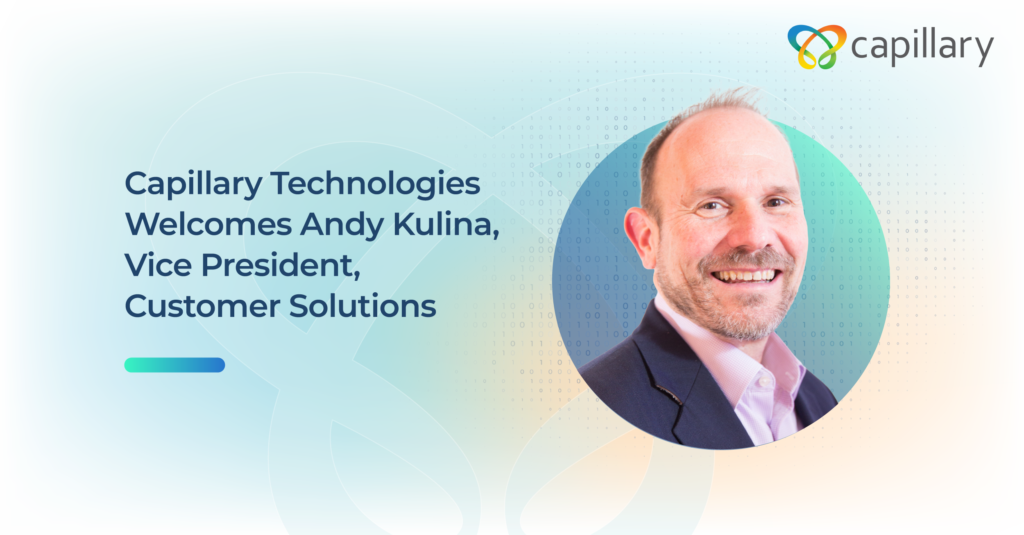
 Capillary Technologies, the global leader in AI-powered loyalty and customer engagement solutions, today announced the appointment of Andy Kulina as Vice President, Customer Solutions. Andy joins the company to accelerate Capillary’s expansion across the continent, reporting directly to Jan-Pieter (JP) Lips, President of Europe.

Andy brings over three decades of deep-domain expertise in the loyalty and customer engagement sector. Most recently, he worked for Oracle CrowdTwist EMEA, where he was instrumental in shaping retention loyalty strategies for major enterprise brands. His career is marked by a “360-degree view” of the industry—ranging from his early days helping launch the Kroger Plus program in the US & Natwest Rewards in the UK, to founding loyalty startups and leading high-growth sales teams in the UK and EU.

In his new role, Andy will lead Capillary’s business development efforts, helping European retailers and enterprises replace legacy systems with Capillary’s cloud-native, AI-driven platform.

Jan-Pieter (JP) Lips, President of Europe at Capillary Technologies, commented:

“I have known Andy for many years as one of the true pioneers of the loyalty industry. He has an incredible knack for understanding the intersection of technology and consumer behaviour. As we continue to scale our footprint in Europe, Andy’s deep relationships and proven track record in delivering value to complex enterprise clients will be a massive asset. I am thrilled to have him on board to help us redefine what loyalty looks like for European brands.”

Andy Kulina, Vice President, Customer Solutions, added:

“Capillary is at a fascinating inflection point, especially following its acquisitions, recent IPO and consistent recognition as a leader in the loyalty space by clients and industry analysts like Forrester. The European market is hungry for more agile, AI-driven solutions that move beyond simple transactions to true emotional engagement. I look forward to working with JP and the global team to bring these next-generation capabilities to our partners.”

Share

Similar Articles

Contact Us

Get the best loyalty & customer engagement platform out there!

  • Design industry shaping loyalty programs
  • Integrate easily and go live quicker
  • Deliver hyper-personalized consumer experiences
Request A Call