
March 9, 2026
AI transforms loyalty campaign planning by compressing weeks of strategy, segmentation, and execution into hours, enabling CRM teams to launch faster, optimize in real time, and focus on strategic decision-making rather than operational bottlenecks.
The Challenge Loyalty Teams Know Too Well
If you have managed a CRM or loyalty program for any meaningful period of time, the campaign planning cycle will feel familiar.
A major retail moment approaches. Ramadan across the Middle East. An End-of-Season Sale in fashion. Black Friday in the United States. Boxing Day across Europe.
The planning process typically unfolds in predictable stages.
First comes strategy definition: identifying the target audience, allocating budgets, and determining offer mechanics. This alone can take five to eight days.
Next comes analytics and segmentation. Data models are built, customer cohorts are scored, and segments are validated against historical behavior. Depending on data complexity, this step can take another seven to ten days.
Then the campaign setup phase begins. Variants are created across markets and languages, incentives are configured, messages are drafted, and journeys are tested. This stage often consumes eight to twelve days.
Finally, the campaign moves through review and launch, including stakeholder approvals, QA checks, and deployment. Even under optimal circumstances, this adds another two to four days.
End-to-end, the cycle easily stretches to 20–30+ man-days of effort. And that estimate assumes minimal rework or iteration.
The issue is rarely the team. Most CRM teams are highly capable.
The challenge lies in the process itself. By the time the campaign launches, the window of opportunity it was designed for may already be narrowing.
The Shift Toward AI-Orchestrated Campaign Planning
Artificial intelligence is not replacing CRM teams. Instead, it is removing operational bottlenecks that have historically slowed campaign execution.
When integrated correctly, AI-driven CRM operations transform how campaigns are designed, built, and optimized.
The most effective implementations start with something simple but powerful: encoding real business constraints into the planning process.
Instead of asking AI to “generate a campaign,” marketers can input the actual parameters that govern campaign decisions:
- Budget limits
- ROI thresholds
- Margin guardrails
- Incentive caps
- Channel spend limits across SMS, email, and push notifications
- Regional promotion rules
With these constraints in place, the output is no longer a generic campaign proposal. It becomes a structured plan aligned with the realities of the business.
What previously required multiple rounds of planning and stakeholder revisions can often be resolved in a single iteration.
Platforms that combine AI with a unified customer data platform enable this shift by allowing marketers to operate on real-time customer intelligence rather than fragmented campaign data.
From Blank Page to Campaign Framework in Hours
One of the most time-consuming steps in campaign planning has always been the strategy phase.
AI can now accelerate this dramatically.
By analyzing historical campaign performance, member behavior, tier structures, and margin thresholds, AI-powered systems can generate a complete campaign framework within hours.
This includes:
- Segment-level targeting recommendations
- Offer structures aligned with business objectives
- KPI projections such as basket size, transaction value, and purchase frequency
- Incentive mechanics tailored to different customer cohorts
Consider a Ramadan promotion spanning six markets, or a three-week end-of-season markdown campaign across multiple store locations.
Traditionally, developing the strategy alone might require week-long workshops across marketing, analytics, and merchandising teams.
With AI-powered campaign planning, the first structured draft can emerge within an afternoon.
The team’s role shifts from building the strategy to validating and refining it.
Accelerating Segmentation and Targeting
Segmentation is another area where campaign timelines typically expand.
Analysts often spend days identifying behavioral patterns, scoring customers, and validating segments across markets.
AI can compress this process significantly.
With a unified customer data foundation, customer behavior can be analyzed in a single pass to identify patterns such as:
- Seasonal purchasing behaviors
- Ramadan-specific shopping signals
- Lapsed-customer reactivation opportunities
- Cross-category purchase correlations
Segments can be generated with propensity scores and projected performance metrics, allowing stakeholders to review targeting strategies immediately.
Importantly, these systems are not black boxes. The logic behind each segment remains transparent, allowing teams to adjust, challenge, or refine the recommendations with full context.
What previously required seven to ten days of analytical effort can often be completed in a single working session.
From Reporting to Real-Time Decision Support
Campaign analytics has traditionally been retrospective.
Before launch, teams prepare projections based on historical performance. After launch, analysts compile results into dashboards or spreadsheets that may take weeks to interpret.
AI changes the role of analytics from reporting to real-time decision support.
Before a campaign goes live, AI can generate projected impact models estimating expected uplift across key metrics such as:
- Conversion rates
- Average transaction value
- Incremental revenue
After launch, performance analysis can be produced as a structured narrative rather than raw data tables.
Instead of navigating dozens of spreadsheet tabs, teams receive clear insights on:
- What worked
- What underperformed
- What adjustments should be made
This allows CRM teams to spend less time assembling reports and more time acting on insights.
Mid-Campaign Optimization Becomes Practical
The most transformative shift occurs once campaigns are live.
Historically, performance reviews occurred weekly or even monthly. By the time issues were identified, the campaign window was often already closing.
With AI integrated into campaign execution, teams can analyze performance within hours rather than weeks.
If results begin to decline, the system can quickly diagnose possible causes:
- Incorrect segment targeting
- Offer fatigue
- Underperforming channels
- Messaging inefficiencies
This allows teams to revise strategy mid-campaign by adjusting segments, modifying incentives, or reallocating budget while the campaign is still active.
Campaign execution moves from static planning to dynamic optimization.
What AI Cannot Replace
Despite its advantages, AI does not eliminate the need for human judgment.
Brand context still matters.
AI may identify high-value segments, but it cannot determine how a brand should express itself during culturally significant moments such as Ramadan or Black Friday. A luxury retailer and a value retailer may interpret the same data very differently.
Organizational alignment remains essential.
Many campaign delays are caused not by analytics but by coordination across marketing, merchandising, procurement, and finance. AI cannot replace those decision-making processes.
The most effective systems therefore adopt a human-in-the-loop model.
AI generates recommendations and accelerates analysis, but final approval and strategic judgment remain with the team.
The Competitive Advantage: Speed of Learning
In modern loyalty and CRM environments, differentiation is increasingly defined by operational speed.
The brands that outperform are not simply those with the most sophisticated programs. They are the ones that can:
- Plan faster
- Launch faster
- Learn faster
- Adjust faster
In markets where consumer behavior shifts weekly, a 30-day campaign planning cycle becomes a structural disadvantage.
AI is fundamentally changing that equation.
By compressing campaign planning from weeks to hours and enabling real-time optimization, organizations can operate with a level of agility that was previously impossible.
The gap between teams that adopt AI-powered CRM and loyalty platforms and those that rely on traditional workflows will only continue to widen.
See How AI Can Accelerate Your CRM Operations
Modern CRM teams need the ability to move from strategy to execution in hours rather than weeks.
With AI-powered loyalty and customer engagement platforms, brands can design campaigns faster, analyze performance instantly, and optimize customer engagement in real time.
Explore how Capillary Technologies helps brands transform CRM operations with AI-powered loyalty and customer engagement platforms.
Share

Toshi Agarwal
Trending Topics
Ecommerce in Malaysia: Growth, Trends & Opportunities
Capillary Technologies acquires Brierley
Similar Articles
Great Ingredients, Broken Recipes: Why North America’s Biggest Loyalty Programs Are Failing Their Best Customers
A few weeks ago, I set out to answer a question that had been nagging
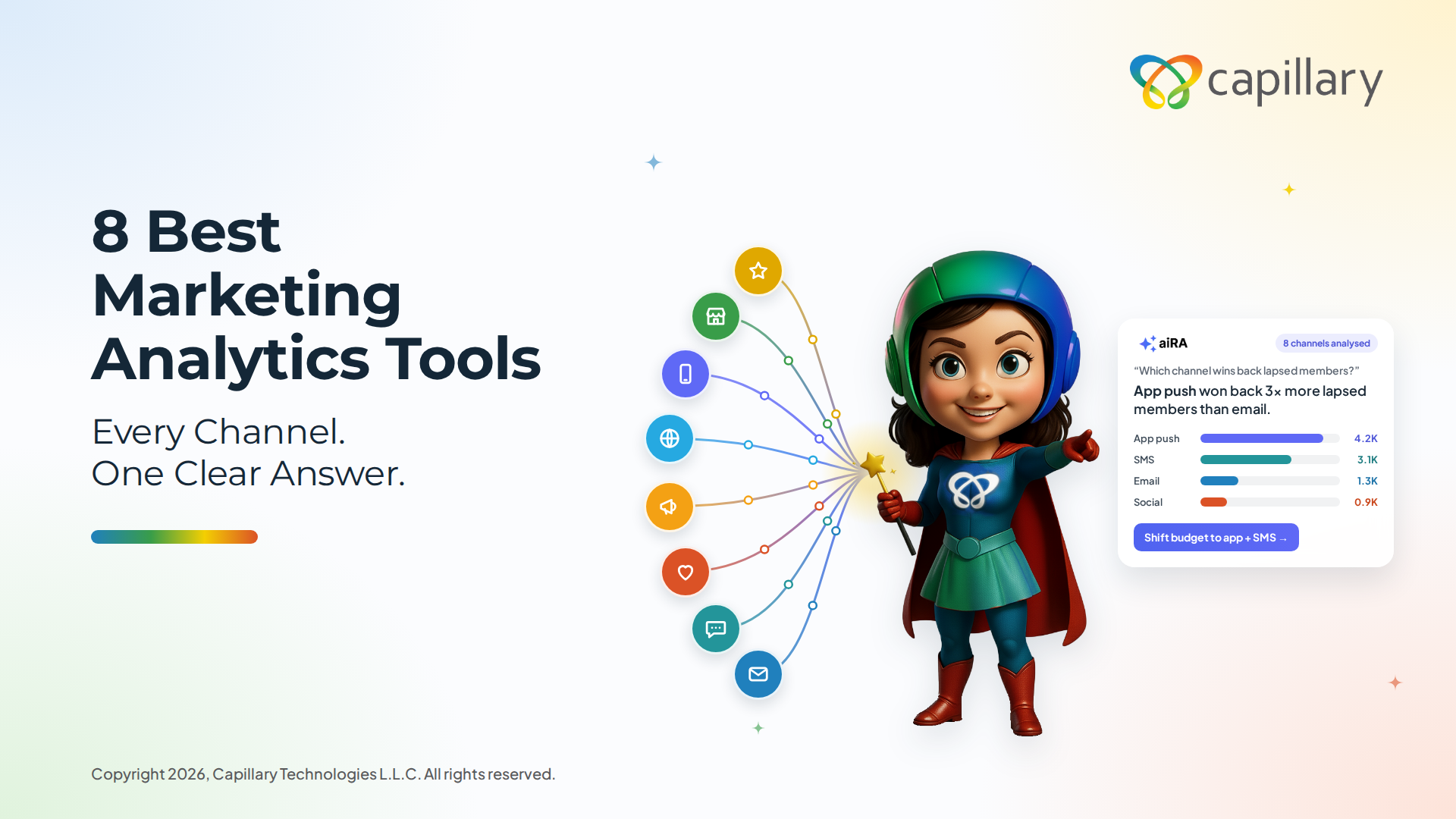
8 Best Marketing Analytics Tools for 2026 (Self-Service & AI-Powered Compared)
Introduction Marketers are drowning in channel data, yet most still wait days for a simple
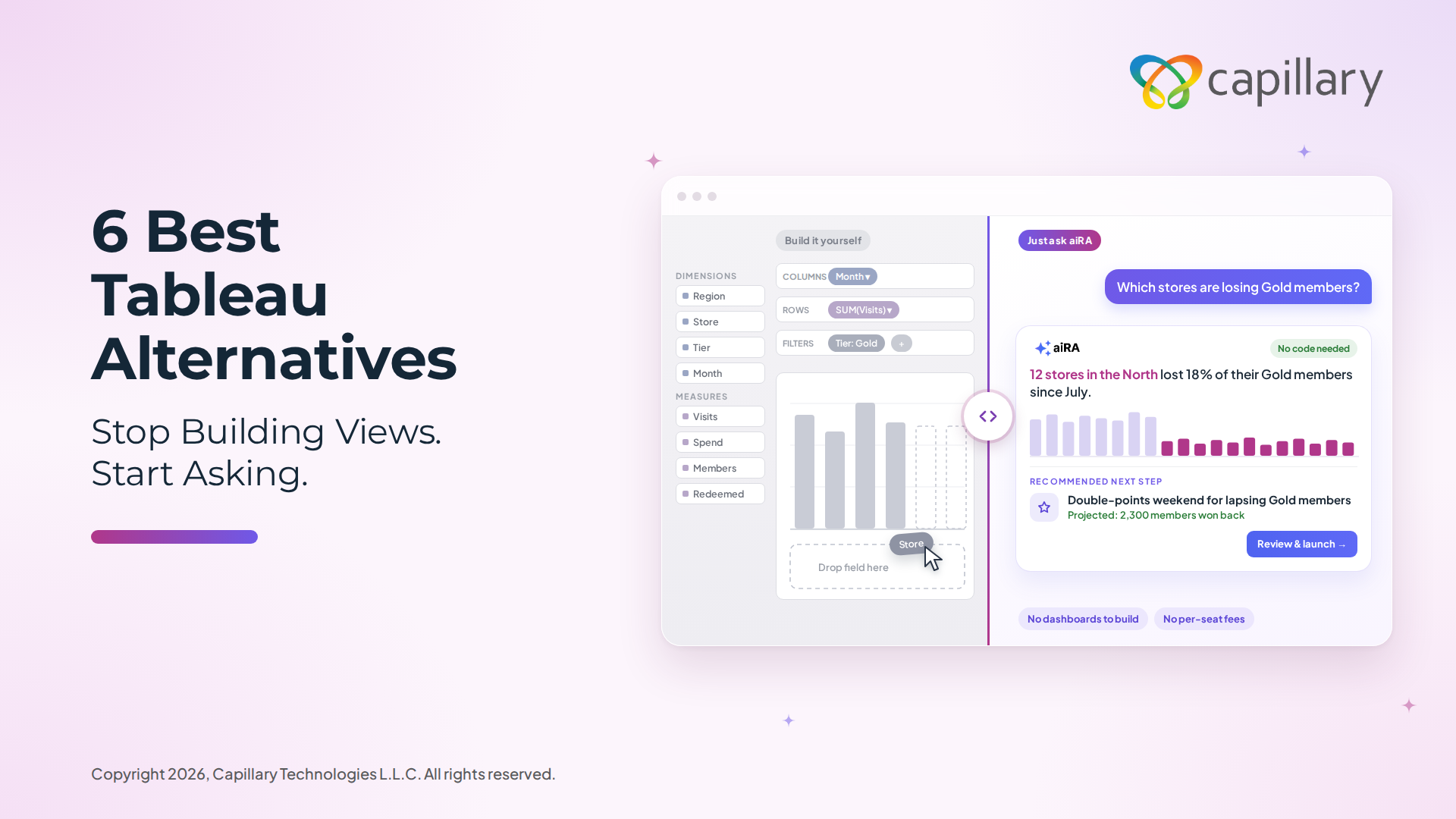
Tableau Alternatives: 6 No-Code & AI-Powered BI Tools Worth Switching To in 2026
Introduction Tableau is powerful, but it is also heavy. The learning curve is steep, most
Contact Us
Get the best loyalty & customer engagement platform out there!
- Design industry shaping loyalty programs
- Integrate easily and go live quicker
- Deliver hyper-personalized consumer experiences