
Introduction
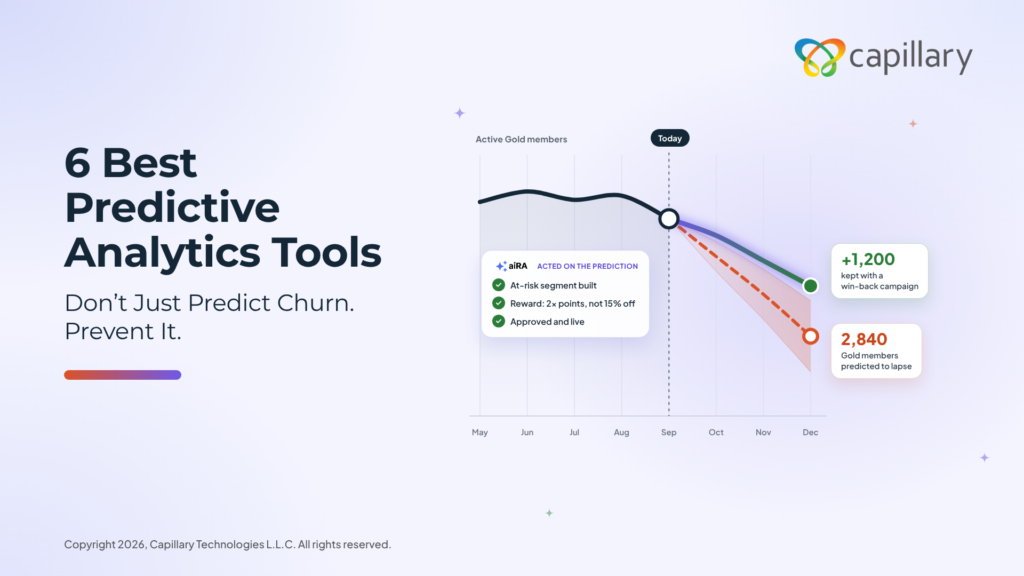
Most predictive analytics demos look magical. A churn forecast appears on a slide, the accuracy number is impressive, and the room nods along. Then the project dies in the gap between the model and the team that was supposed to act on it. The hard part was the plumbing: getting clean data in, keeping the model from drifting, and getting the score in front of someone who will do something with it. A churn score that sits in a data scientist’s notebook doesn’t retain a single customer. That gap defines the 2026 market. Predictive analytics tools have split into two camps:
- Forecasting engines that build, validate and monitor models, then hand the output to someone else.
- Action-oriented tools that close the loop from prediction to segment to campaign.
Who this guide is for: Marketing, loyalty, CX and RevOps teams who own a number (retention, repeat purchase, redemption, revenue per member) but don’t have a data scientist on call. If you’re a data science leader choosing an enterprise ML platform, the comparison table and the DataRobot and Dataiku sections will help most.
How we evaluated each tool:
- Who builds the model: You, an analyst, a data scientist, or the tool itself.
- What it predicts: Churn, lifetime value, propensity, demand, anomalies, or general-purpose targets.
- Where it stops: At the score, at a dashboard, or at an executed action.
- Governance: Data privacy, explainability, monitoring and human control.
- Pricing clarity: Whether you can scope a budget before talking to sales.
TL;DR
- The market has split into forecasting-only tools and action-oriented tools. Which side you need depends on what you plan to do with the prediction.
- aiRA by Capillary is the only tool on this list built to go from prediction to segment to live campaign in one conversation, with human approval on every action. It’s best for loyalty, marketing and CX teams working on customer and transaction data.
- Pecan AI builds models from a plain-English question and suits business teams without data scientists. It focuses on producing the prediction.
- DataRobot is an enterprise AutoML with deep governance and monitoring, best for enterprises with an existing ML function.
- Dataiku is an end-to-end platform that scales from analyst experiment to governed production, best for mixed-skill data teams.
- Alteryx is a drag-and-drop workflow tool with predictive capability, best for analysts who already live in workflows.
- Qlik / Tableau Pulse put forecasting and anomaly detection inside dashboards your team already opens, best for BI teams.
Predictive analytics tools compared at a glance
Tool | Best for | Who builds the model | Prediction type | Stops at insight or acts? | Governance | Pricing model | Key limitation |
aiRA by Capillary | Loyalty, marketing and CX teams | The business user, in plain English | Propensity, segment value projections, reward ROI on customer and loyalty data | Acts: prediction → segment → campaign, with approval | PII masking, cross-brand isolation, human approval on every action, full audit trail | Quote-based, 2-4 week pilot | Built for customer and loyalty data |
Pecan AI | Business and analytics teams without data scientists | Pecan’s AI agent, from a plain- English question | Churn, LTV, lead scoring, demand | Prediction, with delivery to downstream systems | Standard platform controls | Usage-based or custom; sources conflict | Stops at the prediction; narrower than a full data science platform |
DataRobot | Enterprises with an ML function | Data scientists, accelerated by AutoML | General- purpose supervised and time-series models | Insight, with deployment and monitoring | Deep: monitoring, drift detection, compliance tooling | Custom enterprise; no public price | Heavier, costlier, technical |
Dataiku | Mixed- skill data teams | Analysts and data scientists together | General- purpose ML | Insight and production pipelines | Governed projects and deployment | Free edition, trial, then quote | Overkill for a single use case |
Alteryx | Analysts who live in workflows | The analyst, via drag-and- drop | Predictive tools within workflows | Insight and automated workflows | Platform-level controls | Per-seat | Predictive depth is secondary; per-seat cost adds up |
Qlik / Tableau Pulse | BI teams | Built-in AutoML or automated insights | Forecasts, anomalies, drivers | Insight, inside dashboards | Inherited from the BI platform | Capacity or seat-based, premium tiers | AutoML less deep than a specialist; wrong reason to buy |
The 6 best predictive analytics tools in 2026
1. aiRA by Capillary
Best for: Loyalty, marketing and CX teams working on customer and transaction data who want predictions that execute.
What aiRA by Capillary is: aiRA is Capillary’s agentic AI co-pilot for marketing and loyalty. It’s built into the Capillary platform and trained on your brand’s context. It’s an action-oriented layer over customer and loyalty data, designed so a marketer can ask a question, see the prediction behind the answer, and act on it without leaving the conversation. Capillary frames the idea as “marketing at the speed of a conversation.” Describe the brief, and aiRA by Capillary builds the audience, optimizes the rewards, and launches across markets.
How it predicts: The flow starts with a plain-English question, such as which customers are likely to lapse, or which segment is worth the most. aiRA by Capillary works through a five-stage sequence:
- Customer analysis: Who your customers are, profiled and segmented at scale.
- Behavioral trends: How they’ve behaved, including seasonal patterns, preferences and engagement signals.
- Segmentation and projections: What each segment is worth, with propensity scores and projected campaign value.
- Campaign strategy: Offer types, rewards, messaging and channel mix recommended by AI.
- Impact and measurement: KPIs defined up front and results tracked in real time.
The differentiator: Every other tool in this guide ends somewhere short of the customer. A score lands in a table, an export or a dashboard, and then a human has to turn it into a segment, brief a campaign, configure the channels, get approvals and launch. Without aiRA by Capillary, an enterprise campaign workflow spans five phases across three or more teams and 26+ days:
Phase | Typical time |
Strategy definition | 5-8 days |
Analytics and segmentation | 4-7 days |
Campaign setup | 8-12 days |
Review and launch | 2-4 days |
Analytics feedback | 7-10 days |
A forecasting tool shortens, at best, the analytics phase. aiRA by Capillary collapses all five into one conversation, with human approval built in at each step. That’s the difference between a tool that predicts and a tool that closes the loop.
Trust and governance: Putting an LLM near customer data raises obvious questions. aiRA by Capillary’s architecture answers them directly:
- PII masking before the LLM: No personally identifiable information is transmitted to the model, and inputs are masked before processing.
- Cross-brand isolation: The architecture prohibits cross-brand data analysis.
- Human-in-the-loop approval: aiRA by Capillary recommends and you decide. No customer-impacting action goes live without explicit approval.
- Full audit trail: All AI interactions are logged, with drift monitoring, guardrails and incident response SLAs, including P1 containment under one hour.
- Compliance alignment: ISO 27001 aligned, PCI DSS compliant, and GDPR / CCPA / PDPA compliant, in line with responsible-AI policies.
Proof points:
- 26+ days to minutes: The campaign cycle compression described above.
- 62+ analyst hours a month reclaimed: The time otherwise burned on custom segment queries.
- A global fashion retailer (400+ stores): Created nine personalized push notification messages within minutes, instead of days of multi-team coordination.
- A leading electrical and consumer goods conglomerate (25+ countries): Let its marketing team build segments and campaigns independently, with zero analyst tickets.
A worked example: Here’s how a retention question could run from prediction to launch. This is a representative flow:
- The question: A loyalty marketing manager types: “Which of our Gold-tier members are most likely to stop shopping with us this quarter, and what are they worth?”
- The prediction: aiRA by Capillary profiles the tier, looks at behavioral trends and returns a segment with propensity scores and projected value, along with the factors behind the result.
- The segment: The manager says: “Build that segment, excluding anyone who purchased in the last 30 days.” aiRA by Capillary builds it.
- The strategy: aiRA by Capillary recommends an offer type, reward and channel mix, predicts ROI by market, and explains why it prefers a targeted reward over a flat discount.
- The campaign: The manager asks for localized messaging across the relevant markets. aiRA by Capillary drafts it with brand voice intact.
- The approval: The manager reviews and approves. Nothing launches without that step. The campaign goes live, with KPIs already defined for measurement.
Where it stops: It doesn’t. It acts, with a human approving.
Pricing: aiRA by Capillary is quote-based. Capillary’s structured pilot takes you from first conversation to full deployment in about 2-4 weeks, in four phases: business requirements, training and testing, brand testing in a sandbox, and go-live. A dedicated success manager is included, and minimal brand involvement is required.
Limitation: aiRA by Capillary is built for customer and loyalty data. If your data scientists need to build bespoke models on arbitrary data (sensor streams, credit risk, genomic data), choose a platform like DataRobot or Dataiku. Many teams will run both, with the data science platform for custom modeling and aiRA by Capillary for the customer-facing prediction-to-campaign loop.
See aiRA by Capillary go from question to campaign. Request a demo.
2. Pecan AI
Best for: Business and analytics teams that want predictive models without a data science function.
How it predicts: Pecan wraps AutoML in what it calls Predictive GenAI. You describe a business question in plain English. Pecan’s AI agent handles data prep, feature engineering, model building and validation automatically. The vendor says customers deploy their first model in about a week.
What it predicts: The core use cases are customer churn, lifetime value, lead scoring, propensity and demand forecasting. For LTV, Pecan highlights the factors that influence each customer’s predicted value, which helps with explainability.
Where it stops: Pecan is strongest at producing and delivering the prediction. Predictions can be scheduled, run and delivered automatically, and one review notes CRM write-back among the capabilities. What it doesn’t do is build the segment, design the offer and launch the campaign. Your marketing stack takes over from there.
Governance: Standard platform controls. Pecan is a modeling product, so brand-safety and campaign-approval workflows live elsewhere in your stack.
Pricing model: Sources disagree. One directory lists a Starter tier from $950 per month, while another describes custom enterprise pricing.
Limitation: It’s narrower than a full data science platform, and the prediction still needs a downstream process to become action.
3. DataRobot
Best for: Enterprises with an existing ML function that need governance and production monitoring at scale.
How it predicts: DataRobot automates the machine learning lifecycle, from data preparation and AutoML through deployment, monitoring and governance. Data scientists remain the primary users. AutoML accelerates their work and doesn’t replace them.
What it predicts: Anything you can frame as a supervised or time-series problem, including churn, demand, fraud and risk.
Where it stops: At a deployed, monitored model. Turning scores into customer-facing action is your integration work.
Governance: This is DataRobot’s strongest suit. Its observability covers model performance and data drift, and its governance module runs compliance checks against frameworks like the EU AI Act and NIST AI Risk Management Framework, generating audit documentation automatically. For regulated industries, that matters.
Pricing model: DataRobot publishes no price list. Its pricing page routes to a demo request or a trial, and add-ons such as MLOps monitoring and governance are often priced as separate line items. A 30-day trial is available. Third-party estimates vary widely, so treat any number as a rough guide.
Limitation: It’s heavier, costlier and more technical than business teams need for a single customer-prediction use case.
4. Dataiku
Best for: Mixed-skill data teams that want one governed platform to scale from experiment to production.
How it predicts: Dataiku combines visual interfaces with code environments in Python and R, so analysts and data scientists can collaborate on the same project. Its AutoML covers common predictive tasks, with full code available when you need to go further.
What it predicts: General-purpose. Churn, LTV and demand are all possible, but you build them.
Where it stops: At governed production pipelines and deployed models. Campaign execution sits outside.
Governance: Project-level governance, deployment management and monitoring suit teams that need controlled promotion from sandbox to production.
Pricing model: The entry points are generous. The free edition is installed locally, and a separate 14-day cloud trial is available. Paid editions are quote-based, and third-party sources suggest pricing often starts around $4,000 per month, with costs rising from there.
Limitation: It’s overkill if you have one use case and no data team to maintain a platform.
5. Alteryx
Best for: Analysts who live in drag-and-drop workflows and want predictive steps alongside data prep.
How it predicts: Alteryx is a visual workflow tool first. Its Designer product offers hundreds of pre-built tools across data preparation, blending, spatial and predictive analytics. Predictions are one block in a larger workflow.
What it predicts: Whatever the analyst builds: forecasts, classification, clustering and more, within the workflow.
Where it stops: Workflow output, such as a file, a table or a report. It can automate those workflows, but marketing action still happens elsewhere.
Governance: Platform-level controls and shared workflows. Governance depth depends on the edition.
Pricing model: Alteryx repackaged its plans as Alteryx One in 2026. A Starter edition is published at roughly $250 a month, with Professional and Enterprise quote-based. Per-seat cost adds up as teams grow, and Designer licenses have historically run into the thousands of dollars per user per year.
Limitation: Predictive depth is a secondary capability, and per-seat pricing scales quickly.
6. Qlik Predict / Tableau Pulse
Best for: BI teams that want forecasting and anomaly detection inside the dashboards people already open.
Qlik Predict: Qlik’s AutoML gives analysts a no-code workflow to build explainable models, publish forecasts into dashboards and trigger data-driven actions, including multivariate time-series forecasting and SHAP-based explainability. Pricing sits within a capacity-based model. AutoML and Predict features sit on the Premium tier and above, and one breakdown lists Premium starting at $2,750 a month for 50 GB of data. Confirm current terms directly with Qlik.
Tableau Pulse: Pulse monitors the metrics you follow and surfaces insights in plain language. It detects drivers, trends, contributors and outliers. Forecast insights require the Tableau+ license edition. For deeper prediction, Tableau relies on Einstein Discovery, which brings predictive modeling, such as churn and revenue forecasting, into dashboards.
What they predict: Forecasts, anomalies and drivers on the metrics your BI team tracks.
Where they stop: At the dashboard or digest. They tell you something moved. The follow-up is manual.
Governance: Inherited from your BI platform’s permissions and metric definitions.
Limitation: AutoML here isn’t as deep as a specialist platform, and buying a BI platform just for prediction would be backwards. These make sense if you already run Qlik or Tableau.
How to choose: what happens after the forecast?
The question most buyers ask is which tool forecasts best. The more useful question is what happens after the forecast. If a data science team will consume the prediction, you’re buying a modeling platform. DataRobot and Dataiku lead on depth and governance. Pecan is lighter and faster for analytics teams.
If a BI team will watch the trend, you’re buying predictions inside a dashboard. Qlik and Tableau Pulse fit, and they work best when you’re already invested. If a marketer needs the prediction and the campaign that acts on it, you’re buying something different. The bottleneck is the chain of hand-offs. That’s the case for an action-oriented tool like aiRA by Capillary.
A quick self-test:
- Does your churn model exist, but your retention campaign still takes weeks to launch? You have an action problem.
- Do marketers wait on analysts for every segment? You have an access problem.
- Do you have no model at all and no data scientist to build one? You have a build problem, which Pecan and aiRA by Capillary both address from different angles.
Conclusion
The decision is “what happens after the forecast.” For data science teams building and governing models, DataRobot and Dataiku are the serious options. For analysts in workflow tools, Alteryx fits. For BI-embedded trends, Qlik and Tableau Pulse. Pecan is a good fit for business teams that want a model built from a plain-English question.
But for business teams that need a prediction and the campaign that acts on it, on customer and loyalty data, aiRA by Capillary closes the loop: the prediction becomes a segment, the segment becomes a campaign, and a human approves it before anything goes live.
See aiRA by Capillary go from question to campaign. Request a demo.
FAQs
What are predictive analytics tools?
Software that reads historical data, finds patterns, and produces forward-looking scores, such as churn risk, lifetime value or demand.
What’s the difference between predictive and prescriptive analytics?
Predictive analytics forecasts what will happen. Prescriptive analytics recommends, and in some tools takes, the best action to influence it.
Do I need a data scientist to use predictive analytics tools?
No, tools like aiRA by Capillary and Pecan let business users work in plain English. Platforms like DataRobot and Dataiku are built with data scientists in mind.
Which predictive analytics tool is best for marketing and loyalty teams?
aiRA by Capillary, because it turns predictions into live segments and campaigns in one flow.
Can predictive analytics tools take action automatically?
Most stop at the prediction. aiRA by Capillary is built to execute, from segment to campaign, with human approval.
How long does it take to get started with aiRA by Capillary?
Capillary’s structured pilot runs about 2-4 weeks, from requirements through training, brand testing and go-live.
Share

Capillary Marcom
Trending Topics
Ecommerce in Malaysia: Growth, Trends & Opportunities
Capillary Technologies acquires Brierley
Similar Articles
What makes shoppers choose one retailer over another? 5 lessons for growth
A shopper walks into your store every weekend. They know your aisles, use your app,
Capillary Strengthens US Leadership, Names Bill Swift as President, Americas
Capillary Strengthens US Leadership, Names Bill Swift as President, Americas
Dallas, TX, October 29, 2026 — Capillary Technologies, a leading provider of AI-powered loyalty and
Contact Us
Get the best loyalty & customer engagement platform out there!
- Design industry shaping loyalty programs
- Integrate easily and go live quicker
- Deliver hyper-personalized consumer experiences