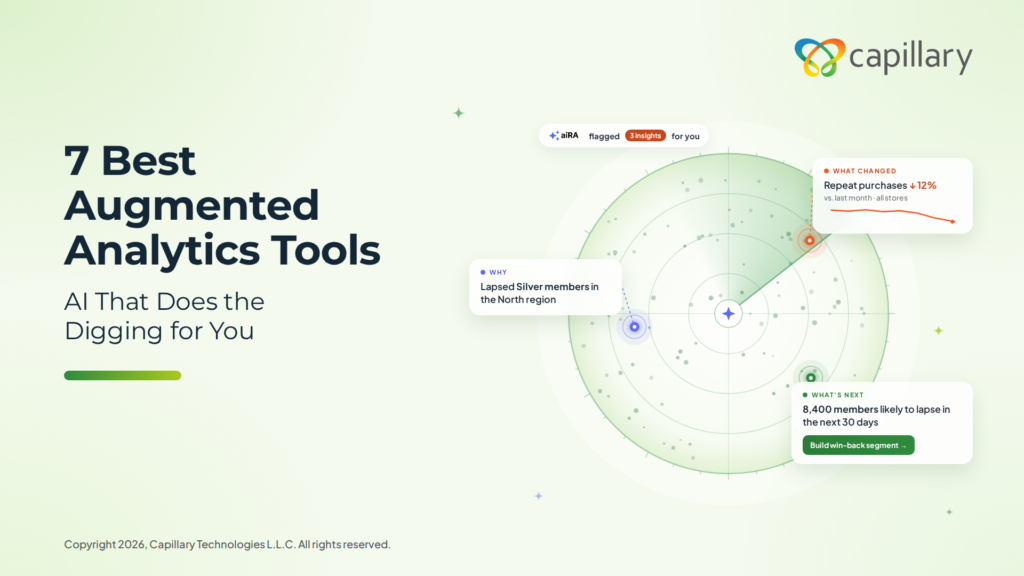
7 Best Augmented Analytics Tools for Marketing and CRM Teams in 2026

Most dashboards show you what happened, but they leave the digging to your team. Augmented analytics does that digging for you. It scans your data, flags what changed, and shows you why it happened.

For marketing and CRM teams, this saves time. You can spot a drop in repeat purchases early and respond before it grows.

In this guide, we explain what augmented analytics is and what to look for in a tool. We also compare seven tools to help you find the right fit for your team.

Tl;dr 

  • Augmented analytics uses AI to find patterns in your data, explain changes, and predict what may happen next.
  • For marketing and CRM teams, the best tools also help you act on what you learn.
  • aiRA by Capillary is our top pick for teams that want to quickly go from customer insights to live campaigns.
  • The other six tools suit different needs, from business users who want quick answers to analysts who build workflows.

What is augmented analytics?

Augmented analytics uses AI to handle part of the analysis work for your team. It looks for patterns in your data and explains why a metric went up or down. It can also predict what is likely to happen next. The key difference is that it does this without waiting for someone to ask. 

Traditional BI tools show charts and reports, and your team has to decide what to look for. With augmented analytics, the important changes come to you. To learn more about tools that answer questions in plain language, read our guide to conversational analytics tools.

What to look for in an augmented analytics tool

Marketing and CRM teams need more than a faster way to read data. The right tool should help you understand your customers and act on what you learn. Here are five things to check before you choose one:

  • Automated insight discovery: A good tool spots changes in customer behavior on its own. You should not have to know the right question before it shows you something useful.
  • Explanation of why: When redemptions drop, you need to know the reason. The tool should show which region, segment, or offer caused the change, in plain language.
  • Predictive capabilities: Look for a tool that can score customers on how likely they are to lapse or respond. Your team should be able to use these scores without a data scientist.
  • Understanding of customer and campaign data: Some tools treat customer data as just another set of tables. A better tool already knows what a lapsed member or a redemption means, so you get useful answers sooner.
  • Ability to act on insights: Most tools stop once they explain what happened. The best ones also help you build the segment and launch the campaign from the same place.

How this list was tested and selected

An augmented analytics tool should do some of the thinking for your team. It should point out what changed, explain it clearly, and help you decide what to do next. It should also do this without months of setup.

We used these ideas to build our criteria. Here are the questions we asked about each tool:

FocusThe question we asked
DiscoveryDoes the tool surface insights without being asked?
ExplanationDoes it explain the drivers behind a change in plain language?
SetupHow much data modeling does it need before the first useful insight?
ActionCan your team act on an insight, or does it end at a chart?
GovernanceDoes a person approve customer-facing actions, and is there an audit trail?

Augmented analytics tools at a glance


Tool nameBest forStandout featureLimitation
aiRA by CapillaryMarketing and CRM teams that want to go from question to campaignTurns a plain-English customer question into a live campaignBuilt for marketing and CRM use cases, not company-wide BI
TelliusBusiness users who want automatic explanationsDriver analysis that explains metric changesLimited options for heavily customized dashboards
Qlik Cloud AnalyticsTeams exploring data from many sourcesAssociative engine for free-form explorationData loading and modeling take time to learn
Microsoft Power BIOrganizations that run on Microsoft 365Quick insights and CopilotDAX and data modeling are hard for beginners
TableauAnalyst teams that build visual dashboardsTableau Pulse and Explain DataBusiness users often wait on analysts for new views
ThoughtSpotSearch-led exploration of dataSpotIQ automated analysisWorks best after the data team models the warehouse
AlteryxAnalysts who automate data prep and workflowsNo-code workflow canvas with predictive toolsBuilt mainly for analysts, not business users

The 7 best augmented analytics tools

1. aiRA by Capillary
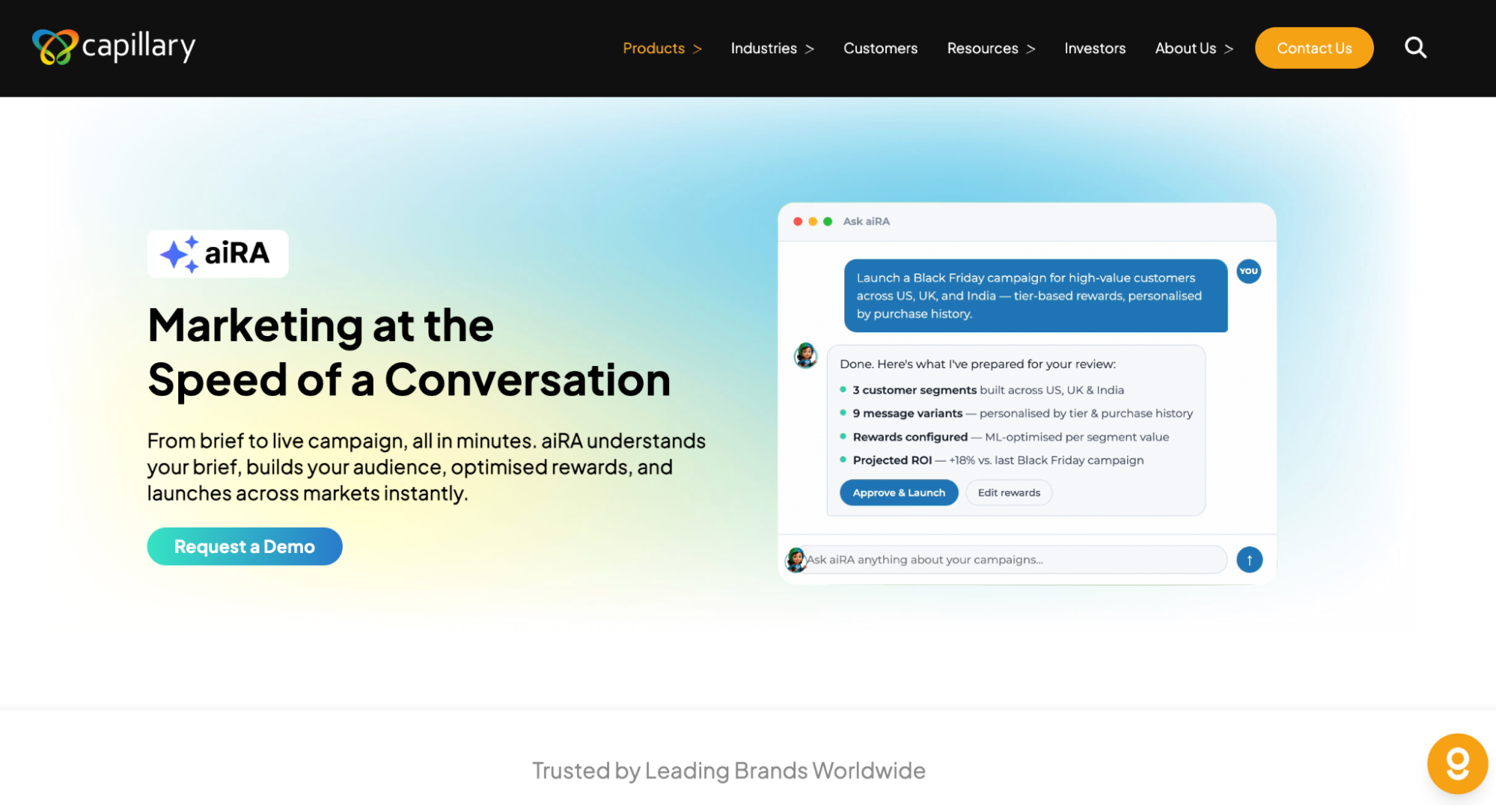
Screenshot of aiRA by Capillary webpage. aiRA by Capillary is an analytics agent.

Best for: Marketing and CRM teams that want to move from a customer question to a live campaign.

aiRA by Capillary is an AI agent for marketing and customer teams. Users ask questions about customers in plain English. aiRA by Capillary answers from the brand’s own customer data. Then it recommends offers, messages, and channels.

The tool suits teams that run frequent campaigns. Every customer-facing step can wait for human approval. A full deployment on brand data takes two to four weeks. Your team gets a dedicated success manager throughout.

Key features

  • Users can ask about customer behavior and engagement trends without writing SQL.
  • aiRA by Capillary builds segments from a plain description and scores each one.
  • Teams can set up the audience and messaging from a single brief.
  • Personal data is masked before it reaches the language model, and every AI interaction is logged.

See how aiRA by Capillary handles a real question from your own customer data. 

Request a demo.


2. Tellius

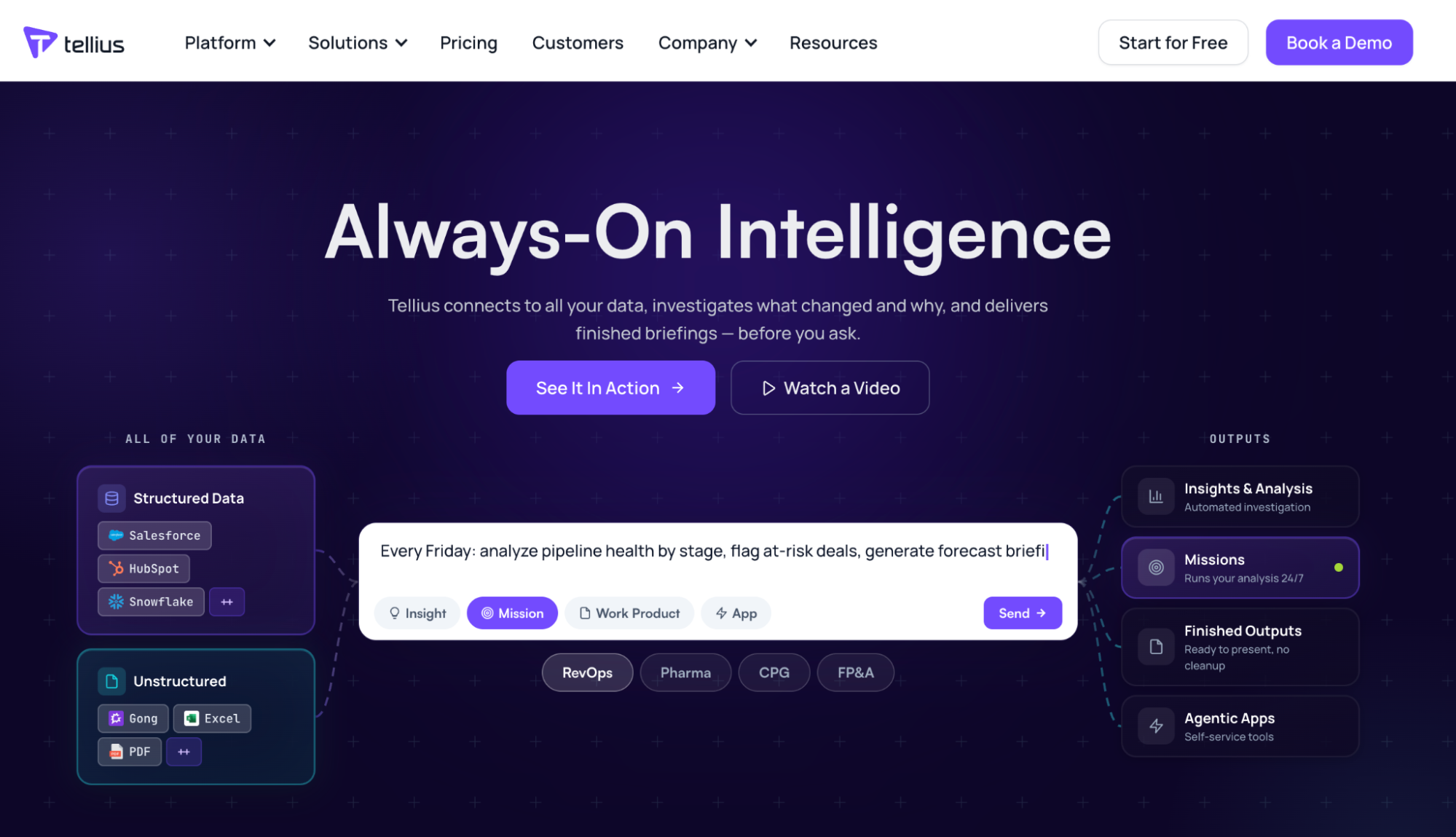
Screenshot of Tellius webpage

Best for: Business users who want automatic explanations of metric changes.

Tellius is an augmented analytics platform built around explanation. Users ask questions in natural language. The platform finds the factors behind a change in a metric. It also surfaces patterns nobody asked about.

Tellius suits business teams with clear metrics and a data team to connect sources. Teams that need heavily customized dashboards may need a second tool. They built the product for investigation first.

Key features

  • Users can search business data in natural language.
  • The platform finds unusual changes in metrics without a prompt.
  • It shows which factors contributed to a change.


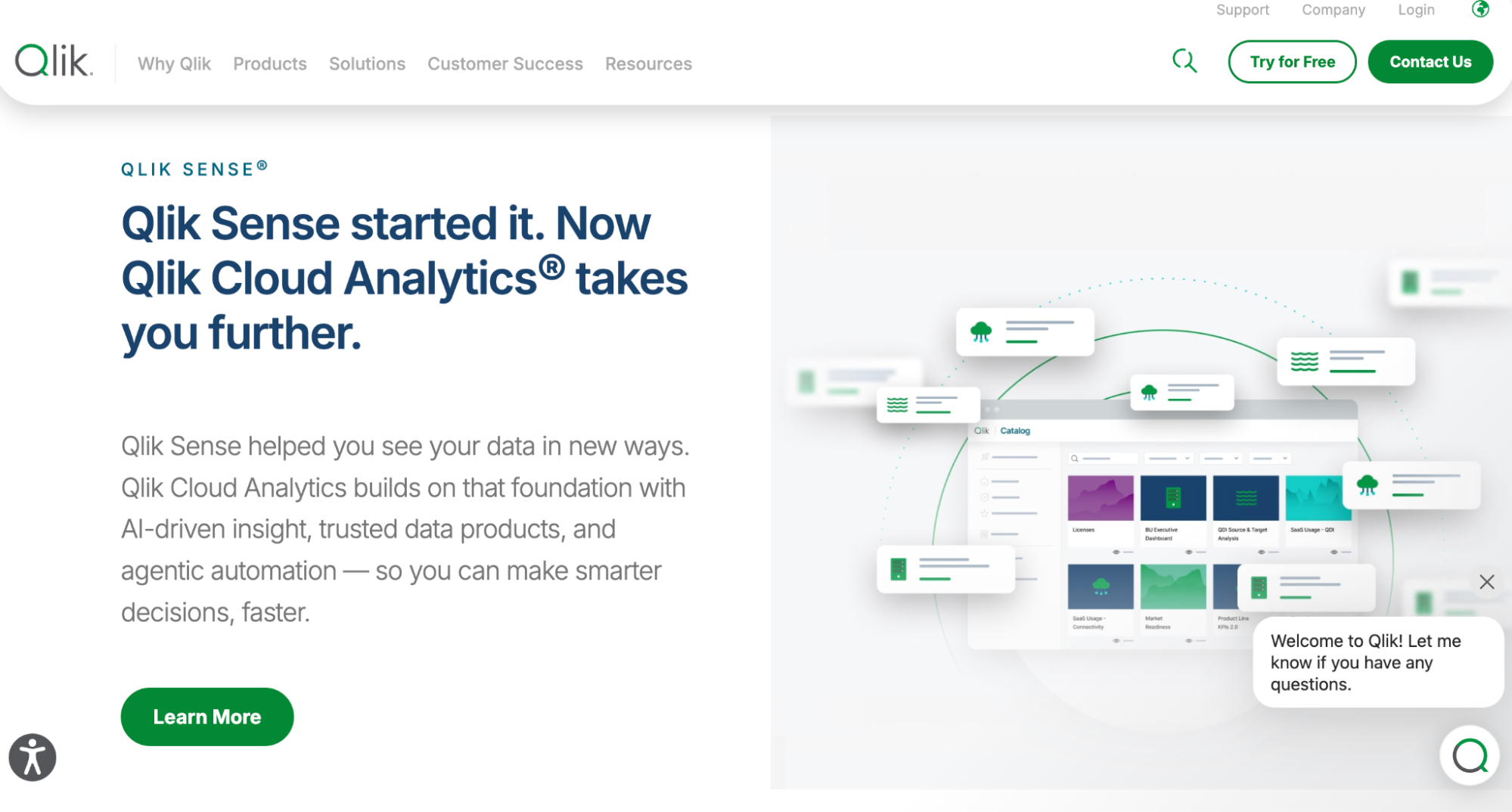
3. Qlik Cloud Analytics
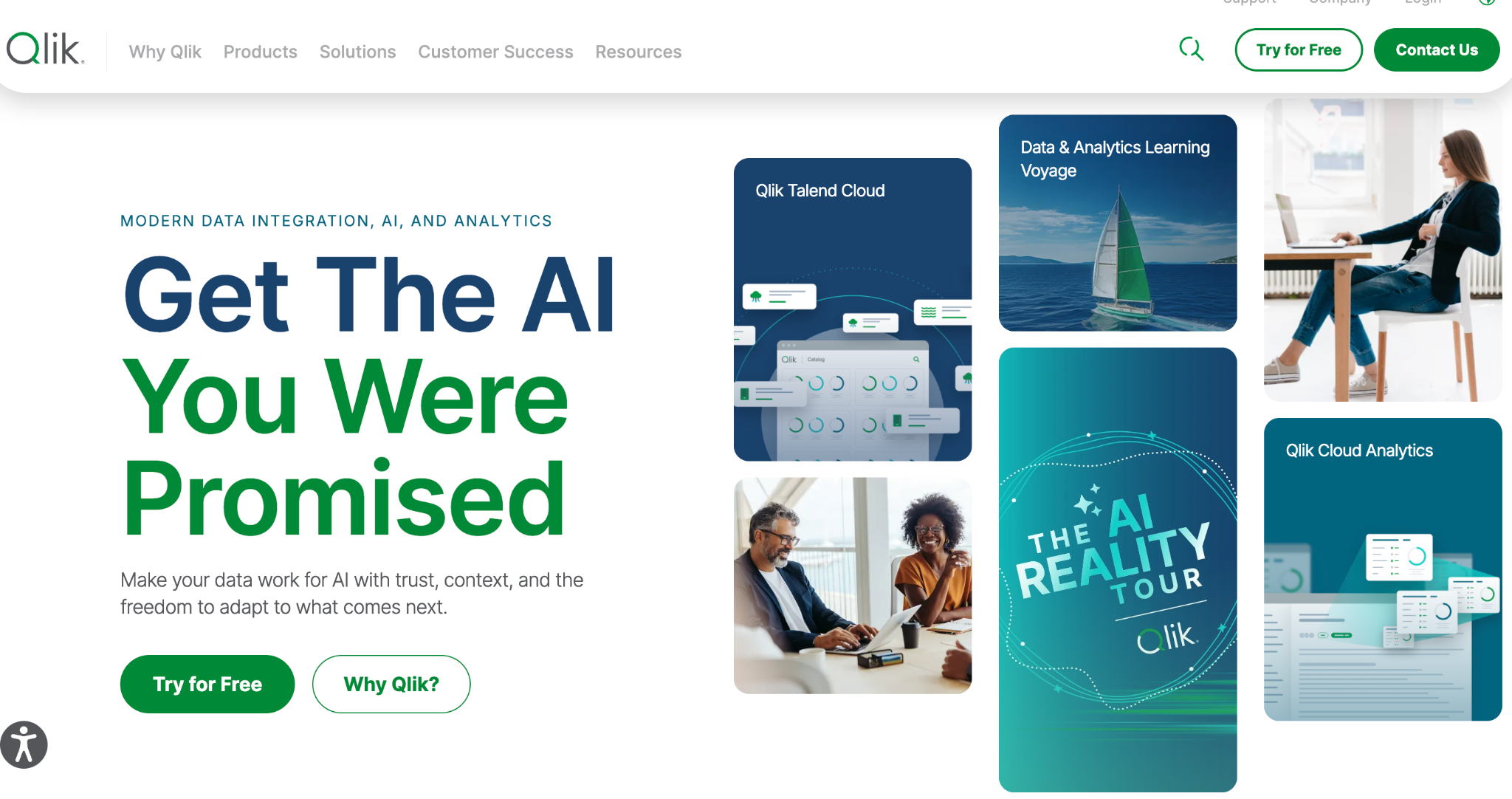
Screenshot of the Qlik Cloud Analytics homepage

Best for: Teams that want to explore data from many sources and get AI-generated insights.

Qlik Cloud Analytics is the cloud platform from Qlik for analytics and AI-driven insight. It builds on the associative engine in Qlik Sense. Users can click through data in any direction. The platform adds AI assistance to speed up discovery.

Qlik suits organizations with BI developers who build data models for the business. New users need time to learn load scripts. Business users get the most from the platform once that groundwork is ready. They offer both cloud and on-premises deployment.

Key features

  • Clicking any value filters every chart at once.
  • Insight Advisor generates insights and answers natural language questions.
  • Users can combine data from databases, SaaS apps, and files.


4. Microsoft Power BI
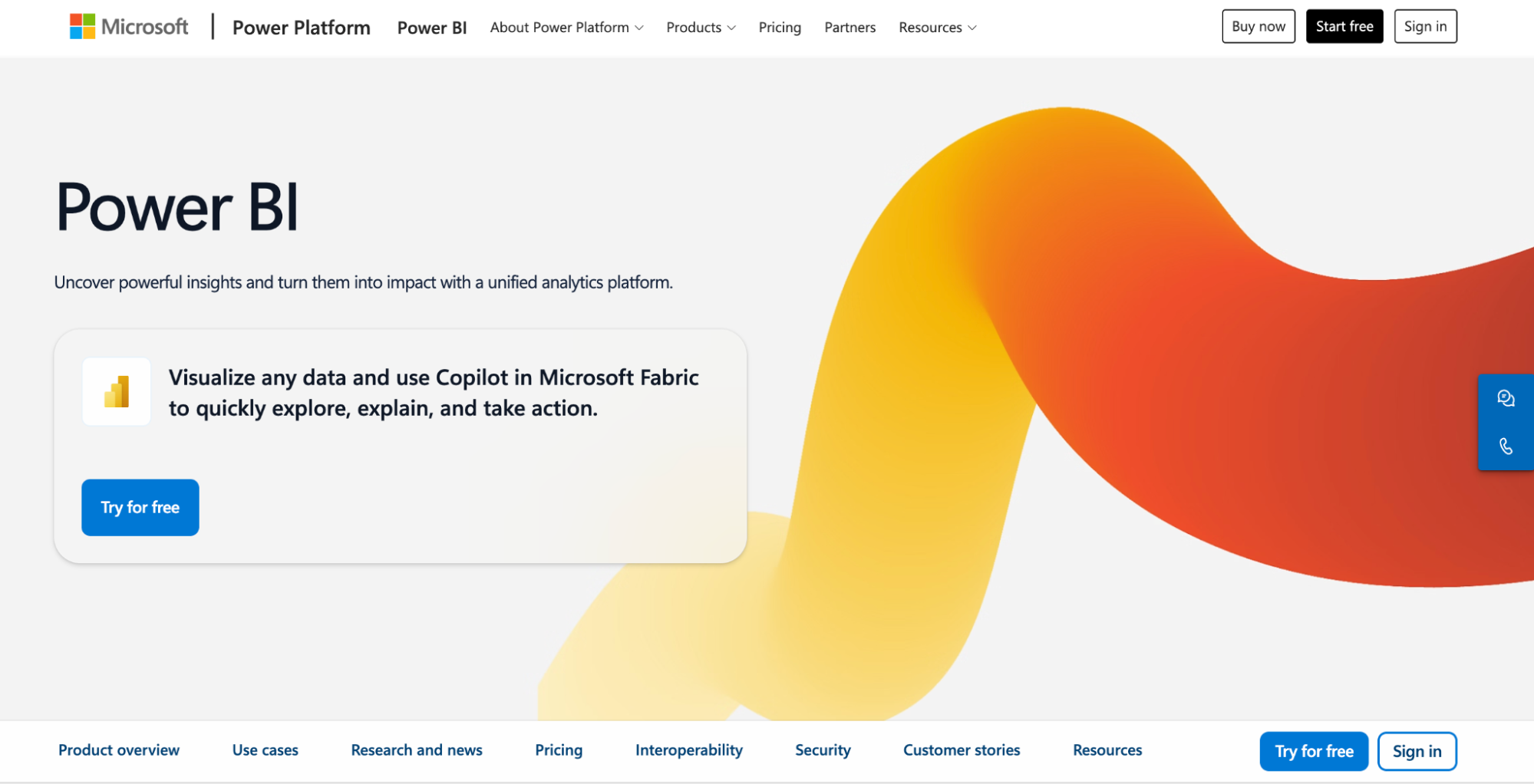
Screenshot of Power BI webpage

Best for: Organizations that run on Microsoft 365 and want reporting inside that ecosystem.

Power BI is the business intelligence platform from Microsoft. It connects to Excel, SQL databases, and cloud sources. Quick insights surfaces patterns in a dataset. Copilot answers questions in plain language and helps build reports.

Power BI suits companies that already use Excel, SharePoint, and Teams. It works best with BI developers who maintain the data models. Basic reports come together quickly. Advanced analysis often needs DAX and modeling skills.

Key features

  • Quick insights surfaces patterns with a few clicks.
  • Copilot lets users ask questions in plain language.
  • The key influencers visual shows which factors link to an outcome.
  • Reports work inside Excel and Teams.


5. Tableau
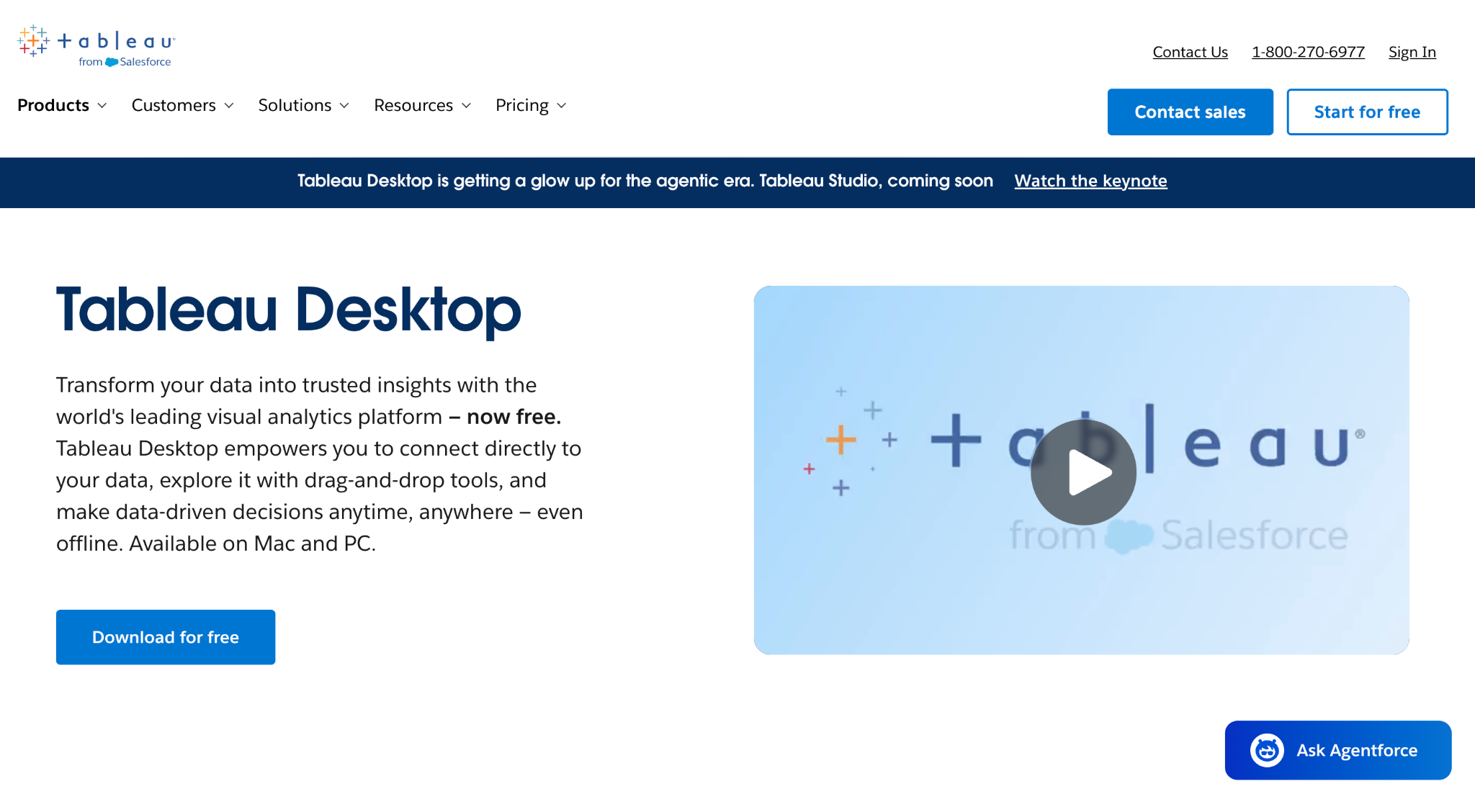
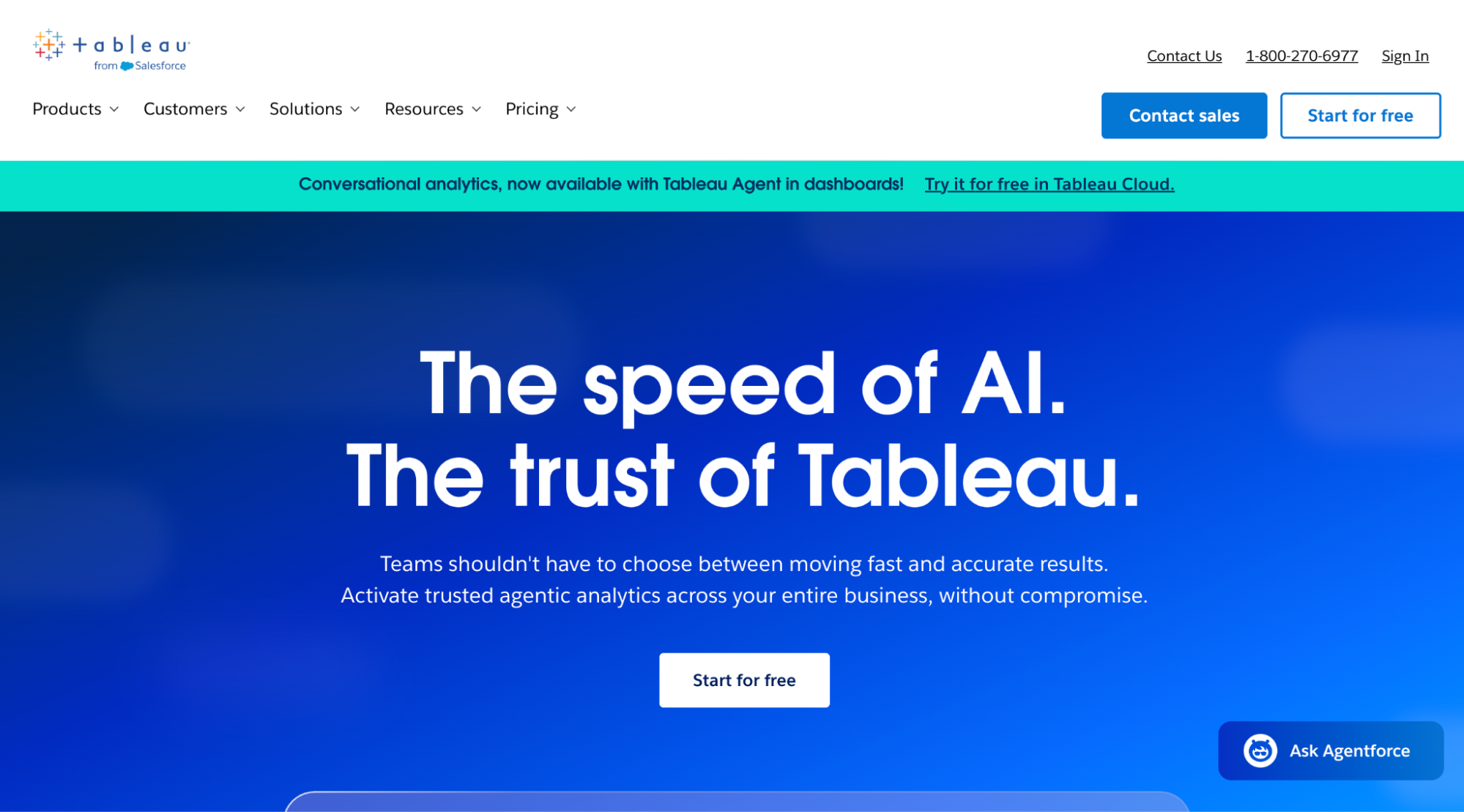
Screenshot of Tableau webpage

Best for: Analyst teams that build visual dashboards for other people.

Tableau is a BI platform from Salesforce built around visual analysis. Tableau Pulse tracks key metrics and sends alerts when they change. Explain Data suggests possible causes for a value in a chart.

Tableau works best when analysts design and maintain dashboards. Business users can explore those dashboards. When their questions change, they usually wait for analysts to build new views.

Key features

  • Users drag fields onto a canvas to build charts and dashboards.
  • Users can follow key metrics and get digests when they change.
  • Explain Data suggests reasons behind a value.
  • Teams can connect to SQL databases and cloud warehouses.


6. ThoughtSpot
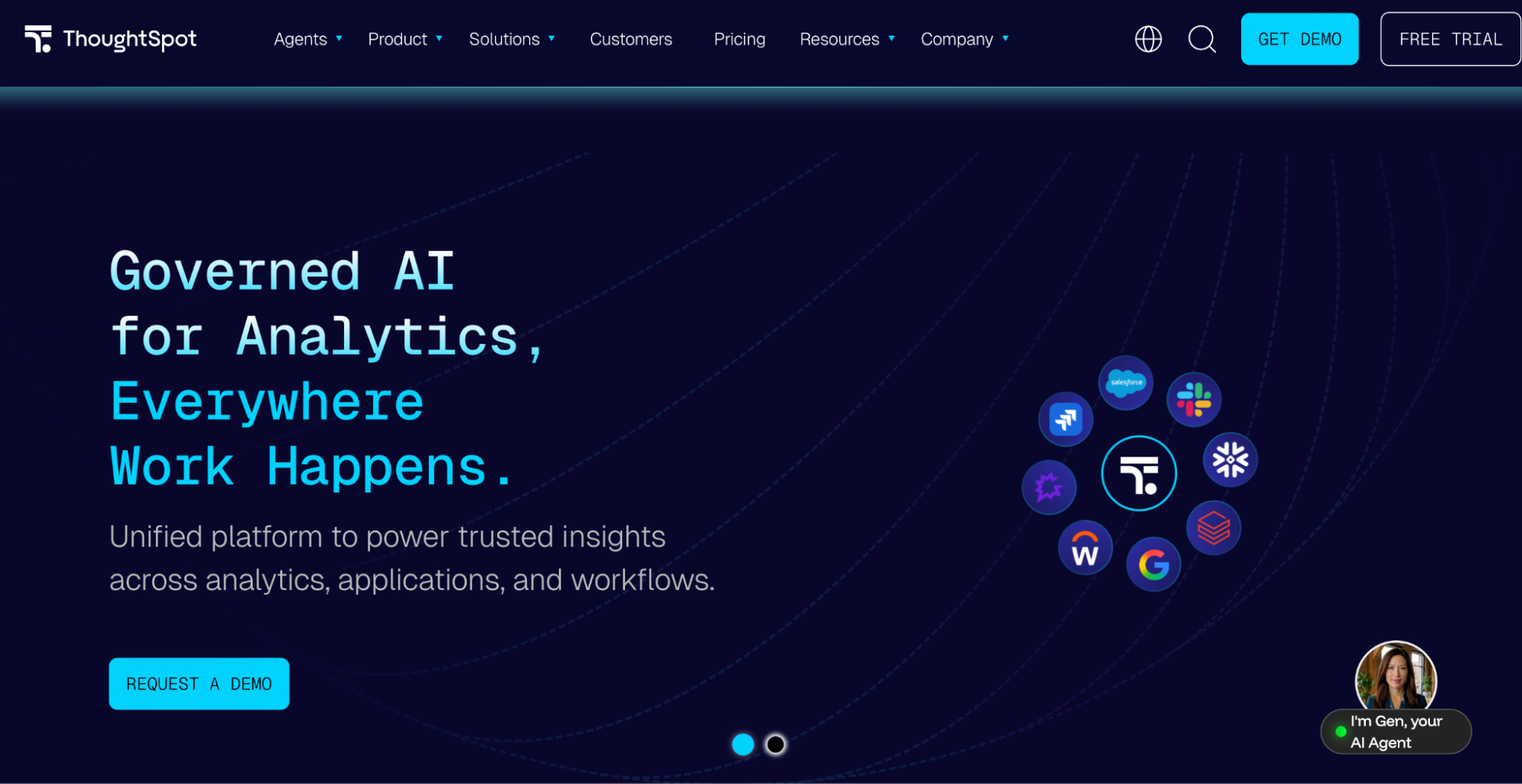
Screenshot of ThoughtSpot webpage

Best for: Teams that want search-led exploration of data and automated analysis.

ThoughtSpot is an analytics platform built around search. Users type questions about their data and get charts back. SpotIQ runs automated analysis to find patterns and outliers that users may have missed.

ThoughtSpot works best after a data team models the warehouse. Teams that need answers before that work is done may find setup slow. Much of the functionality depends on good data modeling.

Key features

  • Users can ask questions in natural language and get visual answers.
  • SpotIQ surfaces patterns and outliers automatically.
  • Liveboards let teams share dashboards built from search results.
  • The platform connects to modern cloud data warehouses.


7. Alteryx
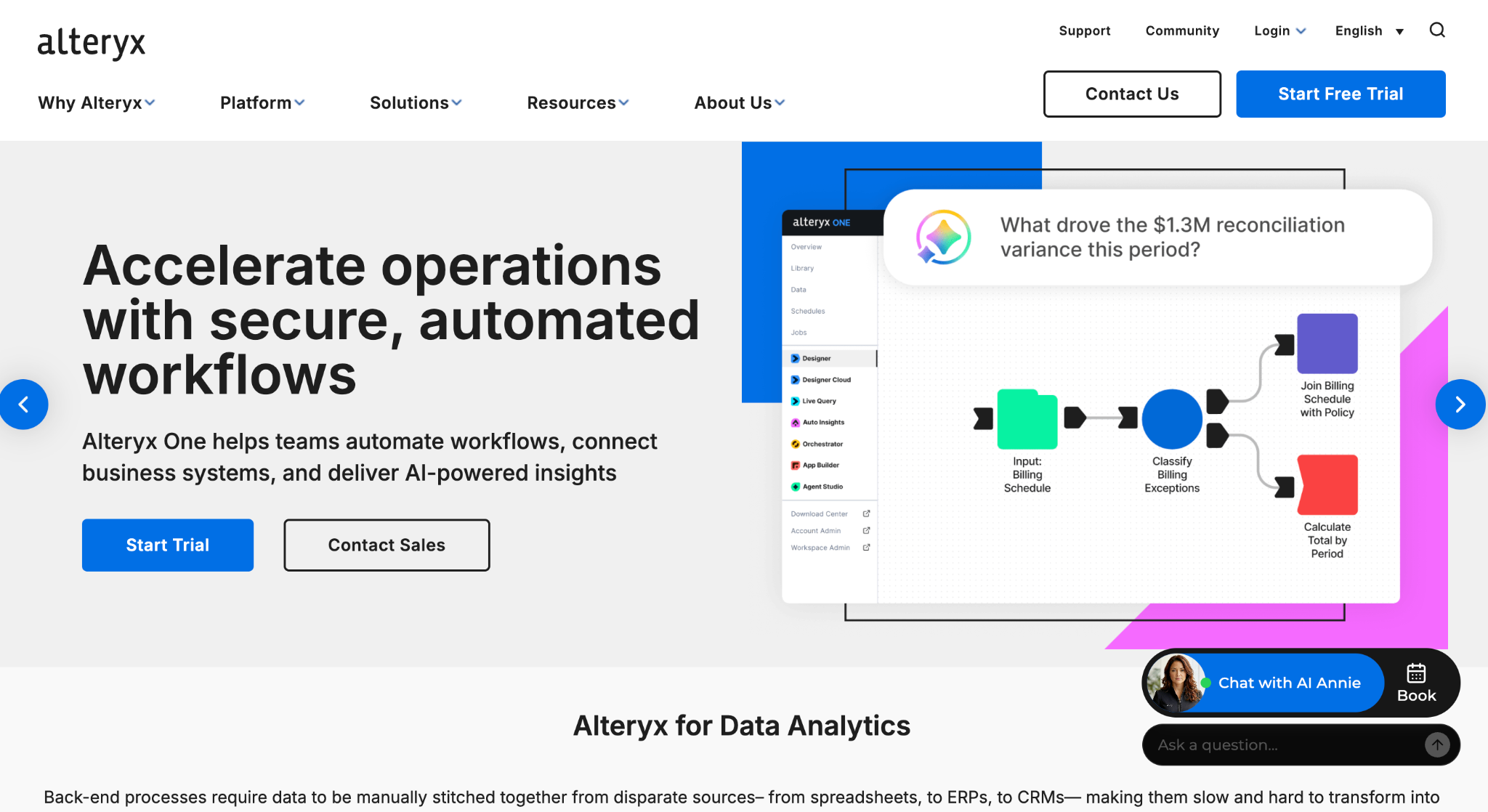
Screenshot of Alteryx webpage

Best for: Analysts who want to automate data prep and analytics in no-code workflows.

Alteryx is an analytics automation platform. Users build workflows by connecting tools on a canvas. The platform combines data preparation, analysis, and predictive modeling in one place.

Alteryx suits analyst teams that prepare data and run repeatable workflows. Marketing teams can use the outputs for segmentation and reporting. An analyst usually builds the workflow first. Business users who want plain-English answers may find the tool less direct.

Key features

  • Users build data pipelines by dragging tools onto a canvas.
  • The platform blends and cleans data from many sources.
  • Analysts can run predictive models inside a workflow.
  • Teams can schedule and share finished outputs.

Augmented analytics use cases for marketing and CRM teams

Augmented analytics is most useful when it helps marketing and CRM teams act on what they find. Here are four common use cases:

1. Spotting churn risk early

Augmented analytics watches engagement and purchase patterns across customers. It flags groups that start to slow down. Your team can act before those customers lapse. The best tools also explain which behaviors signal the risk.

2. Explaining a campaign dip

When a campaign falls short, the first question is what changed. Augmented analytics compares segments and offers to find the driver behind the drop. With that cause in hand, a team can respond within days rather than weeks.

3. Forecasting campaign outcomes

Predictive models can estimate how a campaign may perform before launch. Teams can compare options and fund the one most likely to work. Forecasts improve as the tool learns from each campaign.

4. Finding high-value segments

Some customers are far more likely to respond to an offer than others. Augmented analytics groups customers by how likely they are to respond and how much they are worth. That lets your team direct budget toward the customers most likely to buy.

Choosing the right augmented analytics tool for your team

Augmented analytics shows you why a metric changed. For marketing and CRM teams, that is only the first step. The next step is using that insight to plan and launch a campaign.

Each tool on this list works in a different way. Some are made for analysts who build dashboards for other teams. Others let business users look at data on their own. If you want to find an insight and launch a campaign in one place, choose a tool that does both.

aiRA by Capillary is built for that. Your team can ask questions about customers in plain English, build segments with projected value, and set up campaigns that are ready to launch. A person on your team approves every customer-facing step before it goes live.

Request a demo to see how aiRA by Capillary works on your own customer data.

FAQs

1. What is augmented analytics?

Augmented analytics uses AI to find patterns, explain changes, and forecast results. It does this with little prompting from the user.

2. What is the difference between augmented analytics and traditional BI?

Traditional BI presents reports that people must interpret. Augmented analytics adds automated discovery, explanation, and prediction.

3. What is the difference between augmented analytics and conversational analytics?

Conversational analytics lets users ask questions in plain language. Augmented analytics adds discovery and prediction. Many tools now offer both.

4. Will augmented analytics replace data analysts?

The tool handles routine questions and first-pass analysis. Analysts still build data models, review results, and handle complex work.

5. Which augmented analytics tool is best for marketing and CRM teams?

aiRA by Capillary is built for marketing and CRM teams. It answers customer questions and helps launch campaigns. People approve each customer-facing step.


Share

Similar Articles

Contact Us

Get the best loyalty & customer engagement platform out there!

  • Design industry shaping loyalty programs
  • Integrate easily and go live quicker
  • Deliver hyper-personalized consumer experiences
Request A Call

Power BI vs Tableau vs aiRA

Your Dashboard Shows the Drop. aiRA Shows Why, & What to Do About It.

Power BI and Tableau are excellent at reporting on the business. aiRA by Capillary picks up where they stop: it finds out why customer behaviour changed, then builds the campaign to act on it. Here's how the three compare.

aiRA works where 100+ enterprise brands already trust Capillary

Aditya Birla
Arvind
ASICS
Cochran
Indian Terrain
IndiGo
Kanmo Group
Metro Shoes
NASCAR
Optum
Rack Room Shoes
Redtag
Shell

The report is clear: 40,000 members went quiet last quarter.

Any marketer knows what to ask next. Who are they? What did they stop buying? Which offer would bring them back?

In most teams, only a handful of analysts can put those questions to the data, and every marketer's request joins their queue. By the time the answers come back, many of those 40,000 members are already shopping somewhere else.

None of this is the dashboard's fault. Power BI, built into the Microsoft stack, is one of the most widely adopted BI platforms in the world, and Tableau remains the benchmark for visual analytics. For reporting across the business, either one is a sensible default.

So the real issue isn't which platform is more powerful. For a customer analytics buyer, it's narrower: who asks the question, and what happens once the answer arrives.

How Is aiRA by Capillary Different From Power BI and Tableau?

Power BI and Tableau are BI tools that report what changed in your data. aiRA by Capillary is an agentic customer analytics platform that lets marketing teams ask why customer behaviour changed, and turns the answer into action.

Power BI

General BI dashboards

Charts the metrics you tell it to chart. Trend lines, KPIs and totals across a modelled dataset. Gives a clear view of the what, once an analyst has built the model.

Tableau

Visual exploration

Lets an analyst explore and visualise the same data with more design control. Professional, flexible views, but turning them into action is still largely on you.

aiRA by Capillary

Agentic customer analytics

Goes past the number to the reason: root cause, need-states, propensity, category affinity. Explains it in plain language, and builds the segment, reward and campaign to act on it.

Beyond the Dashboard: The Full Comparison

What matters to customer and marketing teams, from who can ask a question to what it costs.

Power BITableauaiRA by Capillary
What an answer includesA chart or summary from the prepared modelA visualisation or metric insightThe answers, the reason behind it, and the audience to act on it
Who can self-serveAnalysts, technical business usersAnalysts and data-literate usersMarketers, CRM, and growth teams directly. No SQL, DAX or modelling
Insight-to-actionGeneric actions from reports, like updating records or triggering workflows, built by your teamActions from insights via Tableau Next and Salesforce workflows, set up by your teamLoyalty-native actions built in: segments, rewards, coupons and campaigns, ready to approve
Out of the box customer & industry contextBlank canvas; you need to model itBlank canvas; you need to model itPre-built playbooks per industry, no modelling from scratch
Data movement requiredOften imported / modelled firstExtracts or live connections, modelledReads data where it sits such as Databricks, Snowflake, BigQuery, Redshift. Sandboxed, read-only
Governance & PII for AIOrg-configuredOrg-configuredPII masked before reaching LLM. Human approval on every action. Full audit trail.
Pricing modelPer-user (Pro, Premium Per User) or Fabric capacityPer user Viewer, Explorer and Creator tiers, plus Tableau+Credits on work done, no per-seat license

Which should you choose?

Choose Power BI or Tableau for company-wide reporting built and maintained by analysts.
Choose aiRA by Capillary when customer and marketing teams need to find out why customer behaviour changed and launch the response themselves.

Case study: US healthcare provider

$100K of Power BI Licensing Retired in One Month

A US healthcare provider ran its customer-facing engagement reporting on 16 Power BI dashboards, per-seat licences and an outside partner to maintain them. Only a handful of people could write DAX, so every change, even a label, took a full development cycle, with up to ten requests in the queue.

The team rebuilt all 16 dashboards as a single aiRA app, laid out like the originals so no one had to relearn anything. Every change since has happened in chat.

Power BIaiRA by Capillary
Reporting stack16 dashboards1 app
Power BI licences$100K a year, per seatCancelled
Skill neededDAXChat
Turnaround on a changeWeeksMinutes
Client decksOn request1 click
Ad-hoc questions-In app

No retraining was needed on the client side, and nothing about the reporting their own customers receive changed.

See what this looks like for your team with a real working session ➡

Analyze, Decide, Act: How aiRA by Capillary Works

Here's what happens when the customer question goes to aiRA instead of the data team's queue, with your approval before anything reaches a customer.

01Analyse

See what's happening, and why

aiRA reads your customer and loyalty data to explain the drop, not just report it.

  • Root-cause deep dives on baskets, visits, redemptions
  • Churn & lapse propensity, scored per member
  • Category affinity and need-state segmentation
  • Anomalies flagged early

02Decide

Pick the right offer and audience

aiRA recommends the move most likely to work and shows the reasoning and projected impact before you commit.

  • Campaign strategy: which audience, which offer
  • Reward recommendations with projected ROI, instead of flat discounts
  • Redemption & response forecast before launch
  • Opportunities ranked by impact, effort and readiness

03Act

Launch it on your approval

You review, refine and approve the strategies generated. Then it goes live, measured from day one.

  • Promotions & personalised coupons, ready to sign off
  • Audiences built in conversation, no analyst queue
  • Win-back and lifecycle journeys that run once approved
  • One message across every channel and market

A Supermarket's Customer Looks Nothing Like an Airline's

A BI tool gives every business the same blank canvas. aiRA by Capillary comes with the questions, segments and campaigns that match how each industry actually runs.

IndustryOutcomes
HospitalityMore stays, on-property spend, direct bookings.
Digital ExperienceMore engagement, fewer cancellations, richer rewards.
SupermarketsBigger baskets, more visits, cross-aisle shopping.
Fuel RetailMore fill-ups, more shop visits, fleet growth.
Fashion RetailMore visits, stronger launches, less discounting
AirlinesMore miles activity, higher tiers, add-on revenue
HealthcareBetter adherence, preventive and wellness care
Pharmacy RetailMore refills, health cross sell, script linked rewards
BanksMore card spend, better rewards, less churn
IndustryAnalyseDecideAct
HospitalityGuest-value analysis, lapse-risk model, RCAStay-frequency reward, ancillary attach, direct-book incentiveTier milestones, cross-property promo, win-back
Digital ExperienceChurn propensity, usage segmentation, RCAEngagement rewards, points marketplace, tier designRetention journeys, reactivation campaigns
SupermarketsCategory affinity, churn propensity, RCA on basketsBasket builder & cross-sell promos, private-label pushPersonalised coupons, win-back journeys
Fuel RetailAttach-rate, fleet profiling, pump & card fraudFill-frequency reward, fuel-grade upsell, fleet tieringLocation targeting, B2B fleet loyalty, win-back
Fashion RetailStyle & size affinity, churn propensity, RCAVisit milestones, seasonal drops, full-price protectionVIP-access promos, post-purchase journeys, creatives
AirlinesRoute & cabin analysis, status-risk model, fraudMiles earn & burn, tier fast-track, ancillary attachBonus-miles win-back, status milestones, campaigns
HealthcareAdherence drop-off, engagement propensity, consent auditWellness rewards, adherence nudges, outcome-linked rewardsConsent-safe journeys & reminders, member tiering
Pharmacy RetailRefill-gap detection, health cross-shop, fraudRefill-frequency reward, compliant script-linked earnFront-of-store attach, refill win-back, reminders
BanksAttrition model, spend-category analysis, fraudCard-spend rewards, merchant-funded offers, tieringReward redemption, attrition journeys, campaigns

FAQ's

Can aiRA by Capillary replace Power BI or Tableau?

For customer and engagement reporting, it can. A US healthcare provider retired 16 Power BI dashboards and $100K a year in licensing within a month, replacing them with a single aiRA app its team updates in chat. For company-wide finance and operations reporting, Power BI and Tableau remain the right tools.

Do I need to move my data to use aiRA by Capillary?

No. Reads data where it sits (Databricks/Snowflake/BigQuery/Redshift), with sandboxed read-only access.

Do I need SQL or DAX?

No. You ask questions in plain English, and aiRA handles the queries.

Is my customer data safe? Is PII sent to the AI?

PII is masked before anything reaches the LLM. Every customer-facing action needs human approval, and there's a full audit trail. Capillary Technologies is ISO 27001 and PCI DSS certified, and supports GDPR, CCPA and PDPA.

Does aiRA by Capillary act on its own?

No. aiRA recommends and builds segments, rewards and campaigns, but nothing reaches a customer until someone on your team approves it.

How long does it take to see value?

Most teams go from first conversation to full deployment in 2 to 4 weeks, including testing aiRA on your own data.

How is aiRA by Capillary priced?

aiRA by Capillary is priced on credits for the work it does, rather than per-seat licences.

Bring aiRA a real question.

Thirty minutes, your data, one real question. We reply within one business day with a time and the security brief.

Book a working session

PLDT and Smart partner with Capillary to unify loyalty programs

Manila, Philippines — PLDT Inc. (PLDT) and its wireless subsidiary Smart Communications, Inc (Smart) have partnered with Capillary Technologies to transform and unify their loyalty ecosystem across mobile, broadband, and partner engagement platforms.


Through the partnership, Capillary will power a next-generation loyalty platform, bringing together PLDT Home, Smart, and Ka-Partner programs into a single ecosystem designed to deliver more personalized and rewarding experiences across millions of customers.


The initiative marks a significant step in PLDT and Smart’s customer engagement strategy as the group consolidates multiple loyalty environments into a more intelligent and scalable platform powered by artificial intelligence (AI), advanced personalization, and real-time engagement capabilities.


PLDT and Smart selected Capillary for its deep loyalty expertise, scalable enterprise architecture, and proven track record across high-growth markets.


“Customer loyalty is key to the PLDT Group’s long-term growth,” according to Menardo G. Jimenez, Jr., PLDT Chief Operating Officer. “As PLDT and Smart customer expectations evolve, we must strengthen our relationship with them, deepen engagement through our products and services, and deliver greater value throughout the customer journey. By investing in customer loyalty through our collaboration with Capillary, we are investing in stronger customer retention, sustainable growth, and the PLDT Group’s continued industry leadership.”


“Our customers are at the heart of everything we do, and their loyalty deserves to be rewarded in ways that are meaningful and relevant. With Capillary’s platform, we can offer a more personalized rewards experience that gives our subscribers and partners access to exclusive perks, curated offers, exciting partner benefits, and rewarding experiences tailored to their preferences. It’s our way of saying thank you while making every interaction with PLDT Home more valuable, more engaging, and more rewarding,” said John Y. Palanca, Head of PLDT Home.


“This new loyalty platform allows us to recognize not only our subscribers, but also the Smart retailers and e-load partners who help us serve millions of Filipinos every day. By bringing Smart and PLDT onto one loyalty ecosystem, we are also creating the foundation for more seamless, converged rewards and experiences in the future,” according to Lloyd R. Manaloto, officer-in-charge of Smart.


Santosh Reddy, President – APAC at Capillary Technologies, said: “PLDT and Smart have consistently led the way in redefining digital experiences at scale, backed by a strong understanding of evolving customer expectations. As enterprises across global markets increasingly invest in loyalty as a strategic growth lever, Capillary is proud to bring its experience working with leading brands across APAC and beyond to support this transformation. Together, we look forward to building a more intelligent, engaging, and connected loyalty experience for millions of subscribers.”


The rollout will follow a phased implementation approach over the next year.

About Smart Communications, Inc.

Smart Communications, Inc. (Smart) is a wholly owned wireless communications and digital services subsidiary of PLDT, Inc., the Philippines’ largest and only integrated telecommunications company. Smart serves approximately 97% of the country’s population with its combined 2G, 3G, 4G LTE, and 5G network, providing mobile communications services, high-speed internet connectivity, and access to digital services and content to Filipinos, supporting the country’s growing digital economy, and providing the best customer experience for an increasingly digital Filipino lifestyle.


About PLDT Inc.

PLDT Inc. (PLDT) is the Philippines’ largest fully integrated telco company. Through its principal business groups — from fixed line to wireless — PLDT offers a wide range of telecommunications and digital services across the Philippines’ most extensive fiber optic backbone, and fixed line and cellular networks. PLDT is listed on the Philippine Stock Exchange (PSE:TEL) and its American Depositary Shares are listed on the New York Stock Exchange (NYSE:PHI). PLDT has one of the largest market capitalizations among Philippine—listed companies.

About Capillary Technologies

Founded in 2012, Capillary Technologies is a global leader in AI-powered customer loyalty and engagement solutions. The platform helps brands deliver personalised, omnichannel experiences that drive customer retention and business growth. Supporting 100+ loyalty programmes in over 46 countries, Capillary powers loyalty for enterprise brands. Capillary’s SaaS platform delivers loyalty experiences for 1.9 billion+ consumers and is recognised by leading industry analysts. Know more at www.capillarytech.com.

8 Best Databricks Genie Alternatives for Faster, AI-Driven Insights in 2026

Databricks Genie can answer a question about your lakehouse data but the answer still lands as a chart. Someone still has to read it, decide what to do, brief a marketing team, wait for a segment to be built, and hope the campaign ships before the moment passes. That gap between knowing and doing is exactly why teams start hunting for alternatives.

Genie is genuinely good at natural-language querying that sits directly on the Databricks lakehouse, with a tight fit into Unity Catalog and the broader Databricks ecosystem. If your data already lives there and your users are technical, it’s a natural extension of the stack.

The trouble starts when Genie assumes a mature Databricks/lakehouse setup. It leans toward data-savvy users who are comfortable with semantic models and governance overhead. And critically, its answers stay inside the analytics layer. There’s no route from insight to execution for the business teams who actually need to act on the data like marketers, loyalty leads, growth teams.

This guide ranks eight of the best Databricks Genie alternatives for 2026, from AI-native conversational analytics to enterprise BI and lakehouse-adjacent tools. Each entry covers what it does, its strengths, its trade-offs, and pricing, so you can match the tool to who’s asking the questions and what happens after the answer.

TL;DR

  • Databricks Genie is a capable conversational layer on the lakehouse. Its limits include dependence on the Databricks stack, a bias toward technical users, and no built-in route from insight to action.
  • aiRA by Capillary is the top pick for marketing and loyalty teams. Ask questions in plain English, build segments without SQL, and launch campaigns from the same conversation.
  • ThoughtSpot and Tableau Pulse are best for search-led and visualization-driven self-service.
  • Looker and Qlik Sense suit governed modeling and associative exploration.
  • Amazon QuickSight (Q) and Zoho Analytics are budget-conscious, cloud-native picks.
  • Snowflake Cortex Analyst is the natural warehouse-native counterpart to Genie.

Databricks Genie alternatives compared

ToolBest ForNatural-Language QueryingEase of UseInsight-to-ActionFree TrialStarting Price
aiRA by CapillaryMarketing & loyalty teams✅✅✅✅✅✅✅ (campaigns)Demo/
Pilot
Custom
ThoughtSpotSearch-driven self-service✅✅✅⚠️ Limited✅$1,250/mo
Tableau (Pulse)Advanced visualization✅✅✅⚠️ Limited✅$75/user/mo
LookerGoverned data modeling✅✅⚠️ Limited✅Custom
Qlik SenseAssociative exploration✅✅✅⚠️ Limited✅$20/user/mo
Amazon QuickSight (Q)AWS-native, usage-based BI✅✅✅⚠️ Limited✅$24/user/mo (Q add-on)
Snowflake Cortex AnalystConversational analytics on Snowflake✅✅✅⚠️ Limited✅ (trial credits)Token-based
Zoho AnalyticsSmall businesses on a budget✅✅✅⚠️ Limited✅$24/mo

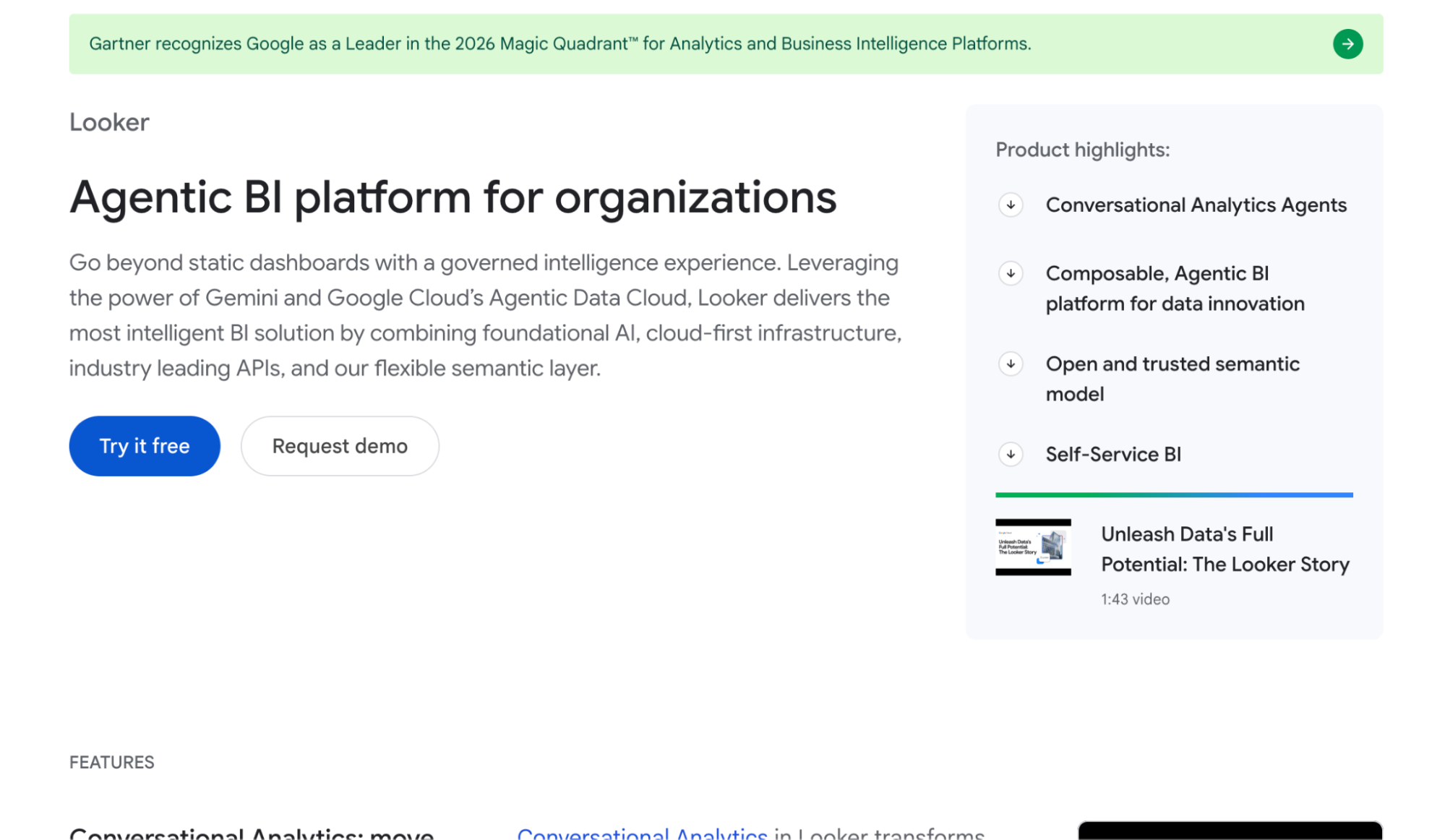
1. aiRA by Capillary: Best for conversational analytics that turns insights into campaigns

Screenshot of aiRA by Capillary webpage. aiRA by Capillary is an analytics agent.

aiRA is Capillary’s agentic AI co-pilot, built directly into the Capillary loyalty and engagement platform and trained on your brand’s own context from day one. It answers customer questions in plain English and then carries that answer all the way through to a live, multi-market campaign. 

Genie assumes a technical audience and delivers insight inside the lakehouse. aiRA by Capillary is built for the business users who act on insight and it covers strategy, segmentation, rewards, launch, and measurement in a single conversation.

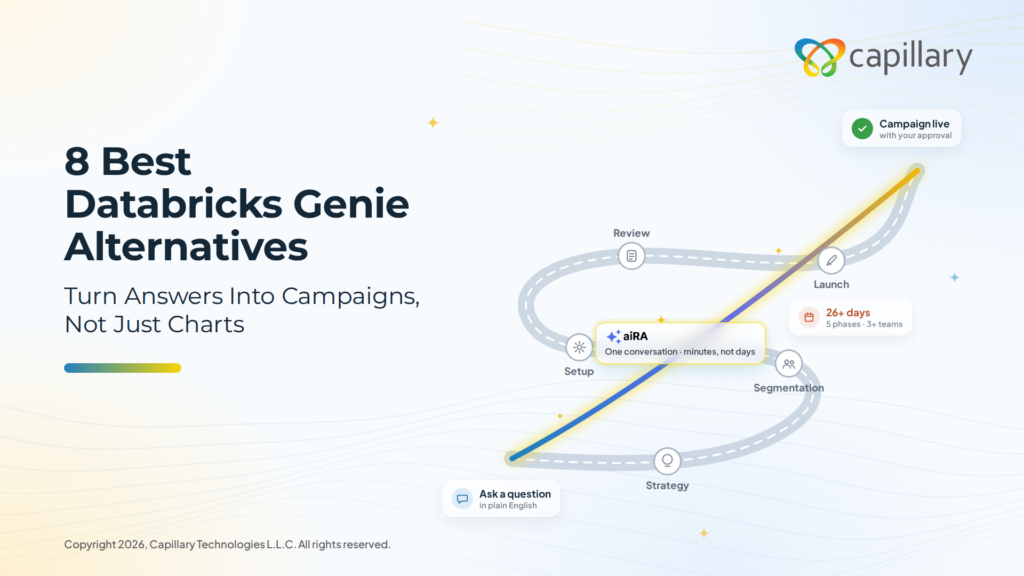
Without aiRA, a typical enterprise campaign workflow spans 5 phases, 3+ teams, and 26+ days with strategy definition, analytics and segmentation, campaign setup, review and launch, then a feedback loop. aiRA collapses those five phases into one conversation, with human approval built in at every step.

Why aiRA by Capillary is a strong Databricks Genie alternative

Genie is a query engine for people who already know how to query. aiRA by Capillary is a full-stack marketing intelligence partner for people who don’t and don’t want to learn. You don’t need a mature lakehouse, a semantic-modeling practice, or an analyst queue to get value. You describe what you want, and aiRA orchestrates the rest.

Key features

  • AI-powered conversational analytics: Ask any question about your customers in plain English and get an instant answer.
  • Natural-language segmentation: Describe an audience and aiRA builds the segment instantly, eliminating 62+ analyst hours a month without a single query being written.
  • Conversational campaign creation: Give a brief, and aiRA handles audience, rewards, messaging, and multi-channel setup.
  • Intelligent reward optimization: aiRA replaces flat discounts with ML-driven rewards, predicts ROI market by market, and explains every recommendation before you approve it.
  • Multi-country, multi-language execution: One workflow, many markets. aiRA localizes messaging per region and segment while keeping brand voice intact.
  • Human-in-the-loop at every step: aiRA recommends and you decide. Nothing customer-facing goes live without your explicit approval.

How aiRA by Capillary works

  • Customer analysis: Who your customers are, profiled and segmented at scale.
  • Behavioral trends: How they’ve behaved, including seasonal patterns and engagement signals.
  • Segmentation & projections: What each segment is worth, with propensity scores and projected campaign value.
  • Campaign strategy: Offer types, rewards, messaging, and channel mix recommended by AI.
  • Impact & measurement: KPIs defined upfront and tracked in real time.

Who aiRA by Capillary is built for

  • Marketing managers: Launch across multiple zones and languages in minutes instead of days. One example workflow in 7 zones, 6 languages, 8 personalized messages, ready start-to-finish in minutes.
  • CMOs: Trade flat, margin-eroding discounts for ML-optimized rewards with ROI prediction and a market-by-market breakdown.
  • Heads of analytics: Hand self-service segment building back to marketing and reclaim the 62 analyst hours a month burned on ad hoc queries.

Enterprise security and governance

aiRA by Capillary is enterprise-grade from the architecture up. No PII is transmitted to the LLM and cross-brand data analysis is strictly prohibited. Every AI interaction is logged, with drift monitoring, guardrails, and incident-response SLAs. It’s ISO 27001 aligned, PCI DSS compliant, and GDPR/CCPA/PDPA compliant.

Real results

  • A global fashion retailer with 400+ stores created 9 personalized push messages in minutes, collapsing a multi-day, multi-team process.
  • A conglomerate operating across 25+ countries removed analyst tickets entirely, marketing now builds segments and campaigns independently, with instant turnaround.

Implementation

Onboarding runs as a structured 2-4 week pilot across four phases with a dedicated Capillary success manager throughout and minimal involvement required from your team.

  • Pros: No-code, plain-English analytics, goes past insight into execution, enterprise-grade governance, backed by Capillary’s recognition as a Leader in The Forrester Wave™: Loyalty Platforms, Q4 2025.
  • Cons: Purpose-built for marketing and loyalty rather than general-purpose BI, delivers the most value inside the Capillary ecosystem.
  • Pricing: Custom. See aiRA turn a question into a live campaign. 

Request a Demo.

2. ThoughtSpot: Best for search-driven self-service analytics

Screenshot of ThoughtSpot webpage

ThoughtSpot pioneered the “search your data” model of BI, and its AI assistant, Spotter, extends that into full natural-language, conversational analytics. You type a question the way you’d type into a search bar and get back an auto-generated visualization, with drill-downs one click away.

Key features:

  • Google-style search interface over governed data, so non-analysts can self-serve.
  • Spotter, an agentic AI analyst for follow-up questions and autonomous insight discovery.
  • Embeddable analytics for putting search-led insights inside your own products.

Pros: Genuinely low barrier for business users, strong at surfacing unexpected drivers behind a metric, good embedding story.

Cons: Best results still depend on a well-modeled data layer underneath, pricing sits at the enterprise end for smaller teams.

Pricing: Team edition starts around $1,250/month. Enterprise is custom.

How it compares to aiRA: ThoughtSpot gets a business user to the answer fast, but the answer is where it stops. aiRA by Capillary carries the same question through to a launched campaign.

3. Tableau (Tableau Pulse): Best for advanced visualization with AI insights

Screenshot of Tableau webpage

Tableau remains the benchmark for depth and beauty of visualization, and Tableau Pulse layers a proactive, AI-driven insight feed on top. Pulse delivers plain-language summaries of metric changes and lets users ask follow-up questions conversationally, powered by Tableau’s Einstein/Agentforce AI.

Key features:

  • Best-in-class visual analytics and dashboarding.
  • Pulse’s automated, personalized metric digests with natural-language explanations.
  • Deep integration across the Salesforce ecosystem.

Pros: Unmatched flexibility for analysts who want to craft exactly the right view. Pulse makes insights accessible to non-analysts, a huge community and resource base.

Cons: Full power still requires analyst skill, can get expensive once you add Pulse and Data Management capabilities.

Pricing: Tableau Creator around $75/user/month. Viewer and Explorer tiers cost less.

How it compares to aiRA: Tableau is where analysts build. aiRA is where marketers act. Tableau visualizes the “what,” aiRA by Capillary executes the “so what.”

4. Looker (Google Cloud): Best for centralized, governed data modeling

Screenshot of Looker webpage

Looker’s signature is LookML, a governed semantic modeling layer that defines metrics once, consistently, for the entire organization. Everyone queries the same trusted definitions. With Gemini in Looker, natural-language querying and conversational analysis now sit on top of that governed foundation.

Key features:

  • LookML semantic layer for a single source of truth on metrics.
  • Gemini-powered conversational analytics and automated report generation.
  • Tight integration with BigQuery and the wider Google Cloud stack.

Pros: Exceptional governance and metric consistency, strong for embedded and operational analytics, developer-friendly and version-controlled.

Cons: LookML has a real learning curve, setup and modeling are engineering-heavy, much like Genie, it rewards a mature data practice.

Pricing: Custom, platform-plus-user based, typically an enterprise commitment.

How it compares to aiRA: Looker is the closest philosophical cousin to Genie, governed, modeling-first, technical. aiRA by Capillary sits at the opposite end: no modeling burden, built for the business user, action-oriented.

5. Qlik Sense: Best for associative data exploration

Screenshot of Qlik Sense webpage

Qlik’s differentiator is its associative engine, which lets users explore data freely in any direction, surfacing not just what’s related to a selection but what isn’t, which often reveals the insights a linear query would miss. Qlik’s Insight Advisor adds natural-language search and AI-generated insights.

Key features:

  • Associative engine for non-linear, exploratory analysis.
  • Insight Advisor for NLQ and automated insight suggestions.
  • Strong data integration and preparation tooling.

Pros: Powerful for discovery and “what am I not seeing” questions, scalable, flexible deployment options.

Cons: The associative model takes time to learn, the interface can feel dense to new users.

Pricing: Standard plans start around $20/user/month, with capacity-based enterprise options.

How it compares to aiRA: Qlik is built for open-ended exploration by analysts. aiRA by Capillary is built to convert a defined intent into a live loyalty campaign without exploration overhead.

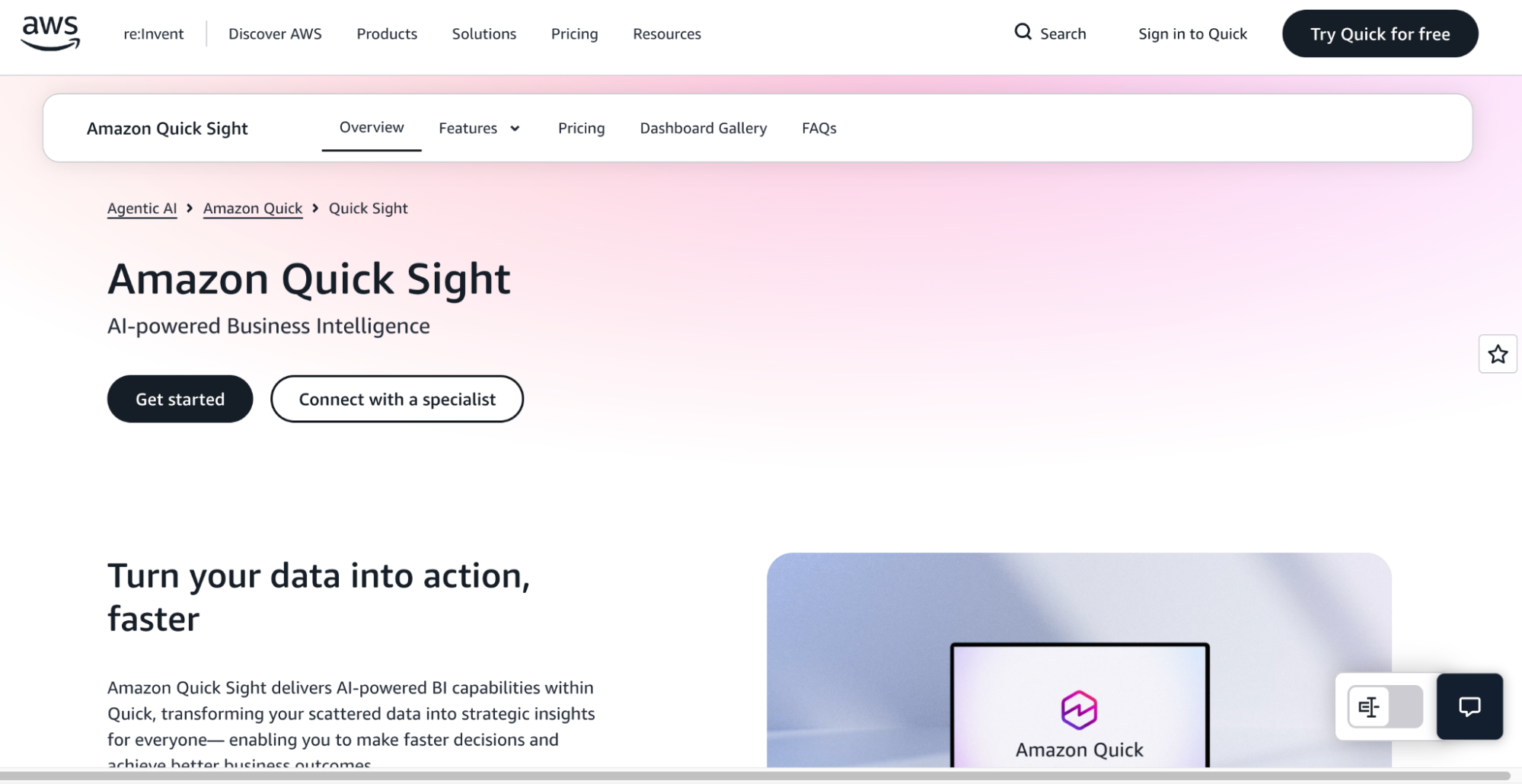
6. Amazon QuickSight (with Q): Best for AWS-native, usage-based BI

Screenshot of Amazon QuickSight webpage

QuickSight is AWS’s serverless BI service, and Amazon Q in QuickSight adds generative-AI capabilities like asking questions in natural language, generating data stories, and building dashboards with AI assistance. Its usage-based pricing makes it attractive for organizations already standardized on AWS.

Key features:

  • Serverless, auto-scaling BI with pay-per-session options for readers.
  • Amazon Q for natural-language Q&A, executive summaries, and data stories.
  • Native integration with Redshift, S3, Athena, and the AWS data ecosystem.

Pros: Cost-efficient at scale, especially for large reader populations, no infrastructure to manage, deep AWS fit.

Cons: Less polished visually than Tableau or Qlik. Q’s best answers assume clean, well-prepared AWS data.

Pricing: Authors from $24/user/month, the Q generative-BI capability is a paid add-on, reader sessions are billed per use.

How it compares to aiRA: QuickSight is a strong, economical BI layer for AWS shops but like Genie, it delivers dashboards, not campaigns. aiRA by Capillary owns the step after the dashboard.

7. Snowflake Cortex Analyst: Best for conversational analytics on the Snowflake warehouse


If Genie is the conversational layer for the Databricks lakehouse, Cortex Analyst is its direct counterpart for the Snowflake warehouse. It’s a fully managed service that lets business users ask questions in natural language against structured Snowflake data, using an agentic text-to-SQL setup guided by a user-defined semantic model.

Key features:

  • Conversational, self-serve analytics native to Snowflake.
  • Semantic-model-driven accuracy, with Snowflake reporting 90%+ text-to-SQL accuracy on benchmarks.
  • Available as a REST API, so teams can embed it in their own apps under Snowflake’s RBAC and governance.

Pros: Excellent fit for Snowflake-committed organizations, no separate infrastructure, strong governance inheritance.

Cons: Accuracy in the real world depends heavily on a clean semantic model. Raw schemas can drop accuracy to 60-70%, and, like Genie, it assumes your data already lives in the platform.

Pricing: Token-based, billed per query on top of Snowflake consumption, new accounts get trial credits.

How it compares to aiRA: Cortex Analyst is the most Genie-like option here which is warehouse-native, technical-adjacent, insight-focused. aiRA by Capillary trades platform-nativeness for something Genie and Cortex both lack: a path from the answer to the action.

8. Zoho Analytics: Best for small businesses on a budget


Zoho Analytics brings self-service BI and conversational analytics to smaller teams at a fraction of enterprise pricing. Its AI assistant, Zia, supports natural-language querying, automated insights, and forecasting, and it connects to a wide range of data sources out of the box.

Key features:

  • Zia AI assistant for NLQ, auto-generated insights, and what-if analysis.
  • Broad connector library and easy data blending.
  • Tight integration across the Zoho suite (CRM, Books, and more).

Pros: Very affordable, quick to stand up, friendly for non-technical users and small teams.

Cons: Not built for very large, complex enterprise data estates, advanced modeling is limited compared with Looker or Qlik.

Pricing: Paid plans start around $24/month for a small number of users.

How it compares to aiRA: Zoho is the budget entry point to conversational BI. aiRA by Capillary is a different category, an enterprise co-pilot that runs marketing execution.

Choosing the best Databricks Genie alternative for your team

The right choice comes down to two questions: who needs the answers, and what do they do with them?

If you want lakehouse- or warehouse-native conversational querying and your users are technical, Snowflake Cortex Analyst or a governed layer like Looker stays closest to the Genie model. If analyst-led exploration and visualization is the priority, Tableau or Qlik lead.

If budget is the deciding factor, Zoho Analytics or Amazon QuickSight deliver conversational BI without an enterprise commitment. And ThoughtSpot is the pick for search-first self-service across a broad user base.

But if the point of the question is a campaign then aiRA by Capillary is the standout. It’s the only tool on this list that treats the answer as the beginning of the workflow.

Ready to see the difference? 

Book an aiRA demo.

FAQs

What is the best Databricks Genie alternative?
For marketing and loyalty teams, it’s aiRA by Capillary. For general lakehouse or warehouse querying, Snowflake Cortex Analyst and ThoughtSpot are common choices.

Who are Databricks Genie’s main competitors?
ThoughtSpot, Tableau Pulse, Looker, Qlik, Snowflake Cortex Analyst, and Amazon QuickSight.

Which Databricks Genie alternative is best for enterprise?
aiRA by Capillary for marketing and loyalty at scale, Looker or Snowflake Cortex Analyst for governed enterprise data.

Do I need a Databricks lakehouse to use these alternatives?
No, most alternatives, including aiRA by Capillary, work independently of Databricks.

Which Databricks Genie alternative is best for marketing teams?
aiRA by Capillary, because it links analytics directly to segmentation, rewards, and campaign launch.

Why do companies switch from Databricks Genie?
Mainly for easier self-service for non-technical users, less dependence on the Databricks stack, and a path from insight to action.

Share

Similar Articles

Contact Us

Get the best loyalty & customer engagement platform out there!

  • Design industry shaping loyalty programs
  • Integrate easily and go live quicker
  • Deliver hyper-personalized consumer experiences
Request A Call

7 Best Agentic Analytics Tools for Databricks in 2026

Every BI and lakehouse vendor now claims to offer agentic analytics. Look closely and most of it still just answers questions instead of acting on them. If you’re searching for agentic analytics on Databricks, chances are you want more than a smarter dashboard sitting on top of your customer data.

The category is moving fast. Gartner predicts 40% of enterprise applications will be integrated with task-specific AI agents by the end of 2026, up from less than 5% in 2025. Databricks is leaning in too, with its own push into marketing AI through Data Intelligence for Marketing.

But hype and results are two different things. According to McKinsey’s State of AI report, only 23% of organizations have scaled an agentic AI system into production, while 62% are at least experimenting. That gap is where architecture matters. A tool that only reports insights stalls out. A tool that can act on them makes it to production.

If you’re choosing an agentic analytics tool for Databricks, this guide compares 7 options on one question: does the tool act on your customer data (build the segment, launch the campaign, adjust the reward), or does it only report on it? It’s written for marketing and loyalty teams, not data engineers.

TL;DR

  • The core question: Most “agentic analytics” tools for Databricks still stop at answering questions. This guide compares 7 tools on whether they act on your customer data (build the segment, launch the campaign, adjust the reward) or only report on it.
  • Best for marketing and loyalty teams: aiRA by Capillary builds campaigns, segments, and rewards end to end from plain-language requests, with human approval at each step and no engineering dependency. Capillary’s platform is built on the Databricks lakehouse.
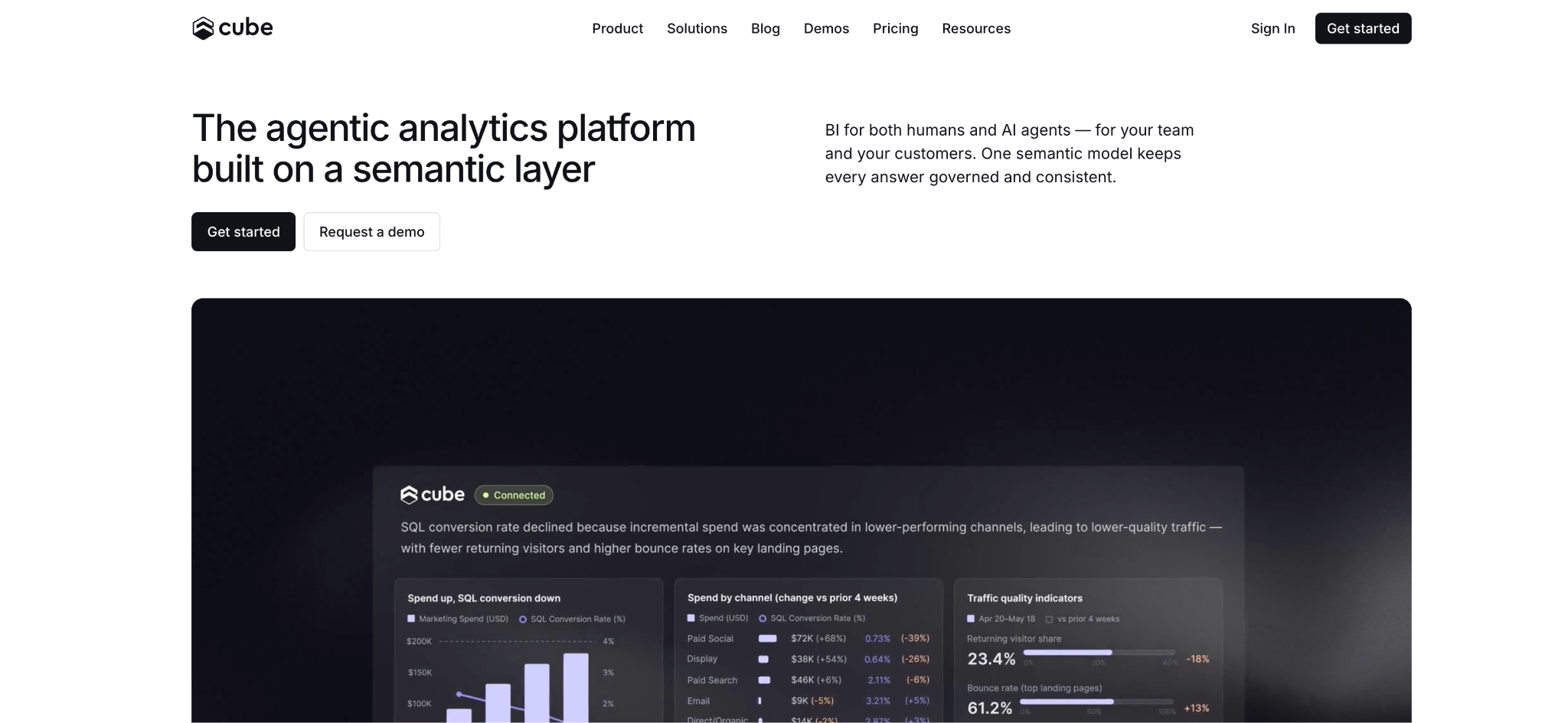
  • Best for governed BI across the business: Cube gives data teams a universal semantic layer, but has no marketing execution layer.
  • Most native option: Databricks Data Intelligence for Marketing with CustomerLake adds campaign agents and activation, but it’s in Private Preview, needs data team setup, and has less depth on loyalty.
  • Best for data teams and analysts: Hex (notebooks and self-serve), ThoughtSpot (search and embedded analytics), Sigma (spreadsheet-style BI with writeback), and Looker (Google Cloud shops). Where these tools can act, the actions are general-purpose or developer-built, not marketing workflows.
  • The deciding test: Ask who has to act on the answer. If it’s your data team, most of these tools work. If it’s your marketing team and the goal is a live campaign, aiRA is the strongest fit.

How Long Does It Take to Get Agentic Analytics Live on Databricks?

Most comparisons ask which tool is the smartest. The better question is which one actually ships. Marketing teams don’t control the data team’s roadmap, so a tool that needs heavy setup often never gets prioritized, no matter how good the demo looked.

The dependency problem

Most agentic analytics tools built around Databricks, including Cube, ThoughtSpot, and Databricks’ own Genie, need a data team to model the semantic layer, define metrics, and maintain access rules before a marketer can ask a single question. The blocker isn’t the AI’s capability. It’s the queue behind IT. Your campaign waits in line behind every other ticket.

Where aiRA removes the dependency

aiRA by Capillary lets marketers work in plain language, so launching or adjusting a campaign doesn’t need engineering in the middle. Two anonymised deployments show what that looks like:

  • Consumer superapp: Promotions are authored in plain English with no engineering dependency. The team handles 20+ promotion templates a month without a data team touching them, with promotion creation time cut by 50% and zero configuration errors.
  • US healthcare provider: Configuration effort dropped from 90 days to 21, and the team shrank from 20 specialists to 4. It scaled from one to 90+ partner organizations without a proportional jump in headcount.

The takeaway: these are setup-effort and time-to-value numbers, not just accuracy numbers.

What this means if you’re on Databricks

These deployments aren’t Databricks-specific, but the pattern carries over. Even when your warehouse is Databricks, it’s rarely the bottleneck. The bottleneck is whoever has to build and maintain the layer between the warehouse and the campaign. aiRA removes that layer for marketing and loyalty use cases, and it can sit alongside whatever BI or semantic tool your data team runs for internal reporting.

How to Evaluate an Agentic Analytics Tool for Databricks

Plenty of tools now call themselves agentic. Some are the real thing, and some are a chatbot bolted onto a dashboard. Use these five criteria to tell them apart before you look at any ranking.

  1. Databricks-native connectivity: Does the tool read Unity Catalog and Delta Lake directly, or does it connect through a generic connector? Direct access means fresher data, fewer copies, and less to maintain.
  2. Insight vs. insight-to-action: Does it stop at answering a question, or can it take the next step itself, like building a campaign, updating a segment, or changing a reward? This is the biggest divider in the category.
  3. Built for marketers vs. analysts: Does it require SQL or semantic-layer knowledge, or can a non-technical marketer run it in plain language? If only your data team can operate it, marketing is still waiting in line.
  4. Governance carried to the action layer: Are access rules and approvals enforced when the AI acts, not just when it reports? Reading data safely is table stakes. Acting on it safely is what matters once an agent can touch live campaigns.
  5. Time-to-value: Does a data team need to model and maintain a layer before a marketer can use it, or does it work with minimal setup? The faster it ships, the faster it pays off.

Most tools clear one or two of these. Very few clear all five, and the comparison table below shows exactly where each one lands.

aiRA by Capillary vs. Agentic Analytics Tools for Databricks

PlatformBest forDatabricks-nativeAgentic depthBuilt for marketersMain tradeoff
aiRA by CapillaryMarketing and loyalty teams who want AI to build and launch campaigns, not just reportYes, Capillary’s platform is built on the Databricks lakehouseInsight-to-action: builds campaigns, segments, and rewards end to end, with human approval at each stepYes, plain language, no engineering dependencyPurpose-built for marketing and loyalty, not company-wide BI
Cube (D3)Data teams needing a governed, universal semantic layer across BI, embedded, and AIVia connector; warehouse-agnostic, supports Databricks and dbtAgentic analytics: agents build semantic models, answer questions, and create data appsNo, built for data teams and analystsStrong semantic foundation, but no marketing execution layer
Databricks (Data Intelligence for Marketing + CustomerLake)Teams fully inside the Databricks ecosystemYes, fully nativeInsight-to-action: CustomerLake adds campaign and profile agents, audiences, and activationYes, but still needs data team setupNew product; less depth on loyalty and rewards programs
HexData science, exploratory analysis, and data-team-led self-serveVia connector, plus Unity Catalog Metric Views syncAgentic analysis: Notebook Agent and ThreadsPartial, data-team-firstNo marketing execution
ThoughtSpotSearch- and agent-driven analytics, embedded analyticsDeep integration via DataSpot and Unity CatalogAgentic analytics: Spotter agent suite; writeback via embed SDKPartial, needs up-front data modelingActions are developer-built, not a marketing workflow
SigmaSpreadsheet-fluent finance, ops, and business teamsDeep integration: live queries and writeback on DatabricksInsight plus action: Sigma Agents, AI Apps, writebackPartial, business-friendly but not marketing-specificGeneral-purpose execution, not campaign or loyalty workflows
LookerExisting Google Cloud and Looker shopsVia connectorMostly insight: Gemini Conversational Analytics; action-triggering agents still in previewNo, relies on LookML developersProprietary LookML; agentic actions still maturing

Best Agentic Analytics Tools for Databricks in 2026

1. aiRA by Capillary

Screenshot of aiRA by Capillary webpage. aiRA by Capillary is an analytics agent.

Best for: Marketing and loyalty teams on Databricks who want AI to build and launch campaigns, not just report on them.

aiRA is Capillary’s agentic co-pilot for marketing and loyalty, and Capillary’s platform is built on the Databricks lakehouse. Instead of surfacing an insight and leaving the next step to a human, aiRA takes a request in plain language and builds the campaign, segment, or reward end to end. Every step goes through human approval, so marketers stay in control of what actually goes live.

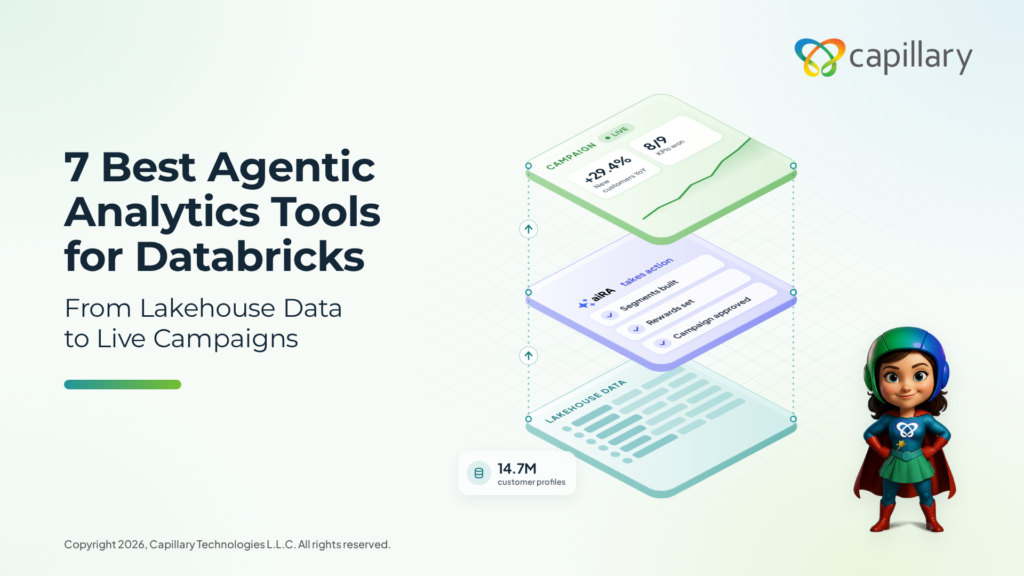
That end-to-end approach shows up in real results. A Middle East fashion retailer used aiRA to run its Ramadan 2026 campaign across a 14.7M-customer base. aiRA built behavioural segments across five lifecycle cohorts, ran the campaign from start to finish, and recalibrated it every cycle. The regional growth gap narrowed from -9.6pp to -2.2pp, new customers grew 29.4% year over year, and aiRA won 8 of 9 scorecard KPIs against a dedicated analytics agency.

Pros

  • Builds campaigns, segments, and rewards end to end, not just insights
  • Human approval at each step, so marketers keep control
  • Plain-language interface with no engineering dependency
  • Proven on loyalty work, including a full loyalty programme redesign for an Indian menswear brand delivered in 38 days
  • Cuts setup effort, as covered in the implementation section above

Cons

  • Purpose-built for marketing and loyalty, so you’ll still need a separate tool for company-wide BI and reporting
  • Pricing is quote-based, so you can’t ballpark cost from a public price list
  • Human approval at each step is good for control, but teams wanting fully hands-off automation should expect a review loop

Pricing: Quote-based, as part of the Capillary platform. You can choose a fixed license fee that includes implementation, configuration, integrations, training, and self-service support, or a lower fixed fee plus a revenue share based on incremental sales. The second option ties your cost to sales lift, which lowers the upfront commitment.

2. Cube

Screenshot of Cube webpage

Best for: Data teams needing a governed, universal semantic layer across BI, embedded analytics, and AI.

Cube (D3) is built around one idea: define your metrics once in a semantic layer, then let every tool and agent use those same definitions. It’s warehouse-agnostic and supports Databricks and dbt, and its agentic analytics features let agents build semantic models, answer questions, and create data apps. If your data team wants consistent, governed numbers behind everything from dashboards to AI, Cube is a strong foundation.

Pros

  • Governed, universal semantic layer across BI, embedded analytics, and AI
  • Agents that build semantic models, answer questions, and create data apps
  • Warehouse-agnostic, with support for Databricks and dbt
  • Free tier available, and open-source Cube Core is free to self-host

Cons

  • Built for data teams and analysts, not marketers
  • No marketing execution layer, so insights still need a person or another tool to act on them
  • Connects to Databricks via a connector rather than natively
  • Costs vary with usage, since the invoice is driven by consumption

Pricing: Starter is $40 and Premium is $80 per developer per month, but the invoice is driven by consumption in Cube Compute Units plus AI token grants. There’s a free tier, and open-source Cube Core is free to self-host.

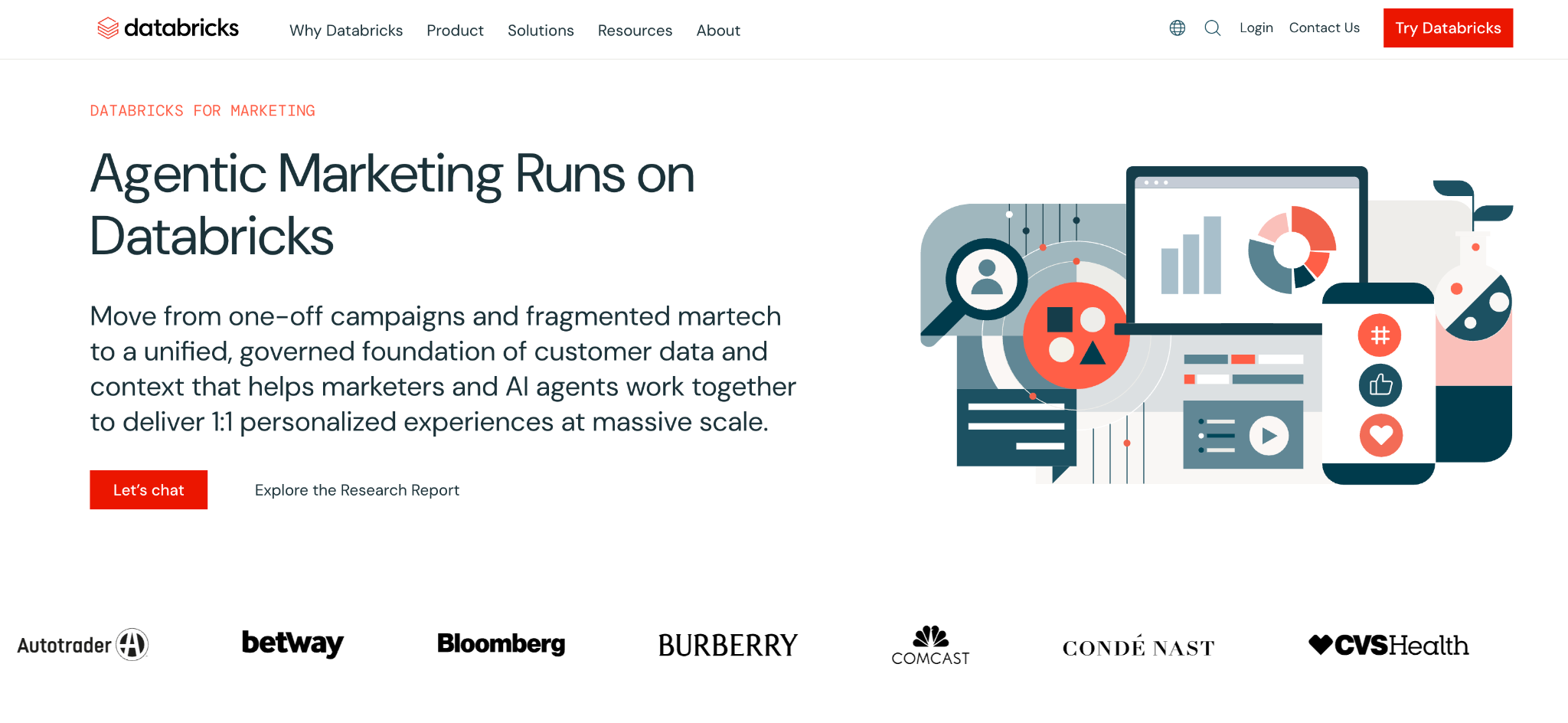
3. Databricks Data Intelligence for Marketing

Screenshot of Databricks Data Intelligence webpage

Best for: Teams fully inside the Databricks ecosystem.

Databricks’ own marketing offering pairs Data Intelligence for Marketing with CustomerLake, and it’s the most native option on this list. CustomerLake adds campaign and profile agents, audiences, and activation, so it goes beyond insight into action. Because everything runs inside Databricks, there’s no separate integration to build. It’s aimed at marketers, though it still needs a data team to get set up.

Pros

  • Fully native to Databricks, with no separate integration needed
  • Insight-to-action: CustomerLake adds campaign and profile agents, audiences, and activation
  • Built with marketers in mind
  • No separate platform fee, so you’re not adding another vendor contract

Cons

  • Currently in Private Preview and not generally available, with only a handful of named early adopters
  • Still needs data team setup before marketers can use it
  • Less depth on loyalty and rewards than a purpose-built marketing tool
  • No disclosed pricing rates, which makes budgeting hard

Pricing: No disclosed pricing rates. It’s consumption-based, with no separate platform fee, and Databricks monetizes it through the underlying compute and storage you use.

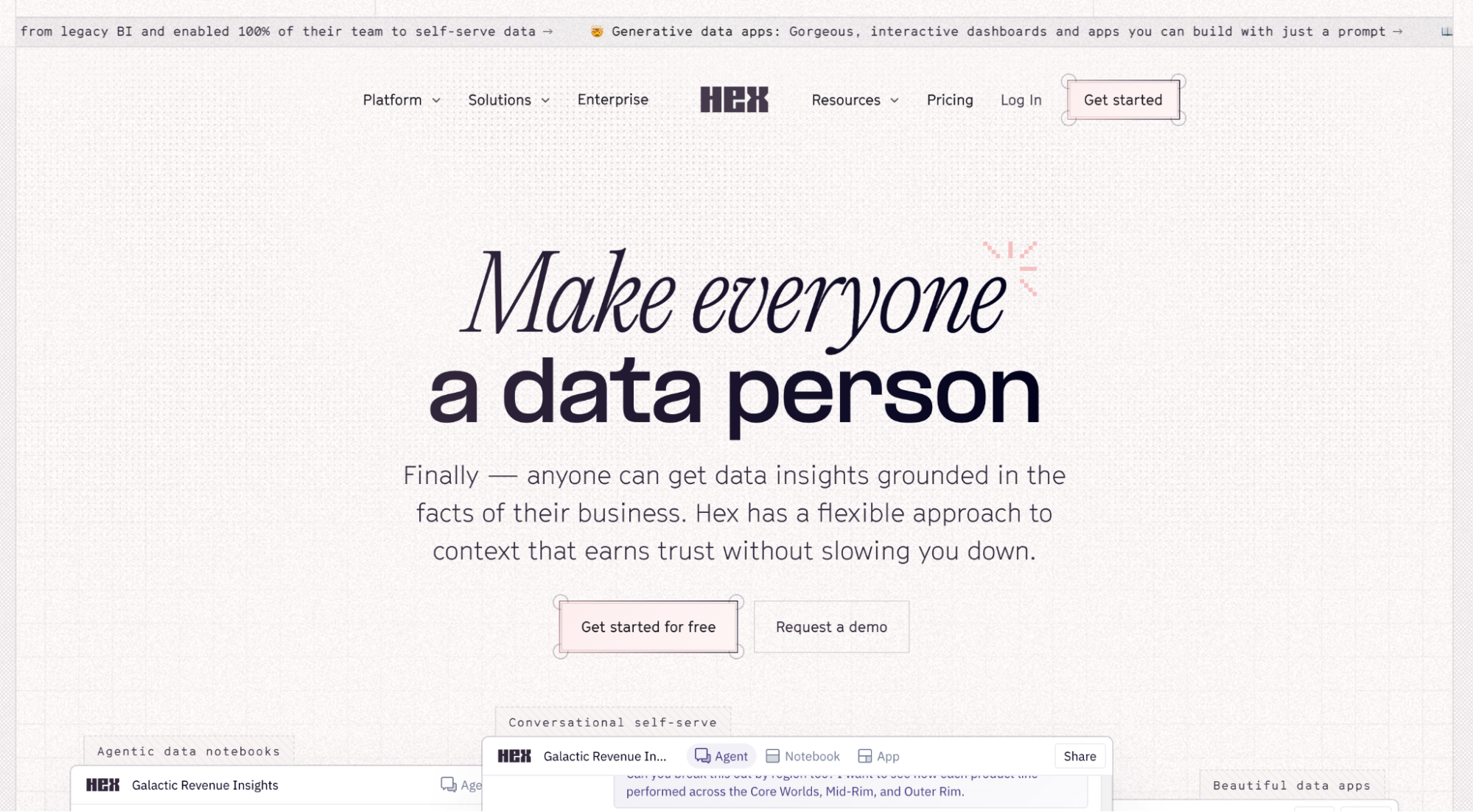
4. Hex

Screenshot of Hex homepage

Best for: Data science, exploratory analysis, and data-team-led self-serve.

Hex is a collaborative analytics workspace where data teams explore data, build analyses, and share them with the rest of the business. Its agentic features include a Notebook Agent and Threads, which help analysts work through questions faster. It connects to Databricks via a connector, with a sync for Unity Catalog Metric Views. It’s a solid pick when your data team leads and wants to open up self-serve for others, but it’s data-team-first rather than built around marketers.

Pros

  • Agentic analysis through Notebook Agent and Threads
  • Syncs with Unity Catalog Metric Views on Databricks
  • Supports data-team-led self-serve for the wider business
  • Free Community plan, so it’s easy to try

Cons

  • No marketing execution, so campaigns still need another tool
  • Only partly suited to marketers, since it’s built data-team-first
  • Connects to Databricks via a connector rather than natively
  • Costs can climb, since bigger machines, GPUs, and AI features are pay-as-you-go

Pricing: Free Community plan. Professional is $36 per editor per month, Team is $75 per editor per month, and Enterprise is custom. Bigger machines, GPUs, and AI features are pay-as-you-go.

5. ThoughtSpot

Screenshot of ThoughtSpot webpage

Best for: Search- and agent-driven analytics, and embedded analytics.

ThoughtSpot lets people ask questions of their data through a search-style interface, and its Spotter agent suite adds agent-driven analysis on top. It has one of the deeper Databricks integrations on this list, working through DataSpot and Unity Catalog. It can also push actions back into other systems through writeback via its embed SDK. That said, those actions are built by developers, so it’s a better fit for teams with engineering support than for marketers who want to launch something on their own.

Pros

  • Deep Databricks integration via DataSpot and Unity Catalog
  • Spotter agent suite for agent-driven analytics
  • Writeback via embed SDK, so it can trigger actions and not only report
  • Strong option for embedded analytics
  • Entry plans are affordable, starting at $25 per user per month

Cons

  • Needs up-front data modeling before marketers can use it
  • Actions are developer-built, not a ready-made marketing workflow
  • Only a partial fit for marketers
  • Enterprise costs run high, with a reported average around $137,000 a year, and all plans are billed annually

Pricing: Essentials is $25 per user per month and Pro is $50 per user per month. Enterprise is custom, with a reported average of around $137,000 a year. All plans are billed annually.

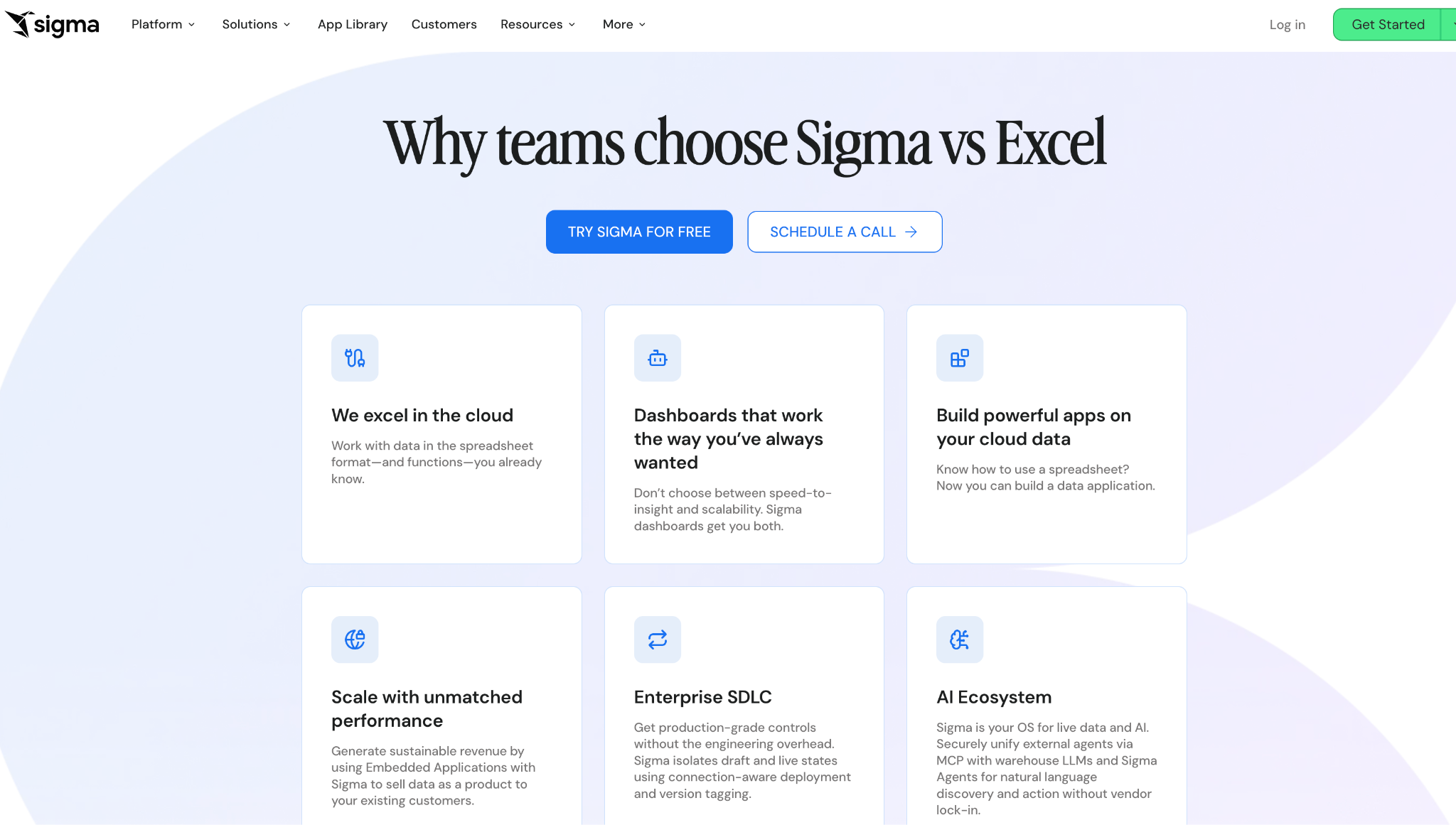
6. Sigma

Screenshot from the Sigma website showing info about Sigma vs Excel

Best for: Spreadsheet-fluent finance, ops, and business teams.

Sigma gives business users a familiar spreadsheet-style interface on top of their warehouse, so people who live in Excel can work with live data without writing SQL. It integrates deeply with Databricks, with live queries and writeback. Its Sigma Agents, AI Apps, and writeback features also let teams take action on the data, not just analyze it. It’s business-friendly, but it’s a general-purpose tool rather than one built for marketing.

Pros

  • Deep Databricks integration with live queries and writeback
  • Insight plus action through Sigma Agents, AI Apps, and writeback
  • Approachable for spreadsheet-fluent business users
  • Four license tiers (View, Act, Analyze, Build), so you can match access to the role

Cons

  • Not marketing-specific, so it’s only a partial fit for marketers
  • Execution is general-purpose, not built around campaign or loyalty workflows
  • No public per-user price list, since it’s sales-led
  • Usage credits come on top of license tiers, which makes costs harder to predict

Pricing: Sales-led, with no public per-user price list. There are four license tiers (View, Act, Analyze, Build) plus usage credits. Reported annual costs have a median of $60,500, ranging from $17,500 to $132,507.

7. Looker

Screenshot from Google Cloud products page, showing info about Looker

Best for: Existing Google Cloud and Looker shops.

Looker is Google Cloud’s BI platform, and it makes the most sense if your team has already invested in the Looker and Google Cloud stack. It connects to Databricks via a connector, and its Gemini Conversational Analytics lets people ask questions in natural language. Action-triggering agents are still in preview, so today it leans mostly toward insight rather than action. It also relies on LookML developers, which puts it out of reach for marketers who want to work on their own.

Pros

  • Natural fit if you already run Google Cloud and Looker
  • Gemini Conversational Analytics for natural-language questions
  • Action-triggering agents in preview, so there’s a path toward execution
  • Standard, Enterprise, and Embed options to match different use cases

Cons

  • Relies on LookML developers, so it isn’t built for marketers
  • Proprietary LookML adds a learning curve and a skills dependency
  • Mostly insight for now, with agentic actions still maturing
  • Connects to Databricks via a connector rather than natively
  • No public pricing, with annual commitments of one to three years

Pricing: Standard, Enterprise, and Embed are all listed as “Call sales,” on 1-, 2-, or 3-year annual commitments. Reported Standard platform fees are around $60,000 to $66,000 a year, plus per-seat adders.

Which Agentic Analytics Tool Should You Pick?

The right choice depends on who owns the outcome and what has to happen after the insight. Find the situation that matches your team.

  • Your marketing or loyalty team runs on Databricks data and needs AI that acts, not just reports: aiRA by Capillary is the strongest fit. It builds and launches campaigns, segments, and rewards from plain-language requests, with human approval at each step and no engineering dependency. A revenue-share pricing option ties cost to incremental sales.
  • You need a governed source of truth for BI and embedded analytics across the business: Cube gives your data team a universal semantic layer that keeps metrics consistent across BI, embedded analytics, and AI.
  • You’re committed to the Databricks ecosystem and want a native marketing option: Databricks Data Intelligence for Marketing with CustomerLake is worth a look. It’s currently in Private Preview and still requires data team setup, so confirm availability before you plan around it.
  • Your data science team works in notebooks and explores data hands-on: Hex suits data-team-led exploration and self-serve.
  • You want search and agent-driven analytics, or embedded analytics, and have engineering support: ThoughtSpot fits, as long as you plan for up-front data modeling and developer-built actions.
  • Your finance or ops teams live in spreadsheets: Sigma offers a familiar interface, with live queries and writeback on Databricks.
  • You’re already invested in Google Cloud and Looker: Looker is the natural extension, though its agentic actions are still maturing.

One test to make the call 

Ask who has to act on the answer. If it’s your data team, most of the tools above will serve you well. If it’s your marketing team, and the goal is a live campaign rather than a better chart, the field narrows quickly. Most options stop at insight or need engineering to act on it. aiRA is built so the marketer can do the acting.

Databricks’ own offering is the closest alternative for that job, so the next section puts the two side by side.

aiRA by Capillary vs. Databricks Data Intelligence for Marketing

If your customer data lives in Databricks, you’ll likely weigh Databricks’ own marketing offering against aiRA. Both go beyond reporting into action. The difference is what it takes to get value from each, and how soon.

Availability and setup

Databricks Data Intelligence for Marketing, with CustomerLake, adds campaign and profile agents, audiences, and activation. It’s a strong concept, but it’s in Private Preview, not generally available, with only a handful of named early adopters. It also still needs data team setup, so your marketers wait on the same queue as everyone else.

aiRA is live in customer deployments today. Capillary’s platform is built on the Databricks lakehouse, and marketers work in plain language, with no engineering dependency to launch or adjust a campaign.

Depth where marketing teams need it

Databricks has less depth on loyalty and rewards programs. aiRA has proof in exactly that area:

  • Loyalty redesign: An Indian menswear brand redesigned its loyalty programme in 38 days. aiRA modeled 3rd- and 5th-visit milestone rewards with revenue projections, with discounts held at 10% or less.
  • Campaign execution: A Middle East fashion retailer ran its Ramadan 2026 campaign through aiRA, growing new customers 29.4% year over year and winning 8 of 9 scorecard KPIs against a dedicated analytics agency.

Commercial clarity

Databricks bills through consumption with no disclosed pricing rates, so budgeting is guesswork. aiRA is quote-based, with two clear structures: a fixed license fee that includes implementation, integrations, and training, or a lower fixed fee plus a revenue share tied to incremental sales.

When Databricks’ own tool still makes sense

If staying entirely inside Databricks tooling is your top priority, and your team can wait for general availability and data team setup, the native option is worth watching.

The verdict

If you need marketing and loyalty execution now, with depth on rewards and no dependency on the data team’s roadmap, aiRA is the stronger choice. It’s built on the same Databricks foundation, so you don’t give anything up to get it.

Conclusion

Agentic analytics on Databricks comes down to one distinction: tools that answer questions, and tools that act on the answer. Most options either stop at insight or leave the action to developers and data teams. That’s fine for some jobs and a real bottleneck for others.

If you need governed BI or embedded analytics across the business, Cube or a similar semantic-layer tool is the right foundation. If you prefer to stay fully native inside Databricks, Databricks Data Intelligence for Marketing is the option to watch, once it’s available to you and your data team can support the setup. And if you run a marketing or loyalty team that wants AI to execute rather than just report, aiRA by Capillary is the better fit. It’s built on the Databricks lakehouse, works in plain language, and keeps your team approving every step, so campaigns, segments, and rewards move at marketing speed instead of waiting in a queue.

Timing matters here too. Gartner expects 40% of enterprise applications to include task-specific AI agents by the end of 2026, up from less than 5% in 2025. This category is moving fast, so the smart move isn’t picking the tool that looks best today. It’s picking the one built for where this is heading, and for marketing teams, that means AI that does the work.

The easiest way to judge that is to see it on your own data.

See aiRA on your Databricks data. Book a walkthrough with the Capillary team and watch a real request go from a plain-language question to a campaign ready for your approval. 

Book your aiRA demo →

Frequently Asked Questions

What is agentic analytics on Databricks?

Agentic analytics on Databricks means AI agents that work with the data in your Databricks lakehouse and do more than answer questions. Instead of surfacing an insight and waiting for a person to follow up, the agent can take the next step, like building a segment or launching a campaign. Tools differ a lot in how far they go, which is why it helps to compare them on insight versus action.

Is Databricks Data Intelligence for Marketing the same as an agentic analytics tool?

It counts as one. With CustomerLake, Databricks adds campaign and profile agents, audiences, and activation, so it goes beyond reporting into action. The caveats for buyers are that it’s in Private Preview and not generally available, it still needs data team setup, and it has less depth on loyalty and rewards programs than a purpose-built marketing tool.

Can agentic analytics tools trigger actions, not just answer questions?

Some can, and the depth varies. Sigma offers agents, AI apps, and writeback, and ThoughtSpot supports writeback through its embed SDK, though those actions are built by developers. Looker’s action-triggering agents are still in preview. aiRA by Capillary builds campaigns, segments, and rewards end to end, with human approval at each step, and marketers run it in plain language.

What’s the best agentic analytics tool for Databricks marketing teams?

For marketing and loyalty teams that want AI to build and launch campaigns, aiRA by Capillary is the strongest fit. It’s built on the Databricks lakehouse, needs no engineering dependency, and has proven results in loyalty and campaign work. If you need governed BI across the whole business instead, a semantic-layer tool like Cube is the better foundation.

Does aiRA by Capillary require a Databricks integration?

Not as a separate project for your team to build. Capillary’s platform is built on the Databricks lakehouse, and marketers work in plain language without waiting on engineering. If you want to know how it fits your specific Databricks setup, that’s a good question for the walkthrough with the Capillary team.

Share

Similar Articles

Contact Us

Get the best loyalty & customer engagement platform out there!

  • Design industry shaping loyalty programs
  • Integrate easily and go live quicker
  • Deliver hyper-personalized consumer experiences
Request A Call

Top Loyalty Conferences & Events in 2026

The loyalty industry is moving fast, and 2026 has brought real advances in customer engagement, AI-powered personalization, and omnichannel loyalty strategies.


Whether you’re a loyalty manager, marketing strategist, or technology vendor, attending the right conference can provide invaluable insights, competitive benchmarking, and essential industry connections to drive your organization forward.


Here is our curated list of the top global loyalty conferences and other relevant events in 2026, including a recap of Captivate 2026, Capillary Technologies’ flagship loyalty conference.


The Premier Loyalty Conference of 2026


Captivate 2026, the third edition of Capillary Technologies’ flagship annual conference, brought loyalty, CX, and marketing leaders to the Gaylord Opryland Resort & Convention Center in Nashville, Tennessee, on September 29–30, 2026. The theme was “Catalyzing Growth.” The event drew 90+ customer and partner leaders from 51 brands, with 30+ speakers across keynotes, customer showcases, and five panel discussions.


Capillary Technologies used the event for three launches: Experience+ for gamified loyalty experiences, Empower+ for healthcare, and the Balanced Loyalty Quotient Report 2026. It also gave a preview of agentic workflows in aiRA by Capillary. Brands including Hertz, NASCAR, ADAC, RaceTrac, Adobe, Bilt, and Blain’s Farm & Fleet shared what is actually working in loyalty and AI today.


Loyalty Conferences & Events at a Glance


The table below lists every event in this guide in date order, with its city and dates. Select an event name to jump to its full listing.

Dates verified against official event sites as of October 2026.


Event

Location

Dates

Loyalty & Retail Media Summit Berlin 10-11 February 2026
eTail Palm Springs (eTail West) Palm Springs 23-26 February 2026
TBH Loyalty™ London 2026 London 24 February 2026
Asia Pacific Loyalty Awards Melbourne 19 March 2026
DACH Loyalty Days Frankfurt 24-25 March 2026
Shoptalk Spring Las Vegas 24-26 March 2026
Aviation Festival Asia Singapore 25-26 March 2026
TBH Loyalty™ Toronto 2026 Toronto 21 April 2026
Advanced Customer Loyalty & Retention 2026 London 23 April 2026
Loyalty & Engagement Awards Hong Kong 30 April 2026
Loyalty Expo Orlando 12-14 May 2026
CRMC 2026 Frisco 1-3 June 2026
Aviation Festival Americas Miami 3-4 June 2026
Loyalty Summit Europe London 3-4 June 2026
Shoptalk Europe Barcelona 9-11 June 2026
eTail Boston (eTail East) Boston 10-12 August 2026
Captivate Nashville 29-30 September 2026
TBH Loyalty™ Amsterdam 2026 Amsterdam 6-7 October 2026
World Aviation Festival Lisbon 13-15 October 2026
Loyalty Summit Hong Kong Hong Kong 4-5 November 2026
TBH Loyalty™ Chicago 2026 Chicago 10 November 2026
Loyalty & Awards Conference Vancouver 16-18 November 2026
Loyalty360 CX Fest Charlotte 16-18 November 2026
Points & Loyalty Summit Sydney 25-26 November 2026


Loyalty Conferences banner showing an audience watching a keynote at a loyalty industry event

Without further ado, here are the top loyalty events of 2026, in date order:


Loyalty & Retail Media Summit

Dates: 10-11 February 2026

Location: Berlin, Germany

Organizer: FT Events


The Loyalty & Retail Media Summit Berlin 2026 unites retail innovators and loyalty professionals to explore how loyalty strategies intersect with retail media to deliver measurable engagement and revenue growth.


Featuring case studies and thought leadership on data-driven personalization, customer journey optimization, and loyalty-first media monetization frameworks, the summit provides actionable insights for marketers and strategists looking to integrate loyalty with commercial media ecosystems.


eTail Palm Springs (eTail West)

Dates: 23-26 February 2026

Location: Palm Springs, CA, USA

Organizer: WBR (Worldwide Business Research)


eTail Palm Springs is a four-day eCommerce and retail innovation conference, with around 2,500 expected registrations, where senior retail executives explore cutting-edge digital commerce strategies, omnichannel growth, and retail technology innovation.


The event features keynote speeches, interactive problem-solving roundtables, hands-on workshops, and unparalleled networking opportunities designed for operator-level learning and practical application.


TBH Loyalty™ London 2026

Dates: 24 February 2026

Location: London, UK

Organizer: Europe’s Loyalty Association (The ELA)


TBH Loyalty™ London is a one-day meet-up for loyalty leaders and practitioners at Glaziers Hall, overlooking London Bridge. TBH stands for The BIG Handshake, and the event bills itself as loyalty’s friendliest meet-up.


The program mixes brand keynotes, breakout sessions, live loyalty experiments, and challenges, with plenty of time for networking and debate on where loyalty is heading next.


Asia Pacific Loyalty Awards

Dates: 19 March 2026

Location: Melbourne, Australia

Organizer: Australian Loyalty Association


Dress Code: Black tie


The Asia Pacific Loyalty Awards celebrate excellence, innovation, and best practices in the loyalty industry across the Asia Pacific region.


The event features a rigorous judging process by independent industry experts and culminates in a spectacular gala evening at Sofitel Melbourne, recognizing standout organizations and individuals contributing to the thriving loyalty industry.


DACH Loyalty Days

Dates: 24-25 March 2026

Location: Frankfurt, Germany

Organizer: The Bonus Awards


DACH Loyalty Days brings together loyalty and CRM leaders from Germany, Austria, and Switzerland for two days of strategic discussions and real-world case studies on customer retention, loyalty program innovation, and data-driven engagement.


The event connects regional practitioners with expert speakers and peers to share best practices, network with industry decision-makers, and explore the latest approaches to building stronger customer relationships in the DACH market.


Shoptalk Spring

Dates: 24-26 March 2026

Location: Las Vegas, NV, USA

Organizer: Shoptalk


Shoptalk Spring 2026 is a premier retail transformation event bringing together 10,000+ retail leaders, 180+ speakers, and industry innovators at Mandalay Bay in Las Vegas.


The event features keynotes from top brands, panel discussions on AI, omnichannel strategies, and supply chain innovation, plus hands-on workshops and networking opportunities focused on the future of retail.


Aviation Festival Asia

Dates: 25-26 March 2026

Location: Singapore

Organizer: Terrapinn


Aviation Festival Asia is the region’s leading aviation technology conference bringing together 2,500+ attendees and 150 speakers over two days at Suntec Singapore.


The event focuses on software, services, sustainability, marketing, and distribution strategies for airlines and airports, creating partnerships and exploring tech innovation across the Asia-Pacific region.


TBH Loyalty™ Toronto 2026

Dates: 21 April 2026

Location: Toronto, Canada

Organizer: Europe’s Loyalty Association (The ELA)


TBH Loyalty™ Toronto 2026 marks the first North American edition of the TBH Loyalty™ series, held at the Sheraton Centre Toronto.


Like the European editions, it favors candid, practitioner-led conversations over formal panels and sales pitches, giving loyalty professionals a place to compare notes on what is actually working for brands today.


Advanced Customer Loyalty & Retention 2026

Dates: 23 April 2026

Location: London, UK

Organizer: Global Insight Conferences


This one-day conference offers fresh approaches to retaining customers, increasing repeat purchases, and enhancing loyalty using AI, automation, and advanced data analytics.


The event features 24+ speakers sharing insights and case studies, plus interactive panel discussions and speed networking with experts from retail, travel, consumer goods, and hospitality.


Loyalty & Engagement Awards

Dates: 30 April 2026

Location: Hong Kong

Organizer: MARKETING-INTERACTIVE


The Loyalty and Engagement Awards is an awards ceremony and gala dinner, held at the Kowloon Shangri-La, recognizing excellence in customer-centric marketing campaigns and loyalty strategies in Hong Kong.


Now in its seventh year, the event celebrates creativity, vision, and transformative strategies that strengthen customer relationships, judged by a panel of independent senior marketers and loyalty veterans.


Loyalty Expo

Dates: 12-14 May 2026

Location: Orlando, FL, USA

Organizer: Loyalty360


Loyalty Expo 2026 brings hundreds of loyalty professionals and brand marketers to Orlando, Florida, featuring sessions on best practices, case studies, and actionable loyalty strategies.


The event includes the Loyalty360 Awards, which Loyalty360 calls the most coveted awards in customer loyalty, along with an exhibit hall showcasing cutting-edge loyalty technologies and extensive networking opportunities.


CRMC 2026

Dates: 1-3 June 2026

Location: Frisco, TX, USA

Organizer: CRMC


The 32nd Annual Customer Relationship Management Conference (CRMC) takes place at the Omni PGA Frisco Resort & Spa in Frisco, Texas, bringing together about 800 attendees from 200+ retail brands.


The event focuses on future trends in customer loyalty, retention, and personalization, with keynotes on human connection, sustainability, and omnichannel customer experiences.


Aviation Festival Americas

Dates: 3-4 June 2026

Location: Miami, FL, USA

Organizer: Terrapinn


Aviation Festival Americas unites 1,500+ airline and airport executives across the USA, Canada, and Latin America over two days at Miami Beach Convention Center.


The event features 200+ influential speakers across six conference tracks, live demonstrations, and extensive networking focused on new strategies, technologies, and partnerships driving aviation industry growth.


Loyalty Summit Europe

Dates: 3-4 June 2026

Location: London, UK

Organizer: FT Events


Loyalty Summit Europe, run by FT Events, brings together senior travel loyalty professionals in London for two days of strategic exploration featuring keynotes, panel discussions, fireside chats, and networking opportunities.


The event focuses on emerging technologies, next-generation customer experiences, and innovative loyalty strategies within a premium, executive-focused environment.


Shoptalk Europe

Dates: 9-11 June 2026

Location: Barcelona, Spain

Organizer: Shoptalk


Shoptalk Europe is a three-day retail innovation event at Fira Barcelona Gran Via attracting 4,500+ decision-makers from leading retailers, brands, and tech companies worldwide.


The event features 180+ industry speakers, Europe’s largest retail meetings program with 25,000+ matchmade meetings, and a focus on digital transformation and omnichannel retail strategies.


eTail Boston (eTail East)

Dates: 10-12 August 2026

Location: Boston, MA, USA

Organizer: WBR (Worldwide Business Research)


eTail Boston 2026 brings together East Coast retail leaders and digital transformation specialists at the Sheraton Boston Hotel for a strategic checkpoint mid-year.


The event features keynotes, panel discussions, problem-solving roundtables, and hands-on clinics focused on leveraging data, AI, and technology to drive growth and optimize omnichannel retail strategies.


Captivate

Dates: 29-30 September 2026

Location: Nashville, TN, USA

Organizer: Capillary Technologies


Captivate is Capillary Technologies’ annual flagship conference for loyalty, CX, and marketing leaders. Day 1 opened with a hands-on workshop for aiRA by Capillary, a kick-off from CEO Aneesh Reddy, and a keynote from Cooper Manning. It continued with a panel on loyalty-enabled growth featuring RaceTrac, Adobe, and OSJL, and a conversation with Bilt on the new loyalty economy.


Day 2 led with the launch of the Balanced Loyalty Quotient Report 2026, followed by customer showcases from ADAC, Hertz, and Blain’s Farm & Fleet. Panels with leaders from NASCAR, The Cheesecake Factory, Arcos Dorados (McDonald’s), SharkNinja, and Simon-Kucher covered:

  • global loyalty lessons
  • partnership-led rewards
  • what healthcare teaches brands about human behavior
  • AI in marketing


Capillary Technologies also launched Experience+ and Empower+ and introduced agentic workflows in aiRA.


Missed it? Read the Captivate 2026 recaps.


TBH Loyalty™ Amsterdam 2026

Dates: 6-7 October 2026

Location: Amsterdam, Netherlands

Organizer: Europe’s Loyalty Association (The ELA)


Now in its fourth edition, TBH Loyalty™ Amsterdam is the flagship event of Europe’s Loyalty Association, bringing loyalty, CRM, and customer engagement professionals together for two days.


The program combines keynotes, panel debates, live labs, and curated networking for brand-side practitioners, solution providers, and industry thinkers, with an emphasis on honest case studies over polished pitches.


World Aviation Festival

Dates: 13-15 October 2026

Location: Lisbon, Portugal

Organizer: Terrapinn


World Aviation Festival is the premier global aviation technology conference and exhibition at FIL Lisbon, bringing together 4,500+ attendees and 600 speakers over three days.


The flagship event unites airlines, airports, and technology leaders from around the world to discuss collaboration, innovation, and strategies shaping the future of global aviation.


Loyalty Summit Hong Kong

Dates: 4-5 November 2026

Location: Hong Kong

Organizer: FT Events


Loyalty Summit Hong Kong, also billed as Loyalty Summit Asia-Pacific, gathers senior travel loyalty leaders for two days under the 2026 theme “Loyalty in Motion: Building the next generation of travel loyalty across Asia-Pacific.”


Airlines, hotels, airports, banks, and technology partners examine the future of airline programs, the role of AI and data, and the commercial realities of co-brand and payments partnerships across the region.


TBH Loyalty™ Chicago 2026

Dates: 10 November 2026

Location: Chicago, IL, USA

Organizer: Europe’s Loyalty Association (The ELA)


TBH Loyalty™ Chicago is a one-day customer loyalty conference for brands and retailers, held at the Omni Hotel on Chicago’s Michigan Avenue.


It brings together senior professionals in customer loyalty, CRM, customer engagement, and retention for candid sessions with speakers from leading consumer brands and retailers, trading polished sales pitches for practical, straight-talking conversations.


Loyalty & Awards Conference

Dates: 16-18 November 2026

Location: Vancouver, Canada

Organizer: Global Flight


Loyalty & Awards is a two-and-a-half-day travel loyalty conference hosted by Global Flight at the Pan Pacific Vancouver, where airlines, hotels, suppliers, and industry professionals convene to exchange information on new trends and innovations.


The event features expert keynotes, workshops, social activities, and the prestigious Golden Loyalty Awards gala dinner on 17 November, recognizing excellence in travel loyalty programs.


Loyalty360 CX Fest

Dates: 16-18 November 2026

Location: Charlotte, NC, USA

Organizer: Loyalty360


CX Fest is the customer experience conference from Loyalty360, the association behind Loyalty Expo, held at the Hilton Charlotte University Place.


The event hosts the Loyalty360 Customer Experience Awards, where brand finalists present their customer experience initiatives during the conference.


Points & Loyalty Summit

Dates: 25-26 November 2026

Location: Sydney, Australia

Organizer: FACTS


The Points & Loyalty Summit is part of FACTS 2026 at ICC Sydney and focuses on the points and rewards economy, from how points are created and earned to how they are redeemed for travel.


It brings together airline loyalty leaders, banks, card issuers, payment platforms, points advisors, publishers, and technology providers to explore the growing role of frequent flyer points and credit card rewards as an alternative travel currency.


Elevate Your Loyalty Game in 2026

With so many major loyalty conferences and loyalty events happening globally in 2026, there’s no shortage of opportunities to learn, network, and discover the latest trends shaping the future of customer loyalty. From intimate executive summits to large-scale industry expos, these events offer the platforms needed to elevate your loyalty strategy and stay ahead of the competition.


Ready to transform your loyalty program?


Talk to Capillary Technologies’ Loyalty Experts to discuss how you can leverage these industry insights and cutting-edge loyalty solutions to maximize customer lifetime value and drive sustainable business growth.